Hot air balloon circa 1972
Persons: 2
Diameter: 51 ft
Height: 67 ft
Volume: 60,000 cu.ft
Weight: 380 lb
Payload: 830 lb
Burner: 12 Million BTU/hr
Fuel capacity: 20 USG
Cost: (1972): US$ 5575
FAI AX-7
Hot air balloon circa 1972
Persons: 2
Diameter: 51 ft
Height: 67 ft
Volume: 60,000 cu.ft
Weight: 380 lb
Payload: 830 lb
Burner: 12 Million BTU/hr
Fuel capacity: 20 USG
Cost: (1972): US$ 5575
FAI AX-7
Avian Aircraft Ltd was formed February 1959 by Peter Payne, together with a small group of fellow designers and engineers, who had left Avro Canada once the contract for the “Arrow” interceptor was completed.
This Canadian company has its headquarters at Georgetown, Ontario, and from its inception concentrated on the development of a special wingless autogiro type, the Avian 2/180. First flown in 1960 but an accident delayed development. In 1964 the Canadian Government provided financial assistance for further research and development. Certification was granted in 1968.
The Aviamilano A-2 is a high performance Standard Class single-seater of 15m (49 ft 2.5 in) span, and this Italian design went back into production in 1966 after first flying in prototype form a few years earlier.
The mid-set wing has rectangular inner panels and tapered outer panels which can be replaced individually if damaged; the central torsion box and spar structure is all-metal. There are trailing edge air brakes on the inner wings.
The fuselage is of all-wood construction, with the forward part covered in glassfibre and the rear part with plywood.
The pilot’s seat is under a long flush transparent canopy, and the landing gear consists of a rubber-mounted skid and retractable monowheel. The cantilever T-type tail unit has all-moving horizontal surfaces with an anti-servo tab.
A-2 Standard
Span: 49 ft 2.5 in
Length: 23 ft 1 in
Wing area: 127.6 sq.ft
Aspect ratio: 19
Emptyweight: 419 lb
Max take-off weight: 683 lb
Max speed: 161 mph (in smooth air)
Min sinking speed: 2.03 ft/sec at 41mph
Best glide ratio: 34:1 at 54 mph

Flying pre-1961, the Aviamilano P.19 Scricciolo can be fitted with either tail or nose wheel undercarriage.


A four seat design by Stelio Frati, largely based on the F8 Falco. First flown at Milan on 16 January 1958, only limited production took place.

Aviamilano Costruzioni Aeronautiche
During 1950s, after production of Falco F8L was transferred, under license, to Aeromere, the company continued to build P.19 two-seat trainer and F.14 Nibbio four-seat cabin monoplane, a development of Falco. Aviamilano also built prototype of F.250 three-seat cabin monoplane, but sold rights to Siai-Marchetti. Aviamilano Construzioni Aeronautiche went into liquidation 1968.
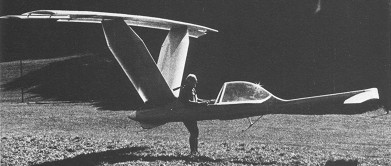
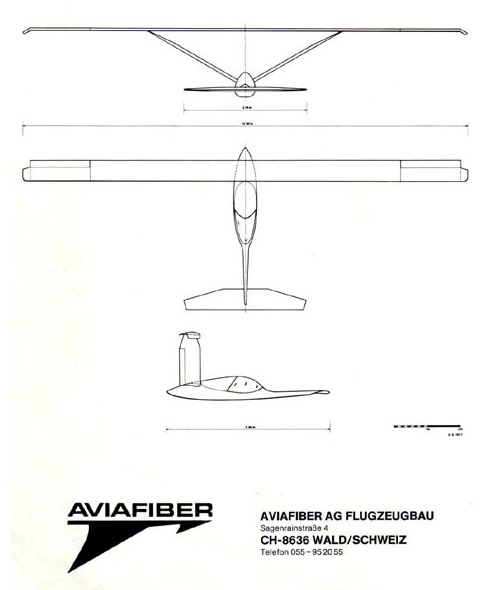
Variously described as a rigid-wing hang-glider or as a foot-launched sailplane, the Canard 2FL was designed by Swiss aero-dynamicist Hans Farner. Of fibreglass construction, it consisted of a small fuselage, big enough to accommodate the pilot in a prone position, provided with doors in the bottom through which the pilot’s legs could protrude for take-off and landing. A large canard was fitted at the nose, and the main lifting surfaces were supported atop tall, V-shaped pylons which both generated lift and acted as vertical fins. Wings, pylons and canard have Wortmann FX-67-170 airfoil section.
Construction is fiberglass to form in the matrix of the skin and spar fiberglass laminate, with extensive use of foam filler Styrofoam. To transport the wing unit disassembled into three sections of 4.8 meters (15.8 ft), to lay on the roof of a car or trailer.
Pylons (two “V” wings) attach a high wing at the mid-point of the span on both sides – positioning the main wing out of the flow of the canard. The vee-tail pylons have a core of solid hard foam unlike the styrofoam of the wings, while the ailerons have cores of hard foam cells. The wing has a Wortmann FX-63-137 section and is a single-spar structure with a vacuum-formed shell of laminated resin and glassfibre and a core of styrofoam plate. The canard did not hinge in the horizontal axis to produce pitching moments as convention dictates, but rather twisted about the glider’s longitudinal axis to control adverse yaw, thus stall was impossible (unacellerated), and Vne could not be exceeded even by deliberate pilot action. The canard was positioned out front of a fully canopied pilot pod via a slender extension. The one piece canopy/windscreen is open at the rear and for landing there is a retractable front skid and a nonretractable tailskid. A monowheel is optional for downhill rolling take-offs.
The control system is mixed. The longitudinal control, pitch, is changed by the pilot the shifting center of gravity. The pilot rotates prone on a stomach board that slides fore and aft 80 cm (32 inches). Pilot weight at launch is supported on shoulder straps. Ailerons and all-moving canards (each console can rotate (or warp) on 5 degrees relative to the longitudinal axis of the machine). On the vertical tail is mounted brakes, to control the rate of descent giving a sink rate of 0.6 m/s (120 fpm).
At first the claim of 35:1 seemed excessive but consider this, Farner had Lockhead as his client. The joined wing concept allowed an effective span of the main wing plus the pylons of around 65 feet, without the tip drag induced by the vortices of biwings.
At the start of the pilot runs on his feet, after the lift-off, pulls his legs inside the fuselage, rotated horizontally, the bottom hatch (and lantern above) is closed for the streamlining of the fuselage. Landing can take place either on the ski under the fuselage, or the pilot’s legs. After launch, doors under the pilot were closed, the pilot rotated prone and the rear canopy half was closed.
The construction and development of Canark 2FL began in August 1976 in a workshop in Hinwil, Switzerland, on the basis of a previous project by Hans Farner and Ernst Ruppert, the Colibri, dating back to 1972. The Canard-2 FL made its first flight on 7 September 1977.
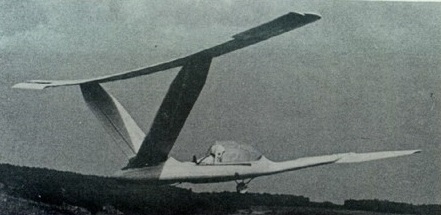
Results of flight testing with the engine running encouraged Farner and Bucher to designa dedicated motor-glider version as the Canard Aviation Canard SCM, powered by a 15–18 kW (20–24 hp) engine. Farner had previously designed a motor-glider using the FL concept as the Farner HF Colibri 1 SL, which first flew in 1979.
Test flights of the Canard took place in Vaduz. Hans Farner was killed test flying the Canard after a small number were sold. The 1980 accident that claimed the designer’s life was due to over-control of pitch. The pilot strapped into a dolly that pivoted flat after takeoff. The dolly slid forward and aft on rollers and changed the CG to control pitch. The designer slid off the dolly and ended up over-controlling and fell out of the final pull-up upside down.
The business promoter (H. Bucher) decided to withdraw the Canard 2FL, Canard SC and Canard SCM from sale, buying back all the remaining four gliders after the accident and then redesign and re-release the Canard as a sailplane. The moulds were in the small town of Wald not too far from Zurich. Another incident finally ruined the reputation of the Canard 2FL design.
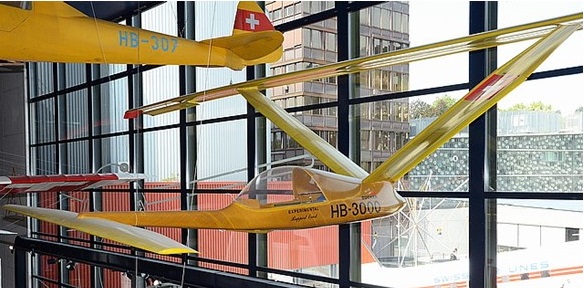
Airframes constructed by Ruppert Composites of Wald, Switzerland, were HB-3000 (Sept 1978), HB-3001 (Apr 1979, HB-3002 (Aug 1979), and HB-3003 (Aug 1981).
One of the glider remains in the Swiss Lucerne Transport Museum.
Variation:
Rochelt Solair I
Canard-2 FL
Length: 4.5 m (14 ft 9 in)
Wingspan: 13.5 m (44 ft 3 in)
Wing area: 13 sq.m (140 sq ft)
Airfoil: Wortmann FX-67-170
Height: 5 ft 11 in
Empty weight: 50 kg (110 lb)
Max weight: 372 lb
Aspect ratio: 20.0
Never exceed speed: 100 km/h (62 mph; 54 kn)
Stalling speed: 24 mph
Maximum glide ratio: 31 at 37.5 mph
Minimum sink: 0.6 m/s / 120 ft/min / 1.64 ft/sec at 31 mph
Crew: 1
Packed size: 4.8 m (15.8 ft.)

Designed by Pieraldo Mortara and first produced in 1945 by Azionaria Vercellese Industrie Aeronautiche / A.V.I.A., the LM-5 Aviastar two-seat light cabin monoplane was taken over in 1947 be Francis Lombardi & C.
The Aviastar is powered by a 60 hp C.N.A. D.4 engine, but a Continental C85 may be installed.
Engine: 60 hp C.N.A. D.4
Wingspan: 26 ft 5 in
Length: 20 ft 2 in
Height: 7 ft
Empty weight: 726 lb
Loaded weight: 1232 lb
Max speed: 118 mph
Cruise: 102.5 mph
Service ceiling: 16,400 ft
Range: 580 mi

An all wood, side-by-side, enclosed cabin monoplane, of which more than 300 open cockpit derivatives had been built for the Regia Aeronautica under and Italian Government contract (by Francis Lombardi & Co of Vercelli).
Variation
Meteor F.L.53-54
Vercellese Industrie Aeronautiche
Azionaria Vercellese Industrie Aeronautiche / Avia
In 1929, Charles Fauvel participated in the creation of AVIA with Massenet, Auger and a few friends; this was a committee founded to promote the development of soaring. He then left the air force to join AVIA as sport director.
Azionaria Vercellese Industrie Aeronautiche; first flew F.L.3 two-seat cabin monoplane in 1939, and 400 built between 1939 and 1942.
Vercellese Industrie Aeronautiche was formed at Vercelli about 1940 to produce F.L.3 light tourer.
In 1946-1947 was renamed AVIA (Azionaria Vercellese Industrie Aeronautiche), continuing to develop F.L.3. Production resumed after the war, until the end of 1947, when company was absorbed by Francis Lombardi. Types known as Lombardi (AVIA) included L.M.5 Aviastar, first produced 1945.

