Bell X-1

X-1B

Initially designated the XS-1, (the S, which stood for Supersonic, was dropped early in the program), the X-1 was the first aircraft given an “X” designation, and became the first aircraft to exceed the speed of sound in controlled level flight on 14 October 1947. Developed jointly by the USAF, Bell and NACA, the type reached Mach 1.015 at approximately 45,000 feet in the hands of Captain ‘Chuck’ Yeager. The type was planned specifically for investigation into transonic and supersonic flight, and was based on a cylinderical fuselage that accommodated the 6000 lb (2722kg) thrust Reaction Motors E6000-C4 rocket motor and the tanks for its liquid propellants. The flying surfaces were straight but thin, and the first X-1 air launch of the X 1 was made on 19 January 1946, but powered flights were not attempted until 9 December 1946 after an air drop from a Boeing B-29 motherplane, using the second prototype. The third was destroyed at Edwards AFB during flight fuelling operations.

Supersonic flight was achieved by Captain Charles ‘Chuck’ Yeager on 14 October 1947. The speed reached by the X 1 on that occasion was 670 mph (1,078 kph) at a height of 42,000 ft (12,800 m), and therefore equivalent to a Mach number of 1.015.
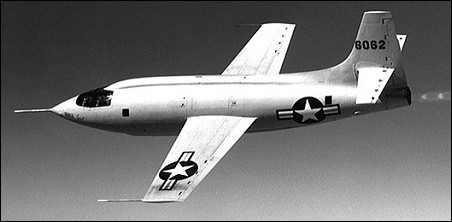
On 5 January 1949, piloted by Chuck Yeager, the X-1 took-off from the ground under its own power. After a take-off run of 2300 ft it climbed at 13,000 fpm.

The three X-ls were followed by the second generation X-1s were designed to double the speed of sound and set altitude records in excess of 90,000 feet. Only the X-1A and X-1B were actually built—the X-1C, which was designed to test high-speed armaments, was cancelled before completion.

Bell X-1 Article

The X-1A had a longer fuselage for greater fuel capacity, a revised cockpit canopy, and turbopumps replacing the previously pressurised nitrogen fuel system: the X-1A reached a speed of Mach 2.435 and an altitude of more than 90,000 ft (27430m) on 4 June 1954.

In 1955 this aircraft was given new wing panels, but was destroyed before its first flight in this configuration. The X-1A was destroyed after it was jettisoned following an inflight explosion over Edwards AFB on 8 August 1955.

The X-1A and X-1B differed by having a stepped canopy, a 4 ft 7 in longer fuselage, and a turbo-pump fuel system. The X-1A attained Mach 2.5 (1650 mph) at 70,000 ft on 16 December 1953. The X-1B was used for thermal research,

X-1B

The X-1D was destroyed during what was to be its first powered flight in August 1951 after being jettisoned from its B-50 carrier-plane, following an explosion.

On 8 August 1955, just an instant before Joe Walker was to be dropped in the X-1A, an explosion within its rocket engine rocked the B-29. Walker immediately scrambled up and out of the X-1A and into the bomb bay of the mothership. The X-1A was to damaged to fly, and the B-29 could not risk landing with it still hooked to the underside. B-29 pilot Stan Butchart had no choice but to jettison the X-1A into the desert. The machine exploded on impact, ending the X-1A programme. It was learned later that a gasket blew when Walker threw the switch to pressurise the liquid oxygen and water alcohol in the X-1A’s fuel tanks.
A leather gasket made by the Ulmer Company, when saturates with liquid oxygen, was so unstable that a shock of and magnitude caused the gasket to blow. A number of accidents occurred involving the X-1-3, X-1A, X-1D, and X-2, before the malfunctioning gasket was identified and a fix made.

Neil Armstrong and Stan Butchart air-dropped pilot Jim McKay in the X-1B for a zoom to 55,000ft, one that did not slow enough at the top to check out reaction controls. Immediately after McKay’s flight, mechanics found irreparable cracks in the rocket motor’s liquid oxygen tank (by then the X-1B was about 10 years old), ending the entire X-1B program.

Despite the loss of the third X-1 and the X-1D, a requirement still existed for a higher performance X-1 so that the NACA could continue high-speed research. To satisfy this requirement, the second X-1 was almost completely rebuilt and redesignated the X-1E. Significant modifications included an updated knife-edge windscreen canopy, ultra-thin wings (4 percent thickness/chord ratio), turbo-driven fuel pumps, and a rocket assisted ejection seat.
With these aircraft, a speed of 1,650 mph (2655 km/h) at 70,000 ft (21,325 m) and altitudes of up to 90,000 ft (27,425 m) were attained in 1953-54.
The maximum altitude achieved by the X-1E was over 75,000 feet, and the top speed was Mach 2.24 (1,450 mph). During its test series, the X-1E demonstrated that the thin wing section was technically feasible for use on supersonic aircraft. An improved Reaction Motors XLR11, using a low-pressure turbopump, was also validated during X-1E test flights.
The aircraft was retired from service in November 1956 after 26 flights, and is now on permanent display in front of the NASA Dryden Flight Research Center.
The first X-1 is on permanent display in the National Air and Space Museum in Washington, DC. The third X-1 was destroyed on 9 November 1951 at Edwards AFB, California.
A total of 156 flights were made with the X-1, 21 with the X-1A, 27 with the X-1B, one with the X-1D and 26 with the X-1E.

Gallery

X-1
Powered by: One Reaction Motors XLR-11-RM 5 four-chamber bi-fuel (alcohol and liquid oxygen) rocket, maximum of 6,000 lb (2722 kg) st for 2.5 min.
Wing span: 28 ft 0 in (8.53 m).
Length: 31 ft 0 in (9.45m).
Height: 10 ft 8 in (3.25m).
Empty Weight: 8,100lbs (3,674kg)
Gross wt: 13400 lb (6,078 kg).
Max speed: 1000 mph (l609 kph) at 60,000 ft (18,2 90 m).
Rate of climb: 28.000 ft (8,534 m)/min.
Ceiling: 22250 m / 73000 ft
Accommodation: Crew of 1.
No built: 3
Operated: 1946-51
No of flights: 157

X-1A
Power: 6,000 lb thrust Reaction Motors XLR-11-RMS rocket
Span: 28 ft
Weight: 16,000 lb
Speed: 1650 mph.
Ceiling: 90,000 ft.
Full power endurance: 4.2 minutes
No built: 1
Operated: 1953-55
No of flights: 25

X-1B
Endurance: 4.2 min
Empty weight: 7000 lb
Loaded weight: 18,000 lb
Wingspan: 28 ft
Length: 35 ft 7 in
Height: 10 ft 8 in
No built: 1
Operated: 1954-58
No of flights: 27

X-1D
No built:
Operated: 1951
No of flights: 1

X-1E
No built: 1
Operated: 1955-58
No of flights: 26

Bell 39 / L-39

L-39-1

Two war surplus P-63s (1 P-63A / 1 P-63N) were modified by Bell under Navy contract for flight testing of low-speed and stall characteristics of high-speed wing designs. The aircraft received new wings with adjustable leading edge slats, trailing edge flaps and a pronounced sweep of 35 degrees. The wings had no wheel wells; only the nose gear was retractable. L-39-1 first flew 23 April 1946, demonstrating a need for extra tail surface and rear fuselage length to balance the aircraft in flight – the wing repositioning reduced empennage effectiveness and moved the center of lift aft.

A lighter three-bladed propeller from a P-39Q-10 was mounted and the necessary changes to the empennage were made. L-39-2 incorporated these adjustments from the start. L-39-1 later went to NACA at Langley for wind tunnel testing, where much valuable data were gathered. L-39-2 also served as a testbed for the Bell X-2 40-degree wing design.

L-39-2

Bell Aircraft Corp / Bell Aerosystems / Bell Aerospace Corp

Larry Bell had been born in Indiana in 1894, but his family moved to California when he was 13. In 1912, he went to work for aviation pioneer Glenn L. Martin, rising to the vice-president position of the Martin firm by 1920. Martin wasn’t the easiest person to work for and Bell knew he’d never get into a partnership position with the company, so Bell quit in 1925. He couldn’t find steady work for three years, but then he landed a job at Consolidated Aircraft in Buffalo, New York, rising to become general manager.

When Consolidated moved its operations to California, Bell decided to stay in Buffalo along with a cadre of like-minded individuals, forming Bell Aircraft in 1935. Later Bell would admit that naming the company after himself wasn’t a good idea, since it made it more difficult to delegate authority and learned that “when your name’s out front, you have to do a lot of things that are a terrible bore.”

The first product built by Bell was an innovative machine, designed by a team under Bell chief engineer Robert Woods, named the “Airacuda”.

Original company of 1935, Bell Aircraft Corporation, responsible for P-39 Aircobra and P-63 Kingcobra of Second World War. Built first U.S. turbojet, the P-59 Aircomet fighter/trainer. Built the rocket-powered Bell X-1, in which USAF pilot Charles Yeager was the first to exceed the speed of sound, on October 14,1947. Subsequent X- 1A flown at 2,655km/h in 1953.

Company subsequently known as Bell Aerosystems, then on July 5,1960 became Bell Aerospace Corporation, a wholly owned subsidiary of Textron Inc., which had acquired the former Bell Aircraft Corporation.

Responsible for:

Bell Model D2127 tilting-duct research aircraft

Two lunar Landing Research Vehicles (LLRV) for NASA to train astronauts to land safely on the moon

Automatic Carrier Landing System (ACLS), used on U.S. Navy aircraft carriers; and was involved with an air-cushion landing system that was expected to enable military transports to land and take off from practically any surface.

Terminated aircraft production.

Bellamy-Hilborne BH.1 Halcyon

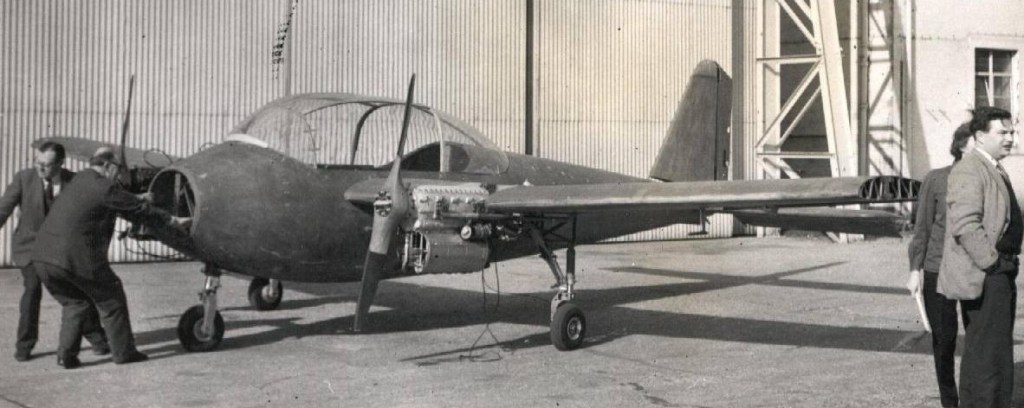
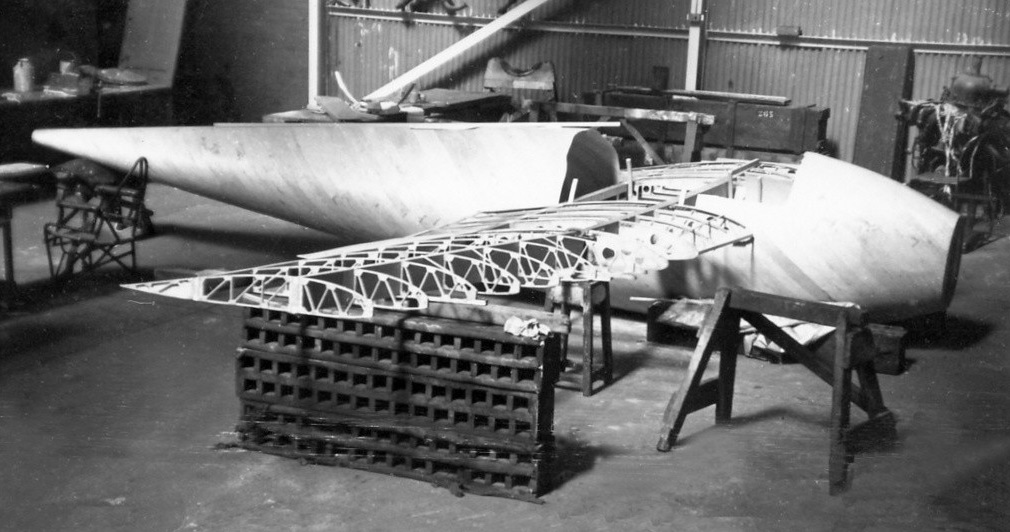
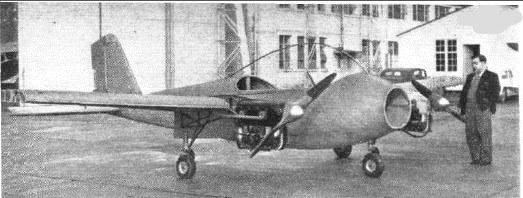
The Bellamy Hillborne B.H.1 Halcyon was an all-wood four-seater with retractable nose wheel undercarriage, powered by two 105 h.p Walter Minor engines. Designed by R.J.Hillborne and built at Eastleigh by the Hampshire Aero Club under the direction of Vivian H.Bellamy 1960-61.

One aircraft only built: G-ARIO. C/n HAC.5., registered (C of R R7117/1) to Vivian H. Bellamy 30.1.61. Construction well advanced by May 1961 and engines run September 1961, but the project was abandoned when the aircraft was damaged during taxiing trials at Eastleigh Airport, Southampton, Hampshire 17.2.1962. Reportedly G-ARIO collided with Hampshire Aeroplane Club’s hangar and was wrecked.

The damage suffered in taxiing trials was severe, namely a fracture of the centre section rear spar which rendered the Halcyon beyond economic repair and thus the project was abandoned, the aeroplane was put into storage and eventually its remains were burned.

Despite this, the registration was not cancelled until eleven years later – on 13.9.73 – as P.W.F.U. (“Permanently Withdrawn From Use”)

Wingspan: 30.05 ft
Length: 23.0 ft

Bellamy Pfalz D.III

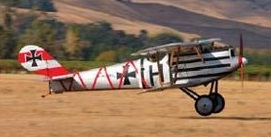
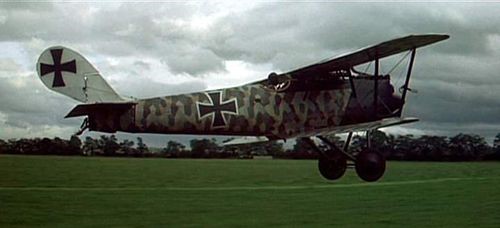
20th Century Fox purchased the film rights of Jack D Hunter’s “The Blue Max” and the film was to be a multi-million dollar production, and the stars were to be the full sized reproductions of World War I fighters constructed for the film- two Pfalz D.III biplanes, two Fokker Dr.I triplanes, two S.E.5a scouts and three Fokker D.VII biplanes.

The reproductions had to be built in a hurry to meet the time frame for shooting and were constructed in different locations. One Pfalz D.III reproduction each was constructed by Personal Plane Services (G-ATIF, ZK-FLZ) and the other by the Hampshire Aero Club (reported as G-ATIJ and G-ATIG).

The availability of these aircraft would see them appearing in more movies. “Darling Lili” of 1970 was a vehicle for Rock Hudson and Julie Andrews. A musical comedy, the building of six S.E.5a reproductions added to the Allies squadron. These were based on the Currie Wot airframe and were referred to as Minis due to their not being full size reproductions. Appearances in “You Can’t Win them All”, “Von Richtofen and Brown” (aka “The Red Baron”), and “Zeppelin”, followed. The latter two movies saw fatal crashes and the aircraft were soon after dispersed to private collections.

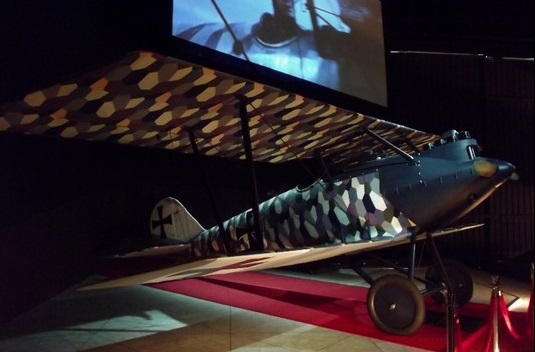
One of two produced for the movie ‘The Blue Max’ in 1965, c/n PT16 ex EI-ARD, G-ATIJ, N905AC, ZK-JPI, was built by Viv Bellamy of the Hampshire Aero Club in England from drawings by Ray Hillborne. The aircraft was presented in a spurious seven colour lozenge paint scheme for the filming. After spending some time in Ireland, the aircraft was later sold to Frank Ryder and operated from the museum in Alabama. In the mid-1980’s many of the ‘Blue Max’ aircraft were purchased by the ‘Fighting Air Command’ and moved to Hartlee Field near Denton, Tx. At that time the aircraft was was presented in a black fuselage and purple wings and was no longer airworthy. The aircraft was acquired by the Omaka Fighter Collection and imported into New Zealand in September 1999. The collection is managed by the 14-18 Aviation Heritage Trust, which is chaired by Peter Jackson.

Both of the Pfalz replicas and one Fokker D.VII now belong to New Zealand film director Peter Jackson’s 1914–18 Trust, with the Viv Bellamy-designed Pfalz being on display at the Omaka Aviation Heritage Centre in New Zealand. All three aircraft are kept in fully airworthy condition.

Engine: Gipsy Major 10-II
Span: 30.11 ft
Length: 23.02 ft

Beets G/B Special

Designed by Glen Beets, the G/B is a single-seat, open-cockpit sporting plane featuring a high parasol-braced wing and conventional tailwheel type landing gear. While the fuselage is a fabric-covered steel tube structure, the wing is built with spruce spars and ribs, also fabric covered. All plans, kits, and components are sold through the Stolp Starduster Corp.

The engine uses a 2.5:1 gear reduction unit designed and built by Beets and Fred Nelson.

Engine 70-hp Volkswagen, 1641cc.
Gross Wt. 925 lbs.
Empty Wt. 603 lbs.
Wingspan 25 ft
Length 16 ft 4in
Top speed 156 mph.
Cruise 120 mph.
Stall 35 mph.
Climb rate 2000 fpm.
Takeoff run 200 ft.
Landing roll 300 ft.
Range: 600 sm.

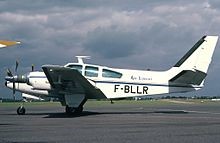
Beechcraft-SFERMA PD-146 Marquis

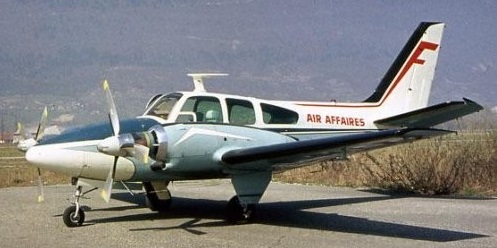
In 1962, the SFERMA (French Society for Maintenance and Repair of Aeronautical Equipment) modified a Model 95 Travel Air by fitting it with the swept tail units of the Model 55 “Baron” and by replacing the piston engines with two Astazou IIA turboprop of 440hp.

Seventeen Model 55 “Baron” cells are also re-engineered, including three for Beechcraft, and an eighteenth is not completed.

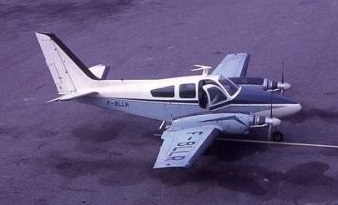
Beech-Sferma PD-146 60A Marquis F-BLLR

The PD-146 “Marquis” n°2 (F-BJSI) is re-engined with Astazou X 600hp turbines and established several world speed records in its category (C-1-d, Group 2):

On February 21, 1964, 1,000km at 502.12km / h (piloted by Maurice Oppeneau and Jacques Boisbeau).

On June 19, 1964, 2,000km at 446.92km / h (piloted by Maurice Oppeneau and Jacques Boisbeau).

SFERMA 60A Marquis

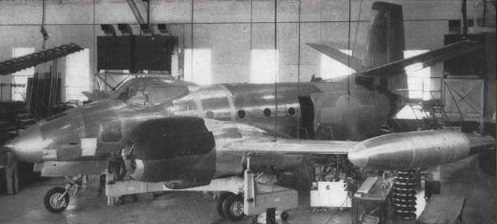
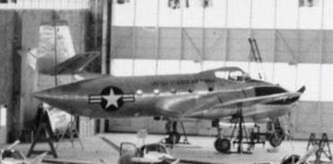
Beechcraft T-36

A 4-12 place low wing monoplane with retractable undercarriage, the T-26 was intended to replace C-45s in Air Training Command. A batch of 195 aircraft was ordered, but canceled June 1953 when the first flight of the prototype was a matter of only hours away.

Two were built, as T-36A, but neither was flown.

Engines: two 2300hp P&W R-2800
Wingspan: 70’0″
Length: 52’2″
Est speed: 300+ mph
Gross wt: 25,000 lb approx.

Beechcraft 45 / T-34 Mentor

T-34A

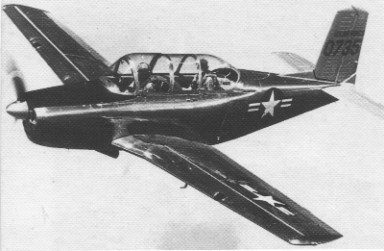
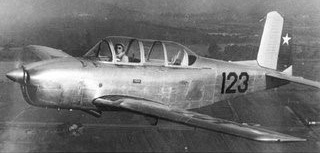
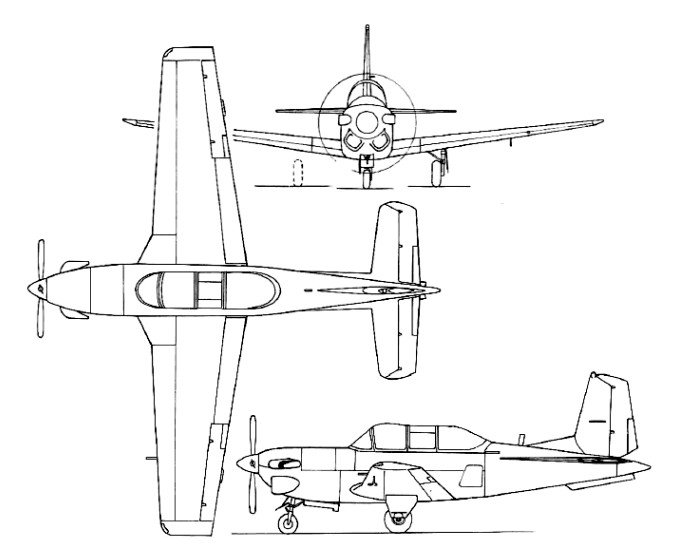
In 1948 Beech built as a private venture a two-seat trainer developed from the V-tail civil Bonanza. Having tandem seating for pupil and instructor and a conventional tail unit, the aircraft was designated Beech Model 45 Mentor, and flew for the first time on 2 December 1948.

Beechcraft 45 / T-34 Mentor Article

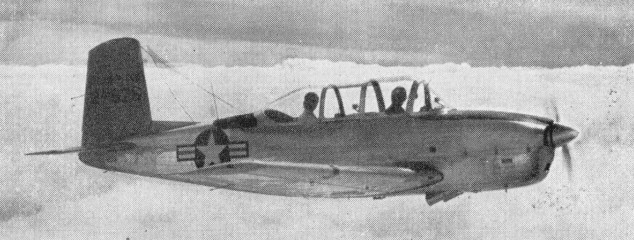
USAF evaluated three examples of the Beech Model 45, two powered by the 153kW Continental E-185-8 engine and one by the 168kW Continental E-225-8; all three were designated YT-34 by the USAF. These three aircraft made their first flights in May, June and July 1950, and were tested extensively during a competition period, being flown not only by evaluation pilots, but also in the primary training role with pupils and instructors. On 4 March 1953, the USAF selected the Model 45 as its new primary trainer, under the designation T-34A Mentor, and ultimately 450 were built for that service, 350 by Beech and 100 by the Canadian Car & Foundry Company in Montreal, Canada. An initial order from the USAF for 34 aircraft was followed by one for 25 from the RCAF and yet another from the USAF for 66. RCAF plans were changed after only one training course and in 1955, 23 of its Mentors were donated to the Turkish Air Force. The last complete airframe to be built by Car Car was the T 34A Mentor.

US Navy evaluation of the Model 45 began soon after the USAF had placed its initial contract with Beech, and on 17 June 1954 the Navy ordered 290 under the designation T-34B. A total of 423 were acquired eventually. In July 1951 one of the original prototypes was modified to mount two 7.62mm machine-guns in the wings, with provision additionally for underwing racks capable of accepting six rockets or two 68kg bombs; this was evaluated by the USAF as a potential light close-support aircraft, but no orders materialised.

The US Navy decided in 1973 to investigate the possibility of retaining the Mentor in service, with its piston engine replaced by turbine powerplant. To evaluate this proposal, the USN instructed Beech to convert two T-34Bs to turbine power, under the designation YT-34C.

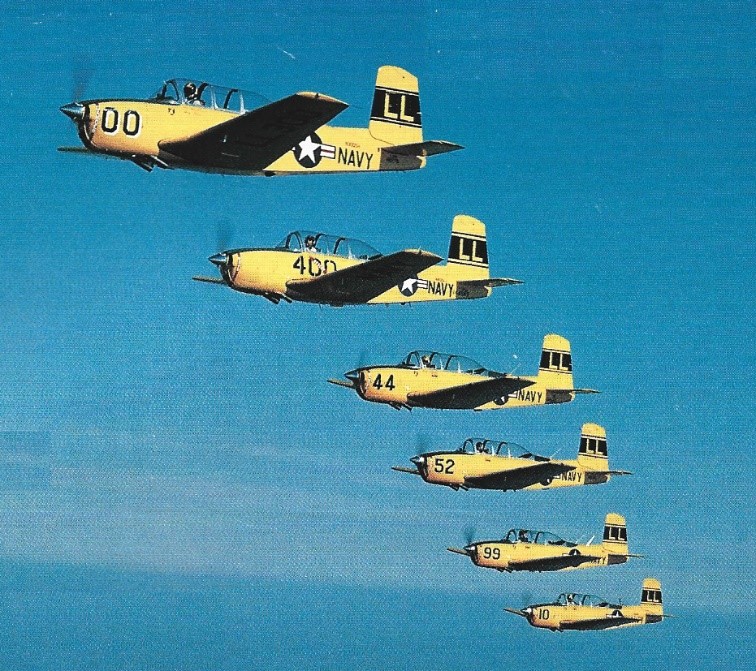
The powerplant chosen by Beech for the conversion was a Pratt & Whitney Aircraft of Canada PT6A-25. In this particular application it is provided with a torque limiter that restricts power output to some 56 per cent of maximum, ensuring constant performance over a wide range of altitude/temperature conditions, and also offering long engine life. The first YT-34C was flown on 21 September 1973, and following satisfactory evaluation of the two aircraft, Beech received contracts valued at approximately $72 million for the construction of 184 new aircraft. In addition to the installation of the new engine, the production aircraft were also given structural strengthening to ensure an airframe fatigue life of some 16,000 hours. The first T-34C Turbo-Mentor entered service with the USN’s Naval Air Training Command in November 1977, and student training with the type began during the following January. Since then production has reached 353, with six being transferred to the US Army.
The landing gear was designed to survive the hard simulated carrier landings practiced by student pilots and angle of attack indicators, a necessity for carrier approaches, are standard on the T-34C. Even though the Beeches are not operated on carriers, new Navy pilots become aware of the importance of angle of attack right from the beginning. Power off stall speed with gear and flaps down is 56 knots; the stall warning is a rudder shaker felt as a shudder in the pedals when approaching the stall.
On 24 June 1976, the US Navy replaced both its North American T 28 Trojan and Beech T 34B Mentor trainers by the improved Beech T 34C turboprop¬-powered version of the Mentor.

In 1981 the US Navy ordered an additional batch of 41 T-34C Turbo Mentors with FY81 funds. Previously a total of 155 T-34Cs had been delivered to the USN, and 81 had been exported to seven nations.
Beech developed a T-34C-1 version for armaments system training, equipped with four underwing hardpoints with a total weapons capacity of 544kg. Examples of this version have been supplied to the navies of Argentina, Ecuador, Peru and Uruguay, and to the air forces of Ecuador, Indonesia and Morocco. An export civil version, known as the Turbine Mentor 34C, has also been delivered for use in Algeria’s national pilot training school.
In Japan, the Fuji company built 176 T-34s for their own and the Philippine military forces. The Canadian Car and Foundry produced 125 Mentors, and an additional 75 were assembled in Argentina.

T34A

Gallery

T-34
Engine 225-hp Continental.
Gross Wt. 2950 lbs.
Empty Wt. 2156 lbs.
Fuel capacity 50 USG.
Top speed 189 mph.
Cruise 173 mph.
Stall 53 mph.
Initial climb rate 1120 fpm.
Range 975 sm.
Ceiling 20,000 ft.
Takeoff distance (50ft) 1200 ft.
Landing distance (50ft) 960 ft.
Seats 2.

T-34A
Engine: Continental O 470 13, 225 hp.
Max speed, 189 mph (304 kph)
Cruise, 173 mph (227 kph)
Initial climb, 1,230 fpm (6.24 m/sec)
Service ceiling, 20,000 ft (6096 m)
Range, 737 mls (1186 km)
Empty weight: 2,156 lb (978 kg)
Loaded weight: 2,950 lb (1338 kg)
Span, 32 ft 10 in (10 m)
Length, 25 ft 11 in (7.9 m)
Wing area, 177.6 sq.ft (16.49 sq.m)

T-34B
Engine 225-hp Continental O-470-13
Wingspan: 32 ft 10 in
Wing area: 177.6 sq.ft
Length: 25 ft 10 in
Height: 9 ft 7 in
Empty weight: 2055 lb
Loaded weight: 2750 lb
Fuel capacity 50 USG.
Max speed: 188 mph
Cruise: 167 mph
Vne: 280 mph IAS
Stall 53 mph.
ROC: 1210 fpm
Service ceiling: 21.200 ft
Max range: 975 mi
Takeoff distance (50ft) 1200 ft.
Landing distance (50ft) 960 ft.
Seats 2.

T-34C Turbo Mentor
Engine: Pratt & Whitney PT6A 25, 400 shp.
Prop: 3 blade, constant speed, reversible.
Length: 28 ft 8 in.
Height: 9 ft 11 in.
Wingspan: 33 ft 5 in.
Wing area: 179 sq.ft.
Max ramp weight: 4,325 lbs.
Max takeoff weight: 4,300 lbs.
Standard empty weight: 3,003 lbs.
Max useful load: 1,297 lbs.
Max landing weight: 4,300 lbs.
Wing loading: 23.9 lb/sq.ft.
Power loading: 10.8 lb/hp.
Max usable fuel: 130 USG/845 lbs.
Max rate of climb, sea level: 1,440 fpm.
Max rate of climb, 8,000 ft: 1,350 fpm.
Max operating attitude: 20,000 ft.
Max speed (17,500 ft): 214 kts.
Cruise, max power at 17,500 ft: 214 kts.
Cruise, max range at 20,000 ft: 186 kts.
Fuel flow at max cruise: 39 USGph.
Endurance at max cruise, no res: 3.3 hrs.
Stalling speed, clean: 74 kts.
Stalling speed, flaps down: 56 kts.
Range: 683 nm / 1265 km
Turbulent air penetration speed: 195 kts.
Crew: 2

T-34C-1
Engine: 1 x P&WAC PT6A, 300 kW.
Span: 10.2 m.
Length: 8.7 m.
Wing area: 16.7 sq.m
Empty wt: 1360 kg.
MTOW: 1950 kg.
Warload: 620 kg.
Max speed: 425 kph.
Initial ROC: 660 m / min.
Ceiling: 9150+ m.
T/O run (to 15m): 595 m.
Ldg run (from 15m): 470 m.
Fuel internal: 490 lt.
Range: 1390 km.
Combat radius: 555 km.

Allison AT-34 Mentor
Average conversion price: US$430,000
Engine: Allison 250B17F, 450 hp
TBO: 3500 hr
Fuel type: Jet A, Jet A1, JP 5, JP 8, limited AvGas
Propeller make/type: 90-inch CS three-blade full-feather reversing
Landing Gear type: Tri./Retr.
Gross weight: 3400 lb
Max landing weight: 3400 lb
Empty weight, std: 2020 lb
Useful load, std: 1380 lb
Fuel capacity, std: 114 USgal
Wingspan: 32 ft. 10 in.
Overall length: 27 ft. 8 in.
Height: 10 ft
Wing area: 177.6 sq. ft
Wing loading: 16.8 lbs./sq. ft
Power loading: 7.6 lbs./hp
Wheel track: 9 ft. 7 in.
Wheel size: 6.00 x 6 in main; 5.00 x 5 in nose
Seating capacity: 2
Cabin doors: 2
Cabin width: 25 in
Cabin height: 42 in
Baggage capacity: 220lb
Cruise speed @12,000 ft.: 200 kt
Cruise speed @17,500 ft.: 212 kt
Cruise speed @23,000 ft.: 195 kt
Fuel consumption @12,000 ft.: 28 USgph
Fuel consumption @17,500 ft.: 25 USgph
Fuel consumption @23,000 ft.: 21 USgph
Stall speed (gear, flaps up) (kts.): 60
Stall speed (gear, flaps down): 55 kt
Best rate of climb (sea level): 2500 fpm
Service ceiling: 25,000 ft
Takeoff ground roll: 600 ft
Landing ground roll: 600 ft
Landing over 50 ft. obstacle: 670 ft

T-34C