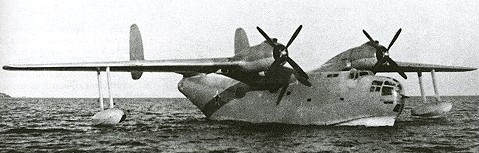
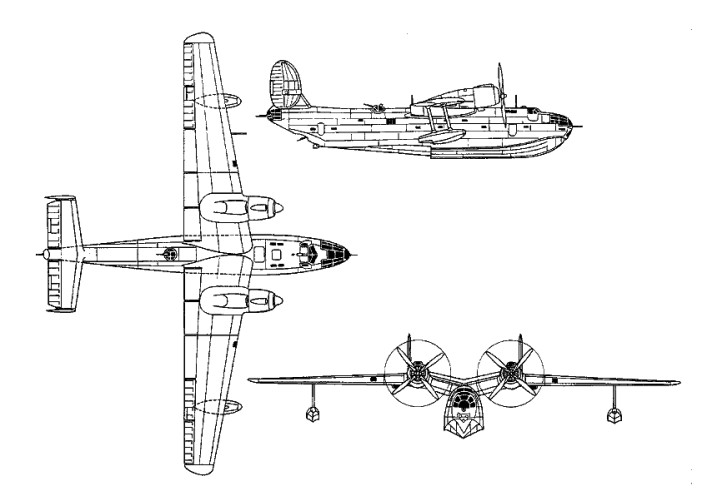
Development of a large maritime reconnaissance and bombing flying-boat was initiated by the Beriev design bureau in 1943, and the Beriev LL-143 prototype flew for the first time on 6 September 1945. An all-metal high-wing monoplane, it was powered by two 1492kW Shvetsov ASh-72 radial engines. Armament comprised twin NS-23 23mm cannon in a tail turret (behind the twin fins and rudders) and similar provision in a remotely controlled dorsal barbette. A single NS-23 cannon was installed in the bow turret.
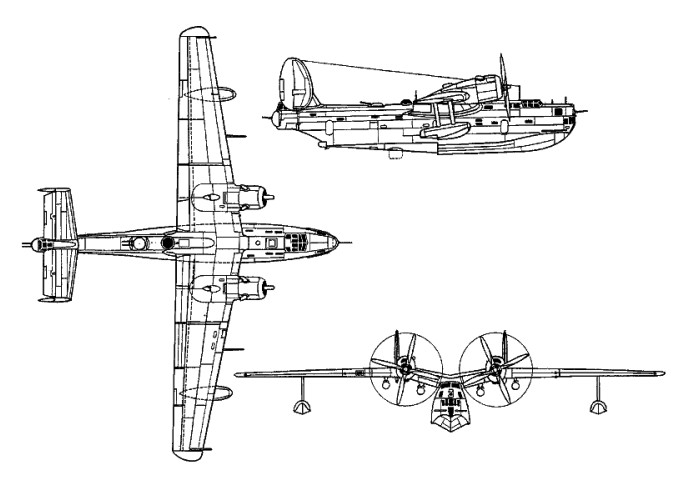
The LL-143 was developed into the Beriev Be-6 production aircraft, the first example of which was flown by M. I. Tsepilov in 1949. It differed from the prototype by having more sophisticated equipment, which included a retractable radome aft of the second step, and a redesigned nose without cannon armament. At a later stage the tail gun position was replaced by MAD (magnetic anomaly detection) equipment. The Be-6, to which NATO allocated the code-name ‘Madge’, carried a heavy offensive load comprising various combinations of mines, depth charges or torpedoes on underwing pylons outboard of the engines.
Be-6
Be-6s operated patrol, maritime reconnaissance and anti-submarine duties until the early 1970s, and a few remained in service on transport or fishery patrol duties into the late 1970s.
LL-143 Take-off weight: 21300 kg / 46959 lb Empty weight: 15110 kg / 33312 lb Wingspan: 33.0 m / 108 ft 3 in Length: 23.0 m / 75 ft 6 in Height: 7.5 m / 24 ft 7 in Wing area: 120.0 sqm / 1291.67 sq ft Max. speed: 371 km/h / 231 mph Ceiling: 6000 m / 19700 ft Range: 5100 km / 3169 miles
Be-6 Engine : 2 x ASh-73TK, 1765kW, 2300 hp Take-off weight; 23400 kg / 51588 lb Empty weight: 18827 kg / 41507 lb Wingspan: 33.0 m / 108 ft 3 in Length: 23.7 m / 77 ft 9 in Height: 7.6 m / 24 ft 11 in Wing area: 120.0 sqm / 1291.67 sq ft Max. speed: 400 km/h / 249 mph Range: 4900 km / 3045 miles Crew: 8 Armament: 4 x 23mm machine-guns
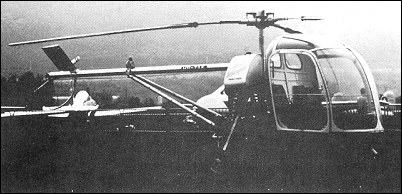
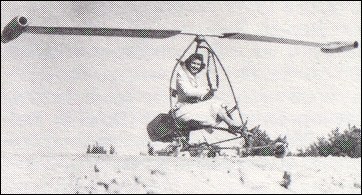
This miniature single-seater helicopter, designed as a private venture mainly for use in the United States Navy, has been simplified to such a degree that its components can be reassembled with hand tools. At each tip of the two-bladed rotor is a ram-jet engine, weighing 2.5 kilos and running on either ordinary petrol or fuel oil. The “Midget” is reported to be able to lift four times its own weight. The initial tests were carried out in 1954.
Engines: 2 x ram-jets equivalent to 40hp Number of seats: 1 Rotor diameter: 4.57m Weight fully loaded: 227kg Empty weight: 45kg Cruising speed: 120km/h
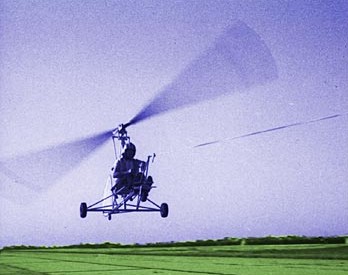
Take-off and flight of the Kopter is under full piston-engine power. Takes off at 30 mph. Cruises at 60 mph, with a high speed of 85+ mph. Climbs at 1,000 fpm and will reach an altitude of 12,000 ft. Engines of as little as 35 hp may be used (with reduction drive), or up to 80 hp. If flown as an ultralight, the B-20 is free of licensing or certification requirements. The B-19 may easily be converted at any time to the powered B-20, as is fully detailed in the same Construction Plans.
Engine (original): McCulloch 4318 Horsepower Range: 45 to 70 Height: 6 ft Length: 10½ ft Width: 5½ ft Empty Weight (minus engine): 150 lbs Empty Weight (with engine): 230 lbs Gross Weight (max): 530 lbs Payload Weight: 300 lbs Rotor Diameter: 21 ft Rotor Chord: 7 in Disc Loading: 1.53 lbs/sq ft Maximum Speed: 90 mph Airframe construction: welded steel tubing Control System: joystick; rudder pedals Cruise Speed: 60 mph Take-off Speed: 30 mph Rate Of Climb: 1,000 fpm Maximum Altitude: 12,000 ft
Towed by car, the B-19 becomes airborne at about 23 mph. Flight is completely pilot-controlled, limited only by the length of the tow cable. By adding a cable release, once airborne the pilot may free the craft for unrestricted soaring. The B-19 may easily be converted at any time to the powered B-20, as is fully detailed in the same Construction Plans.
Engine (original): McCulloch 4318 Horsepower Range: 45 to 70 Height: 6 ft Length: 10½ ft Width: 5½ ft Empty Weight (minus engine): 150 lbs Empty Weight (with engine): 230 lbs Gross Weight (max): 530 lbs Payload Weight: 300 lbs Rotor Diameter: 21 ft Rotor Chord: 7 in Disc Loading: 1.53 lbs/sq ft Maximum Speed: 90 mph Airframe construction: welded steel tubing Control System: joystick; rudder pedals Cruise Speed: 60 mph Take-off Speed: 30 mph Rate Of Climb: 1,000 fpm Maximum Altitude: 12,000 ft
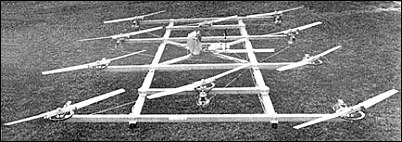
A manned research vehicle for possible agricultural operations. An aluminum framework with 10 McCulloch M75 two-cycle engines and 2.1m rotors; first flown 2 November 1961. Hovered at 6m, flew sideways and backwards with success.
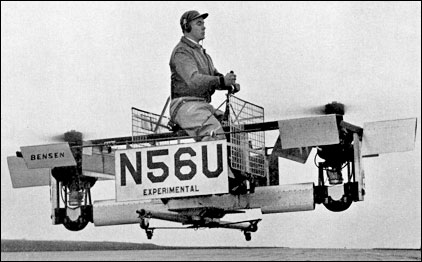
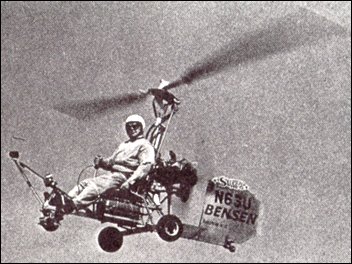
The Bensen B-10 Propcopter consisted of a boxy frame with 1.2 meter (4 foot) props mounted vertically on the front and back of the frame. Each was powered by its own 54 kW (72 HP) McCulloch engine. The Propcopter flew in 1959.
The B-10 was flown in prototype form (N56U) on 6 August 1958 and apparently was tricky to handle. It was not developed further.
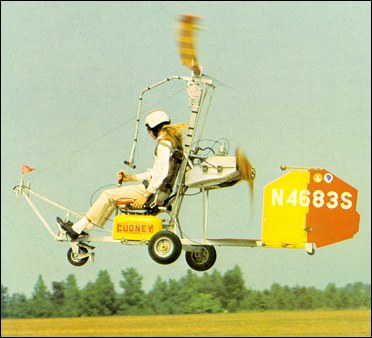
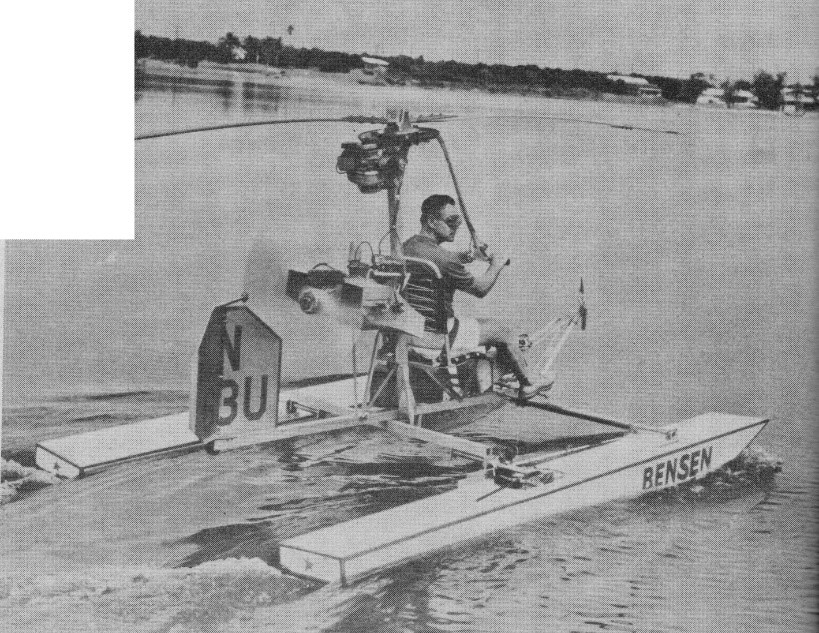
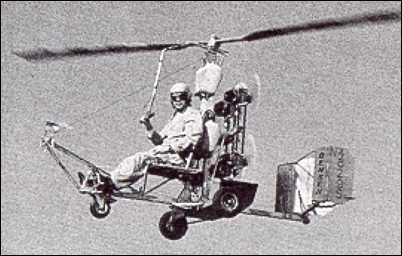
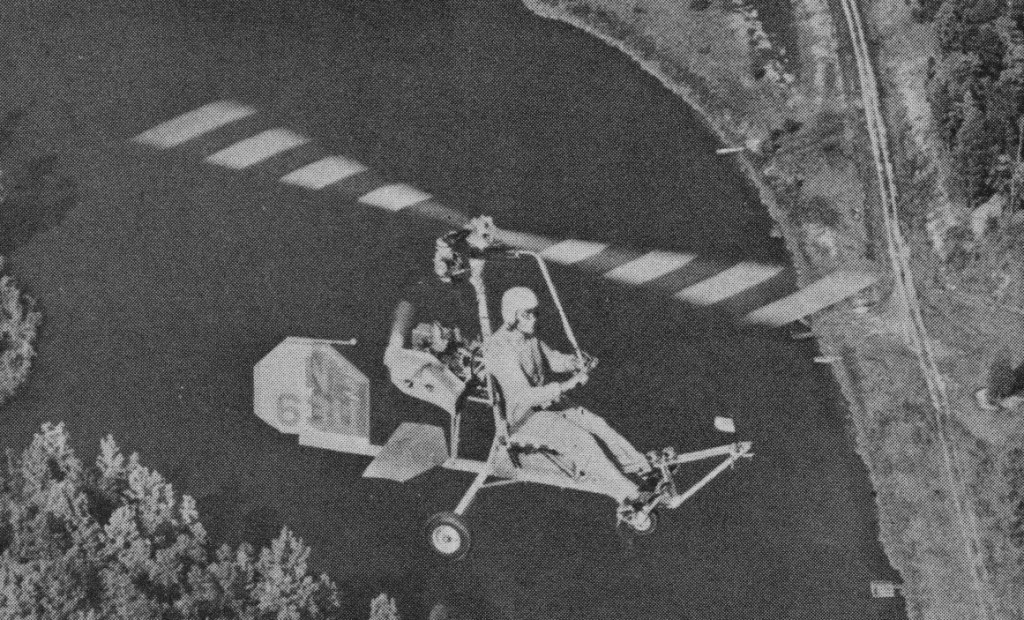
From the B-5 Gyro-Glider factory-built prototype of 1954, Bensen evolved the B-6 and B-7, and from these has come the standard production model the B-8. This has a more sturdy construction and was available as a factory-built machine or in kit form for amateur construction. Two water-borne versions of the B-8 were also available: the B-8B Gyro-Boat which has a boat-type hull and twin outrigged stabilising floats, and the B-8W Hydro-Glider mounted on twin floats. From the reworked B-7M came the B-8M variant, first flying on 8 July 1957 and by the first production B-8M on 9 October 1957. The B-8M is normally powered by a 72hp McCulloch piston engine. Optional features include a 90hp McCulloch engine and a mechanical rotor drive enabling the autogyro to make jump starts.
A float version of the B-8M is known as the Hydro-Copter.
The Gyro-Boat is a variant of the Gyro-Glider, in which the basic free-turning rotor system, known as the Roto-sail, is mounted on any standard small dinghy. The result is literally a flying boat, intended to be towed above water by a motor boat. The two-blade steel and plywood rotor has a diameter of 6.10m and disc area of 29.2sq.m. Each blade has an area of 1.0sq.m. When fitted to a 3.66m aluminium dinghy weighing 45kg, the complete Gyro-boat has an empty weight of 68kg and a loaded weight of 147kg carrying one person or 227kg carrying two people. It takes off when towed at a forward speed of 37km/h, cruises at 55-110km/h and lands at 11km/h. The prototype Gyro-Boat flew for the first time on April 25, 1956, and the first production model on July 8, 1956. The 1959 version can be fitted with stabilizing pontoons on outriggers for rough water operation.
B-8B Gyro-Boat
Designed for home construction from kits or plans, captured a series of international records in 1967, including an altitude of 7,275 ft (2,717 m) and a speed of 79 mph (127.15 kph) over a 15 km course. In early 1968 the USAF ordered three as X-25 to test methods of improving the odds of a downed flyers escape. The X-25A had a more robust structure and a small engine. The two-seat X-25B was originally used un-powered but was later fitted with an engine.
By 1984 there were more than 10,000 active rotorcraft fans in the United States. With purchase of their plans and component kits, it is possible to build a machine in a few weeks of spare time, with only a drill press and a few wrenches. Bensen Gyrocopters can be towed behind a car or boat or flown under their own power. The simple glider models are available as one or two seaters. The powered gyrocopters are available only as single seaters. The Gyrocopter is capable of climbing to 12,500 feet. The powerplant is a 72- to 90-hp McCulloch. Price in 1982: $4,850 (Excludes engine). Units delivered to June 1982: 4,000.
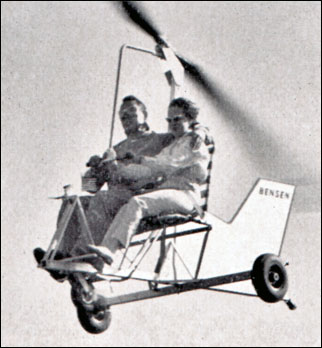
The B-8 Gyro-Glider is a simple unpowered rotor-kite which can be towed behind even a small motor car. It is available as either a completed aircraft or kit of parts for amateur construction. Alternatively, would-be constructors can purchase a set of plans, with building and flying instructions. No pilot’s licence is required to fly it in the United States and many hundreds of kits and plans have been sold. Application was been made for an Approved Type Certificate. The original Model B-7 Gyro-Glider was followed by the Model B-8, which is offered as either a single-seater or two-seater, the latter version being suitable for use as a pilot trainer. The Model B-8 consists basically of an inverted square-section tubular aluminium T-frame structure, of which the forward arm supports the lightweight seat, towing arm, rudder bar and landing gear nose-wheel. The rear arm supports a large stabilising fin and rudder, with the main landing gear wheels carried on a tubular axle near the junction of the T-frame. The free-turning two-bladed rotor is universally-mounted at the top of the T-frame and is operated directly by a hanging-stick control. It is claimed that the entire aircraft can be made from commercial tubing, wood and locally-available materials.
B-8 Gyro-Glider
B-8MH Hover-Gyro
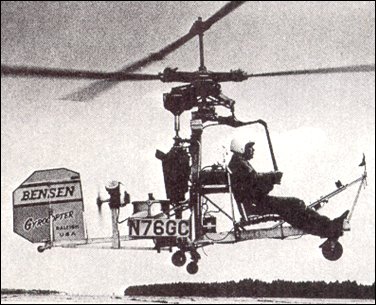
Demonstrated in public for the first time in 1976, the B-8MH Hover-Gyro is described as a ‘Hovering Gyro-Copter’. It was powered by a 70-110hp modified water-cooled outboard engine driving the lower of the two rotors; the upper rotor autorotates. One 14 hp modified air-cooled go-kart engine drives the pusher propeller mounted at rear.
B-8 Super Bug
The B-8 Super Bug was a B-8M modification with two engines installed to spin up the rotor prior to take-off.
B-8HD
The B-8HD was a 1979 Gyro-Copter was based on the Super Bug design. It uses hydraulic drive to feed about 4hp from the engine to the rotor, instead of having a separate engine for pre-rotation. This is reported to give the aircraft a take-off run of less than 61m.
In August/September 1964 the B-8M three-view drawings, photos and specification were available for $2, or the complete construction plans for $30.
B 8M Engine: McCulloch 4318E 4 cylinder, 72 hp Rotor dia: 20 ft 0 in (6.1 m) Fuselage length: 11 ft 4 in (3.45 m) Height: 6 ft 3 in (1.9 m) Max TO wt: 500 lb (227 kg) Empty Wt. 247 lbs / 112kg Fuel capaci¬ty 6 USG Max level speed: 85 mph (137 kph) Cruising speed: 72km/h Ceiling: 12,000 ft / 3810m Range: 161km