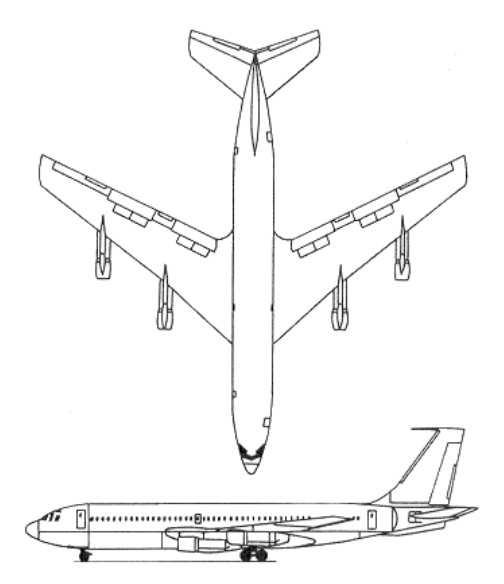
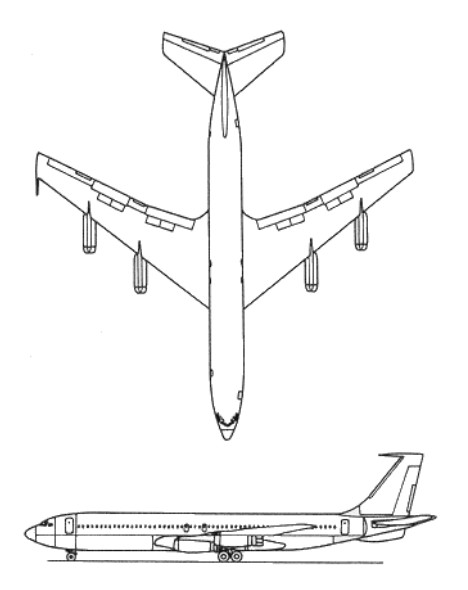
The most important aerodynamic change compared with the 707-120 is a refinement to the wing leading-edge, which increases the angle of sweepback and decreases the thickness/chord ratio, with improvement in take-off performance and cruising speed. These modifications were incorporated subsequently on the Boeing 707-120B. Major weight saving has been achieved by lightening the structure to the extent made possible by reducing the standard fuel load.
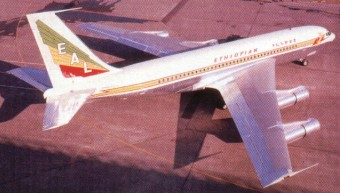
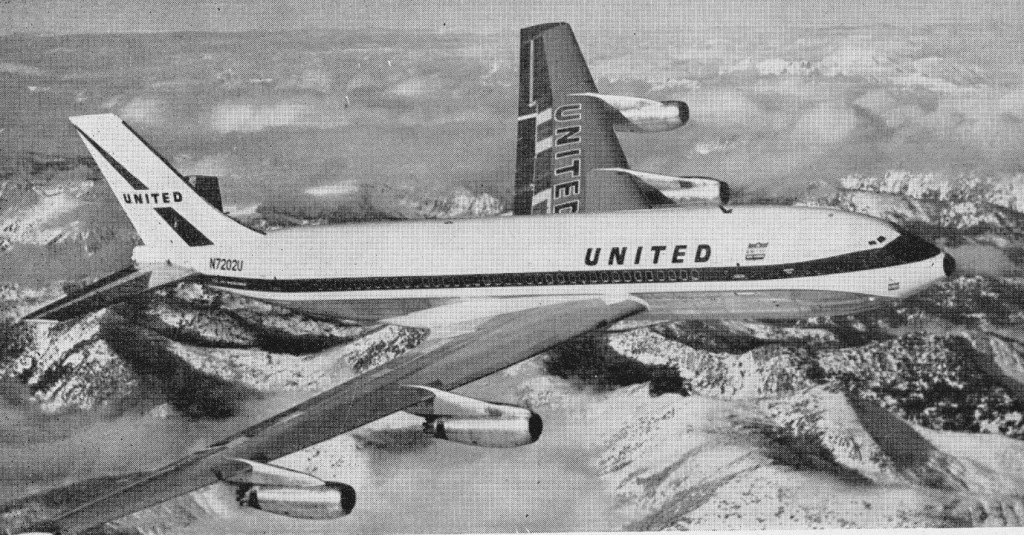
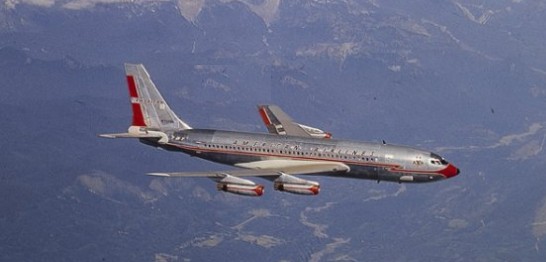
First flying on 23 November 1959, and first ordered by United Airlines, only 154 Boeing 720s were built before production ceased in September 1967, the type being replaced by the Boeing 727.
Engines: 4 x P+W JT-3 D-1, 75.6kN Wingspan: 39.9 m / 130 ft 11 in Length: 41.5 m / 136 ft 2 in Height: 11.7 m / 38 ft 5 in Wing area: 226.0 sq.m / 2432.64 sq ft Take-off weight: 103870 kg / 228995 lb Empty weight: 49705 kg / 109581 lb Cruise speed: 1000 km/h / 621 mph Ceiling: 12800 m / 42000 ft Range w/max.fuel: 8400 km / 5220 miles Range w/max.payload: 6700 km / 4163 miles Crew: 3-4 Passengers: 110-149
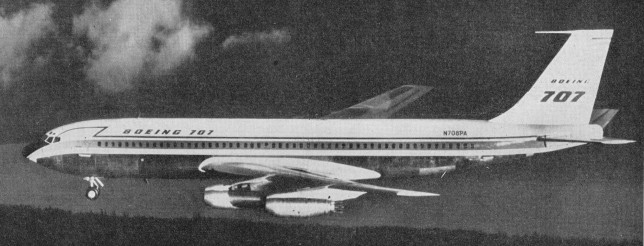
In October 1954 an order came through for 29 KC-135 tankers, based on the 367-80. When the company enlargened the cross-section of the fuselage, Boeing decided to design a new upper lobe for the commercial 707, while keeping the original one for the KC-135. The new fuselage upper lobe was of 140 in diameter making it easier to accommodate a triple seat each side of the aisle. The first 707 flew on 20 December 1957.
The 1st Boeing 707
Three airlines put Conway-engined Boeing 707s into service across the North Atlantic in the spring of 1960. The first was Lufthansa.
1st Lufthansa 707
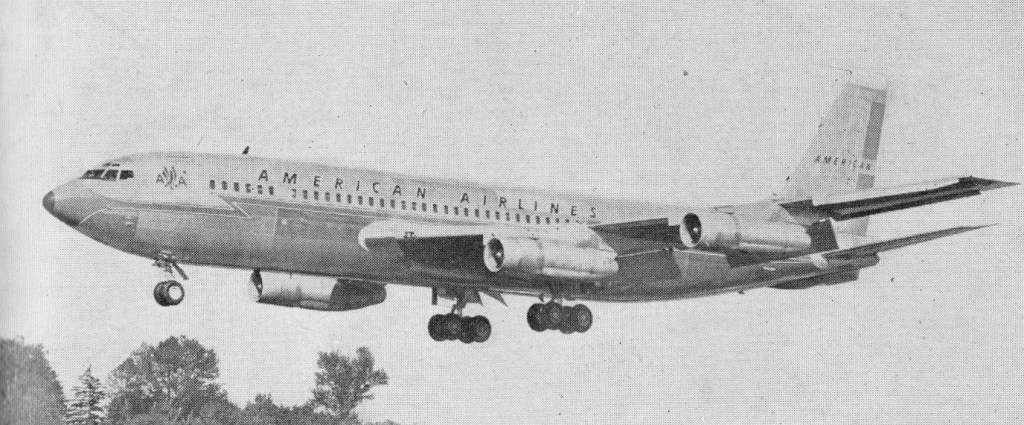
The Boeing 707-120 was introduced in 1954. As the 707-121, the first of a whole family of passenger and cargo variants, it was launched on its career by Pan Am in 1958 with a $296 million order for 20 — on the transatlantic route for prestige reasons, although it was designed and subsequently used for medium-range domestic service.
The first flight of a Pratt & Whitney JT3D turbofan powered 707-120B was made on 22 June 1960.
707-120B
The first operator of the 707-120 was Pan American who started daily service between New York and Paris on 26 October 1959.
Pan American began using its 707-120s on US domestic routes on 20 March 1959. Starting in July 1965, Pan American Airways replace the human navigator with inertal navigation systems in their entire fleet of 55 Boeing 707s at a cost of $12,500,000.
A brand-new presidential Boeing VC-137A, purchased in 1959, was equipped by a CIA team with a series of large cameras under conditions of secrecy at Andrews Air Force Base. Of the three military Boeing 707 aircraft provided for the White House and the American Government, 86970 was most frequently used as ‘Air Force One’.
VC-137A Air Force One
Some photographs were taken during test flights with the Special Air Mission Boeing, proving that from a height of 9 km the number plates of cars could be read. The large cameras in the belly of SAM 970 were installed behind hidden panels. The operation was controlled from the cockpit in such a way that possible Soviet ‘escorts’ would not notice anything.
The 707-121 was followed by the intercontinental -320, the largest passenger jet of its era (which flew the first ever round-the-world service in 1959) and the short-range -720. The Boeing 707-320B was introduced in 1959. The 707-138 was tailored exclusively to QANTAS specifications, combining the short fuselage of the -120 with P&W JT3D turbofans (replacing the JT3C-6 turbojets), and taller tail fin, and other aerodynamic improvements significantly boosting performance. Modification to 707-138B standard included fitting leading edge flaps and the installation of JT3D-1 turbofans.
The first QANTAS 707 (and Australia’s first jet) VH-EBA, a 707-138B, was retored at Southend and returned to Australia on 16 December 2006. Now registered VH-XBA (EBA was taken) it was to be delivered to the QANTAS Founders Outback Museum at Longreach QLD.
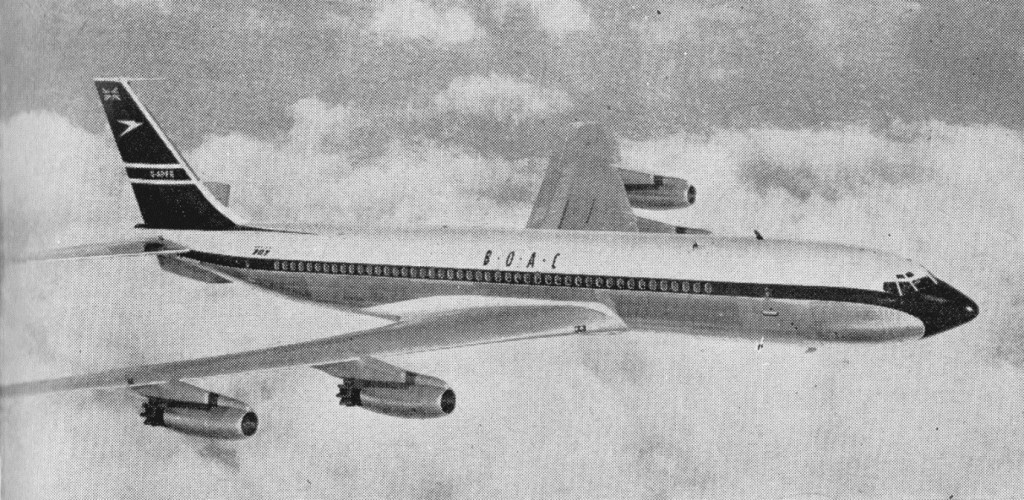
In the early months of 1960, modifications were adopted on the 707 to improve its controllability under certain critical conditions. The modifications, first applied to the Conway-engined 707-436s of BOAC, included a taller fin and a small ventral fin.
Lufthansa Boeing 707-430 jets first entered service on the non-stop Frankfort-New York route on 17 March 1960.
On 29 July 1963 BOAC’s flight 568, a Boeing 707, left Montreal for a non-stop to London. At the controls were Capts. Hilbert Alcock and Ernest E. Brow. On 15 June 1919 two British Navy pilots. Capt. John Alcock ant d Lt. Arthur Brown, made the first non-stop flight across the Atlantic in 16 hr 12 min. The jet flew 1300 miles further in 6 hrs 10 min.
BOAC 707-436
On 707s only the rudder is power operated; the other control surfaces, aerodynamically balanced, are moved by spring tabs on the trailing edges. Though criticized for being noisy and excessively smoky, and for needing longer runways than existed at most airports in the 1950s, the 707 quickly overcame all opposition by flying more passengers and cargo faster, farther and more economically than any other passenger plane. Models fitted with turbofan engines were considerably quieter than the early turbojet-powered versions and by the early 1960s, runways at major airports had been extended to accommodate the new generation of jets. During the two decades of 707 production, almost 2,000 have been built.
A modified Boeing 707-353B joined the US Presidential fleet in August 1972, designated as a VC-137C. President John F. Kennedy’s VC-137 (tail number 26000) was based on a USAF C-137C model which in turn was based on the Boeing 707. This aircraft gained more significance in becoming the aircraft used to transport Kennedy’s body back from Dallas, Texas in 1963. The aircraft served as the official office to which Vice President Lyndon B. Johnson was sworn in as the 36th President of the United States following Kennedy’s assassination at the hands of Lee Harvey Oswald. Today, this very aircraft resides at the United States Air Force Museum in Dayton, Ohio. The aircraft exhibit details the event complete with text and pictures showing the swearing in and the area of the aft portion of the interior cabin modified to fit the coffin of John F. Kennedy for the trip back to Washington, D.C.
The same aircraft transported the body of President Lyndon B. Johnson back to Texas for final rest. President Richard M. Nixon utilized VC-137 on his historic visits to China and the Soviet Union.
John F. Kennedy’s VC-137 was the first presidential aircraft to be popularly known as “Air Force One”.
Powered by four turbojet engines the long range 707-320C can carry up to 202 passengers and has provided safe, fast and comfortable jet travel around the world. Its success can be measured by the fact that no fewer than 859 had been delivered by 1 June 1972.
In 1982 Boeing modified a commercial 707-320 airliner to demonstrate its potential as a tanker/ transport. As flown, the demonstrator has a centreline and wing-tip hose and drouge refuelling systems, but several alternatives are offered, including a centreline flying boom installation. For the tanker role an optional tank may be fitted in the lower rear cargo hold to provide an additional 19,000 lt of fuel. Spain will receive two tanker/transports with VIP interiors during 1987, while Brazil will take delivery of its fourth and last in November 1987.
Boeing completed the first 707-320 Inter-continental as no.16 off the Renton line, flying it on 11 January 1959. The Intercontinental had been ordered by nine airlines. Britain’s CAA caused a minor hiccup by insisting on extra vertical tail area. At first this was met by a big underfin, but the definitive answer was a taller fin, which Boeing made standard. The name Inter-continental was later dropped. The -320B had the JT3D engine and wings with a high-lift leading edge with full-span Kruger flaps and longer-span curved wingtips. These matched weight increases to 333,600lb, paralleled by the -320C mixed-traffic version cleared for 202 passengers or 96,126 lb of cargo.
The -320C remained in production until March 1982, the final total standing at 917. This does not include such military versions as the E-3 AWACS and KE-3A, E-6, E-8A and EC-18 series; with these the total is almost exactly 1,000.
Northrop Grumman undertakes production of E-8C Joint STARS as joint USAF and U.S. Army co-operation program for an airborne surveillance and target acquisition system (first flown August 1995 for first production E-8C).
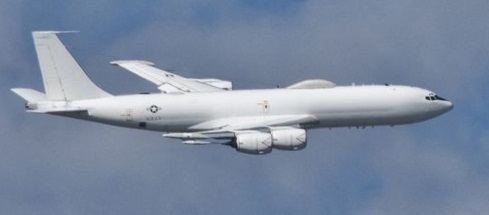
U.S. Navy Boeing E-6B Mercury airborne command post
The last commercial 707 was 707-320C for Moroccan government delivered March 1982.
Based on the E-3 airframe and powered by four CFM International Fl08-CF-100 turbofans rated at 22,000 lb st (9 979 kgp) each, E-6As will replace EC-130Q Hercules in the TACAMO (Take Charge And Move Out) role to communicate with nuclear submarines. The E-6A is equipped with very-low-frequency (VLF) radio systems for commu¬nication with the US Navy’s Trident nuclear submarine fleet.
In 1990 the US Navy ordered eleven Boeing 707 derivatives. The particular USN variant ordered was the E-6 submarine communication aircraft which uses a five mile long trailing wire as a very low frequency antenna to produce a carrier wave to penetrate the ocean surface and reach submerged submarines worldwide.
For the US Navy, Boeing is building 15 of these survivable airborne communications systems, based on the Model 707 airliner airframe. E-6A – Powered by CFM-56 engines, the E-6A proto¬type flew on 19 February 1987 (minus avionics). Development of the survivable airborne communications system for the US Navy will continue until 1989.
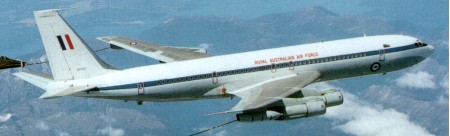
Five Royal Australian Air Force Boeing 707 jets, with 29 years of service, where used for air-to-air refuelling and transport. A 707 tanker can carry up to 43 tonnes of fuel – the wingtip refuelling pods removable to reduce weight and drag and increase range on non-tanker missions.
As a transport aircraft, the 707 can seat up to 152 passengers or carry 60 tonnes of cargo. From 2009, the RAAF 707s were progressively replaced by new KC-30B Multi-Role Tanker Transports, specially-modified Airbus A-330s.
A re-engined Boeing 707 with four Pratt & Whitney JT8D-219 engines has shown up to 22% improvement in fuel usage over its original engines. This aircraft has been dubbed the B707RE. Also tested (as 707-700) was a re-engined version with CFM56.
The Boeing 707 80 prototype obtained speeds well below 100 mph during landing approach in tests conducted by NASA and Boeing at Langley Research Centre. The plane, which once set a coast-to-coast record at 612 mph, was modified by Boeing at its own expense. It has large wing flaps, a boundary layer control system, thrust modulating system and instruments to provide flight data. The Boeing 707 80 prototype was presented ultimately to the Smithsonian Air and Space Museum.
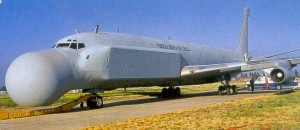
Keen to market its own AEW system for the Israeli Air Force (IAF) and for export, Israeli Aircraft Industries (IAL) developed the Phalcon Airborne Early Warning, Command and Control System and mounted it on a Boeing 707 airframe. The Phalcon system has attracted interest from a variety of countries, however, when China expressed an interest in mounting the radar system on a Russian-built Ilyushin/Beriev A-501 Mainstay in Jul 2000, the USA eventually blocked the sale.
B707-120 Engines: 4 x Pratt & Whitney JT3C-6 turbojet. Length: 145 ft 1 in. Seats: up to 180.
B707-138B Engines: 4 x Pratt & Whitney JT3D-1 turbofan.
Engines: 4 x Pratt & Whitney JTD 3 turbofan, 18,000 lb. (8,165 kg.) thrust. Length: 149 ft 7 in (46.61 m) Height: 12.9 m / 42 ft 4 in Wing span: 145 ft 8 in (44.42 m) Wing area: 273.3 sq.m / 2941.77 sq ft Weight empty: 138,385 lb (62,771 kg) Take-off weight: 148780 kg / 328005 lb Cruise speed: 960 km/h / 597 mph Max. accommodation: 189 Ceiling: 42,000 ft (12,800 m) fully loaded Range w/max.fuel: 8690 km / 5400 miles Range w/max.payload: 7885 km / 4900 miles Crew: 4
B707-220 Seats: up to 180
707-320 Engines: 4 x Pratt & Whitney JT-4A turbojet
707-320B Engines: 4 x Pratt & Whitney JT9D 7 turbofan, 19,000 lb Wing span: 145 ft 9 in (44.42 m) Length: 152 ft 11 in (45.61 m) Height: 42 ft 5 in (12.92 m) Max TO wt: 333,600 lb (151,315 kg) Max level speed: 627 mph (1010 kph) Ceiling: 42,000 ft Range 6,160 miles Seats: up to 219
B707-320C Engines: 4 x Pratt & Whitney JT3D-7 turbofans, 19,000lbs thrust Length: 149.61ft (45.6m) Width: 145.73ft (44.42m) Maximum Speed: 551mph (886kmh; 478kts) Maximum Range: 4,300miles (6,920km) Service Ceiling: 38,993ft (11,885m) Accommodation: 9 + 189 Empty Weight: 145,999lbs (66,224kg) Maximum Take-Off Weight: 333,592lbs (151,315kg)
B707-720 Seats: up to 180
B707-420 Engines: 4 x Rolls-Royce Conway Seats: up to 219
B707RE Engines: 4 x Pratt & Whitney JT8D-219
B707-700 Engines: 4 x CFM56
E-6A Engine: 4 x CFM56-2 turbofan. Installed thrust: 392.6 kN. Span: 45.2 m. Length: 46.6 m. Empty wt: 78,380 kg. MTOW: 155,130 kg. Max speed: 980 kph. Ceiling: 12,200 m T/O run: 1650 m. Ldg run: 720 m. Range: 11,750 km. Endurance: 15.4 hr. Air refuel: Yes.
Boeing 707 RAAF Role: Air-to-air refuelling, passenger and cargo transport Crew: Two pilots, flight engineer, loadmaster, navigator (air-to-air refuelling role), up to six crew attendants Engines: Four Pratt and Whitney JT3B turbofans (8,172kg thrust each) Length: 46.5m Height: 12.9m Wingspan: 44.5m Weight: 152,000kg Speed: 890 km/h Range: Over 7,400km Ceiling: 42,000 feet Accommodation: Up to 152 passengers
Boeing VC-137B Stratoliner Maximum Speed: 628mph (1,010kmh; 545kts) Maximum Range: 5,757miles (9,265km) Rate-of-Climb: 4,000ft/min (1,219m/min) Service Ceiling: 49,869ft (15,200m; 9.4miles) Engines: 4 x Pratt & Whitney JT3D-3 Turbofans, 80kN (18,000 lbs)
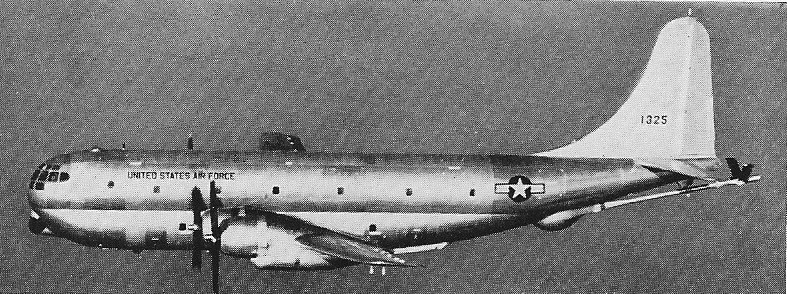
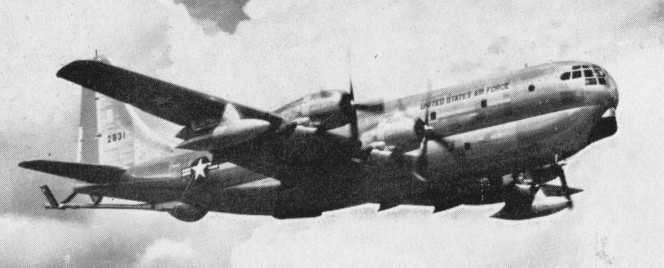
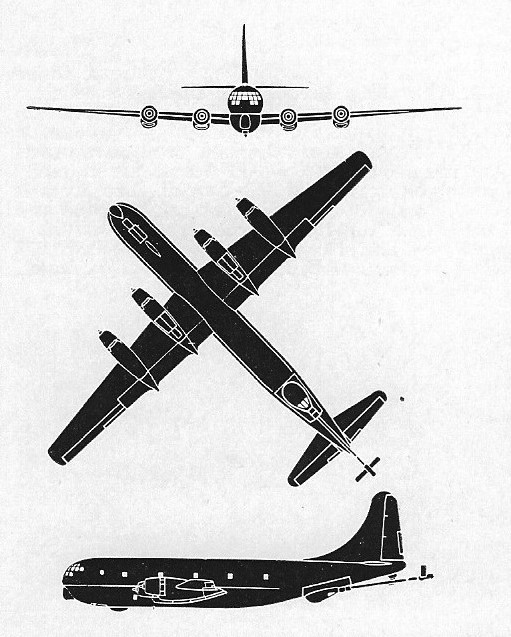
In early 1942 Boeing initiated a design study to examine the feasibility of producing a transport version of its B-29 Superfortress. The company’s proposal was submitted to the USAAF for consideration and, because at that time the long-range transport was a much-needed type of aircraft, a contract for three prototypes was awarded on 23 January 1943. Identified by the company as the Boeing Model 367, and designated XC-97 by the US Army Air Force, the first made its maiden flight on 15 November 1944. The XC-97 had the entire wing and engine layout of the B-29. The ‘double-bubble’ section fuselage appears to be entirely new, but the lower ‘bubble’ was basically a B-29 structure, and so was the tail unit attached to the new (and larger) upper ‘bubble’. On 6 July 1945, following brief evaluation of the prototypes, 10 service-test aircraft were ordered. These comprised six YC-97 cargo transports, three YC-97A troop carriers, and a single YC-97B with 80 airline-type seats in its main cabin.
The first production contract, on 24 March 1947, for 27 C-97A aircraft with 2425kW Pratt & Whitney R-4360-27 engines, specified accommodation for 134 troops, or the ability to carry a 24,040kg payload. Two transport versions followed, under the designation C-97C and VC-97D, and following trials with three KC-97A aircraft equipped with additional tankage and a Boeing-developed flight-refuelling boom, KC-97E flight-refuelling tankers went into production in 1951. This version was powered by 2610kW R-4360-35C engines.
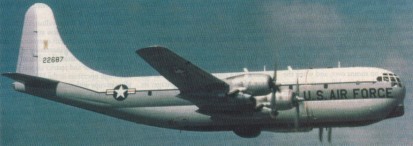
The KC-97F differed only in having R-4360-59B engines. Both the KC-97E and KC-97F were convertible tanker/transports, but for full transport capability the flight-refuelling equipment had to be removed. The most numerous variant, with 592 built, was the KC-97G which had full tanker or full transport capability without any on-unit equipment change.
Boeing KC-97G
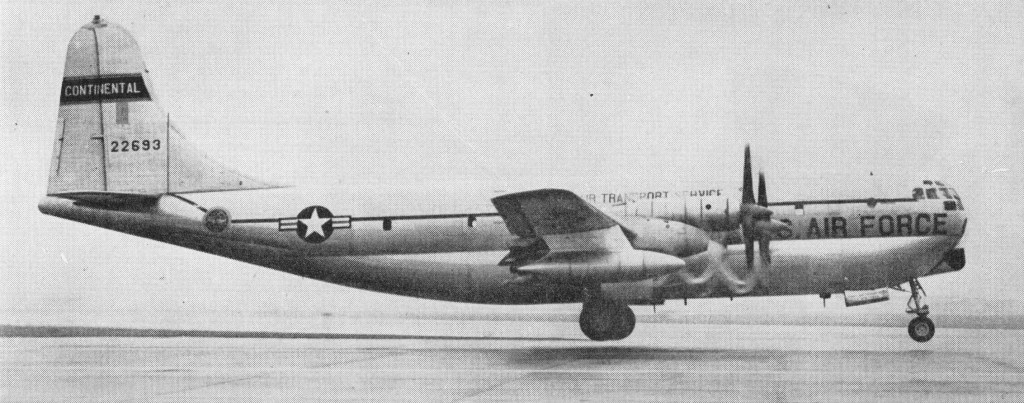
When production ended in 1956 a total of 888 C-97s had been built, and many were converted later for other duties. The KC-97L variant had increased power by the installation of a 2359kg thrust General Electric J47-GE-23 turbojet beneath each wing to improve rendezvous compatibility with Boeing B-47s. KC-97Gs converted to all-cargo configuration were redesignated C-97G, and in all-passenger configuration became C-97K. Search and rescue conversions were HC-97G, and three KC-97Ls went to the Spanish air force, being designated TK-1 in that service. Several have served in many roles with Israel’s air force.
Twenty KC-97s are assigned to each 45-plane wing of B-47 bombers. The KC-97G combines in one aircraft the duties of transport and ” flying boom” tanker, its boom being a permanent fixture. Earlier versions had removable booms for conversion into transport role. The KC-97G usually carries two 1700-gal. fuel tanks under outer wings.
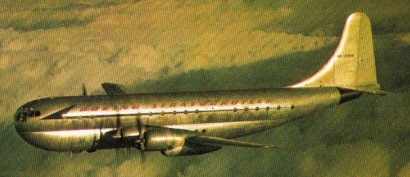
The Boeing Model 377 Stratocruiser was a commercial transport development of the Model 367 (military C-97), and based on the improved-structure YC-97A with Pratt & Whitney R-4360 engines. The first flight of the prototype Model 377-10-19 was made on 8 July 1947, and it was delivered subsequently to Pan American World Airways, which was the biggest user of the Stratocruiser. There were a variety of interior configurations in the Models 377-10-26, -28, -29, -30, -32 accommodating from 55 to 112 passengers or, if equipped as a ‘sleeper’, with 28 upper- and lower-berth units, plus five seats. The main cabin was in the upper lobe of the ‘double-bubble’ fuselage, with a luxury lounge or cocktail bar seating 14 on the lower deck, reached via a spiral staircase.
Of the total of 55 that were built, Pan Am was operating 27 at one period. Of these, 10 were given additional fuel capacity to make them suitable for transatlantic operations, and were known as Super Stratocruisers. At a later date the entire fleet was equipped with General Electric CH-10 turbochargers, enabling each engine to develop an additional 37.3kW. British Overseas Airways Corporation also acquired a fleet of 17 with only six of these were original purchases from Boeing, the remainder acquired from other airlines. After just over nine years’ service with BOAC, 10 were sold to Transocean Airlines in the USA during 1958. Of these, four were converted to 117-passenger high-density seating, the remainder each having an additional 12 seats added to their standard 63- and 84-seat layouts. Before Stratocruisers disappeared from service during 1963, a few had been modified to a cargo configuration, but by far the strangest conversion resulted from those airframes acquired by Aero Spacelines Inc. Under the designation 377-PG, this company built an oversize cargo aircraft which it named ‘Pregnant Guppy’ and subsequently built other examples, using both Model 367 and 377 airframes, under variations of the Guppy name.
The YC-97J designation for two KC-97Gs converted for USAF use as flying test-beds, each with four 4250kW (5,700-shp) Pratt & Whitney YT43-P-5 turboprop engines.
YC-97J
During the course of the Berlin Airlift emphasis was placed more on eavesdropping activities. For those missions the USAF at the West German airbase at Wiesbaden had the 7405th Operation Squadron which used only two Boeing EC-97G Stratocruisers. The only obvious difference from normal transports was an extra aerial blister under the fuselage.
EC-97G
The EC-97G kept on flying to and from Tempelhof in West Berlin up to 1976 when they were replaced by C-130E.
C-97A Engines: 4 x Pratt & Whitney R-4360-27 Wasp Major, 2425kW / 3,500 hp Maximum Range: 2,672miles (4,300km) Service Ceiling: 30,000ft (9,144m) Crew: 4 Capacity: 134 troops, or 24,040kg payload.
C-97C Transport version
C-97D Designation applied to the third YC-97A, the YC-97B, and two C-97As following conversion to a standard passenger configuration; the three VC-97Ds were subsequently redesignated C-97D
VC-97D Transport version
KC-97A Convertible tanker/transports with additional tankage and a Boeing-developed flight-refuelling boom
KC-97E Flight-refuelling tankers Engines: 4 x R-4360-35C, 2610kW
C-97G KC-97Gs converted to all-cargo configuration
C-97K KC-97Gs converted to all-passenger configuration
KC-97H Designation applied to one KC-97F, following modification for service trials as a tanker using the probe-and-drogue flight-refuelling system developed in the UK
YC-97J Final designation of two KC-97Gs converted for USAF use as flying test-beds, each with four 4250kW (5,700-shp) Pratt & Whitney YT43-P-5 turboprop engines
KC-97L / TK-1 Increased power with a 2359kg thrust General Electric J47-GE-23 turbojet beneath each wing
Boeing Model 377-10-19 First prototype. Improved-structure YC-97A with Pratt & Whitney R-4360 engines.
Models 377-10-26, -28, -29, -30, -32 Variety of interior configurations in the accommodating from 55 to 112 passengers or, if equipped as a ‘sleeper’, with 28 upper- and lower-berth units, plus five seats.
377 Stratocruiser Engines: 4 x Pratt & Whitney R-4360 B6 Wasp Major, 3500 hp, 2610kW. Prop: 4 blade 16 ft 7 in (5.05m). Wing span: 141 ft 3 in (43.05m). Length: 110 ft 4 in (33.63 m). Height: 11.66 m / 38 ft 3 in Wing area: 1,769 sq ft (164.3sq.m). Weight empty 83,500 lb. (37,870 kg.). Max wt: 145,800 lb (66,134 kg). Max. speed: 604 km/h / 375 mph Typical cruising speed: 300 mph (483 km/h) at 25,000 ft (7,620 m). Max cruise speed: 340 m.p.h. (550 kph). Ceiling: 32,000 ft. (10,000 m.) fully loaded. Typical range: 2,750 miles (4,426 km) with max payload. Max range: 4 600 miles (7,400 km.). Cruise 50% pwr: 270 kts @ 25,000 ft / 135 USG/Hr/engine. Endurance: 14 hr. T/O run: 7200 ft. Crew: 5. Pax cap: 55-100
Boeing 377 Stratocruiser Engines: 4 x Patt & Whitney R-4360-TSB3-G, 3500 hp Wingspan: 141 ft 3 in Length: 110 ft 4 in Height: 38 ft 3 in Empty weight: 83,500 lb Loaded weight: 142,500 lb Max speed: 375 mph Cruise: 196 mph Normal range: 1500 mi
KC-97G Engines: 4 x Pratt & Whitney R-4360-59B Wasp Major, 2610kW / 3500 hp Wingspan: 43.05 m / 141 ft 3 in Length: 33.63 m / 110 ft 4 in Height: 11.66 m / 38 ft 3 in Wing area: 164.34 sq.m / 1768.94 sq ft Take-off weight: 79379 kg / 175002 lb Empty weight: 37421 kg / 82500 lb Max. speed: 604 km/h / 375 mph Cruise speed: 483 km/h / 300 mph Ceiling: 9200 m / 30200 ft Range: 6920 km / 4300 miles
KC-97G Transport and flight refuelling tanker Engines: 4 x Pratt & Whitney R4360-75, 3,500 h.p. Wingspab: 141 ft. 3 in. Length: 110 ft. 4 in, Loaded weight: 153,000 lb Max speed: 375 m.p.h. Ceiling: 35,000 ft. Max range: 4,200 miles at 300 m.p.h. at 25,000 ft. Crew: 5 Capacity: 96 troops or 68 500 lb. cargo
YC-97J Engines: 4 x 5700 hp Pratt & Whitney T34 turboprop
The L-15 Scout was a light and small observation liaison aircraft produced in limited numbers by the Boeing Aircraft Company following World War 2 – only twelve of the type were produced with the United States Army becoming its top operator. The YL-15 requirements included an aircraft that could be quickly dismantled and loaded on a standard 2.5 ton truck.
First flight was achieved on July 13th in 1947 and production spanned from 1947 into 1949.
The all-metal construction L-15 was designed for operations from short runways (STOL) and specifically intended for the light scout observation role. The L-15 was designed at Boeing’s Wichita, Kansas facility.
The aircraft featured a high mounted monoplane wing assembly to which were affixed “flaperons”, wing devices that could double as ailerons and flaps. The two-person crew, made up of the pilot and the observer, sat in a glassed-in nacelle-type fuselage under the main span of the wings. The engine was mounted at the extreme front of the fuselage with the empennage extended out over the rear portion of the aircraft. The tail section had twin vertical tail fins. The undercarriage was a conventional “tail-dragger”, with two main landing gears and a tail wheel. All were fixed and the tail wheel was positioned under the rearward portion of the fuselage nacelle. The aircrafts size made it suitable for transport in a C-97 aircraft, that is once broken down for the journey. Should the mission call for it, the L-15 could also be fitted with twin floats for water landings.
The Scout could be towed as a glider at speeds up to 165 mph without having its airscrew removed.
No firm L-15 Scout contracts were secured. The remaining seven were later employed by the Federal Fish and Wildlife Service.
Boeing L-15 Scout Engines: 1 x Lycoming O-290-7, 125hp. Length: 25.00ft (7.62m) Wingspan: 39.99ft (12.19m) Height: 8.69ft (2.65m) Empty Weight: 1,512lbs (686kg) Maximum Take-Off Weight: 2,055lbs (932kg) Maximum Speed: 112mph (180kmh; 97kts) Rate-of-Climb: 628ft/min (191m/min) Service Ceiling: 16,398ft (4,998m) Accommodation: 2
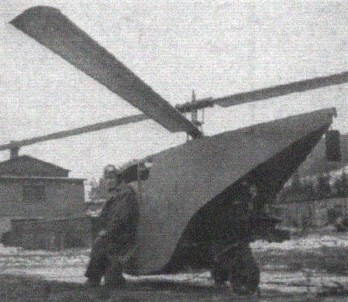
A coaxial-rotor light helicopter built by Bodo Franke of Cologne in 1958. A three-seater, it has a 105hp engine and was expected to sell for DM 65,000.
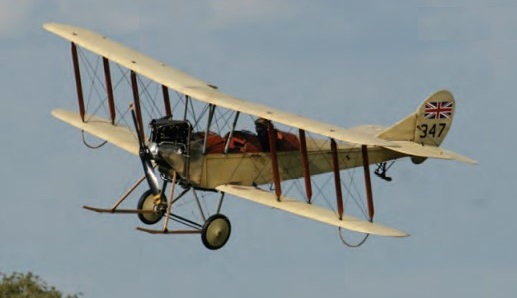
A full-size replica of the 1918 Royal Aircraft Factory BE.2c was built at Sywell, UK, for a ‘Biggles’ film in 1968 by Charles Boddington using Tiger Moth components and a Gipsy Major 10-1.
Registered G-AWYI cn 1 it flew with the serial 2984.
It was later sold in the USA as N1914B.
Engine: Gipsy Major 10-1 Wingspan: 37.00 ft Length: 27.03 ft
In 1956 after restrictions on aircraft construction in Germany were lifted Walter Blume produced, a modernized version of the Ar 79. The canopy was extended rearward, the fin was replaced by a more modern form, the wing replaced by an all metal wing and the landing gear replaced by a tricycle undercarriage. The original Hirth engine Hirth being no longer available, was replaced by the Lycoming O-320.
A four-seater with straight-tapered flying surfaces, there are wingtip fairings to increase the effective aspect ratio and boundary-layer fences between the centre-section and outer wing panels. Two fuel tanks are in the wing centre section, one on each side of the fuselage.
Engine: Lycoming 150 hp Wingspan: 34 ft 5 in Length: 26 ft 9 in Height: 7 ft 10.5 in Empty weight: 1350 lb Loaded weight: 2337 lb Max speed: 149 mph at SL Cruise: 133 mph Range: 630 mph Prop: 2 blade variable pitch Seats: 4
The son of a Jewish doctor, Adolph Bloch, in 1909 Marcel Bloch enrolled in the Paris College of Aeronautics.
During the First World War he set up his own company to make planes which began mass producing just after the war ended. In the 1930s he began building aircraft for the French post office, then the French air ministry.
In 1933 Marcel Bloch established a small factory at Courbevoie, Paris, to build light aircraft. In 1933-34 the company built its first fighter aircraft, the Bloch 130, the first flight of this prototype being made on 29 June 1934. Production Bloch 131s entered service in 1938. Subsequent production included the Bloch 151 /152/155 monoplane fighter, Bloch 175 light bomber, and Bloch MB 200 and MB 210 bomber aircraft. Nationalization of the French aircraft industry in 1937 combined the Bleriot and Bloch companies as Societe Nationale de Constructions Aeronautiques de Sud-Ouest, with Marcel Bloch as managing director.
By June 1940 production totaled about 600, involving five plants. MB.175 twin-engined bomber was in production and was revived after Second World War as torpedo aircraft.
After World War II, although four of the nationalized groups continued operating under state control, private companies were allowed to resume the design and manufacture of both civil and military aircraft. Some of the pioneering names of French aviation, such as Breguet and Morane Saulnier, returned to prominence, and by 1950 a new one had been added Avions Marcel Dassault.
It was not until after World War II that Marcel Bloch, born a Jew, converted to Catholicism and changed his name to Dassault.
The surviving private portion of Bloch became Dassault in 1948.
Designed and built by Herr Gerhard Blessing of Hamburg, this single-seat homebuilt motor glider has provision for carrying a second occupant, and the wings can, at the choice of the builder, be made in two, three or four parts. To assist the amateur constructor further, no component of the aircraft is more than 3.5m (11ft 5.75in) long, and the fuel tank and several other components are standard car items obtainable from the motor industry.
The Rebell is a mid-wing monoplane of basically steel tube construction with wood covering; the wings can be folded for storage and the vertical tail surfaces are swept back, with a dorsal fin. Landing gear consists of a non-retractable semi-recessed monowheel supplemented by a balancer wheel under each wing about halfway along the semi-span, plus a tailwheel.
The prototype Rebell, registered D-KEBO, first flew on 3 June 1973 powered by a 54hp Hirth M28 two cylinder engine driving a Hoffman two-blade pusher propeller that could be feathered for soaring flight.
In 1975 a modified Volkswagen engine was fitted which had a slightly larger air intake.
The fuselage has been redesigned to take a 62hp Limbach SL 1700 engine in the nose, and the Rebell was expected to fly again in this form early in 1980.
Engine: Hirth M28 Span:49 ft 2.5 in Length: 24 ft 7.25 in Wing area: 182.0 sqft Aspect ratio: 13.2 Empty weight: 926 lb Max weight: 1,366 lb Max speed: 124 mph Economical cruising speed: 93 mph Best glide ratio: 24:1