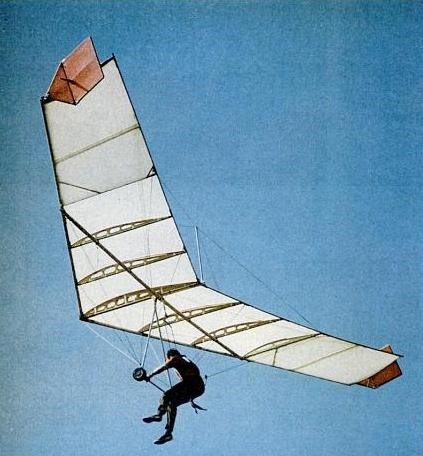
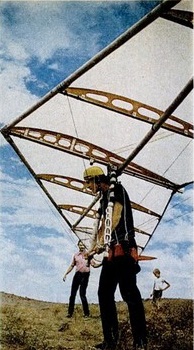
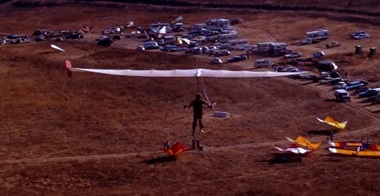
Frank Colver, his son Matt, and his friend Ernest Feher built the bamboo and plastic glider (R Miller’s Bamboo Bomber) that was at the 1st Otto meet. After the meet Colver started designing the one-off Skysail with inspiration from Richard Miller’s Conduit Condor. After testing a scale model actual construction on the Skysail started on November 5, 1971 and the wing was taken to the field for the first time on January 22 of 1972.
Colver sold many copies of plans for a model of the Skysail but never for the full size version, due to liability worries. If someone scaled it up that was their choice.
The airfoil at the tips was inverted to reduce the amount of physical twist need for pitch stability. This was 1974 and by that time Colver had changed from a triangle control bar to a parallel bar system for ease of ground handling.
The end bays of the single surface wing have ribs upside down and were crossed underneath, not on top. Wingtip rudders were controlled through the seat.
After Colver quit flying the Skysail it was donated to the San Diego Aerospace Museum where it burned up in the fire that destroyed the museum.
Hokan (or Hakan) Colting began building balloons in Ireland with fellow Swede Per Lindstrand in 1976, drawn, like many others, by that country’s abundance of available skilled labor (much of the company’s output went to Sweden). Production of Colt balloons by Eire Colting Balloons Ltd. continued until the company moved to London in 1978, and changed its name to Colt Balloons Ltd. The company had half the staff of a giant like Cameron, but innovated by building many challenging special shapes, and fabricating most of the components itself, Colt made a name as a scrappy player in the industry, not to be underestimated. Resembling Thunder in the ’70s, the two companies merged in 1980. ThunderColt continued production of Colt balloons, bringing the marque’s ultimate output to 99 before production ceased.
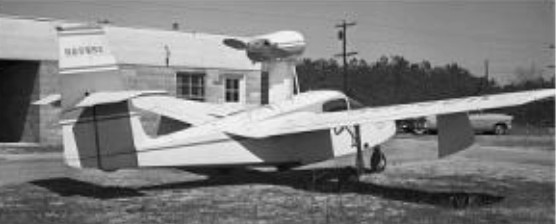
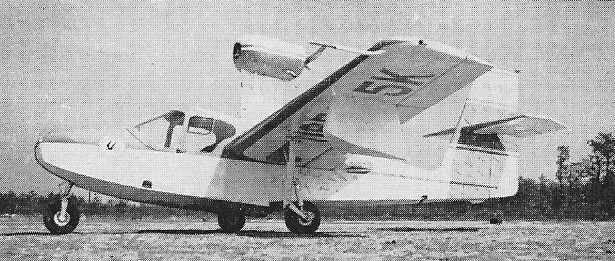
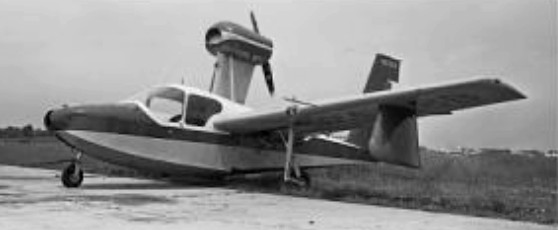
Following World War II, aircraft designer David Thurston, then of Grumman, formed the Colonial Aircraft Corporation as a side job, beginning work on a two/three-seat amphibian, the “Skimmer”. Using some ideas from his previous association with the Gooyear GA-1 Duck and Grumman G-65 Tadpole, Thurston built an all-new amphibian design with a shallower hull and raised turtledeck. Construction on the prototype, called the C-1 Skimmer, began during 1957, powered by a 115 hp Lycoming O-235-C1 with an Aeromatic propeller.
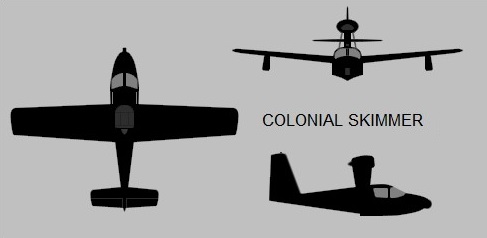
The all metal hull was semi-monocoque and the fully cantilevered wings joined the fuselage in the high mid-position.
Directly from the G-65 was a tricycle undercarriage retracting system in which the main wheels folded into the wings and one-piece, streamlined stabilising floats. The nose wheel, when retracted, left half of the tire exposed to act as a bumper. Flight control configuration was conventional, with flight surfaces manually actuated, except it appears for hydraulically-actuated flaps; there was a fold-down sea rudder at the base of the air rudder. Access was through a hinge-up front windscreen panel on each side, with side-by-side seating up front and a baggage area behind, which could alternatively handle a second passenger sitting sideways.
C-1 Skimmer
The Skimmer C-1 was a small flying boat of all-metal construction, with mid-mounted wings featuring a noticeable dihedral and fixed fin-style floats. It had a tail with a mid-mounted tailplane, and tricycle landing gear – all gear assemblies with single wheels, the main gear pivoting from the wings in towards the fuselage the nose gear semi-retracting upward into the nose. Ground steering was by differential braking, the nosewheel being free-castoring.
The C-1 prototype, registered N6595K, made its first flight on 17 July 1948 and was further developed over the next six years. The Type Certificate was achieved in September 1955. By that time Thurston had quit Grumman and was working at Colonial full-time. Changes included the installation of a 95 kW / 125 hp Lycoming O-295-D engine.
Production totals of the C-1 Skimmer are given as 22 up to late 1957. It led to the improved “C-2 Skimmer IV” during 1957, which was externally all but identical to the C-1 Skimmer, the primary change being an uprated O-320-A1A engine providing 135 kW (180 HP), permitting a higher maximum takeoff weight, enlarged horizontal tail surfaces, modified wing floats, plus structural strengthening of the wings and pylon for the increased gross weight. It was said to have seats for four, with a cabin redesign. The Type Certificate came in December 1957 and twenty C-2s had been completed at the time Colonial sold its assets, after a series of difficulties and shufflings, to Lake Aircraft Corp in late 1959.
Lake Aircraft Corp marketed the aircraft initially as the Lake Skimmer, and developed the aircraft into the LA4. The initial Lake prototype, the “LA-4P”, very similar to the C-2 Skimmer, performed its initial flight in November 1959; it was followed by two “LA-4A” prototypes in 1960, which featured a 1.22 meter (4 foot) wingspan stretch and structural reinforcement.
A total of 43 (all versions) were built.
C-1 Skimmer Engine: 125 hp Lycoming O-290-D Seats: 2-3 Max speed: 125 mph Cruise: 155 mph ROC: 700 fpm Range: 700 mi Empty weight: 1300 lb Loaded weight: 1950 lb Wingspan: 34 ft Length: 23 ft 6 in Height: 8 ft 10 in Wing area: 150.6 sq.ft
Type: 2 place civil amphibian Engine: 1 x 180 hp Lycoming O-360-A5A Prop: 2 blade Constant speed, metal Max speed: 135 mph Cruise speed: 130 mph Range: 625 miles Empty weight: 1525 lb MTOW: 2350 lb Wingspan: 34 ft 0 in Length: 23 ft 6 in Wing area: 170 sq.ft
Founded as a side venture in 1945 by David B. Thurston, an aeronautical engineer at Grumman, and Herbert P. Lindbad (working at Republic). Colonial built its first aircraft at Long Island, New York, during 1947 and 1948, and after receiving the aircraft’s Type Certificate in 1955, the company moved to a new manufacturing facility in Sanford, Maine.
After Colonial was acquired by Lake Aircraft Corp in 1959, with John F. Strayer as the new President, Thurston left the company while Lindbad stayed on.
France Amiot (SECM) company after nationalization; AAC came under control of Junkers during the occupation of France in Second World War and began producing Junkers Ju 52/3m transports for the Luftwaffe. After the war continued building these aircraft under French government contract, designated AAC-1 Toucan. More than 400 produced; when order was completed, factory taken over by Aerocentre-SNCA du Centre.
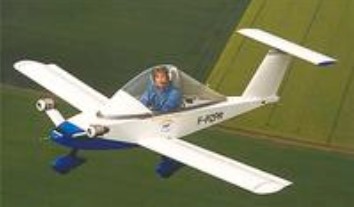
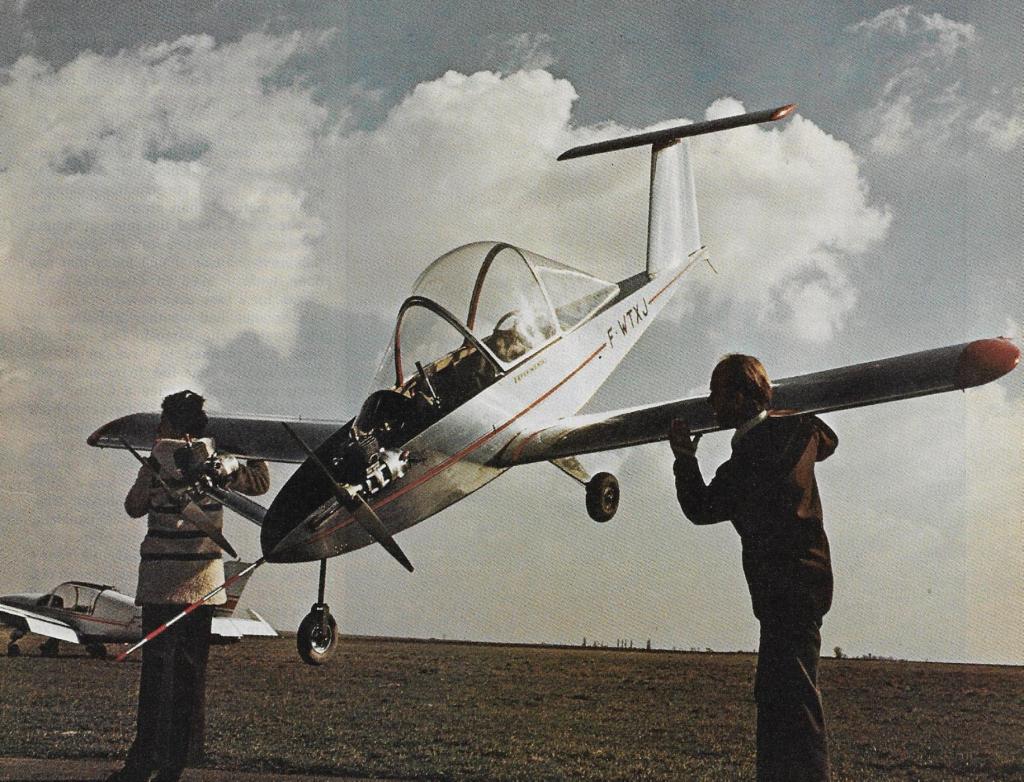
It was in 1971, when aircraft designer Michel Colomban started work on this small aircraft Cri Cri with two engines. His target was to build small, economic plane with two engines, which would be able to flying also some aerobatic maneuvers. Colomban originally planned the Cri-Cri in wood and fabric.
A spar was made with a thin plywood web, but with alloy caps glued on. The bonding was so effective, and the alloy so quick and easy to use, Colomban decided to go toward metal construction, using a lighter material than aluminium for the non-stressed parts of the inner structure. In time he settled on Klegecell, a polyvinyl-chloride (PVC) foam.
The wooden wing was planned to have an NACA 23012 section, but the foam/metal wing used a Colomban-modified Wortman 19% thick design. This changed to 21.7% later. The par is AU 4 G-1 alloy with an I-beam section. The ribs, 32 per panel in the prototype, were sawed out of a stack of Klegecell sheets.
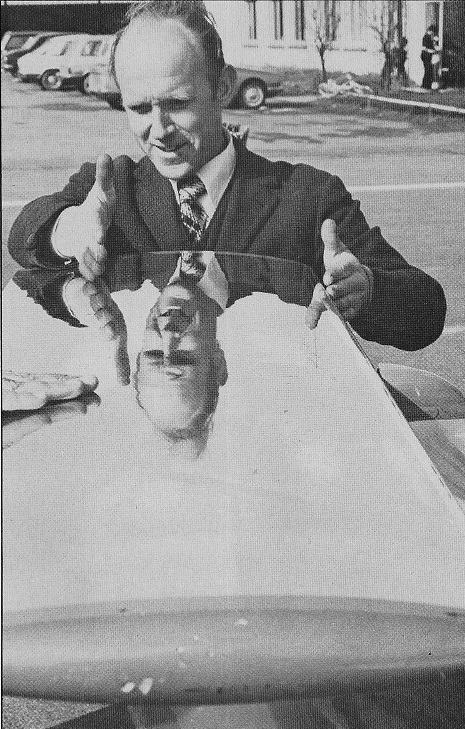
Michel Colomban with wing panel
Price of this plane shouldn’t exceed 1000 USD, including two engines – these prices are from 1970. Construction took around 1500 working hours for the Cri-Cri plane, which name is after nickname of Michel’s daughter, prepared for it’s first flight. The prototype was first flown in 1973, with two 9 hp engines.
The Cri-Cri features brakes, flaps, full harness, nosewheel steering and inflight adjustable rudder pedals. The prototype had ground adjustable variable pitch 68cm / 26.75in in diameter.
Cricket is fully aerobatic (at 170 kg) and was built in France under the approval of the French EAA, the Fleseau du Sport de LAir (RSA).
CriCri is the world’s smallest twin-engine airplane at 16 feet and 160 pounds. Powered with two 12-hp Swedish snowmobile Valmet engines, the tiny twin was first shown at the 1981 Oshkosh Fly-In.
MC15
With trhe help of a Canadian businessman, worldwide marketing was established. Development of a kit to accompany the plans soon followed. The kit product diverged from the original design in a few critical areas, notably, the flaperon torque tube. The new company elected to replace the aluminium tube with a steel one of smaller diameter. The steel tube had some torsional flexibility that harmonised with the flaps themselves and a few crashes resulted from severe flutter problems. Unaccustomed to huge damages sought in the US lawsuits ($10,000,000) Colomban, whose relationship with the Canadian company had cooled considerably, pulled the airplane from all markets in the Western hemisphere. The company was forbidden to sell kits for the Cri-Cri and spare parts suddenly disappeared.
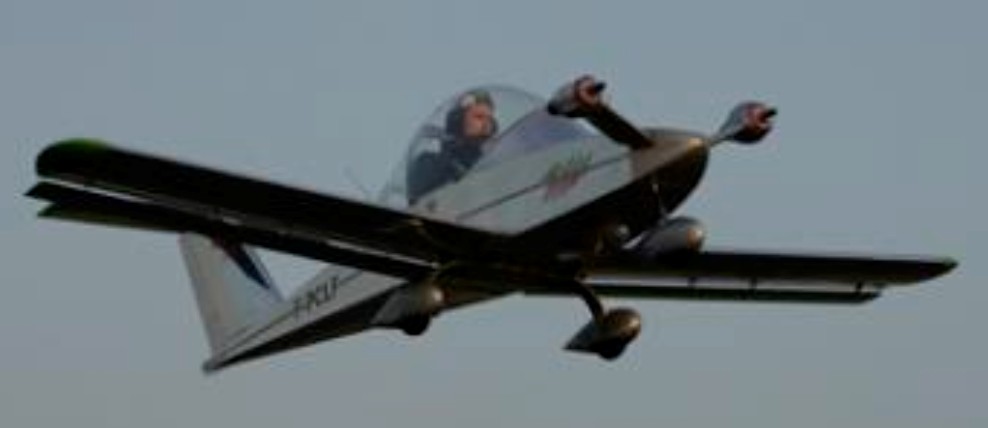
After those Yves Duval and Nicolas Charmont, a third Cricri jet was flying in France. Dominique Bonnaire made him his first flight in this configuration on May 5, 2011. The engine selected was 2 Jetcat P200SX giving a thrust of about 45 kg.
Dominique Bonnaire was the builder and owner of this Cricri, flying since 1996.
Bonnaire Cricri jet
MC-10 Cri-Cri Stall: 39 kt / 45 mph / 72 kmh Cruise: 108 kt / 124 mph / 200 kmh VNE: 159 kt / 183 mph / 295 kmh Empty Weight: 80 kg / 176 lbs MTOW Weight: 170 kg / 375 lbs Climb Ratio: 600 ft/min / 3 m/s Take-off distance (50ft obstacle): 330 ft / 101 m Landing distance (50ft obstacle): 495 ft / 151 m
MC-15 Engine: 2 x JPX 212, 15 hp Wing span: 4.9 m Wing area: 3.1 sq.m MAUW: 170 kg Empty weight: 80 kg Fuel capacity: 23 lt Max speed: 220 kph Cruise speed: 190 kph Minimum speed: 72 kph Climb rate: 6.5 m/s Seats: 1 Fuel consumption: 8.6 lt/hr Plan price (1998): 2650 F
Bonnaire Cricri jet Engines: 2 Jetcat P200SX, 45 kg thrust Wingspan: 4.90 m Length: 3.90 m Height: 1.22 m Empty weight: 78 kg MAUW: 175 kg Fuel capacity: 24 litres Cruise speed: 240 Km / h Maxi speed: 270 Km / h Maxi load: +6 /-3G