Curtiss Aeroplane Co

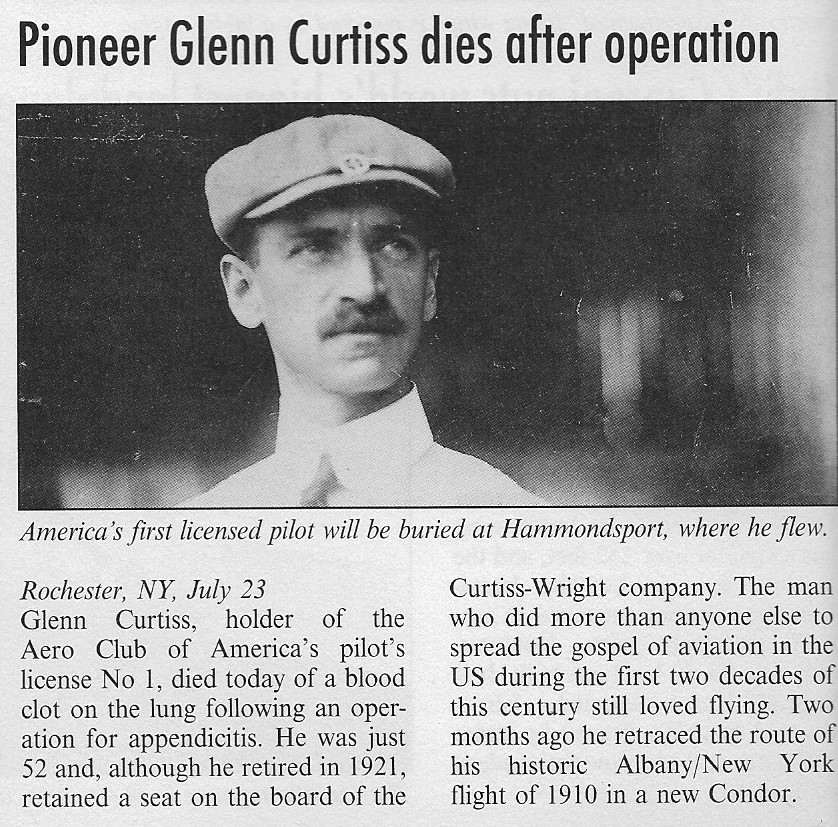
Glenn Curtiss

Curtiss, who was a motorcycle fiend and engine genius, had actually asked the Wright Brothers if they wanted one of his 50 hp engines when he went to discuss some aviation data, but they said no, unaware that Curtiss and the AEA would soon be a major competitor.

Curtiss Aeroplane Co Article

As a member of Alexander Graham Bell’s Aerial Experiment Association (AEA), Glenn Curtiss built the engines for the Red Wing and the White Wing early in 1908, piloted his first plane, and built and flew the June Bug that June.

The AEA disbanded in 1909, and Curtiss formed the Herring-Curtiss Company on 20 March 1909 with Augustus Herring. Its first customer was the Aeronautic Society of New York. Curtiss delivered his first plane to them, the Curtiss No. 1, built to their specifications, on May 29, 1909.

When the Herring partnership split up, Curtiss founded the Curtiss Exhibition Company, the Curtiss Aeroplane Company in December 1911 in Hammondsport, New York, and the Curtiss Motor Company.

As business expanded, the Hammondsport factory became unable to fill all the orders. Curtiss extended its operation to Buffalo, where it rented the site of the company that had supplied Curtiss with his first bicycle engine years before. Curtiss also opened a new plant in Toronto. The quarters in Buffalo quickly became inadequate, and a new 120,000-square-foot (1,115-square-meter) building was constructed that became the company headquarters. Soon after, a new plant that sprawled over 72 more acres was added.

1909-early 1911 – While A, B, and C models are known (or thought) to have existed during this historically important period for Curtiss, where they were applied is not. Numerical assignments, as well, were guesses—Model 2 has appeared for both Rheims Racer and Charles Willard’s Banshee Express but not verified (Willard unjustifiably claimed authorship of that design). By 1910, Model D had been established, in some references tied to Curtiss-Herring, which was actually built after the partners’ dissolution. But there were at least 9 aircraft known to have been produced in this period, the “official” Model D, in one of its many forms, formally appeared in the first company catalog on mid-1911 along with its companion Model E. Production of concurrent Curtiss-Aero Society Model Ds unknown but the design quickly evolved into the Curtiss D (Standard). A Herring-Curtiss, for which plans were published for home-builders of the time, differed from Curtiss D with its ailerons on the front wing struts instead of the rear wing struts. Herring’s contribution, besides that as a temporary partner, was his alleged invention of a gyroscopic stabilization device (claimed, but unsubstantiated, 1909 US patent #12,256), which would circumvent the Wright’s aileron patents, but which was never used on any Curtiss machine.

Curtiss designed and built the following planes
during 1908 – 4,
1909 – 2,
1910 – 4,
1911 – 5,
1912 – 3,
1913 – 3,
total – 21.

In 1916, the Curtiss Aeroplane & Motor Company, Ltd. went public with Curtiss as president. By that time Curtiss had become the world’s largest aviation company, employing as many as 18,000 at Buffalo and 3,000 at Hammondsport.

The Curtiss Aeroplane and Motor Company was created 13 January 1916 from the Curtiss Aeroplane Company of Hammondsport, New York and Curtiss Motor Company of Bath, New York. Burgess Company of Marblehead, Massachusetts, became a subsidiary in February 1916.
In 1916 the company moved its headquarters and most manufacturing activities to Buffalo, New York, where there was far greater access to transportation, manpower, manufacturing, and much needed capital. It became the largest aircraft manufacturer in the world during World War I, employing 18,000 in Buffalo and 3,000 in Hammondsport, New York. Curtiss produced 10,000 aircraft during that war, and more than 100 in a single week.
A third factory (Garden City, Long Island, NY) became boat hull department for flying-boat production. Burgess Company of Marblehead, Massachusetts, became a subsidiary in February 1916. Aircraft built during First World War included A and AH biplanes for USN, Models D and E for U.S. Army, Model F flying-boats for USN, H-4 Small Americas, H-12 Large Americas and H-16 Large Americas (plus 150 by Naval Aircraft Factory).
Best-known were JN-4/JN-6 “Jenny” trainers (5,000 built, plus 1,200 by Canadian Curtiss), HS flying-boats, MF flying-boats, N-9 floatplanes, British S.E.5a fighters, Orenco D fighters, and 5L flying-boats. Total wartime was 4,014 aircraft and 750 aero engines.

After the war, Curtiss, fell on hard times. In August 1920, the company was forced into receivership. Clement Keys, a Canadian financier, obtained funds to manage the company’s debt and led it again to sound financial status. The Buffalo facility became the major facility, and the company remained the largest U.S. aircraft company through the 1920s.

Postwar production, mostly in 1920s, included NC- 1/2/3/4 transatlantic flying-boats (four only); Oriole, Eagle, and Seagull civil types (little success achieved with the few built). Followed by a series of Army (R-6/R-8 etc.) and Navy (CR/R2C/R3C etc.) racers. Twelve B-2 Condor biplane bombers were followed by PW-8 biplane fighters, P-1/P- 6 U.S. Army Hawks, F6C U.S. Navy Hawks, and O-1/11/39 and A-3 Falcons for U.S. Army. The few Carrier Pigeons and Larks were followed by one Tanager biplane, which won 1929 Guggenheim Safe Airplane Competition. Subsequently produced N2C Fledgling, F8C/OC Falcon, and F8C/02C Helldivers for USN.

Foundation of Curtiss-Robertson division in 1928 was followed by, on July 5, 1929, Curtiss Aeroplane and Motor Company became part of Curtiss-Wright Corporation, together with 11 other Wright and Curtiss affiliated companies.
In 1929, shortly before Curtiss died, the Curtiss Aeroplane & Motor Company, Ltd., merged with the Wright Aeronautical Corporation to form the Curtiss-Wright Corporation.
1930

Neither Curtiss or Wright successfully made the transition to the jet age and substantially all aircraft assets were sold to McDonnell and North American by 1950.
Cunliffe-Owen Aircraft Ltd

UK
Cunliffe-Owen Aircraft Ltd was founded 1938 at Southampton Municipal Airport, Eastleigh, Hampshire, to build “flying wing” (lifting fuselage) aircraft based on Burnelli concept. First product was improved version of Burnelli UB-14 known as O.A.1 (two crew, 15 passengers). Second version (three crew, 20 passengers) designed as O.A.2, but not produced owing to outbreak of war. France acquired O.A.1 and used it in Africa during the war. Extensive subcontract work for Air Ministry undertaken, mostly “anglicizing” U.S. Consolidated Vultee, Lockheed, and Martin Lend-Lease aircraft for RAF. Late 1945 converted a number of Lancaster B.lll bombers for air/sea rescue. In 1946 began design of airliner, the Concordia 10-seat passenger transport, first flown May 1947. Prototype and one other built, but work suspended November 1947 owing to insufficient orders. Also built that year the prototype W.10 helicopter for Cierva; this project shelved too, and shortly afterwards company abandoned its aviation interests.

CSS CSS-12

Designed by Dr. Eng. Leszek Dulęba, the CSS-12 airliner was the first all-metal aircraft built in Poland after World War II.

Construction: metal, the cabin accommodated 2 crew and 10 passengers. Landing gear retractable in flight. The drive consisted of two in-line 12-cylinder Argus As411 A1 engines, with a power of 427 kW (580 hp) each.

The prototype flew on November 22, 1950. by L. Lech. After a year, the trials were discontinued, as the priority was given to the serial production of military aircraft. Work was resumed in 1955, as a result of which a second horizontal stabilizer was added. The prototype showed good flight characteristics and performance (Eng. A. Abłamowicz set an international altitude record on it), but the lack of interest in the aircraft on the part of LOT Polish Airlines and the lack of appropriate engines meant that the CSS-12 did not go into mass production. After the aircraft was written down in 1960, the front part of the fuselage was transferred to the NOT Museum of Technology in Warsaw, and the remaining part of the fuselage with wings was placed in the Jordan garden of WSM Sady Żoliborskie in Warsaw. In February 1967, the front part of the fuselage was transferred to the Museum of Aviation and Aeronautics in Krakow.

CSS CSS.11        

The CSS-11 is an aircraft very similar to the CSS-10 aircraft. Work on both structures was carried out in parallel. The CSS-11 aircraft was built under the direction of engineer Leszek Dulęba. In April 1947, Leszek Dulęba was appointed as the Airframe Team Manager. Two prototypes of the CSS-11 aircraft were built in the CSS workshops.

The CSS-11 aircraft is a two-seater low-wing monoplane of mixed construction. The fuselage is made of steel tube, the wings are of wooden structure.

Simple wings with a wooden structure. NACA 23012 profile. They had one spar, covered with plywood from the front. The back part of the wing is covered with fabric. Slotted ailerons, differentially deflected, with a wooden frame, covered with fabric. The wing has no flaps.

Open cabins, second cabin located above. Truss hull, welded from steel pipes. The hull in the cabins is covered with duralumin sheet, in the rear part with fabric on profiled slats.

Trapezoidal tail with rounded ends. Double-girder fins, nose caisson covered with plywood, the rest with canvas. Rudders with a wooden frame, covered with canvas.

Fixed landing gear with tail wheel.

Walter “Minor 6-III” in-line engine with a take-off power of 125 hp (92 kW). The engine is carbureted. Two-bladed wooden propeller.

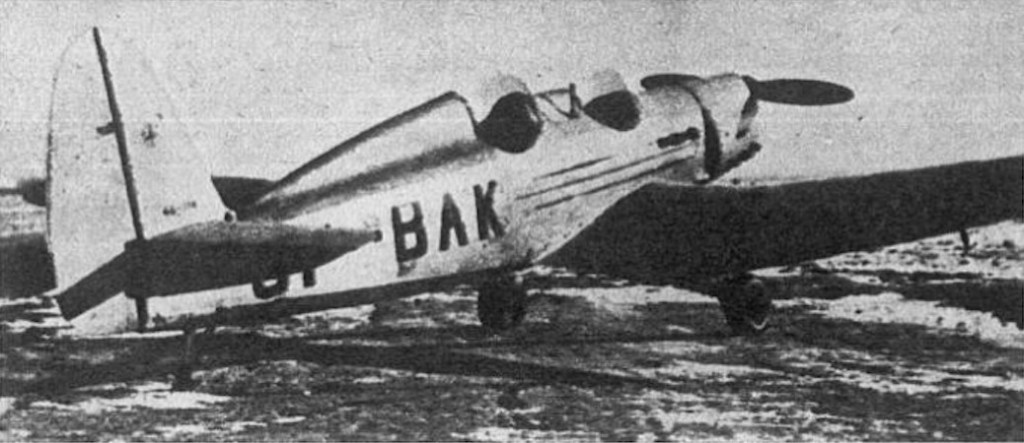
CSS-11 SP-BAH

On 18 October 1948, the first prototype made its first flight. The pilot was J. Szymankiewicz. Both aircraft were handed over to GIL for tests.

The CSS-11 aircraft proved successful. It had good flight characteristics. The results were better than expected. The plane performed aerobatic manoeuvres correctly and easily exited the spin. The assessment of the aircraft said that the CSS-11 aircraft is suitable for training and aerobatics.

Just like CSS-10, it was planned to launch serial production of CSS-11 aircraft. Production was to be 30 machines. The lack of engines stood in the way. License production of Walter engines in Poland has not been started. In the period 1952-1953, for political reasons, both prototypes were cancelled.

Engine: Walter Minor 6-III, 125 hp (92 kW)
Span: 10.60 m / 34 ft 8 in
Wing area: 16.50 sq/m / 168 sq.ft
Length: 7.50 m / 24 ft 8 in
Height: 1.83m / 7 ft
Empty weight: 575 kg
Take-off weight: 850 kg / 2070 lb
Payload: 200 kg
Fuel capacity: 90 lt
Top speed: 208 km/h / 140 mph
Cruising speed: 175 km/h / 105 mph
Landing speed: 75 km/h
ROC: 4.2 m/s
Ceiling: 5,950 m
Range: 660 km / 680 mi
Landing run: 160m
TO run: 120 m

CSS CSS.10

In 1946, the CSS office received an order from the Ministry of Communications to develop thrree aircraft: school, training and aerobatic and passenger. In 1947, the first training aircraft project was developed, which was the CSS-10. The constructors of the aircraft were Franciszek Misztal and Stanisław Lasota.

The CSS-10 aircraft is a two-seat low-wing monoplane of mixed construction. The fuselage is made of steel pipes, the wings are of wooden structure.

Simple wings with a wooden structure. The wing has one spar, covered with plywood from the front. The back part of the wing is covered with fabric. Slotted ailerons, differentially deflected, with a wooden frame, covered with fabric. The wing has no flaps.

Open cabins, second cabin located above. Truss hull, welded from steel tube. The hull in the cabins is covered with duralumin sheet, in the rear part with fabric on profiled slats.

Trapezoidal tail with rounded ends. Double-girder fins, nose caisson covered with plywood, the rest with canvas. Rudders with a wooden frame, covered with canvas.

Fixed landing gear with tail wheel.

Since the construction of the CSS-10 aircraft in the workshops in Okęcie was impossible, the construction of prototypes began at WSK PZL Mielec. Corrections have been made to the design. The Walter Mikron II engine was used, with a power of 65 hp (48 kW). Therefore, the designation of the aircraft was changed to CSS-10 A. The CSS-10 A prototype, made its first flight on 3 September 1948 piloted by Ludwik Lech.

The CSS-10 aircraft was transported to Warsaw to the Central Aviation Institute. At GIL, the aircraft was tested. The aircraft did not perform well because the engine was underpowered. Due to the low engine power relative to the gross weight, the aircraft had a long take-off, low climb and unsatisfactory stall and spin characteristics and was deemed unsuitable for pilot training.

Another prototype, designated CSS-10 C, was equipped with a 105 hp (77 kW) Walter Minor 4-III engine. In addition, the wing received a slight slant. The first flight was made on 24 April 1949. This aircraft was also transported to GIL. The tests of the aircraft went well and the aircraft was cleared for aerobatics. In 1952, the aircraft was subjected to state tests, as a result of which the aircraft was approved for flights as a training and training aircraft. It was planned to build 40 aircraft of this type, but due to the lack of engines, the project was not implemented.

At that time, it was planned to start production of Walter engines under license in Poland. Production of the engines was not undertaken.

It was planned to produce 40 aircraft of this type, but due to the lack of Walter Minor 4-III engines, the project was finally abandoned.

In 1952, the planes were parked behind the hangar. The CSS-10A aircraft was destroyed (1955). In 1955, the CSS-10 C aircraft was renovated by members of the Warsaw Aero Club at Okęcie. The aircraft was shown at the Aviation Exhibition at Okęcie (1956). In order for the aircraft to fly, it was necessary to repair the landing gear, which was not carried out. In 1960 the plane was written off.

There was also an aircraft design, which was marked CSS-10 B. It differed from the CSS-10 C aircraft with a covered cabin. This prototype was not built.

CSS-10 A
Engine: Walter Mikron III, 48 kW (65 hp) take-off power / continuous 35 kW (48 hp).
Span: 10.70 m
Wing area: 15.73 sq.m
Length: 7.36 m
Height: 1.96m
Empty weight: 462 kg
Take-off weight: 691 kg
Payload: 149 kg
Fuel capacity: 82 lt
Top speed: 149 km/h
Cruising speed: 112 km/h
Landing speed: 75 km/h
ROC: 1.5 m/s
Ceiling: 2,250 m
Range: 310 km
TO run: 130 m
Landing run: 150 m

CSS-10 C
Engine: Walter Mikron 4-III, 77 kW (105 hp) take-off power / continuous 59 kW (80 hp)
Span: 10.58 m
Wing area: 15.73 sq.m
Length: 7.55 m
Height: 1.91m
Empty weight: 505 kg
Take-off weight: 756 kg
Payload: 251 kg
Fuel capacity: 82 lt
Top speed: 185 km/h
Cruising speed: 152 km/h
Landing speed: 72 km/h
ROC: 3.5 m/s
Ceiling: 4,900 m
Range: 440 km
Landing run: 130 m
TO run: 150 m

CSS / Centralne Studium Samolotow

Immediately after the Second World War in Poland there was no favorable atmosphere for opening the aviation industry. Nevertheless, in 1946, on the initiative of Professor Franciszek Misztal from the Warsaw University of Technology, the Central Aircraft Study (CSS) was established in Warsaw at Okęcie. The CSS were a kind of design bureau that had its own workshop for building prototype aircraft. CSS, as part of the Aviation Industry Association, were not a factory.

At CSS engineer Franciszek Misztal gathered pre-war aviation engineers and young students.

In 1946, the CSS office received an order from the Ministry of Communications to develop 3 aircraft: school, training and aerobatic and passenger. In 1947, the first training aircraft project was developed, which was named CSS-10. The constructors of the aircraft were Franciszek Misztal and Stanisław Lasota.

Since the construction of the CSS-10 aircraft in the workshops in Okęcie was impossible, the construction of prototypes began at WSK PZL Mielec.

In 1950 transformed into the Communication Equipment Factory. No. 4 Warsaw-Okecie.
Central Aircraft Study (CSS),