It is believed that Phil Fouracre, a well known West Country pilot was the owner of a 1978 Super Eagle. He lost faith in the machine after spinning it whilst flying over the Quantocks.
Eclipse were offering the Super Eagle 79 at the price of £433.00.
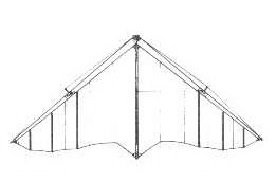
The 1977 Eagle 210 was developed from the SK90 series. The machine was recommended as an ideal trainer, but is also a good performer for experienced pilots.
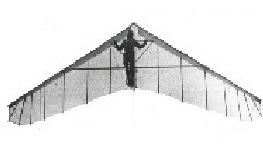
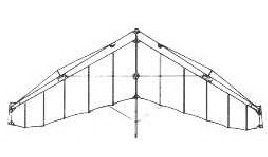
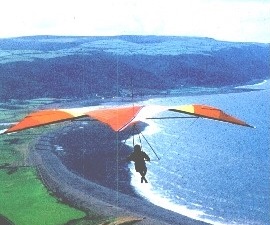
Also made in 1977, the Eagle 2 glider was intended for the more experienced pilot, but was still very easy to fly and has no nasty characteristics. The unusual cambered keel pocket gives the sail a graduated dihedral effect across its chord, which helped to give good stability and light positive control. The glider has three deflexers, folding A frame, reversible rigging for seated or prone flight. Quite a few of this model were sold in small and medium sizes.
Eagle 2
Eagle 210 Leading edge: 19 ft 8 in Keel: 15 ft 6 in Sail area: 221.5 sq ft Nose angle: 99 deg Billow: 1.75 deg Aspect ratio: 4.395 Span: 31.2 ft
Eagle 2 (medium) Leading edge: 20 ft 6 in Keel 10 ft 0 in Sail area: 199.3 sq ft Nose angle: 109.2 deg Billow: 0.4 deg Aspect ratio 5.664 Span: 33.6 ft
Made in 1976, the SK90 was the first glider designed and manufactured by Eclipse Gliders. A number of ’90s’ were built and mostly sold locally. The company policy was to continuously build improvements into its products thus giving rise to numerous designations.
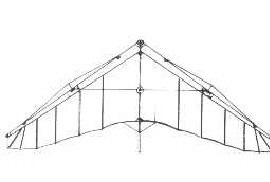
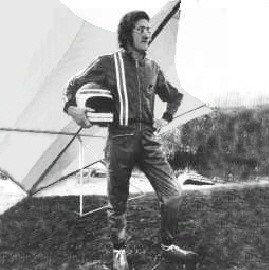
Also made in 1976, it is believed that only one SK96 was constructed. The design incorporates a wider nose angle than usual, reduced billow and radial tip battens. Its owners were Simon Murphy (photo), Graham Rock, Andy White and Peter Kerr. The machine was later fitted with a cambered keel which reportedly improved the handling. The last owner landed the glider in the sea – end of SK96.
The Technological Research Institute constituted the technical base on which Companhia Aeronáutica Paulista emerged. The Institute designed two aircraft that came to be manufactured in series by this company, in addition to designing the Paulistinha aircraft, it was the Paulistinha project, passed on to Companhia Aeronáutica Paulista (CPA) together with the Planalto plane that generated the first royalties paid to the IPT.
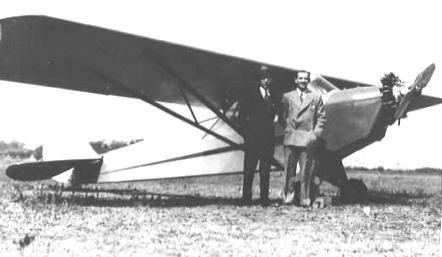
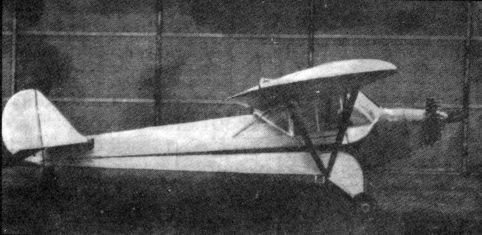
Originally developed by Empresa Aeronáutica Ypiranga (EAY) as an unlicensed copy of the Taylor Cub powered by a Salmson 9Ad radial engine, the EAY-201 featured a high strut-braced wing, two enclosed tandem seats, and a steel-tube fuselage with fabric covering. Its tailwheel undercarriage was not retractable.
Empresa Aeronáutica Ypiranga EAY-201
First flown in 1935, EAY had built five examples by the time that the firm was purchased by Companhia Aeronáutica Paulista (CAP) in 1942. CAP continued manufacturing the type under the designation CAP-4 with a 65 hp Franklin engine.
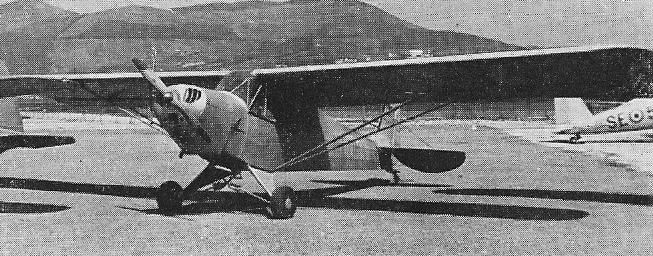
The Paulistinha was produced in three versions. The CAP 4 Tourer, the CAP 4B ambulance aircraft, and the CAP 4C military observation monoplane. The CAP 4C had a cut-down rear fuselage with the side windows extended aft.
Production of the Paulistinha was stopped in 1948, when the Paulistta company experienced financial difficulties, and resumed in 1956 by the Sociedade Construtora Aeronautica Neiva as the Pulistinha 56 (90 hp Continental C90-8F) and 56-B (100 hp Lycoming). The Paulistinha 56-C appeared in 1958, and 210 had been delivered by mid-1963. The Paulistinaha L-6 (100 hp Lycoming) was a liason version for the Brazilian Air Force, 19 being delivered in 1959.
CAP 4
The type was widely successful, with nearly 800 units being produced for Brazil’s flying clubs and armed forces, as well as for export to Argentina, Paraguay, Chile, Uruguay and Portugal. At the time of peak production in 1943, a new CAP-4 left the factory every day, and production continued until 1948 when the company enter financial difficulties.
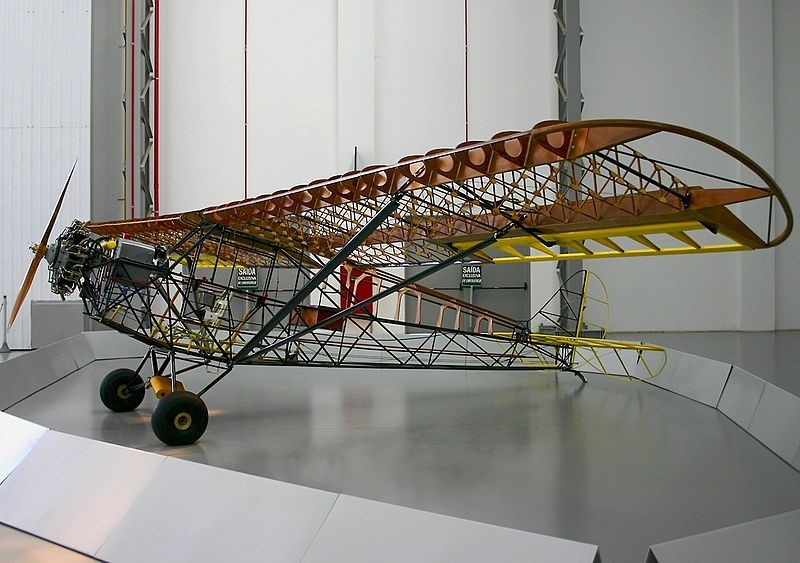
Brazilian Navy CAP-4 preserved at the Museu Asas de um Sonho
In 1956, Sociedade Aeronáutica Neiva (Neiva) acquired the rights renaming it to P-56 Paulistinha, the design was used as the basis for an agricultural aircraft, the P-56 Agricola, adding a fibreglass chemical hopper and spraybars, but this was unable to compete with imported, purpose-built agricultural aircraft.
In dimensions and characteristics, it is similar to the last series of the Paulistinha CAP-4 produced by Companhia Aeronáutica Paulista , from which Neiva acquired the rights, launching a new version, named Paulistinha 56 or Neiva 56.
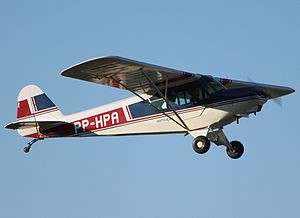
First flying in 1955, the Neiva P-56 Paulistinha could be equipped with a Continental C-90-8F or C90-12F engine, which could develop up to 115hp at 2625 RPM. A total of 256 were built
Its fuel system consists of two gas tanks, one at the top of the cabin and the other between the instrument panel and the engine fire wall, before entering the carburetor the gasoline passes through a filter and decanter type “cup” “.
Neiva P-56 Paulistinha
The Brazilian Air Force operated this aircraft between 1959 and 1967, with the military designation L-6 . It was used in bombing connection, observation and calibration missions. Paraguayan Military Aviation bought four aircraft in the early 1960s. The Paraguayan Aeroclub bought four aircraft in the 1950s
In total about 840 were built.
Variants:
EAY-201 original version Engine: Salmson 9Ad Seats: 2
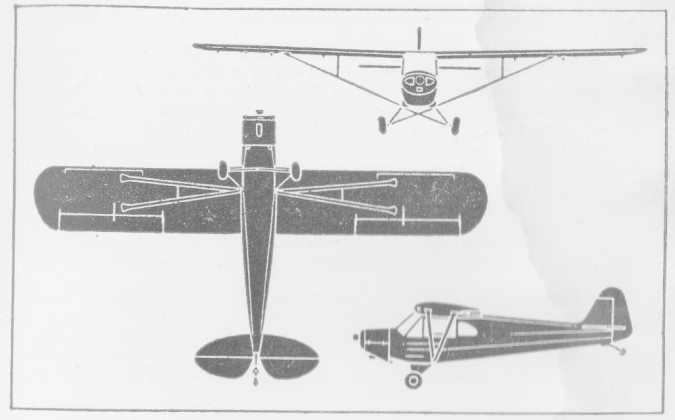
CAP-4 Paulistinha main production version Engine: 1 × Franklin 4AC, 48 kW (65 hp) Wingspan: 10.10 m (33 ft 2 in) Wing area: 17.0 m2 (183 sq ft) Length: 6.65 m (21 ft 10 in) Height: 1.95 m (6 ft 5 in) Empty weight: 320 kg (705 lb) Gross weight: 540 kg (1,190 lb) Fuel capacity: 58 L (15 US gal; 13 imp gal) Maximum speed: 155 km/h (96 mph, 84 kn) Cruise speed: 140 km/h (87 mph, 76 kn) Range: 500 km (310 mi, 270 nmi) Service ceiling: 4,000 m (13,000 ft) Rate of climb: 3.1 m/s (610 ft/min) Crew: Two, pilot and instructor
CAP-4B air ambulance version (2 prototypes built) Engine: 1 × Franklin 4AC, 48 kW (65 hp) Wingspan: 33 ft 2 in Length: 21 ft 10 in Height: 6 ft 4.75 in Empty weight: 706 lb Loaded weight: 1190 lb Max speed: 96.5 mph Cruise: 87 mph ROC: 610 fpm Range: 311 mi
CAP-4C artillery-spotting version, (Paulistinha Rádio or Paulistinha Observação) Engine: 1 × Franklin 4AC, 48 kW (65 hp) Wingspan: 33 ft 2 in Length: 21 ft 10 in Height: 6 ft 4.75 in Empty weight: 706 lb Loaded weight: 1190 lb Max speed: 96.5 mph Cruise: 87 mph ROC: 610 fpm Range: 311 mi
P-56 Agricola agricultural version by Neiva 60 built
Neiva P-56 Paulistinhab Engine: Continental C90-8F, 90 hp Wingspan: 10.8 m (35 ft 4 in) Wning area: 183 sq.ft Length: 6.90 m (22 ft 2 in) Height: 1.95 m (6 ft 5 in) Empty weight: 882 lb MTOW: 1455 lb Max speed: 100 mph at SL Cruise: 90 mph ROC: 875 fpm Ceiling: 19,685 ft Range: 560 mi Endurance: 4 hrs
Neiva Paulistinha 56-C Engine: Continental C-90-8F/12F, 90 hp (67 kW) Seats: 2 256 built by between 1958 and 1964.
P56C-1 Paulistinha Rebocador
Paulistinha 56-D Engine: Lycoming O-320-A1A, 150 hp (110 kW) Single prototype built Brazilian Air Force designated L-6A No production.
The Eaves Cougar 1 is an American homebuilt aircraft that was designed by Leonard R. Eaves of Oklahoma City, Oklahoma and made available in form of plans for amateur construction.
The Eaves Cougar 1 was based upon the Nesmith Cougar and features a strut-braced high-wing, a two-seats-in-side-by-side configuration enclosed cockpit, fixed conventional landing gear and a single engine in tractor configuration.
The construction of the prototype was commenced in January 1957 at Eaves’ home in Oklahoma City. The design won third place in the 1963 Experimental Aircraft Association aircraft design competition. It was featured on the cover of Sport Aviation magazine in February 1963.
Eaves was killed in the crash of another homebuilt aircraft design on 3 March 2012 at age 92 and plans for the Cougar seem to be no longer available.
The aircraft is made from welded steel tubing and wood, covered in doped aircraft fabric. Its wing has a 23.25 ft (7.1 m) span and can be folded for storage or ground transportation. Engines used typically range from 85 to 125 hp (63 to 93 kW) but the airframe can accept engines as powerful as the 150 hp (112 kW) Lycoming O-320.
The aircraft has an empty weight of 700 lb (320 kg) and a gross weight of 1,400 lb (640 kg), giving a useful load of 700 lb (320 kg). With full fuel of 35 U.S. gallons (130 L; 29 imp gal) the payload is 490 lb (220 kg).
Cougar 1 Engine: 1 × Continental C85, 85 hp (63 kW) Propellers: 2-bladed McCauley Length: 18 ft 6 in (5.64 m) Wingspan: 23 ft 4 in (7.11 m) Empty weight: 700 lb (318 kg) Gross weight: 1,400 lb (635 kg) Fuel capacity: 35 U.S. gallons (130 L; 29 imp gal) Maximum speed: 155 mph (249 km/h; 135 kn) Cruise speed: 135 mph (117 kn; 217 km/h) Stall speed: 60 mph (52 kn; 97 km/h) Range: 400 mi (348 nmi; 644 km) Rate of climb: 600 ft/min (3.0 m/s) Crew: one Capacity: one passenger
A veteran, Leonard was proud of serving his country during World War II as communications personnel in North Africa. Afterward, Leonard returned to Oklahoma City and continued working at his family’s automobile repair shop. Leonard made his career there for more than 50 years, and that skill and expertise facilitated his hobby of designing, building, and maintaining airplanes.
When Leonard experienced his first flight in a Piper Cub more than six decades ago, he became “sold” on airplanes and flying. He and Rita soon earned their private pilot certificates, and Leonard also acquired his commercial ticket. In January 1957, they began building a Nesmith Cougar 1 experimental airplane. Their workshop was just behind their home.
Leonard, along with Rita, was a long-time EAA volunteer, helping with the fly-in starting during the Rockford days and long after the event moved to Oshkosh. They were awarded the EAA President’s Award for Outstanding Contributions to EAA in 1973 and 1998. Leonard was a lifetime EAA member, a charter member of EAA Chapter 24, held many offices in the chapter, and received that chapter’s Outstanding Member Award twice.
In 1963, Leonard won third place in an EAA design competition for his modified Cougar with its efficient folding-wing design. He, Rita, and Chigger were featured on the cover of EAA Sport Aviation in February 1963. Leonard designed and built Skeeter, a two-place composite airplane, in the early 1960s, and test-hopped Skeeter in September 1966 at Wiley Post Airport. Rita enjoyed flying Skeeter as well. Leonard was well respected as a test pilot for local homebuilders.
Leonard designed and built several more airplanes throughout the years. Leonard R. Eaves, EAA Lifetime 2194, who lost his life in the crash of his Skeeter 1M homebuilt on Saturday, March 3, 2012. He was reportedly en route to a pancake breakfast in Ponca City, Oklahoma, when the crash happened on the Clarence E. Page Airport near Yukon, Oklahoma. Leonard was 92, and is survived by his wife, Rita.
USA Subsidiary of Barium Steel Corporation. In late 1950s made two Lockheed Shooting Stars almost entirely of magnesium. Also built Australian Jindivik pilotless target under license for U.S. armed services.
Single seat single engined biplane with con¬ventional three axis control. Conventional tail. Control inputs through stick for pitch/roll and pedals for yaw. Wings braced by struts. Undercarriage has three wheels in tail drag¬ger formation. Aluminium tube framework, with optional pod. Engine mounted between wings driving tractor prop¬eller. Named Pee Wee after an early lightweight aircraft developed by Joe Kirk, one of EAA’s directors in the ’50s and ’60s, the Pee Wee machine is a tractor biplane powered by a KFM opposed twin engine with electric start. The design allows a pod to be incorporated, so that if the builder wishes he or she can take advantage of the engine heat to warm the feet. The Princeton Sailwing shape is used in the wing construction and, as befits a biplane, a tail dragger undercarriage is fitted.
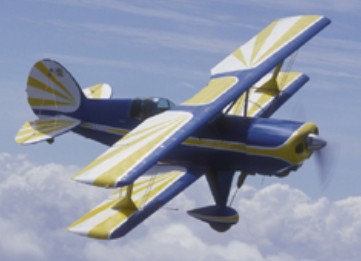
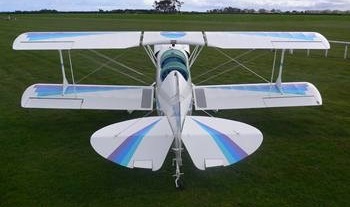
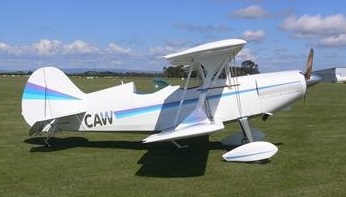
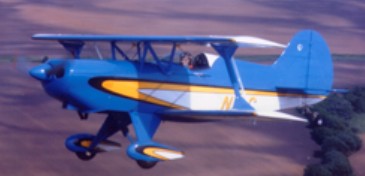
The Acro II, a two-place larger version of the single-place Acro Sport, can be constructed for little more than its single-place brothers. With its larger wheels, wide landing gear and light gross weight, the Acro II is a fun, docile sport airplane designed for engines ranging in power from 115 to 200 hp. When fitted with a 180-hp Lycoming, its empty weight of 875 pounds. First flown on 9 July 1978, like all Acro Sports, its cockpit is designed to be comfortable for pilots up to 6 ft 6 in and 240 pounds. The airframe is larger than the really “midget” biplanes to avoid “touchy” flight characteristics and allow for more baggage. Designed by Paul Poberezny, the Acro II features an M-6 airfoil with a 43-inch chord.
As with all Acro Sport projects, the fuselage is welded steel tube, wings are spruce and Stits Poly-fiber is used for covering. An excellent aerobatic trainer with responsive controls and docile straight and level flight characteristics. Cruise at 123 mph (180 hp), stall at 53 and max out at 152.
I fly N400GB, an Acro II ser# 573. Daniel Reed Aug 2022
This biplane was designed by EAA President Paul Poberezny who wanted to come up with a plane that could be used in high school industrial arts programs and Civil Air Patrol groups as an educational tool. The first flew in January 1972, less than 12 months after the design was started. The Acro-Sport can be fabricated with tools normally found in a high-school shop. It is built with steel tube covered by fabric and 100- to 200-hp engines.



 All Aero