Fleet Aircraft Inc

Reuben H.Fleet launched in 1923 in Buffalo, N.Y. the Consolidated Aircraft Co. Consolidated built flying boats for the U.S. Navy. The creation of the civil Model 14 “Husky”trainer led to the creation of the Fleet Aircraft Division in 1929.

Originally created as a means for Consolidated to enter the civil market, the company abandoned this ambition shortly before the completion of the first prototype. The manufacturing rights were purchased by the designer and Consolidated company president Reuben Fleet to put into production under his new enterprise, Fleet Aircraft. It was an immediate success, and in the first year of production alone, over 300 machines were sold. Consolidated quickly responded by buying Fleet Aircraft and retaining it as a subsidiary while opening a second production line at Fort Erie, Ontario, Canada.

Fleet produced the Fleet Model 2 with Kinner engine, and built a military two-seat primary trainer for the U.S. Army Air Service. Designated PT-6, it was an improved version of the PT series initiated by Consolidated Aircraft Corporation.

Manufacturing rights of the Fleet trainers were sold in 1939 to Brewster Aeronautical Corp.

Fleet Model 80 Canuck two-seat light-plane also built in quantity 1946- 1947, after which aircraft production ceased. In 1952 Fleet acquired type certificate for Super-V twin-engined Beech Bonanza conversion from Bay Aviation Services Co, Oakland, California.

Flaglor Scooter / Ace Aircraft Ace Scooter

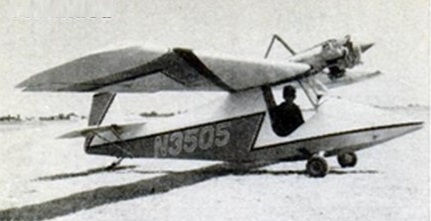
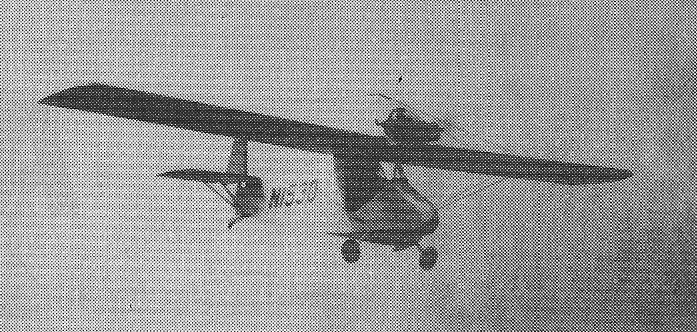
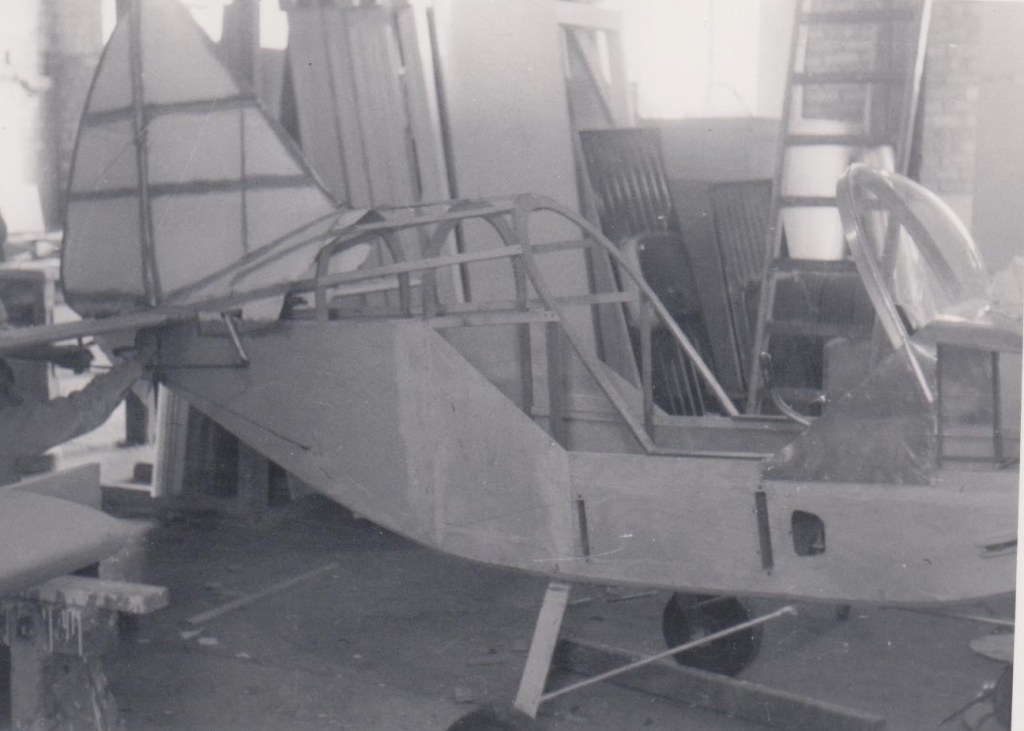
An ultra-light sporting single-seat high-wing monoplane designed by K. Flaglor of Asheville, North Carolina. The Scooter was originally powered by a Cushman golf cart engine, which was ultimately replaced by a 1,500-cc VW engine rated at 40 hp. At the 1967 EAA meet this high-wing, enclosed-cabin taildragger received both the “Outstanding Ultralight” and “Outstanding Volkswagen Powered” awards. Construction is of wood with a plywood covering, except for the aft section of the fuselage which is fabric covered. The VW engine is mounted over the cabin and turns a two-blade propeller.
The Sky Scooter features all wood construction, generous wing area for STOL like performance. Easy to build and maintain.

The Scooter was later marketed by Rotor Wings & Flying Machines.

The plans for the Ace Aircraft Ace Scooter development of the Flaglor Scooter consisted of one sheet 17in x 22in, nine sheets 22in x 34in, and an illustrated construction manual containing 14 photographs used to show key assemblies and construction details. The Airfoil is drawn full size as are most of the fittings.

The Scooter is constructed primarily of marine spruce and plywood. Aircraft quality materials maybe used and are recommended for the spars. All fittings are designed for simple fabrication and are made of 4130 steel as is the motor mount tubing. The metal fairing and wing leading edge can be made of “hardware store variety” aluminium which was the case on the prototype.

The fuselage is composed of spruce longerons with plywood gussets aft and plywood sides in the cockpit area.

Ace Aircraft Ace Scooter

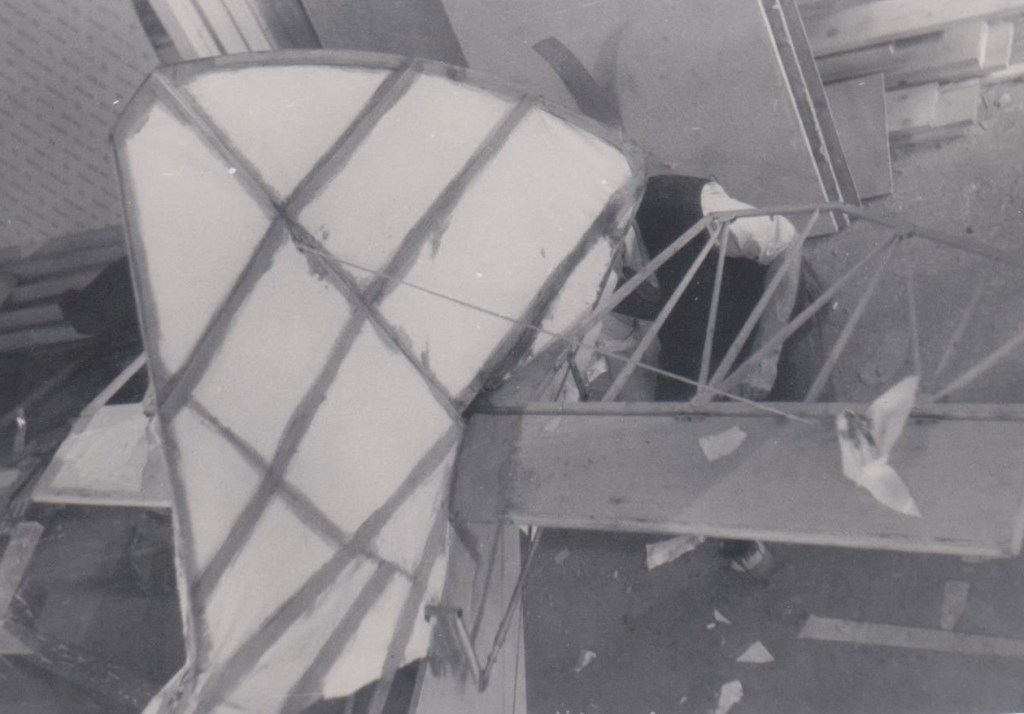
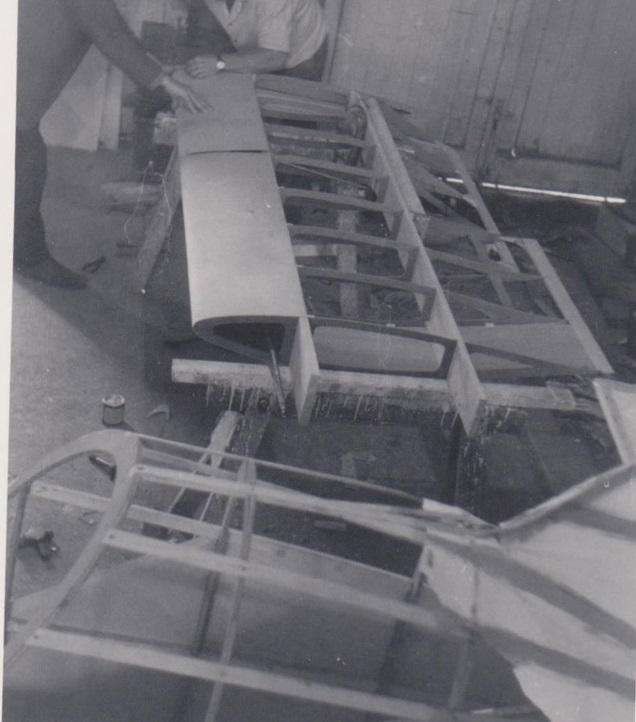
The landing gear is made of steel. All wing ribs are contour sawed 1/4in marine plywood, the main spars spruce as are the false and aileron spars. The wing uses a wood cross hatching in the form of an X between the ribs and spars, resulting in no need for drag or anti-drag wires or fittings.

Plywood wing tips and wood trailing edges complete the structure. Only the wing leading edge is aluminium.

Engine: VW, 25 hp.
HP range: 25-40.
Height: 7 ft.
Length: 15 ft.
Wing span: 28 ft.
Wing area: 115 sq.ft.
Fuel cap: 5 USG.
Weight empty: 390 lbs.
Gross: 625 lbs.
Speed max: 95 mph.
Cruise: 65 mph.
Range: 180 sm.
Stall: 34 mph.
ROC: 325 fpm.
Take-off dist: 250 ft.
Landing dist: 350 ft.
Seats: 1.
Landing gear: tail wheel.

Engine 40-hp 1500cc Volkswagen.
Gross Wt. 650 lb.
Empty Wt. 390 lb.
Fuel capaci¬ty 5 USG.
Wingspan 28 ft
Length 15 ft 8 in
Wing area: 115 sq.ft.
Top speed 90 mph.
Cruise speed 80 mph.
Stall speed 34 mph.
Climb rate 600 fpm.
Takeoff run 250 ft.
Landing roll 250 ft.
Range 175 nm
Seats: 1

Engine: VW 1600 60hp
Span: 27’10”
Length: 15’6″
Wing Area: 115 sq. ft.
Empty Weight: 390 lbs
Useful Load: 235 lbs
Stall: 40 mph
Landing Speed: 60 mph
Cruise: 100 mph
Rate of Climb: 1000 fpm
Take Off Distance: 350 ft
Seats: 1

Ace Aircraft Ace Scooter
Engine: VW 1500
Span: 28 ft 0 in
Wing area: 115 sq.ft
Length: 15 ft 8 in
Height: 7 ft 0 in
MTOW: 625 lb
Empty weight: 390 lb
Fuel: 7 USG
Top speed: 88 mph
Cruise speed: 75 mph
Stall: 34 mph
SL climb: 600 fpm
Ceiling: 12,000 ft
Range: 175 mi
Take-off roll: 250 ft
Landing roll: 350 ft

Fixter Pixie

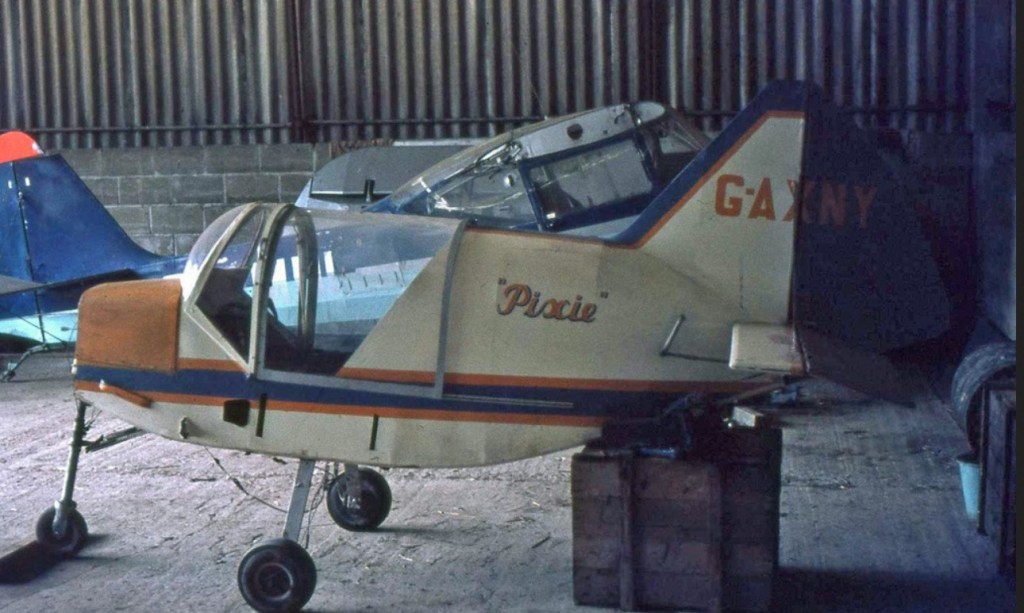
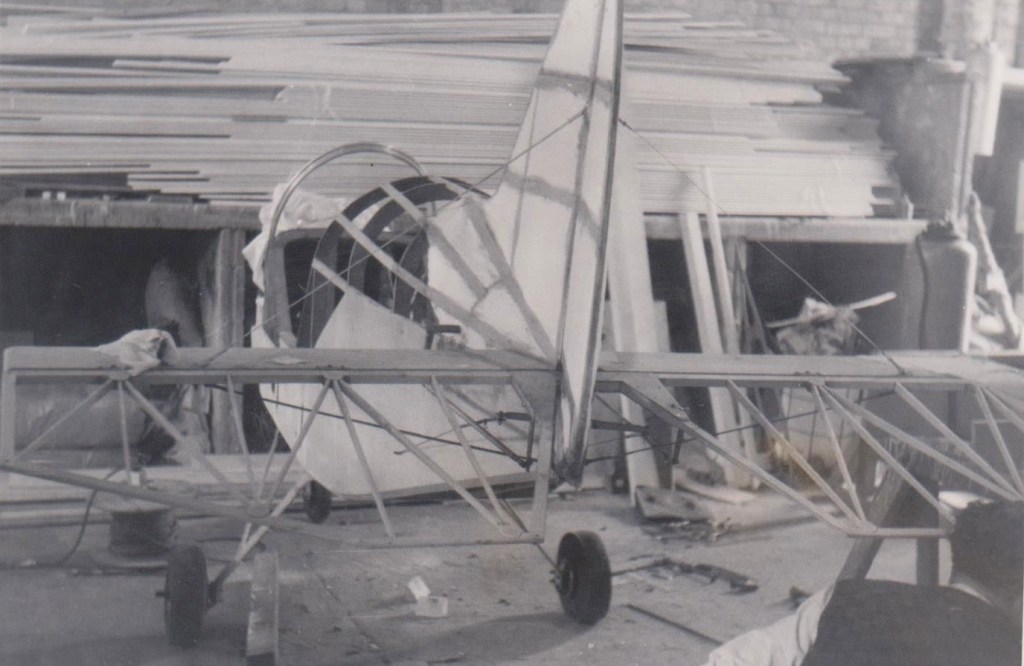
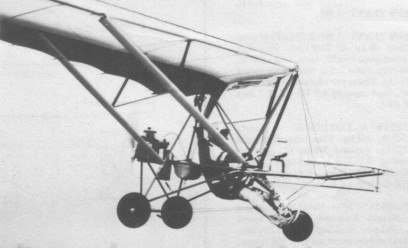
A single-seat low wing monoplane, fitted with tricycle undercarriage and a Volkswagon engine. It was based on the design of Ray Fixter. G-AXNY C/N sbs.1, built by Parkers of Spalding Ltd in 1969.

It undertook taxiing trials at Portland in September of that year, but did not fly.

It was last heard of at Crowland in 1970.

Firestone / Pitcairn Autogiro Co / Pitcairn-Larsen Autogiro Co Inc / Pitcairn-Cierva Autogiro Company (PCA) / AGA Aviation Corp / G&A Aircraft Inc

The youngest son of John Pitcairn, co-founder of Pittsburgh Plate Glass Company, Harold was born in 1897 and took an early interest in aviation. Inspired by the first flight of the Wright brothers in 1903, he began flight training as an air cadet in the last days of WWI, and would eventually earn a pilot’s license signed by Orville Wright.

1924: (Harold F) Pitcairn Air Service
air field, flight school, FBO
Bryn Athyn PA.
USA

Pitcairn was established in the mid-1920s in Philadelphia, Pennsylvania. Pitcairn and Agnew Larsen, who he had met in pilot training, produced the Mailwing airmail series biplanes including PA- 5 Mailwing high-performance single-seat mailplane used on U.S. Air Mail routes.

1925: Pitcairn Air Lines
sold to Eastern Air Transport in 1929 as origin of Eastern Air Lines
1925: Pitcairn Aircraft Inc
Pitcairn Air Field #2
Willow Grove PA.
USA

In 1928 Harold Pitcairn ordered a Cierva C.8W (the W was for the American Wright Whirlwind engine), which arrived at Pitcairn Field, Willow Grove, Philadelphia, PA and on December 18, 1928. It made the first rotary-wing flight in America, piloted by Cierva pilot H. C. A. “Dizzy” Rawson, followed the next day by Pitcairn.

In early 1929, Cierva and Pitcairn negotiators agreed that the Pitcairn-Cierva Autogiro Company (PCA) would be formed in America with the rights to license Cierva’s patents. Pitcairn threw himself into the development and promotion of the Autogiro – and the results of the next 16 months would earn him and his associates the Collier Trophy for the greatest aviation achievement for 1930.

1929: Autogyro operations as Pitcairn-(Juan de la) Cierva Autogiro Co.

c.1930: Autogiro Co of America (aka AGA) as patent licensee (to Buhl, Kellett, Sikorsky, etc).

Pitcairn Aviation Inc turned to autogiro construction with PAA-1 of 1931 and the name changed to Pitcairn Autogiro Company in the early 1930s. They sold a number of PA-18 and -19 autogiros, including a military version of the PA-34 two-seater to the USAAC. Plant and contracts were taken over in 1940 by Pitcairn-Larsen Autogiro Company, in turn succeeded very shortly afterwards by Aga Aviation Corporation.

Feb 1941: Pitcairn-(Agnew E) Larsen Autogiro Co Inc.

Dec 1941: Renamed AGA Aviation Corp (pres: Virgil H Frazier).

In 1943 G and A was acquired by the Firestone Aircraft Company of Akron, Ohio, together with almost 200 patents concerned with rotary-wing aircraft. G and A built gliders and experimental autogiros in the Second World War, and carried out subcontract manufacture.

1946: Acquired by G&A (Gliders & Aircraft) Div, Firestone Rubber Co.

After the company became the G & A Aircraft Division of Firestone, the emergence of Bell and Sikorsky in a depleted post-war market discouraged continuing the helicopter development in the early 1940s.

Firestone was formed in 1946 by name change from G&A Aircraft Inc., a subsidiary of Firestone Tire and Rubber Company.

1947: Firestone Aircraft Co.
Firebird M1

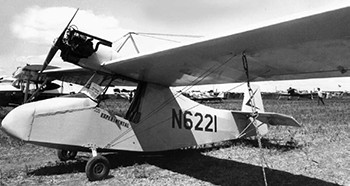
The prototype of the single seater M1 from Firebird made its first flight in 1979 and by 1983 more than 100 examples have been produced. The wing is directly descended from the famous Fledgling designed by Klaus Hill, originally as a hybrid control hang-¬glider. This wing, with its rudders at its wing tips, was powered in 1978 in the USA and the following year in Europe, by Firebird. Just as Pterodactyl does with its Ptraveler and Ascen¬der, Firebird uses it with a variable incidence canard. There is one fundamental difference between Firebird’s approach and that of the Americans, in that the German manufacturer chooses to support the wing with two profiled struts under each half wing, thus dispensing with all the ground and flight rigging wires.
The other principal difference is the power pack, which on the Firebird has to conform with West Germany’s stringent noise regulations. With Konig en¬gine and three bladed propeller, the standard arrangement on the M1, under 60 dB is recorded using the regulation measuring conditions.
Complete with electric start and battery, the M1 cost DM 17,408 in 1983, while options in¬clude an extra fuel tank, an instrument panel, floats and a parachute of 755 sq.ft (70 sq.m) area, which is usable at speeds up to 155 mph (250 kph) and which gives a rate of descent of 1300 ft/min (6.7 m/s) with a 442 lb (200 kg) load. Wing profile; FNI 4 81; double surface. Undercarriage has three wheels in tricycle formation; steel spring suspension on nosewheel and no suspension on main wheels. Push right go left nosewheel steering independent from yaw control. Brake on nosewheel. Aluminium tube/carbon fibre framework, without pod. Engine mounted below wing driving pusher propeller.

Engine: Konig SC430, 24 hp at 4200 rpm.
Propeller diameter 53 inch, 1.34 m (three blade).
Belt reduction, ratio 2.2/1.
Max static thrust 143 lb, 65 kg.
Power per unit area 0.15hp/sq.ft, 1.6 hp/sq.m.
Height overall 9.4 ft, 2.85 m.
Wing span 32.8 ft, 10.00 m.
Chord at root 5.6 ft, 1.70 m.
Chord at tip 4.6ft, 1.40m.
Dihedral 5 degs.
Sweepback 38 degs.
Canard span 6.6ft, 2.00m.
Canard chord 2.1 ft, 0.63 m.
Total wing area 175 sq.ft, 16.3sq.m.
Main wing area 161 sq.ft, 15.0 sq.m.
Canard area 14.0 sq.ft, 1.3 sq.m.
Wing aspect ratio 6.7/1.
Wheel track 6.9 ft, 2. 10 m.
Wheelbase 4.6 ft, 1.40 m.
Nosewheel diameter overall 14 inch, 35 cm.
Main wheels diameter overall 16 inch, 41 cm.
Empty weight 2161b, 98kg.
Max take off weight 420 lb, 190 kg.
Payload 204 lb, 92 kg.
Main fuel capacity 3.4 US gal, 2.8 Imp gal, 13.0 litre
Reserve fuel capacity 2.6 US gal, 2.2 Imp gal, 10.0 litre in.
Max wing loading 2.60 lb/sq.ft, 12.7 kg/sq.m.
Max power loading 17.5 lb/hp, 7.9 kg/hp.
Load factors +4.0, 2.0 design; +6.0, 3.0 ulti¬mate.
Max level speed 50 mph, 80 kph.
Never exceed speed 56 mph, 90kph.
Economic cruising speed 37mph, 60kph.
Stalling speed 24mph, 40kph.
Max climb rate at sea level 400 ft/min, 2.0 m/s.
Min sink rate 350ft/min at 34mph, 1.8m/s at 55 kph.
Best glide ratio with power off 8.5/1 at 37mph, 60kph.
Take off distance 100ft, 30 m.
Landing distance 65 ft, 20 m.
Range at average cruising speed 93 mile, 150 km.

Finsterwalder Bergfex

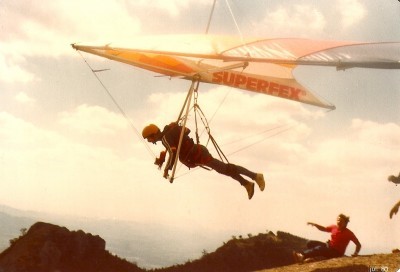
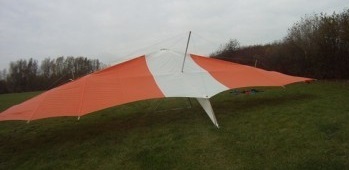
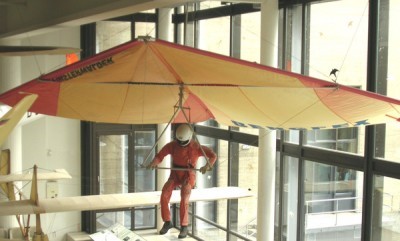
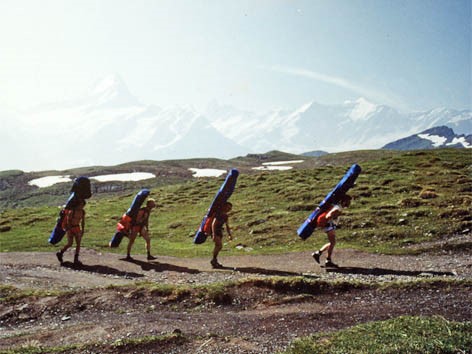
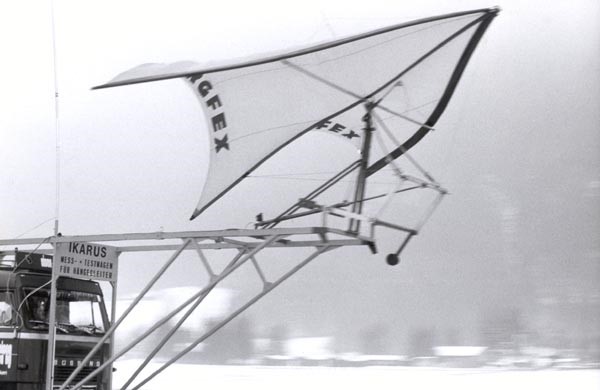
Thomas Finsterwalder develops a glider of his own design. With specially developed high-strength super light-weight and large diameter tubing, the “Bergfex” (mountain freak) weighed a mere 11 kg and could be dismantled in 8 minutes down to a length of 1.80 m without the use of tools, by means of snap fasteners. The sail weighed only 1 kg and was made from spinnacker nylon 32 g/m².

Mountaineering pilots were excited to try them and more than 300 Bergfexes flew accident-free.

The federal aviation authority issued the airworthiness certification.

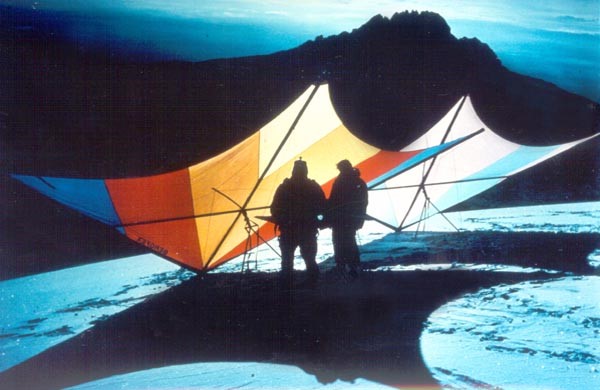
In 1976, Thomas Finsterwalder and two companions climbed to the top of 5895 m high Kilimandscharo. From the summit they flew Bergfex type hang gliders back to the plains below. The flight over a distance of around 25 kilometers took 50 minutes; they had taken three days to make the ascent.

1976: Mt. Kilomanjaro, Tanzania

First appearance in 1976, in 1978 the Superfex came as a successor.

Wingspan: 7.9 m
Span: 19.2 m
Nose angle: 90°
Weight: 11 kg
Maximum glide ratio: ca. 15 at 45 km/h
Maximum sink rate: 2 m/s at 32 km/h