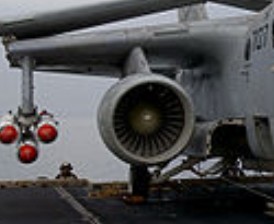
The General Electric TF34 is a military turbofan engine used on the A-10 Thunderbolt II and S-3 Viking. Developed by GE Aircraft Engines during the late 1960s, the original engine comprises a single stage fan, driven by a 4-stage low pressure (LP) turbine, supercharging a 14-stage high pressure (HP) compressor, driven by a 2-stage HP turbine. An annular combustor is featured. The TF34-GE-400A is rated at 9,275 lbf (41.26 KN) static thrust.
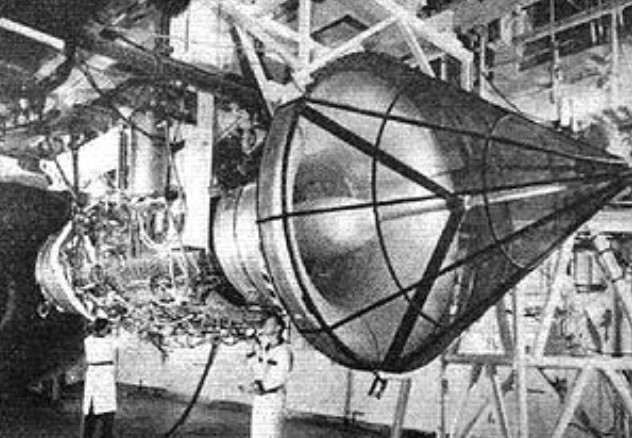
The General Electric J87 (company designation X211) was a nuclear-powered turbojet engine designed to power the proposed WS-125 long-range bomber. The program was started in 1955 in conjunction with Convair for a joint engine/airframe proposal for the WS-125. It was one of two nuclear-powered gas turbine projects undertaken by GE, the other one being the X39 project. The X211 was a relatively large turbojet engine of straight conventional layout, save for the combustion chamber being replaced with a heat exchanger. It featured variable-stator compressors and an afterburner. A single nuclear reactor was intended to supply heat to two X211 engines. In 1956, the USAF decided that the proposed WS-125 bomber was unfeasible as an operational strategic aircraft. In spite of this, the X211 program was continued for another 3 years, albeit with no target application. It was finally terminated in mid-1959, and by 1961, all funding for nuclear propulsion was canceled.
Type: Afterburning turbojet, nuclear powered Length: 41 ft Maximum thrust: 34,600 lb with afterburner
The J85 was originally designed to power a large decoy missile, the McDonnell ADM-20 Quail. The Quail was designed to be released from a B-52 Stratofortress in-flight and fly for long distances in formation with the launch aircraft, multiplying the number of targets facing the SA-2 surface-to-air missile operators on the ground. This mission demanded a small engine that could nevertheless provide enough power to keep up with the jet bomber. Like the similar Armstrong Siddeley Viper being built in England, the engine on a Quail drone had no need to last for extended periods of time, so therefore could be built of low-quality materials.
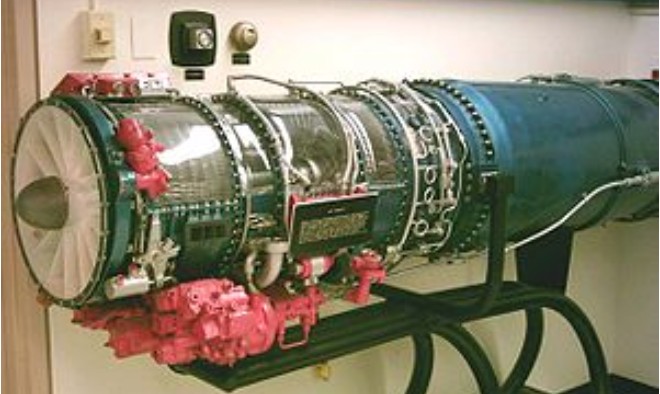
The General Electric J85 is a small single-shaft turbojet engine. Military versions produce up to 2,950 lbf (13.1 kN) of thrust dry, afterburning variants can reach up to 5,000 lbf (22 kN). The engine, depending upon additional equipment and specific model, weighs from 300 to 500 pounds (140 to 230 kg). It is one of GE’s most successful and longest in service military jet engines, the civilian versions having logged over 16.5 million hours of operation. The United States Air Force plans to continue using the J85 in aircraft through 2040. Civilian models, known as the CJ610, are similar but supplied without an afterburner, while the CF700 adds a rear-mounted fan for improved fuel economy.
The fit was a success on the Quail, but again like the Viper it was later built with normal grade materials and subsequently used to power small jet aircraft, including the Northrop T-38 Talon, Northrop F-5, Canadair CT-114 Tutor, and Cessna A-37 Dragonfly light attack aircraft. More recently, J85s have powered the Scaled Composites White Knight aircraft, the carrier for the Scaled Composites SpaceShipOne spacecraft, and the Texas Aircraft Factory Me 262 Project.
The basic engine design is quite small, about 18 inches (46 cm) in diameter, and 45 inches (110 cm) long. It features an eight-stage axial-flow compressor powered by two turbine stages, and is capable of generating up to 2,950 lbf (13.1 kN) of dry thrust, or more with an afterburner. At full throttle at sea level, this engine, without afterburner, consumes approximately 400 US gallons (1,500 L) of fuel per hour. At cruise altitude and power, it consumes approximately 100 US gal (380 L) per hour.
Several variants were produced. The J85-21 variant added a stage ahead of the base 8-stage compressor for a total of 9 stages, improving thrust.
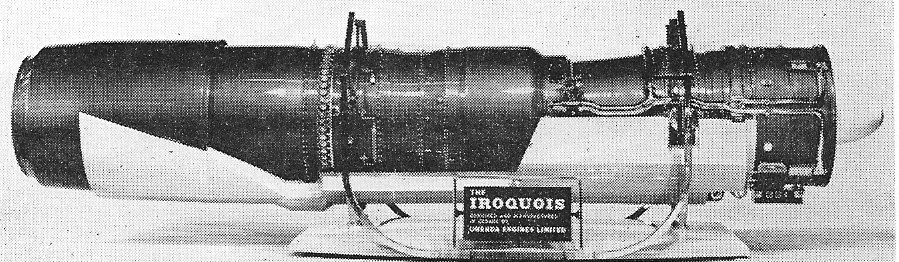
J85-CAN-40 Manufactured by Orenda for the Canadair CT-114 Tutor, 2,650 lbf (11.8 kN) thrust
CJ610 Civilianised J85
CF700 Aft fan variant of the CJ610
Applications: Fairchild C-123 Provider Canadair CL-41 Tutor Canadair CF-5 Cessna A-37 Dragonfly Fiat G.91Y North American T-2 Buckeye Northrop F-5 Northrop T-38 Talon Ryan XV-5 Vertifan Saab 105Ö Scaled Composites White Knight Viperjet MKII American Challenge water speed record jet-powered boat – Two J85-GE-21s Messerschmitt Me-262A-1c and B-1c. The “c” suffix stands for the flyable reproductions equipped with the J85-derived CJ610 engine instead of the original Junkers Jumo 004 jet engine.
Specifications Type: Turbojet engine (with or without afterburner) Length: 45.4–51.1 in (115–130 cm) (depending on accessory equipment installed) Diameter: 17.7 in (45 cm) Dry weight: 396–421 lb (180–191 kg) (depending on accessory equipment installed) Compressor: 8 stages (9 in J85-21) axial Combustors: annular Turbine: 2 stages Fuel type: jet fuel Maximum thrust: 2,850–3,100 lbf (12.7–14 kN) (dry) Overall pressure ratio: 8.3 Turbine inlet temperature: 977C Specific fuel consumption: 0.96 – 0.97 lb/(lbf·h) (27 g/kN·s) Thrust-to-weight ratio: 7.5 (-21), 6.6 (-5), 6.8 (-13), 7 (-15)
An axial-flow turbojet engine, the J79 was developed in the 1950s as an outgrowth of the General Electric J73 engine program, originally called J73-GE-X24A, intended for reliable Mach 2 performance.
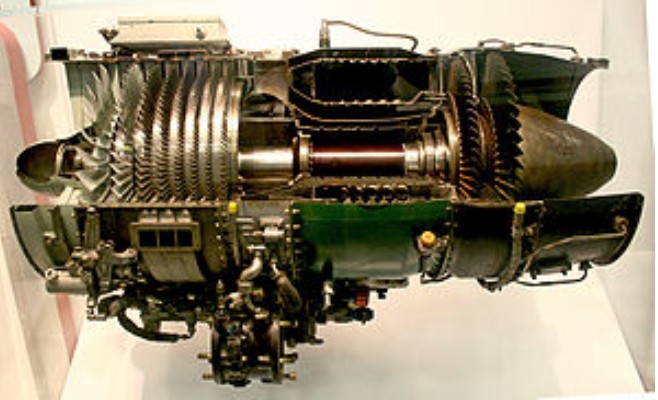
The J79 is a single-spool turbojet with a seventeen-stage compressor with a novel arrangement of variable stator blades which allow the engine to develop pressure similar to a twin-spool engine at a much lower weight. Each blade is made largely of stainless steel. Each blade today costs several thousand dollars to replace. The compressor blades are mounted on disks (the first seven stages being made of titanium) and spaced with corrosion-resistant (not stainless) steel spacers.
The first flight of the engine was on 20 May 1955 where the engine was placed in the bomb bay of a J47-powered B-45C (48-009). The J79 was lowered from the bomb bay and the four J47s were shut down leaving the B-45 flying on the single J79. The first flight after the 50-hour qualification test was on 8 December 1955, powering the second pre-production Douglas F4D Skyray, with the J79 in place of its original Westinghouse J40 engine as part of the General Electric development and qualification program. The YF-104 was the next airplane to fly with the J79 followed by a re-engined Grumman F11F Tiger in a Navy-sponsored program to gain experience with the engine before the first flight of the F4H (F-4).
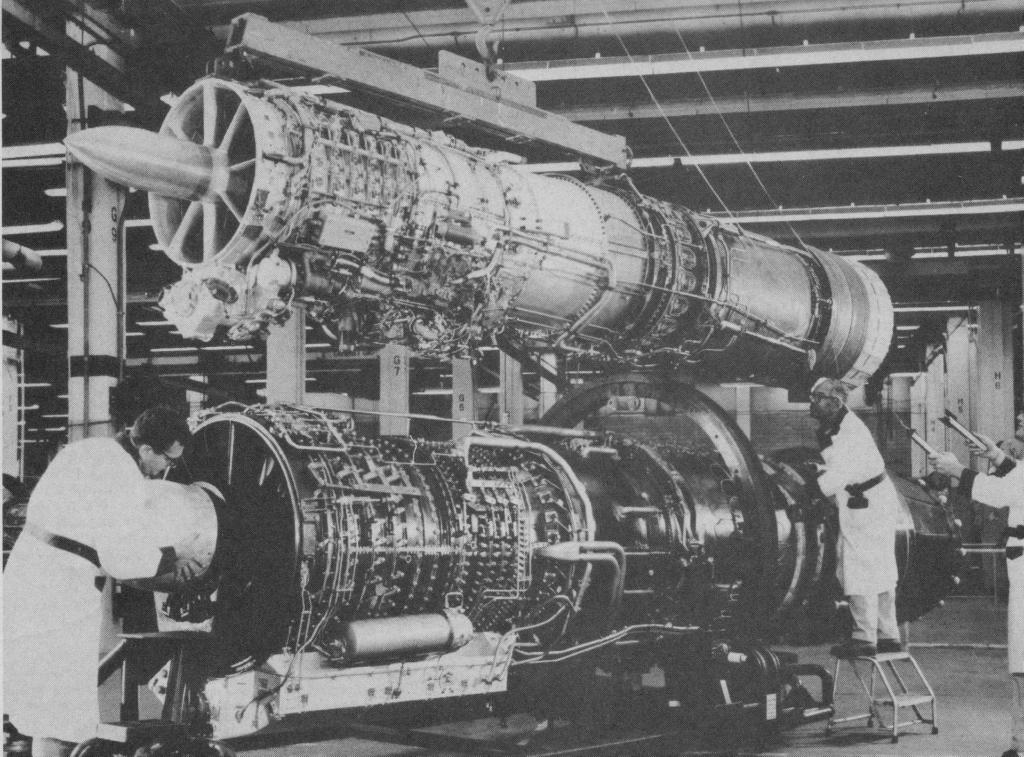
Top – J79, Bottom – YJ93
The J79 was used on the F-104 Starfighter, B-58 Hustler, F-4 Phantom II, A-5 Vigilante, and the IAI Kfir. It enjoyed a production run of more than 30 years. Over 17,000 J79s were built in the United States, and under license in Belgium, Canada, Germany, Israel, Italy, and Japan. The unit cost of the J79-GE-3 in 1960 was US$624,727. A downgraded version of the F-16 Fighting Falcon with a J79 was proposed as a low-cost fighter for export, and though a prototype aircraft was flown, it found no customers.
In the F-104 and the F-4, the J79 makes a particular howling sound at certain throttle settings. The sound is thought to be due to airflow in the exhaust section of the engine being disturbed by the engine bypass flaps. This strange feature led to the NASA operated F-104B Starfighter, N819NA, being named Howling Howland.
A simplified civilian version, designated the CJ805, powered the Convair 880, while an aft-turbofan derivative, the CJ805-23, powered the Convair 990 airliners and a single Sud Aviation Caravelle intended as a prototype for the US market.
The J79 was replaced by the late 1960s in new fighter designs by afterburning turbofans such as the Pratt & Whitney TF30 used in the F-111 and F-14, and newer generation turbofans with the Pratt & Whitney F100 used in the F-15 Eagle which offer better cruise fuel efficiency by moving unburned air around the core of the engine.
For their part in designing the J79, Gerhard Neumann and Neil Burgess of General Electric Aircraft Engines were jointly awarded the Collier Trophy in 1958, also sharing the honor with Clarence Johnson (Lockheed F-104) and the U.S. Air Force (Flight Records).
The turboshaft counterpart to the J79 is the General Electric LM1500, used for land and marine applications. Many J79 derived engines have found uses as gas turbine power generators in remote locations, in applications such as the powering of pipelines.
The J79 has two commercial derivatives: CJ805-3 (a non-afterburning engine, fitted with thrust reverser and sound suppressor), and the CJ805-23 (with a free-wheeling aft fan and thrust reverser) Most fitted to the Convair CV-880 and the Convair CV-990.
Variants and applications:
XJ79-GE-1 Prototype. First ground static test run on 8 June 1954 produced 14,350 lbf (63.83 kN) with afterburner. YJ79-GE-1 Flight test engines were designated YJ79-GE-1. J79-GE-2 Powered the McDonnell F-4H-1 Phantom (F-4A), 16,100 lbf (71.62 kN) of afterburner thrust. J79-GE-2A essentially similar to the -2 J79-GE-3 Used in the YF-104A, F-104A and the Grumman F11F-1F Super Tiger J79-GE3A YF-104A, F-104A and F-104B. J79-GE-3B F-104A and F-104B. J79-GE-5A Convair B-58 Hustler 15,600 lbf (69.39 kN) with afterburner. J79-GE-5B Convair B-58 Hustler 15,600 lbf (69.39 kN) with afterburner. J79-GE-7 F-104C, F-104D and F-104F. J79-GE-7A F-104C, F-104D and F-104F. J79-OEL-7 Licensed production GE-7 manufactured by Orenda Engines to power the Canadair CF-104. J79-GE-8 North American A-5 Vigilante and F4H-1 (F-4B) with 16,950 lbf (75.4 kN) of afterburner thrust J79-GE-8A Sub-variant of the -8 J79-GE-8B Sub-variant of the -8 J79-GE-10 F-4J, 17,900 lbf (79.379 kN) of afterburner thrust. J79-GE-11A F-104G and TF-104G. 15,600 lbf (69 kN) with afterburner. Many -11 engines were licensed manufactured in Europe as part of the large F-104 consortium production programme, Alfa Romeo, Fiat and Fabrique Nationale being the main suppliers for the project. J79-IHI-11A Licensed production GE-11A, built in Japan by Ishikawajima-Harima Heavy Industries Co., Ltd to power their similarly licensed built F-104J and F-104DJ Starfighters. J79-MTU-J1K Licensed built and improved version of the GE-11A manufactured by MTU Aero Engines in Germany. J79-GE-15 F-4C, RF-4C, F-4D. J79-GE-17 F-4E, 17,900 lbf (79.379 kN) of afterburner thrust. J79-GE-19 Aeritalia F-104S; also retrofitted to F-104A’s of the 319th FIS. J79-GE-J1E License-built in Israel by Beit Shemesh Engines Ltd. (BSEL) with 18,750 lbf (83.40 kN) afterburning thrust for the IAI Kfir. CJ805 A non-afterburning civilianised engine, fitted with thrust reverser and sound suppressor, including the aft-fan CJ805-23.
Applications: Convair 880 Convair 990 Coronado Convair B-58 Hustler General Dynamics F-16/79 Grumman F-11F-1F Super Tiger IAI Kfir Lockheed F-104 Starfighter McDonnell Douglas F-4 Phantom II North American A-5 Vigilante SSM-N-9/RGM-15 Regulus II
Land speed record cars Art Arfons’ “Green Monster” Craig Breedlove’s “Spirit of America – Sonic 1”
Specifications:
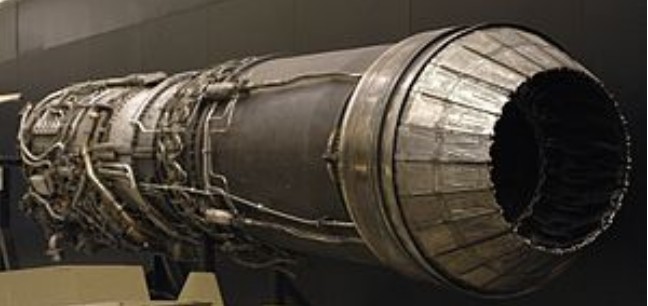
J79-GE-17 Type: Afterburning turbojet engine Length: 17.4 ft (5.3 m) Diameter: 3.2 ft (1.0 m) Dry weight: 3,850 lb (1,750 kg) Compressor: 17-stage axial compressor with variable stator vanes Combustors: cannular Turbine: 3-stage Maximum thrust: 11,905 lbf (52.9 kN) dry; 17,835 lbf (79.3 kN) with afterburner Overall pressure ratio: 13.5:1 Turbine inlet temperature: 1,710 °F (932 °C) Specific fuel consumption: 1.965 lb/(h·lbf) (200 kg/(h·kN)) with afterburner, 0.85 lb/(h·lbf) (87 kg/(h·kN)) at military thrust Thrust-to-weight ratio: 4.6:1 (45.4 N/kg)
The General Electric J73 turbojet was developed by General Electric from the earlier J47 engine. Its original USAF designation was J47-21, but the innovative features (variable inlet guide vanes, and single-shell combustor case) led to its redesignation as J73. A total of 870 were built at a unit cost of US$145,000.
Applications: YF-84J Thunderstreak F-86H Sabre
Specifications:
J73-GE-5 Type: Turbojet Length: 200 in (5 m) Diameter: 39.5 in (1 m) Dry weight: 3,650 lb (1,656 kg) Compressor: 12 stage, axial flow, variable inlet guide vanes Combustors: 10 cannular combustion chambers Turbine: 2 stage Maximum thrust: 9,500 lbf (42 kN) dry, 12,500 lbf (55.6 kN) with afterburner Overall pressure ratio: 7.5:1 Specific fuel consumption: 0.9 lb/hr/lbf (dry power) Thrust-to-weight ratio: 3.4 lbf/lb
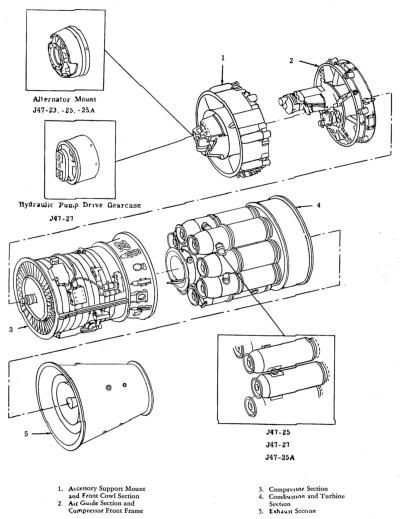
The General Electric J47 turbojet (GE company designation TG-190) was developed by General Electric from the earlier J35 engine, and first flew in May 1948. First run on 21 June 1947, the J47 was the first axial-flow turbojet approved for commercial use in the United States. It was used in many types of aircraft and 36,500 were manufactured before production ceased in 1956. It saw continued service in the US military until 1978.
Overhaul life for the J47 ranged from 15 hours (in 1948) to a theoretical 1,200 hours (625 achievable in practice) in 1956. For example, the J47-GE-23 was rated to run 225 hours between overhauls. As installed on the F-86F, it experienced one in-flight shutdown every 33,000 hours in 1955 and 1956.
Applications: Boeing B-47 Stratojet KB-50J Superfortress KC-97L Stratotanker Chase XC-123A Convair B-36 Convair NB-36 Curtiss XF-87 Blackhawk Martin XB-51 North American B-45 Tornado North American F-86 Sabre North American F-86D Sabre North American FJ-2 Fury Republic XF-91 Thunderceptor
Ground-based vehicles that used the engine include: Spirit of America M-497 Black Beetle jet-powered locomotive
The nuclear-powered X39 In the 1950s, interest in the development of nuclear-powered aircraft led GE to experiment with two nuclear-powered gas turbine designs, one based on the J47, and another new and much larger engine called the X211.
The design based on the J47 became the X39 program. This system consisted of two modified J47 engines which, instead of combusting jet fuel, received their heated, compressed air from a heat exchanger that was part of the Heat Transfer Reactor Experiment (HTRE) reactor. The X-39 was successfully operated in conjunction with three different reactors, the HTRE-1, HTRE-2 and HTRE-3. Had the program not been cancelled, these engines would have been used to power the proposed Convair X-6.
Specifications:
J47-GE-23 Type: turbojet Length: 144 inches (3.7 m) Diameter: 39.5 inches (1.00 m) Dry weight: 2,707 pounds (1,228 kg) Compressor: 12-stage axial compressor Turbine: Single-stage axial Maximum thrust: 5,800 pounds-force (26 kN) at 7950 rpm 6,500 pounds-force (29 kN) with water injection Specific fuel consumption: 0.98 lb/hr/lb
The General Electric GE4 turbojet engine was designed in the late 1960s as the powerplant for the Boeing 2707 supersonic transport. The GE4 was a nine-stage, single-shaft, axial-flow turbojet based largely on the General Electric YJ93 which powered the North American XB-70 bomber. The GE4 was the most powerful engine of its era, producing 50,000 lbf (220 kN) dry, and 65,000 lbf (290 kN) with afterburner. The Boeing 2707 was cancelled in 1971, putting an end to further work on the GE4. First run in 1967, only three were built.
Specifications GE4/J5P Type: Turbojet Length: 27ft 4 in (833.1cm) Diameter: 5ft 11 in (180.3cm) Dry weight: 11,300 lb (5,100 kg) Compressor: Nine-stage axial Combustors: Annular straight-through-flow Turbine: Two-stage axial Fuel type: Special high-temperature JP-6 Fuel Maximum thrust: 50,000 lbf (220 kN) (63,200 lbf (281 kN) with afterburning) Overall pressure ratio: 12.5:1 Turbine inlet temperature: 2,200 ºF (1,204 ºC) Thrust-to-weight ratio: 6.02 Compressor inlet diameter: 60.6 in (1,539 mm) Exhaust nozzle diameter: 74.2 in (1,880 mm) Core airflow: 620 lb (280 kg) per second Noise: Takeoff: 104 dB Sideline: 117 dB Approach: 107 dB
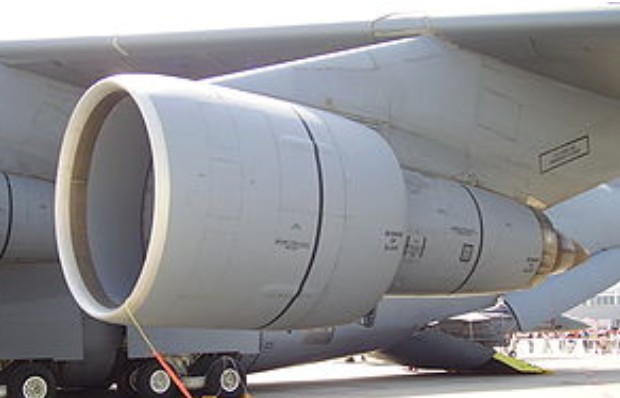
The General Electric TF39 is a high-bypass turbofan engine. Developed to power the Lockheed C-5 Galaxy and first run in 1964, it was the first high-power, high-bypass jet engine available. The TF39 was developed into the CF6 series of engines, and formed the basis of the General Electric LM2500 marine and industrial gas turbine.
The United States Air Force opened the “CX-X Program” in 1964, intending to produce a next-generation strategic airlifter. Of the several airframe and engine proposals returned for consideration, Lockheed’s aircraft and General Electric’s engine were selected for the new design in 1965. The high-bypass turbofan was a huge leap in engine performance, offering a thrust of 43,000 pounds, while improving fuel efficiency by about 25%. The TF39 had an 8-to-1 bypass ratio, 25-to-1 compressor pressure ratio, a 2,500 °F (1,370 °C) turbine temperature made possible by advanced forced-air cooling. The first engine went for testing in 1965. Between 1968 and 1971, 463 TF39-1 and -1A engines were produced and delivered to power the C-5A fleet.
The TF39 is rated from 41,000 to 43,000 lbf (191 to 205 kN) of thrust. It employed a great deal of then-new technological features such as: 1½ stage fan blades (unique to TF39). 8:1 bypass ratio. Variable stator vanes. Turbines equipped with advanced cooling. Fuel efficiency better than any engines available at the time. Cascade-type thrust reversers.
Mechanically, the TF39 is rather unusual for a high bypass ratio turbofan; the single stage is snubbered (‘Snubbers’ are protuberances that stick-out at right angles to the fan aerofoil somewhere between mid-span and blade tip). The snubbers on adjacent fan blades butt-up against each other, in a peripheral sense and improve the vibration characteristics of the blade to the fan rotor which has a set of inlet guide vanes for the outer bypass section and the core booster stage located in front of the fan rotor, rather than behind. This unique design is clearly seen from the front.
The only application was the Lockheed C-5A/B/C Galaxy.
Specifications:
TF39-1C Type: Turbofan Length: 312 in (792 cm) Diameter: 97 in (246 cm) Dry weight: 8000 lb (3630 kg) Compressor: Axial, 1 stage fan, 5 stage low pressure compressor, 16 stage high pressure compressor Combustors: Annular Turbine: Axial, 2 stage high pressure turbine, 6 stage low pressure turbine. Maximum thrust: 43,300 lbf (193 kN) Overall pressure ratio: 25:1 Specific fuel consumption: 0.313 lb/lbf-hr Thrust-to-weight ratio: 5.4:1
The General Electric YJ101 was an afterburning turbofan engine in the 15,000 lbf class (static thrust), first run in 1978. Developed for the Northrop YF-17 entry in the Lightweight Fighter (LWF) competition, the YJ101 formed the basis for General Electric’s successful F404 engine.
A CJ805-3A turbojet installed on a Convair 880 airliner
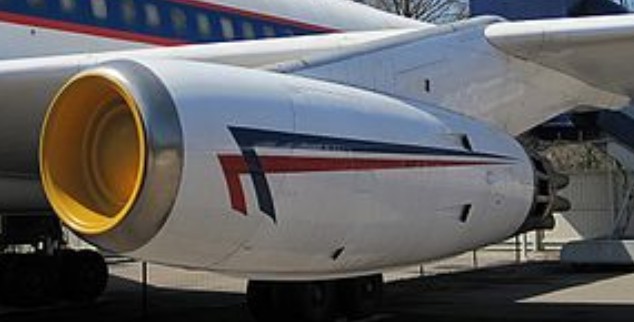
The General Electric CJ805 is a jet engine which was developed by GE Aviation in the late 1950s. A simplified civilian version of the J79 featuring an axial compressor, it was developed in two versions. The basic CJ805-3 was a turbojet and powered the Convair 880, while CJ805-23 (military designation TF35), a turbofan derivative, powered the Convair 990 airliners.
CJ805-23 Flight testing in a Douglas RB-66: Aft-fan variant with a direct drive fan attached to a free-running LP turbine.
CJ805-23A
CJ805-23B Convair 990
CJ805-23C Intended for the proposed Sud Aviation Caravelle 10A Only a single Sud Aviation Caravelle intended as a prototype for the US market, was equipped with the CJ805.
Specifications:
CJ805-3B Type: Single-spool turbojet Length: 188.9 in (4,798 mm) with thrust reverser/suppressor Diameter: 31.6 in (803 mm) Dry weight: 3,213 lb (1,457 kg) with thrust reverser/suppressor Compressor: 17-stage axial flow Combustors: can-annular Turbine: 2× gas generator power stages + 1× free running turbine with fan blades on the periphery Fuel type: Aviation kerosene Oil system: pressure spray/splash Maximum thrust: 11,650 lb (5.28 kN) for take-off Overall pressure ratio: 13:1 Specific fuel consumption: 0.75 lb/lb·hr (76.45 kg/kN·hr) at max. continuous rating Thrust-to-weight ratio: 3.626 lbf/lb (0.356 kN/kg)
 All Aero