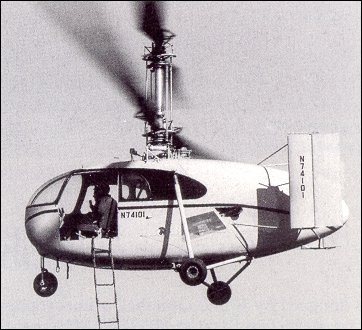
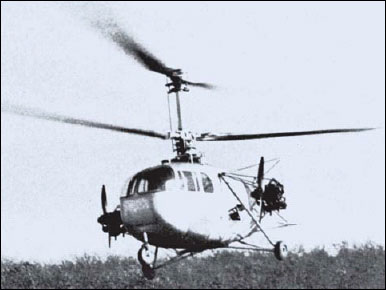
The Gyrodyne Company of America was established by Peter J. Papadakos in 1946. Gyrodyne acquired rights to the five-seat Helicopters Inc. (Bendix) Model J and developed this as the Gyrodyne GCA-2 (N74101). The GCA-2, an all-metal helicopter, had a coaxial twin rotor layout, with a five-seat cabin and a rounded fuselage with twin fins. It was subsequently modified to become the GCA-2A “Helidyne”, with twin 100hp Continental auxiliary engines mounted externally on strutted outriggers to give additional forward speed. It flew in this form on 30 November 1949.
Gyrodyne GCA-2C
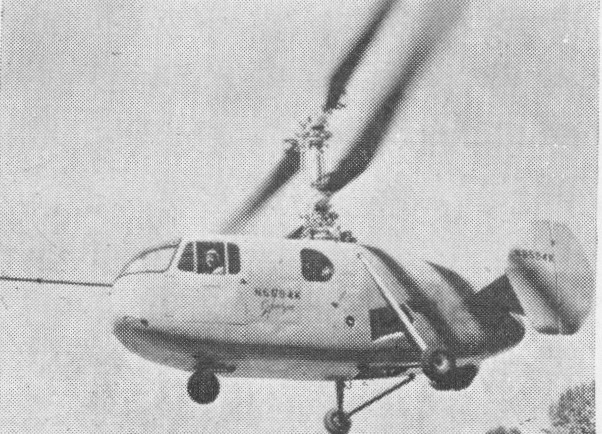
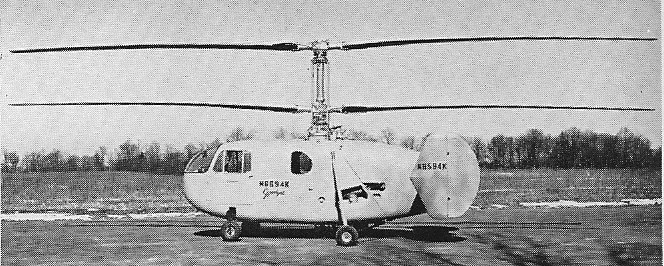
A further development of the GCA-2, serial number N6594K, first flew on April 25, 1952 piloted by Jim Ryan as the GCA-2C. Convertible to an ambulance with three litters.
G.C.A.2C
GCA-2C Engine: 1 x P&W R-985-134, 450hp Rotors: 2x 2 blade co-axial Rotor diameter: 14.64m / 48 ft Height: 14 ft 4 in Fuselage length: 21 ft 6.5 in Empty weight: 3800 lb Loaded weight: 5,750 lb Max. speed: 140km/h / 87 mph Cruising speed: 110km/h / 70 mph ROC: 1030 fpm Ceiling: 9,200 ft Typical range: 250 miles at 69 mph with full load Number of seats: 6-8
Known originally as P. C. Helicopter Corporation, the Gyrodyne Company was incorporated in New York in August 1946 for the development of advanced rotary-wing aircraft. Bought a five-seat coaxial design from defunct Helicopters Inc., and developed it into the G.C.A.2. Projected G.C.A.7 Helidyne with stub wings and two engines with pusher propellers mounted above wings. One-man portable helicopter, XRON-1 Rotocycle, developed for U.S. Navy Bureau of Aeronautics in mid-1950s, plus some ground-cushion vehicles.
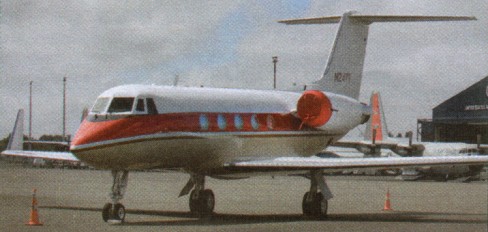
The Gulfstream I, the first of its kind designed specifically for business travel, was a success in the business world, prompting Grumman to develop a jet-powered corporate aircraft called the Gulfstream II or GII.
Announced on 17 May 1965, the G.II was to have a maximum range of 3670 mi / 5907 km.
The Grumman Gulfstream II was originally designed as a business jet, but an enlarged version would eventually serve in feeder airline use. Production of the swept-wing Model II version with turbofan engines started in 1965, and the first delivery was in 1967. It is one of the larger business jets, with a gross weight of 58,000 pounds. It is also one of the fastest, with a top speed of 589 mph, and it has a long-range capability of up to 3,600 miles.
The 200th Gulfstream II was delivered in 1977. In 1981, Gulfstream introduced the Gulfstream GIIB. The GIIB had a modified GII fuselage and the GIII wings, complete with winglets. The variant offered weight and performance characteristics similar to the GIII, but with the shorter GII fuselage. Gulfstream completed and delivered approximately 40 GIIBs. The 256th and final GII delivery took place in 1977.
Gulfstream II 1959 Engines: 2 x RR Spey Mk.511-8 turbofan, 11,400 lb. Seats: 12/19. Wing loading: 80.9 lb/sq.ft. Pwr loading: 2.87 lb/hp. Empty wt. 29,000 lb Max TO wt: 65,500 lb. Operating wt: 36,900 lb. Equipped useful load: 28,207 lb. Payload max fuel: 907 lb. Zero fuel wt: 42,000 lb. Range max fuel/cruise: 1701 nm/3.2 hr. Range max fuel / range: 4009 nm/ 10.2 hr. Service ceiling: 43,000 ft. Top speed 588 mph Max cruise: 512 kt. Max range cruise: 395 kt. Vmc: 89 kt. Stall: 108-130 kt. 1.3 Vso: 140 kt. ROC: 4350 fpm. SE ROC: 1525 fpm @ 214 kt. SE Service ceiling: 24,500 ft. BFL: 5700 ft. Cabin press: 9.45 psi. Fuel cap: 23,300/27,300 lb. Takeoff run 5,000 ft. Landing roll 3,190 ft.
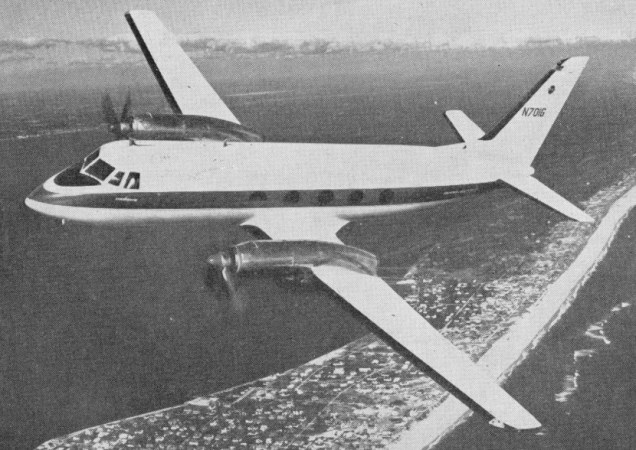
Dubbed the Gulfstream I (GI), the turbo-prop aircraft was named after the Gulf Stream, the current that flows along the coast of Florida, which was a favored vacationing spot for Grumman executives. The Gulfstream I is a business transport designed to carry a crew of two with 10 to 14 passengers, which was introduced in 1958. Power is provided by twin Rolls-Royce Dart turboprop engines turning four-blade Rotol constant-speed propellers.
The Gulfstream I first flew on 14 August 1958 and was the first United States twin-engine business aircraft to be certificated to cruise at 30,000 feet, and had a maximum speed of 350 mph at 25,000 feet and a range of 2,200 miles.
The Gulfstream continued in production in 1960, with about 40 ordered.
A later version received certification as a 24-passenger variation for feeder-line use. Two Gulfstream offspring were enlisted for military use: the VC-4A was a U.S. Coast Guard transport and the TC-4C was an “avionics classroom” for the U.S. Navy.
The aircraft, specifically for business travel, was a success in the business world, prompting Grumman to develop a jet-powered corporate aircraft called the Gulfstream II or GII.
Seats 10-24. Gross wt. 35,100 lb. Empty wt. 21,900 lb. Fuel capacity 1,550 USG. Engines two 2,210 shp Rolls-Royce Darts. Top speed 348 mph. Cruise speed 288 mph. Initial climb rate 1,900 fpm. Approach speed 128 mph. Range 2,540 miles. Ceiling 33,600 ft. Takeoff run 2,550 ft. Landing roll 1,525 ft.
The company that evolved into Gulfstream Aerospace Corp. started in the late 1950s when Grumman Aircraft Engineering Co., a company known for military aircraft production, developed a marketable business aircraft at its manufacturing facilities in Bethpage, N.Y. At the start of the GII program in the 1960’s, Grumman officials separated the company’s civil and military aircraft production to improve efficiency. In 1966, they relocated the civilian component to Savannah, Ga. There they found the needed supply of skilled labour, an established airfield adjacent to the plant site and sufficient acreage for expansion. Transportation facilities suitable for heavy equipment and machinery and weather favorable to year-round flight-testing and flight-training operations further enhanced Savannah’s appeal. The new building in Chatham County opened in June 1967 and was officially dedicated on Sept. 29, 1967. It housed production and flight testing for the GII. The 100-person work force that built the GII was 90 percent local and grew to more than 1,700 within a few years. In 1972, Grumman merged with light-aircraft manufacturer American Aviation Corp. The 256th and final GII delivery took place in 1977. One year later, the Gulfstream line and the Savannah plant were sold to American Jet Industries, which was headed by little-known aviation entrepreneur Allen Paulson. Paulson became the president and CEO of the company, renaming it Gulfstream America. Under Paulson’s leadership, the Savannah work force grew to 2,500 employees by the spring of 1982. Also in this year, the company’s name changed to Gulfstream Aerospace Corp. to reflect its worldwide scope, and a new plane, the Gulfstream IV, was conceived. The following year, Gulfstream offered a total of 8.8 million shares of its stock to the public. In 1985, Chrysler Corp. acquired Gulfstream as a part of the automaker’s plan to diversify and move into high-tech industries. This was also the year that Gulfstream first appeared on the Fortune 500 list, at No. 417. Two years later, the 200th and last Gulfstream III produced was delivered, and the first delivery of a Gulfstream IV took place. The GIV was the first jet in business aviation to have an all-glass cockpit. In 1989, when Chrysler decided to sell Gulfstream, Paulson teamed up with Forstmann Little & Co. – a private equity firm specializing in leveraged buyouts – and bought Gulfstream back. The opening of a $16 million Savannah service center with 136,000 square feet of hangar space was in 1996.
At the end of the 1990s, General Dynamics, a giant in the defense industry, purchased Gulfstream. The company focused on enhancing product performance and lowering costs. It opened a $5.5 million aircraft refurbishment and completions support facility in Savannah in 2000. In 2001, it acquired Galaxy Aerospace and with it, the mid-size Astra SPX and super mid-size Galaxy, which were later rebranded the G100 and G200, respectively. Also in 2001, Gulfstream purchased four U.S. maintenance facilities in Dallas; Las Vegas; Minneapolis; and West Palm Beach, Fla. Those service centers, along with a Gulfstream facility in Westfield, Mass., formed General Dynamics Aviation Services, which maintains and repairs Gulfstream and other business-jet aircraft. In 2002, Gulfstream renamed its products, using Arabic numerals instead of Roman numerals to differentiate its aircraft. At the time, the company’s lineup included the ultra long-range G550 and G500, the long-range G400, the mid-range G300 and G200, and the high-speed G100. 2002 was also the year that Gulfstream introduced its Airborne Product Support aircraft, a specially equipped G100. It is used to deliver parts and provide any-time service to Gulfstream customers in North America and the Caribbean who are operating aircraft under warranty. In 2003, Gulfstream acquired a service center at the London-Luton Airport, the first Gulfstream-owned service center to be operated outside the United States. In 2006, Gulfstream announced plans to expand its manufacturing and service facilities in Savannah. The seven-year, $400 million Long-Range Facilities Master Plan included the creation of a new 624,588-square-foot service center, an independent fuel farm, a 42,600-square-foot, state-of-the-art paint hangar and the addition of a new Sales and Design Center. As a result of the expansion, employment at the facility was expected to grow by some 1,100 jobs. To meet the immediate need for engineering office space, Gulfstream opened a Research and Development Center (RDC). The RDC accommodates approximately 750 technical and engineering employees. The year 2007 also saw its share of major breakthroughs. In April, Gulfstream broke ground for a new business-jet manufacturing building at its headquarters in Savannah. The following month, the company signed a nine-year lease with North Point Real Estate for a second Research and Development Center. The RDC II consists of an office building, which can accommodate some 550 employees, and a Laboratory Building, which is designed for 150 employees and test equipment used in Gulfstream’s research and development efforts. Gulfstream completed the new Sales and Design Center addition in June and officially opened the first phase of the new Savannah Service Center in August.
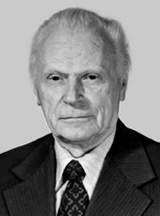
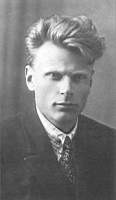
Pyotr Dmitrievich Grushin (Russian: Петр Дмитриевич Грушин) was born in Volsk, Saratov Governorate, Russian Empire on January 2 (15), 1906.
He began his aeronautical construction activity while still a student at the Moscow Aviation Institute (MAI) with the Stal-MAI model that was developed between 1931 and 1934. His diploma work consisted of the project of a light aircraft, developed in 1932 jointly with Dmitr Babad and Afanasiev Marakazov and named ” Brigadny “. This project was presented in the contest developed by the OSOAVIAJIM on October 13, 1932, obtaining the first prize.
Grushin in 1932 as a student at the MAI.
After graduating as a mechanical engineer in aeronautical construction, Grushin remained at the MAI, being appointed from 1933 as main builder of the KB MAI.
Between 1934 and 1940 he worked on various developments including the Oktyabrionok light aircraft, the development of a “blind” cockpit for training flights, an experimental steam engine for the Polikarpov U-2, the ground attack aircraft Sh -Tandem and the BB-MAI light bomber.
In 1940 Grushin was transferred to Factory No.135 in Kharkov as the main builder of the OKB JAZ. The IDS escort aircraft project, also known as Gr-1 (Grushin – 1), stands out in this period.
After the evacuation of 1941 Grushin went to work at Factory No.21 as a senior engineer in Semyon Lavochkin ‘s construction bureau, later being appointed as his replacement.
At the end of 1953 Grushin became head of the Special Construction Bureau No.2 (OKB-2) which since 1967 has been renamed KB “Fakel”. The first major work of this bureau was the development of the 1D (V-750) missile. for the S-75 anti-aircraft system developed by the OKB-1, which entered service with the PVO in December 1957. For the development of this missile on June 25, 1958, Grushin was awarded the title of Hero of Socialist Labor and the Order of Lenin.
Anti-aircraft systems developed by Grushin saw service in Vietnam, Egypt, Syria, and Cuba.
Piotr Grushin died in Moscow on November 29, 1993, at the age of 87.
The former OKB-2, which since 1967 was called KB Fakel today bears the name of Grushin: OAO Bureau of Machine-Building Fakel academician PD Grushin.
In 1987 Grushin gave 140,000 rubles from his private funds to build the “Comprehensive” House of Young Technicians in the city of Khimki, Moscow district, where he lived and worked from 1953 until his death.
A bust of Grushin was erected in his hometown of Volsk, in the Saratov District.
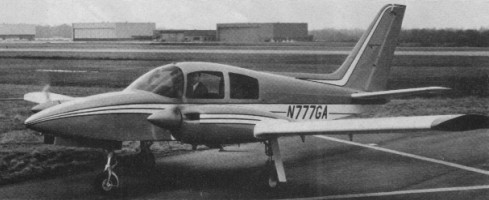
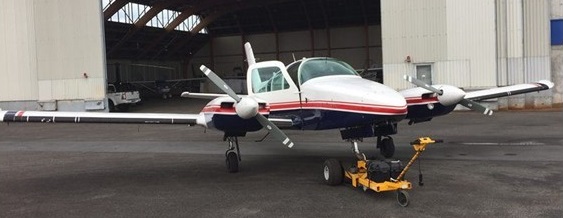
Right on schedule, in December 1974, Grum¬man American got its new light twin, the Cougar, into the air on its first test flight.
The Cougar had a lengthy development period – nearly three years – between the prototype’s first flight on December 20 1974 and certification in September 1877. During that time the aircraft was modified considerably in detail. First flown with a sliding canopy and two cabin windows per side. A third window had been added by the time the aircraft entered production and the sliding canopy replaced by a conventional solid cabin roof and starboard side entry door.
The cabin itself was made a little larger while a two spar wing helped form the structure for an integral wet wing fuel tank. On the prototype the main undercarriage units retracted inwards but on the production models they retracted outwards. The first production standard Cougar flew in January 1977.
Two models were offered for the 1978 model year, the basic GA-7 and the better equipped Cougar with improved fittings, a basic avionics pack and gyro system as standard.
In service, the Cougar’s single engine performance on only 160 hp / 119 kW a side proved to be not as great as early published figures indicated and the numbers were subsequently revised downwards by nearly 30%. Gulfstream responded by proposing two new variants, one with turbocharged 160 hp / 119 kW engines and another with 180 hp / 134 kW normally aspirated engines.
Neither proposal eventuated as Gulfstream ended production of all light aircraft in 1979.
In 1995 plans were made for SOCATA to licence build the Grumman GA-7 Cougar as the TB320 Tangara.
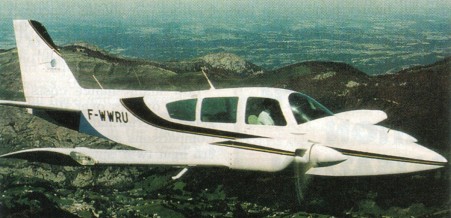
SOCATA TB 360 Tangara
Socata acquired the design and manufacturing rights to the Cougar in 1995. Socata announced plans to produce the aircraft as the TB 320 Tangara and then as the TB 360 with 180 hp / 134 kW Lycoming O-360 engines. Three modified Cougars were built as prototypes, the first (as a TB 320) in mid 1996 and the second (as a TB 360) in February 1997. Planned production was then delayed.
Grumman GA-7 Cougar Engines: Lycoming 0 320 D1D, 160 hp / 119 kW TBO: 2,000 hrs. Props: two blade, constant speed, 73 inch dia. Length: 29 ft. 10 in. Height: 10 ft. 4 in. Wingspan: 36 ft. 10 in. Wing area: 184 sq.ft. Wing loading: 20.67 lb/sq.ft. Power loading: 11.88 lb/hp. Seats: 4. Empty weight: 2,569 lb (1,165 kg) Useful load: 1,155 lbs. Payload with full fuel: 459 lbs. Gross weight: 3,800 lb (1,724 kg) Usable fuel capacity: 116 USG/696 lbs. Service ceiling: 17,400 ft (5,300 m) Rate of climb: 1,150 ft/min (5.8 m/s)Single engine rate of climb: 280 fpm. Single engine climb gradient at 85 knots (Vyse): 197 ft. per nm. Single engine service ceiling: 4,500 ft. Maximum speed: 117 kts. Max cruise, 75% power (2,700 rpm) at 8,500 ft: 165 kts. Range: 1,170 nmi (max econ no res) Duration at maximum cruise: 6.7 hrs. Duration at economy cruise: 9.2 hrs. Stalling speed, clean: 68 kts. Stalling speed, full flaps: 61 kts.
Socata TB 360 Tangara Engines: 2 x Lycoming O-360-A1G6, 180 hp / 134 kW Wing span: 36 ft 11 in / 11.24 m Length: 29 ft 10 in / 9.09 m Height; 10 ft 4 in / 3.15 m Wing area: 184 sq.ft / 17.1 sq.m MTOW: 3800 lb / 1724 kg Max speed: 174 kt / 322 kph Max cruise; 165 kt / 306 kph Long range cruise: 120 kt / 222 kph Initial ROC: 1400 fpm / 427 m/min Service ceiling; 20,000 ft / 6096 m Range at max cruise (45 min res): 800 nm / 1480 kg Max range w/res: 1140 nm / 2110 km
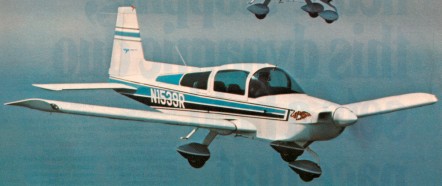
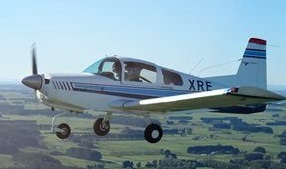
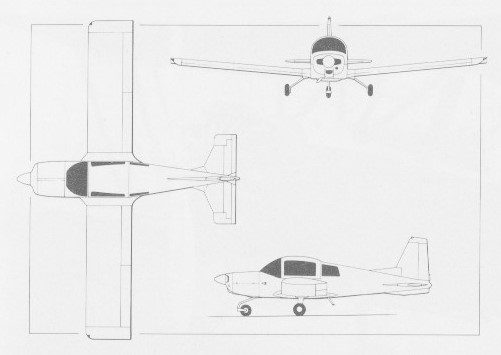
The production 4-seaters were the AA-5 Traveller introduced in 1971, the AA-5A Cheetah and AA-5B Tiger. First introduced in 1972 as the AA-5 Traveler, with 150 horsepower, this four-seater resembled an enlarged AA-1 and also utilised the bonded metal and tubular spar construction of the AA-1. In 1975 Grumman American introduced a major airframe clean up and the more powerful 180 hp AA-5B Tiger. The Tiger features an enlarged and redesigned tailplane (from the AA-5), fixed pitch prop and undercarriage. The modified airframe was reunited with 150 hp in 1976, and the new AA-5A Cheetah replaced the Traveler. All these airplanes share key features. Entrance is through a sliding canopy, which can be left open during flight. Rear seat backs are removable, and the rest of the rear seat folds flat to form a cavernous cargo area, station wagon style. All three airplanes have fixed gear and fixed pitch propellers. And the airframes of the little airplanes are made partially of an aluminum honeycomb material; most of the skins are bonded rather than riveted together. This skin bonding process has had its troubled moments. Problems occurred when Grumman American moved its light¬plane manufacturing from the Cleveland, Ohio area to Savannah, Georgia. The new plant’s bonding process went through a shakedown period during which, occasionally, an airplane control surface would delaminate. But this never happened suddenly, so there was no safety problem, and the factory made good the airplanes that were affected. Fuel is drawn from one wing or the other, and a pointer, activated by the selector, indicates which fuel gauge to read. Taxiing is with the full-swiveling nose wheel dictating that you guide with the toe-brakes. In addition to their basic clean up modifications, the Tiger and Cheetah also have horizontal and vertical stabilizers that differ from those on the Traveler. The changes offer more balance and more responsive control and eliminate the need for the Traveler’s dorsal fin. The Grummans share a free castoring nosewheel. Trying to keep the airplane simple, the makers of the Grumman American lightplanes decided to have no steering on the front wheel. Diffeeential braking on the mains swings the nose in the desired direction, and the free turning nosegear follows.
Traveler AA5
For the 1977 model cabin noise is way down from the 1976 model, thanks to a windshield that’s twice as thick and the firewall’s being raised and extended to meet the top of the cowl deck; formerly, there had been a crescent shaped opening that allowed engine noise to pass. The aft skirt of the canopy has a new, redesigned seal, and the forward edge now has two bladder like seals that meet an opposing rubber strip instead of the bare metal of the windshield bow. Because people had complained about the airplane’s tendency to pitch like a rocking horse on rough surfaces, sometimes leading to prop clings, there’s a new shock absorber for the nosewheel made up of a pair of oleos at the top of the strut, to absorb fore and aft jolts.
Traveler AA5
The rubber seal that covers the attach ¬point gap at the wing roots has been widened. The propeller spinner bulkhead has been beefed up in response to frequent replacements necessitated by cracking. Fuel tank sealing has been im¬proved, as has access to the tanks. Primary airspeed indication is in knots.
The GA Tiger, announced late in 1974, has the same airframe as the Cheetah nee Traveler, but is powered with the Lycoming O-360-A4K of 180-hp, and sold, new, for $5,000 more than the Cheetah. The Tiger has excellent performance, but we’ll deal lightly with it here, because it will be rare in the used market for a while, and priced close to the new ones. The 1976 Tiger’s basic price wasUS$24,170, which may easily go above $30,000 fully equipped.
By 1975, GA was building 200 Travelers per year, along with an equal number of Grumman American Tigers (the 180-hp model) and, following a move from Cleveland to Savannah, programmed for 500 of their four-placers in 1976. Late in 1975, GA gave the Traveler more stabilizer and flap and rechristened it the “Cheetah”. The 1976 Cheetah’s basic price is $19,094.
AA-5 Traveller Engine: Lycoming O-320-E2G, 150 hp Wingspan: 31 ft 6 in / 9.60 m Length: 22 ft 0 in / 6.71 m Empty weight: 1200 lb / 544 kg MTOW: 2200 lb / 998 kg Max cruise 75% 8500ft/2600m: 122 kt / 140 mph / 225 kph Max ROC SL: 660 fpm / 201 m/min Service ceiling: 12,650 ft / 3855 m Range max cruise 45 min res: 390 nm / 450 mi / 724 km Cabin length: 6 ft 6 in / 1.98 m Cabin width: 3 ft 5 in / 1.04 m Cabin height: 4 ft 0.25 in / 1.23 m Baggage space: 12 cu.ft / 0.34 cu.m Baggage space w/rear seat area: 41.5 cu.ft / 1.19 cu.m Max baggage: 120 lb / 54.4 kg Seats: 4
AA-5A Cheetah Engine: Lycoming 0-320-E2G, 150 hp. TBO: 2,000 hr. Prop: McCauley fixed pitch, 73 in. Length: 22 ft. Height: 8ft. Wingspan: 31 ft 6 in. Airfoil: NACA 642415 (mod). Aspect ratio: 7.1. Wing area: 140 sq. ft. Wing loading: 15.7 lbs/sq.ft. Empty weight: 1,262 lbs. Useful load: 938 lbs. Payload with full optional fuel: 626 lbs. Gross weight: 2,200 lbs. Power loading: 14.7 lbs/hp. Fuel cap (standard): 38 USG/1228 lbs. Fuel cap (opt): 52 USG/1312 lbs. Baggage cap: 120 lbs. Seats: 4. Stall speed (clean): 54 kts. Stall speed (flaps down): 50 kts. Minimum runway requirement: 1,600 ft. ROC: 660fpm. Service ceiling: 12,650 ft. Max speed: 137 kts. Cruise (75% @ 8,500 ft.): 128 kt. Economy cruise (55% @ 4,500 ft.): 103 kts. Range @ max cruise (45 min res, std tanks): 461 nm. Range @ max cruise (45 min res, opt tanks): 672 nm. Range @ economy cruise (45 min res, std tanks): 537 nm. Range @ economy cruise (45 min res, opt tanks): 770 nm. Duration @ max cruise (no res, std tanks): 4.4 hrs. Endurance 65%: 6.9 hr. Landing gear: Tri/Fixed Cabin width: 41 in Cabin height: 48 in Takeoff ground roll: 880 ft Landing ground roll: 380 ft
AA-5B Tiger Engine: Lycoming 0 360 A4K, 180 hp. TBO: 2,000 hrs. Prop: McCauley 75in, fixed pitch. Length: 22 ft. Height: 7 ft. 8 in. Wingspan: 31 ft. 6 in. Airfoil: NACA642415 mod. Aspect ratio: 7.1. Wing area: 140.35 sq.ft. Wing loading: 17.1 lb/sq.ft. Seats: 4. Empty weight: 1,410 lbs. Useful load: 989 lbs. Payload with full fuel: 668 lbs. Gross weight: 2,400 lbs. Power loading: 13.3 lbs./hp. Fuel capacity (standard): 51 USG./306 lbs (opt 51 US Gal). Baggage capacity: 120 lbs. Baggage area: 15 cu. ft. Rate of climb: 850 fpm @ 79 kts. Service ceiling: 13,800 ft. Maximum speed: 147 knots. Cruise (75 % @ 8,500 ft): 139 knots. Economy cruise (55 % @ 8,500 ft): 112 knots. Range @ max cruise (45 minute reserve): 512 nm. Range @ economy cruise (45 minute reserve): 567 nm. Duration @ max cruise (no reserve): 4.5 hrs. Stall speed (clean): 56 knots. Stall speed (flaps down): 53 knots. T/O 50ft: 1550 ft. Landing dist 50ft: 1120 ft. Max canopy open speed: 113 kts. Max X-wind: 11 kts.
Grumman American 1976 AA5B Tiger Engine: Lycoming O-360-A4K, 180 TBO: 2000 hr Propeller: Const. spd. Landing gear: Tri/Fixed Gross weight: 2400 lb Empty weight, std: 1294 lb Useful load, std: 1106 lb Fuel: 51 USgal Wingspan: 31 ft. 6 in. Overall length: 22 ft. Height: 8 ft. Wing area:140 sq. ft Seating capacity: 4 Cabin width: 40 in Cabin height: 45 in Baggage capacity:120 lb Cruise speed 75% power: 139kt Cruise speed 65% power: 131 kt Max range (w/ reserve) 75% power: 552 nm Max range (w/ reserve) 65% power: 578 nm Fuel consumption 75% power: 10.8 USgph Fuel consumption 65% power: 9.7 USgph Stall speed (gear, flaps down) : 53 kt Best rate of climb: 850 fpm Service ceiling: 13,850 ft Takeoff ground roll: 865 ft Landing ground roll: 410 ft
After the market success of the AA-1 Yankee Clipper American Aviation turned their attention to developing a four-seat aircraft in 1970-71. The American Aviation engineers started with a “clean sheet of paper” and designed a new aircraft. This aircraft was intended to be produced as the American Aviation AA-2 Patriot.
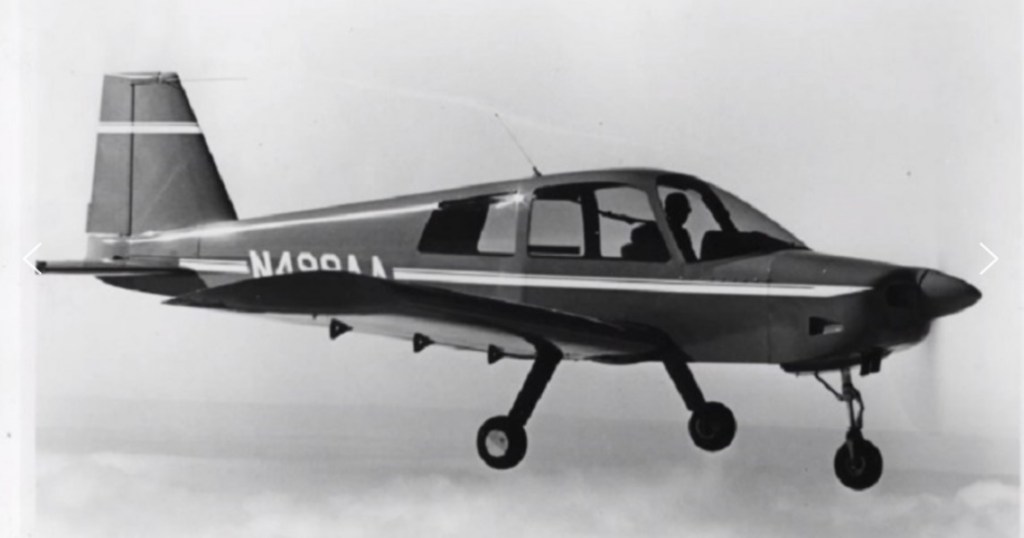
The resulting prototype bore very little family resemblance to the AA-1. The AA-2 was different from the AA-1 in that it had doors instead of the Yankee’s trademark sliding canopy and an oleo strut in place of the Yankee’s spring steel tube nose gear. The aircraft had provisions for retractable gear to be installed on a later version, although the prototype had fixed landing gear. The AA-2 was powered by a 180 hp (134 kW) Lycoming engine.
The prototype, registered “N488AA”, was completed in 1970 and test flying was commenced early in that same year. Aircraft performance during the test flying process fell far short of the design goals so the project was abandoned and the manufacturer eventually disassembled the prototype.
American Aviation made the decision to develop a stretched version of the AA-1 Yankee Clipper instead of pursuing the AA-2. This aircraft eventually was produced as the AA-5 Traveler and was later developed into the AA-5A Cheetah and the AA-5B Tiger.
The prototype has been recovered by members of the American Yankee Association.
Powerplant: 1 × Lycoming O-360-A1A, 180 hp (130 kW) Wingspan: 30 ft 0 in (9.14 m) Length: 23 ft 3 in (7.09 m) Max takeoff weight: 2,400 lb (1,089 kg) Useful load: 1100 lb Maximum speed: 135 kn (155 mph, 249 km/h) Cruise: 145 mph Range: 613 nmi (705 mi, 1,135 km) Crew: One Capacity: Three passengers




 All Aero