1977: PO Box 300/Mansfield, Texas 76063, USA.
Built the HS-180 Hunter helicopter.
1977: PO Box 300/Mansfield, Texas 76063, USA.
Built the HS-180 Hunter helicopter.
Designed by E.A.S. Hulton, London, UK, in 1969, this biplane hang-glider was wooden frame and fabric covered, based on the Ferris 1906 and the Anderson & Singer glider of 1911, with all-moving tailplane.
The upper and lower surfaces of each wing were fabric covered. Ailerons were on the lower wing only. No brakes or flaps were fitted.
Landings were made using leg undercarriage.
Only one was built, the first flight on 8 March 1969 from the I in 2 slope at the White Horse Hill, Uffington, Berkshire. The second flight, from the same site, piloted by David Potter, was unable to correct an almost vertical bank to port that developed, and the glider crashed from 50 ft. The pilot suffered bruising and a short period of unconsciousness. The glider was wrecked.
Wingspan: 6.10 m / 20 ft 0 in
Length: 3.88 m / 12 ft 9 in
Wing area: 14.86 sq.m / 166 sq.ft
Aspect ratio: 5
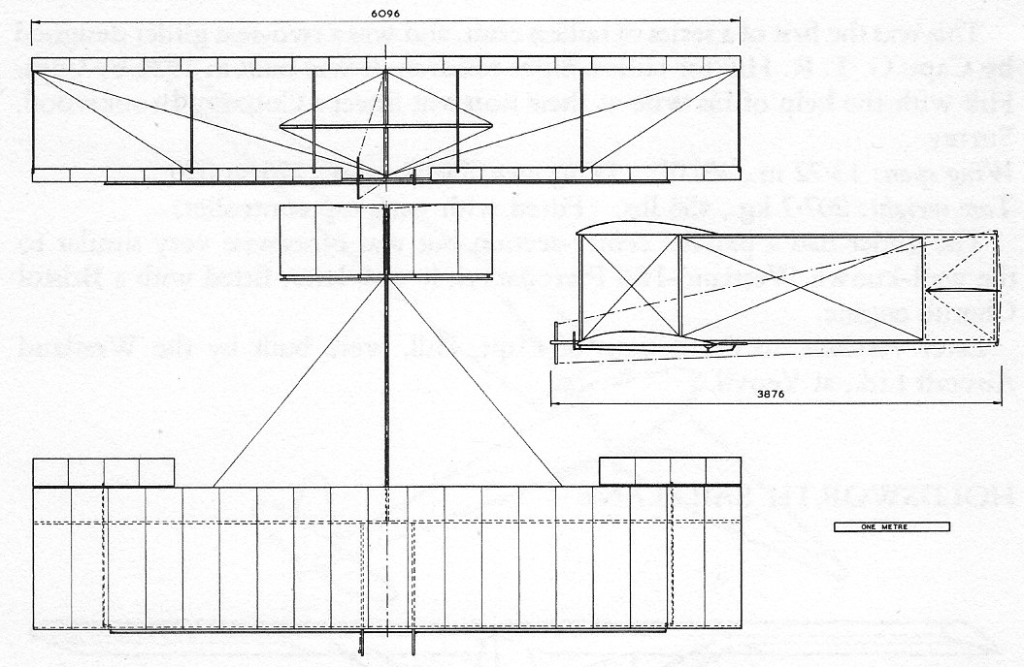
Two types of hang-glider were designed by E.A.S. Hulton, London, UK, in 1969.
The first, a biplane, was built.

With a lot of lift for its small size and light weight, the HU-GO Craft wrings a 105-mph cruise speed out of a mere 65-hp Continental. This single-seater biplane is largely conventional in construction, with fuselage and tail group of welded steel tubing and wings are wood. All surfaces are fabric covered. Several pilots have logged some 275 hours in the HU-GO Craft with no problems reported.
By March 1974 the original/prototype HU-GO Craft was in the EAA Museum after 400 hours in 8.5 years.
Gross Wt. 848 lb
Empty Wt. 558 lb
Fuel capaci¬ty 12 USG
Wingspan 17 ft
Length 14 ft 5 in
Top speed 115 mph.
Cruise 105 mph.
Stall 55 mph.
Climb rate 1000 fpm
Takeoff run 500 ft
Landing roll 500 ft
Range 250 miles
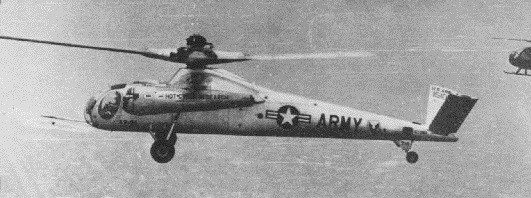
The Hughes XV-9 (company designation Hughes Model 385) was a 1960s American high-speed research helicopter built by Hughes Helicopters.
Convinced that the use of gas pressure to drive rotors, as used in the XH-17 and proposed for the XH-28, was superior to conventional methods as the elimination of the transmission drive system resulted in a lighter, less complex, and more easily maintained system, Hughes engineers sought ways to improve the propulsive efficiency of pressure-jet rotors. Eventually concluding that much improvement would result from ducting the hot efflux of gas generators directly to cascade vanes at each blade-tip instead of piping cold air to tip-burning nozzles, they succeeded in attracting the interest of the US Army.
Funded by the Army beginning in 1962, the multi-phase development programme for the Model 385 began with 60 hours of test running of a prototype hot-cycle rotor mounted on a ground rig. As results were encouraging, Hughes proceeded to the next phase, 15 hours of bench testing of the Model 385 propulsion module consisting of two General Electric YT64-GE-6 gas generators mounted at the tips of stub wings and driving a three-bladed rotor. Each blade was of two-spar construction with the hot efflux of the gas generators being taken to vanes at their tips by means of a Rene 41 high-temperature steel duct passing between the spars. Cooling air was forced through the leading and trailing edges of the constant-chord blades and was exhausted at the tip, fore and aft of the hot efflux. Results remaining promising, Hughes was authorized to proceed with the manufacture and testing of a research vehicle, the XV-9A (serial 64-15107), which was given a VTOL mission designator instead of the more traditional H helicopter designator.
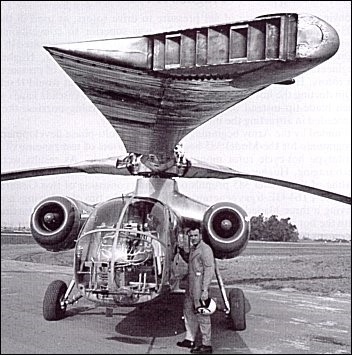
As the XV-9A was only intended as a demonstrator for the hot-cycle system, the Army requested that manufacturing costs be kept to a minimum by using components from other aircraft. Thus, the cockpit of a Hughes OH-6A (with side-by-side accommodation for a pilot and a co-pilot/flight test engineer) and the undercarriage of a Sikorsky H-34 were mated to a specially-built fuselage and V-tail. The hot efflux from two General Electric YT64-GE-6 gas generators, which were loaned by the Navy and mounted at the tips of a stub wing, drove the three-bladed rotor. Bleed air from these generators was ducted to a yaw control system at the tail.
The system was built around two pod-mounted General Electric YT64-GE-6 engines fitted to the ends of two high-set stub wings, one on either side of the fuselage directly below the main rotor hub. Each engine’s turbine section had been removed, and hot exhaust gases were ducted directly through the rotor hub to be expelled at near-sonic speeds through vaned cascades in each of the three blade tips. Smaller exhaust ports on either side of the tail boom just forward of the rudders provided some additional directional stability.
The version for the US Army was designated XV-9A and had a three-blade constant chord metal rotor. There was room for two pilots seated side by side in the cockpit.
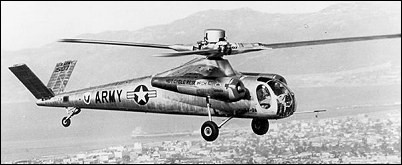
First flown by Robert G. Ferry at Culver City on 5 November, 1964, the XV-9A remained at the manufacturer’s facility until it had completed an initial 15-hour flight test programme. It was then transferred to Edwards AFB, where an additional 23 hours were flown.
The tests were satisfactory and the company was confident that the hot-cycle system would be widely used, although the XV-9A was noisy and had a high fuel consumption. The company was unable to mitigate the problems and the development by Hughes of pressure-jet systems did not proceed. The Army tests were completed in August 1965, with a total of 19.1 hours having been flown, and the helicopter was returned to Hughes.
From an engineering point of view, tests proved highly satisfactory and in 1965 Hughes confidently predicted that the hot-cycle system would be used for heavy-lift military helicopters and for compound civil helicopters.
From the environmental and economic points of view, however, the XV-9A was less successful as the exhaust of hot efflux through cascade vanes at the tips of the rotor was noisy and unacceptable in urban areas and as fuel consumption rate was high. To mitigate these deficiencies, Hughes proposed a refinement of the pressure-jet concept based on the use of turbofans in lieu of gas generators. This warm-cycle system was tested in a wind tunnel and on a whirling stand but improvements were insufficient to warrant the manufacture and testing of a flying prototype, thus bringing to an end the development by Hughes of pressure-jet systems successively based on the cold-cycle principle, as used for the XH-17 and XH-28, the hot-cycle principle, as featured by the XV-9A, and the warm-cycle principle, as evaluated during whirling stand tests.
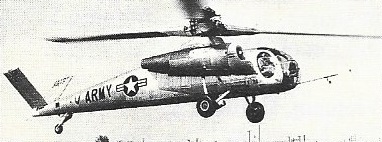
The aircraft was scheduled for delivery to the Smithsonian collection in May 1967 but actually arrived in August. It was shipped via railcar from Ft. Eustis and arrived as a wreck, which was not the Smithsonian’s understanding of the aircraft’s condition. The cockpit had been picked clean and there were multiple holes in the fuselage. Smithsonian correspondence does not make clear how much of this was due to improper handling and security by the railroad and how much was due to inadequate storage by the Army.
At some point in the early seventies, the aircraft was deemed beyond reasonable restoration and scrapped. The Smithsonian did retain most of one of the hot cycle blades and it is still in storage.
XV-9A
Powerplant: 2 × General Electric YT64-GE-6, 2,850 hp (2,126 kW) each
Main rotor diameter: 55 ft 0 in (16.76 m)
Main rotor area: 2,376 sq ft (220.6 m2)
Length: 45 ft 0 in (13.72 m)
Height: 12 ft 0 in (3.66 m)
Empty weight: 8,500 lb (3,864 kg)
Gross weight: 15,300 lb (6,955 kg)
Maximum speed: 173 mph (279 km/h, 150 kn)
Cruise speed: 150 mph (242 km/h, 130 kn)
Range: 165 mi (266 km, 143 nmi)
Service ceiling: 11,500 ft (3,505 m)
Crew: Two

Both the Hughes 500 and the Bell Jet Ranger, rivals in the light turbine helicopter market, were commercial outgrowths of the U.S. Army light observation helicopter competition between 1961 and 1965. Hughes won, and their vehicle became the OH 6A, a machine greatly respected for its agility and survivability in combat. Unencumbered by the production of LOHs, Bell put their design into commercial production, beating Hughes to the civilian marketplace by several years. Then the Texas firm outbid Hughes in a follow on military production procurement and eventually sold more LOHs to the Army than had the original winner of the competition.
First flown in February 1963, the Hughes Model 369 prototype won the US Army’s Light Observation Helicopter contest against Bell and Hiller helicopters, and was ordered into large-scale production. The OH-6A Cayuse (the initial production model) entered service in September 1966. Production was curtailed at 1,434 units out of a planned 4,000, however, when costs rose and production rate fell. The Cayuse proved well suited to the Vietnam War, where it flew armed missions with a multi-barrel machine gun or 40-mm grenade launcher. Some surviving helicopters have been upgraded to OH-6D standard with more advanced electronics and heavier armament. Owing to military orders, it didn’t become available to commercial operators until 1967. It was offered in three versions, the 369HM military export model, 369HE commercial executive model ad 369HS standard model, the difference between the three being in the interior equipment fit. The 369HE was dropped in 1970 after only 25 had been built. The first civilian 500s, powered by the 317 shp Allison 250 C18A derated to 278 shp for five minutes operation and 243 shp for continuous use, were delivered in late 1966, but only a few were available.
The Model 369 was marketed as the 500 Series, with the 369HS as the Series 500C, and 369D as Series 500D.
In 1972, the 400 shp C20 version of the engine was installed in the 500C to provide better density–altitude performance, but the C’s 2,550 pound gross weight and 126 knot cruising speed remained identical to the 500’s since their rotor systems, transmissions and derated horsepower were the same.

In 1975, Hughes started on a 500D model that would be produced with a five blade rotor system, the 420 shp Allison 250 C20B turbine, a new transmission capable of absorbing 375 shp for takeoff 350 for continuous use and a horizontal T tailplane for improved longitudinal stability. To provide adequate anti torque control for the more powerful engine and rotor system, the tall boom would be strengthened and extended two inches, and the tail rotor diameter would be increased four inches. The underbelly of the distinctive egg shaped 500 fuselage also would be strengthened, as would the gear struts, to accept higher gross weights; and the plexiglass canopy supports would be beefed up to withstand the greater air loads imposed by the aircraft’s higher airspeeds.
The five blade rotor system would enable the 500D to lift a one ton sling load and have a 3,000 pound gross weight with internally carried items. Because its lifting capacity would be distributed over five blades, the D would be quieter than its four blade predecessor when both models were operating at identical weights; each blade of the D model could be at a lower collective pitch angle, where the aerodynamic noise produced would be less, yet the total lift generated by the set of five blades would be equivalent to the performance of the four blade system. Weight saved by using elastomeric lead lag dampers in place of the heavier friction dampers employed on the earlier 500 models would offset the weight of the fifth blade, even though each blade would have double the number of structural ribs near the rotor tips to compensate for the helicopter’s higher lifting capability.
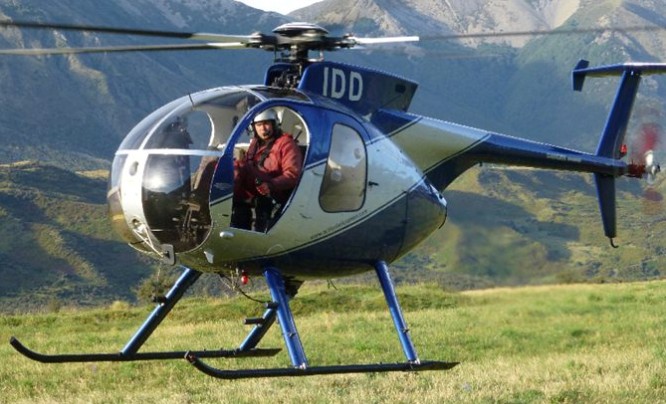
When the 500D finally was granted a type certificate in 1976, its test program had been as extensive and time consuming as the licensing of an original design. The 500D is an original design in ways that are significant to the operator: there’s a 28 percent in¬crease in useful internal load and a 12 per¬cent increase in maximum cruising speed over the 500C, which had been the fastest light helicopter. Projected maintenance costs have been reduced by extension of replacement and overhaul times for many costly components. Hughes anticipates that the main gearbox TBO (now 1,800 hours) will be raised to 5,000 hours; the C model gearbox’s TBO is 1,200 hours. After more flight time has been put on customer ships, Hughes expects the engine TBO to reach 3,000 hours, and the minimum time to replacement for any component will be 5,000 hours. With a maximum speed of 152 knots at reduced weights and a comfortable 140 knot cruise, the Hughes 500D has fixed wing cross country performance.
Breda Nardi Costruzioni Aeronautiche SpA was established on February 15, 1971 by Nardi SA per Costruzioni Aeronautiche, and Breda, a member company of the EFIM state-owned financial group, each with a 50 percent holding. Initiated manufacture of helicopters under a license granted by Hughes Helicopters, and is building the Hughes 300C, 500C, 500D, and 500M under the respective designations of Breda Nardi NH-300C, NH- 500C, NH-500D, and NH-500M-D (TOW). The last is a multirole military helicopter armed with TOW missiles.
The model 500E is essentially a 500D with a more streamlined nose, thereby giving the front seat passengers extra leg room, and larger tail fins. These should not be confused with the earlier 500E which was simply a 500 with an executive interior. Only a few were built.
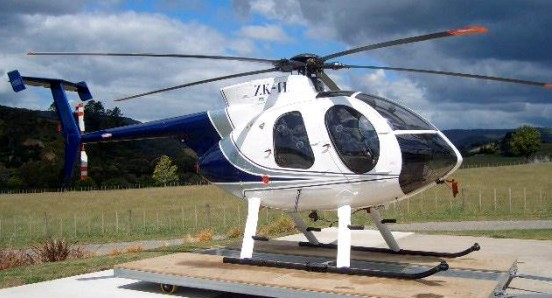
Model 500/530 Defender – A series of Defender military helicopters is based on the Model 500/530 civilian range. Avail¬able were the 500MD Scout Defender, which is the basic military variant armed with gun and rocket pods; the 500MD/TOW Defender with four TOW anti-tank missiles and standard stabilised sight or optional mast-mounted sight; the 500MD/ASW Defender with nose mounted search radar, towed MAD, and torpedo armament; and the 500MD Defender II multimission version, with optional mast-mounted sight, TOW and Stinger missiles, Flir, an infrared supression system, and upgraded avionics. The 500MG and 530MG Defenders, the latter with an uprated 317kW Allison 250-C30 engine, are multirole helicopters intended primarily for anti-armour and attack missions. The 530MG features an advanced cockpit and control system. Operational equipment is similar to that of the 500MD Defender, but in addition a Racal RAMS 3000 integrated control and display system, operating with a MIL 1553B digital databus, is used for adverse weather or nap-of-the-earth flying. A Nightfox version is also available for enhanced night operations, using Flir and night vision goggles.
The last 369E built under the Hughes name was cn 0179, all later being McDonnell Douglas Helicopters.
The 369FF is basically a 369F with an up-graded drive system.
February 19, 1999: Boeing sold MD commercial line to RDM The dutch company bought the ex-McDonnell Douglas models MD 500E and MD 530F single-engine helicopters with conventional tail rotors, the MD 520N and MD 600N single-engine NOTAR helicopters and the MD Explorer series of twin-engine, eight-place helicopters.
The 500C production stopped around the mid-1970s and by 2020 spares were becoming a concern and overhaul parts for gearboxes were getting harder to source as were main rotor drive shafts and anything with no commonality with the D and E models. There were options for PMA 500C booms and stabilisers.
H.369HM/HE/HS
Engine: Allison, 317 shp derated to 278 shp.
500C
Engine Allison 250 C20, 400 shp.
Takeoff power 278 shp.
Max continuous power 243 shp.
Shortest service life, limited component: tailboom 2,030 hrs.
Disc loading 4.68 lbs/sq ft.
Power loading 9.2 lbs./hp.
Max. sling load 1,600 lbs.
Seating 5/7.
Gross weight 2,550 lbs.
External load gross 3,000 lb.
Empty weight 1,240 lbs.
Useful load 1,310 lbs.
Fuel capacity 64 USG/412 lbs.
Overall length, including rotor disc 30.3 ft.
Height 8.5 ft.
Max. cruise speed, sea level 125 knots.
Max. cruise speed. 4,000 ft: 126 knots.
Max. range, sea level 300 nm.
Max. range, 4,000 ft 328 nm.
Max. rate of climb 1,700 fpm.
Service ceiling 14,500 ft.
HIGE 12,900 ft.
HOGE 6,700 ft.
Vne SL: 130kt, 6000ft: 142 kt.
Max side-wind hover 20 kt.
500D
Engine: Allison 250-C20B, 420 shp.
TBO: 1,500 hrs hot section, 3000 hrs.
Main rotor: five blade, fully articulating, 26.4 ft.
Seats: 5.
Length: 30.5 ft.
Height: 8.9 ft.
Max ramp weight: 3000 lbs.
Max takeoff weight: 3000 lbs.
Standard empty weight: 1620 lbs.
Max useful load: 1380 lbs.
Max landing weight: 3000 lbs.
Max sling load: 2000 lbs.
Disc loading: 5.5 lbs/sq.ft.
Power loading: 7.1 lbs/hp.
Usable fuel capacity 64 USG/432 lbs.
Max rate of climb: 1900 fpm.
Service ceiling: 15,000 ft.
Hover in ground effect: 8500 ft.
Hover out of ground effect: 7500 ft.
Max speed: 143 kts.
Maximum cruise 139 kts.
Economy cruise 130 kts.
Duration at max cruise 1.8 hrs.
Normal cruise @ 3000 ft: 143 kts.
Fuel flow @ normal cruise: 189 pph.
Endurance @ normal cruise: 2 hr.
Minimum time component tail rotor hub.
Minimum replacement time 2,440 hrs.
500M D
Engine: Allison 250 C18A turboshaft, 317 shp TO, 243 shp Max continuous
Rotor diameter: 26 ft 4 in / 8.03 m
Fuselage length: 23 ft 0 in / 7.01 m
Empty weight: 1088 lb / 493 kg
Max normal TOW: 2550 lb / 1157 kg
Max overload TOW: 3000 lb / 1360 kg
Max range cruise SL: 117 kt / 135 mph / 217 kph
ROC SL: 700 fpm / 518 m/min
Service ceiling: 14,400 ft / 4390 m
Range at 4000ft/1220m: 327 nm / 377 mi / 606 km
Seats: 5
Cabin length: 8 ft 0 in / 2.44 m
Cabin width: 4 ft 6 in / 1.37 m
Cabin height: 4 ft 3.5 in / 1.31 m
OH-6A Cayuse
Engine: one 317-shp (236-kW) Allison T63-A-5A turboshaft derated to 215 shp (160 kW).
Maximum speed 130 kts / 150 mph (241 kp h) at sea level
Cruising speed : 117 kts / 216 km/h
Initial climb rate 1,840 ft (561 m) per minute
Service ceiling 15,800 ft (4,815 m
Range 413 miles (665 km).
Empty weight: 1,156 lb (524 kg)
Maximum take¬off weight: 2,700 lb (1,225 kg).
Main rotor diameter 26 ft 4 in (8.03 m)
Length overall, rotors turning 30 ft 9.5 in (9.39 m)
Fuselage length: 22.999 ft / 7.01 m
Height 8 ft 1.5 in (2.48 m)
Main rotor disc area 544.63 sq ft (50.60 sq.m).
Payload: four passengers or 431kg freight.
Hughes 369E (500E)
Engine: Allison 250-C20B, 420 hp.
MD500E
Engine: 1 x Allison 250-C20R, 280 kW (375 shp).
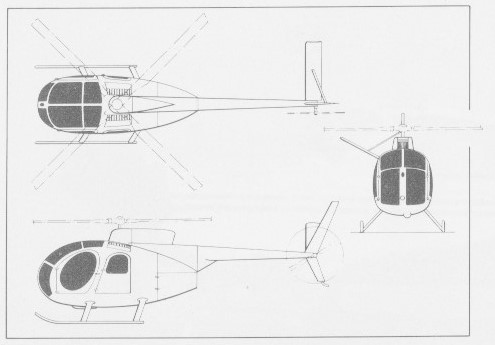

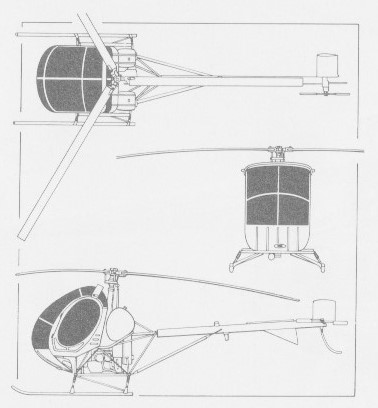
The Hughes 269 program was conceived in 1955 as a private venture 180 hp Hughes 269 of the Hughes Tool Company in ultra light helicopters first flown in October 1956 and emerged in production form during 1961 as the two place 269A, the 200. The moderately low price range of $25,000 to $30,000 stimulated the concept of small helicopters for training, short range transportation and patrol work. By 1963, production of the 269A had reached approximately one per day, and a three seat version was developed. The earlier models had a smaller, high speed rotor but this did not prove very successful and in the late 1950s the 269B with an uprated Lycoming engine and a lower speed tail rotor was developed, as a three seater. Certificated as the 269B, this helicopter incorporated minor changes such as a fuel injected version of the original 180 hp Lycoming engine used on the 269A and three and a half inches more main rotor diameter for improved autorotation performance. The 269B was marketed as the Hughes 300, but only the addition of the third seat squeezed between the two existing seats of the 269A was new. The fuel-injected 180 hp Lycoming and the slightly enlarged rotor blades actually were part of the refined 269A, which had the engineering designation of 269A 1 and was sold as the Hughes 200. The two place Model 200 and its three place companion, the Model 300, each had a gross takeoff weight of 1,670 pounds, an increase of 120 pounds over the original 269A.
Very early in the 269 program, five pre-production helicopters were sold to the U.S. Army for evaluation as a command and observation vehicle. The YHO 2HU, as these 269s were called, demonstrated that the small Hughes could satisfy the Army’s increasing need for light helicopters and paved the way to several sizable orders for a military trainer version of the Hughes 200. Designated the TH 55A Osage, this aircraft actually had an empty weight nearly 100 pounds higher than that of its civilian counterpart and a gross weight of 1,600 pounds, down 70 from the Model 200. The high demand for helicopter pilots during the Viet Nam war led to the purchase of approximately 800 TH-55As.
About 1600 were subsequently built for the US Army and the US military have clocked up over four million hours in the 269.
The improved 269B, known as the Series 300, came along in 1963 and, after 461 were built, came the updated 269C model 300C in 1970. The 300C, certificated officially as the 269C in 1970, was the most pronounced change in the development of the 269 family. Like the 300, it is a three place helicopter, and it possesses all the physical characteristics of the Hughes lineage. The powerplant, however, is the Lycoming HIO 360 D1A, which is normally rated at 225 hp but limited to 190 hp for this installation. The 300C can develop takeoff power, with no time limitations, at altitudes up to 4,250 feet under standard atmospheric conditions. Although only slightly larger than its older brothers, the 300C has increased dimensions where it counts in the rotor blades. Its three blade, fully articulated main rotor system cuts out a disc 26 feet 10 inches in diameter compared with 25 feet three and a half inches for the TH 55A or the Hughes 269A 1. The tail rotor also has been increased in size from three feet four inches to four feet three inches, and the tail boom has been lengthened by one foot two and a half inches. These changes provide greater anti torque control power. The most noticeable change in the 300C’s appearance, however, is the six inches of additional mast height it has compared with older models.
The additional power and increased rotor size give the 300C a useful internal load 39 percent greater than the 269B’s and 79 percent greater than the TH 55A’s. Gross weight for the 300C is 2,050 pounds in the normal category and 2,150 for external load operations; empty weight is listed at 1,046 pounds. Adding normal accessories, including nav/com equipment and a heater, usually increases that last figure by about 75 pounds.
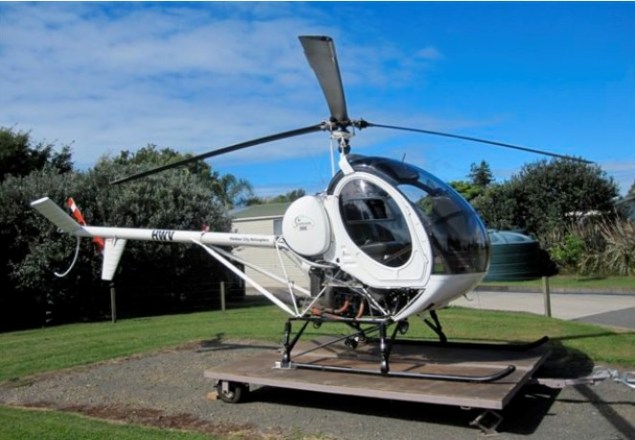
Also licence built by BredNardi in Italy.
In 1987 the Schweizer Aircraft Corporation of New York exercised an option with McDonnell Douglas Helicopter Corporation to purchase the Model 300C programme. Sales of the 300C having tripled from 1983 to 1987, when Schweizer took over licence production of the type.
Some 2,800 Hughes 300s of all versions were built before the design was purchased by Schweizer Aircraft in November 1986. As well as supporting the TH-55A Osage used by the US Army and building new Model 300Cs, Schweizer sold 48 TH-300C trainers to the Thai Army and concluded an agreement for production in Jordan.
The 300C remained in production by Schweizer Aircraft of New York in 1988. In 1995 Schweizer developed the 300CB as a competitor to the R22, with the 180 hp engine, a change to right hand PIC and some minor airframe changes, with increased life. The 300CB is a 300C re-engineered for the training market. Up-graded components include the instrument panel and tailboom. The main rotor blades, head and elastomeric dampers all being 300C components. With operating rpm now at a much reduced 2,700, the result was an extension of the engine’s TBO to 2,200 hours for a drop in power of only about 10 hp.
Schweizer 300CBi is powered by a 180-hp Lycoming HIO-360-GIA, fuel injected.
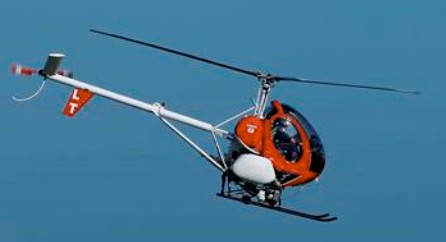
Breda Nardi Costruzioni Aeronautiche SpA was established on February 15,1971 by Nardi SA per Costruzioni Aeronautiche, and Breda, a member company of the EFIM state-owned financial group, each with a 50 percent holding. Initiated manufacture of helicopters under a license granted by Hughes Helicopters, and was building the Hughes 300C, 500C, 500D, and 500M under the respective designations of Breda Nardi NH-300C, NH- 500C, NH-500D, and NH-500M-D (TOW).
Sky Knight
Engines: Lycoming HIO-360-D1A, 190 hp.
Seats: 2/3.
Disc loading: 3.63 lb/sq.ft.
Pwr loading: 10.8 lb/hp.
Max TO wt: 2050 lb.
Empty wt: 1178 lb.
Equipped useful load: 810 lb.
Payload max fuel: 516 lb.
Range max fuel/ cruise: 201 nm/2.4 hr.
Range max fuel / range: 278 nm/ 4.2 hr.
Service ceiling: 10,000 ft.
Max cruise: 81 kt.
Max range cruise: 67 kt.
ROC: 750 fpm.
HIGE: 5900 ft.
HOGE: 2700 ft.
Max sling load: 850 lb.
Fuel cap: 180/294 lb.
H.269A – Engine: 180 hp.
Seats: 2.
H.269B 300
Engine: Lycoming HIO-360-A1A, 180 hp
Rotor diameter: 25 ft 3.5 in / 7.71 m
MAUW: 1670 lbs.
Seats: 3.
300C
Engine Lycoming HIO 360 1D1A, derated to 190 hp.
TBO: 1,200 hrs.
Main rotor diameter: 26 ft. 10 in / 8.18 m
Length: 22 ft. 2 in.
Length overall: 30 ft 11 in / 9.42 m
Height 8ft 9in.
Disc loading 3.63 lbs./sq.ft.
Seats 3.
Empty weight 1,046 lbs.
Useful load 1,004 lbs.
Payload with standard fuel 824 lbs.
Gross weight 2,050 lbs.
Power loading 10.8 lb/hp.
Fuel capacity (standard) 30 USG/180 lbs.
Fuel capacity (optional) 49 USG/294 lbs.
Rate of climb: 800 fpm.
Service ceiling: 12,00 ft / 3660 m
Vne 91 knots.
Max Cruise 5000ft / 1525m: 87 kt / 100 mph / 161 kph
Economy cruise 64 knots.
Range (max cruise (45 min res, std tanks) 112 nm.
Range economy cruise, (45 min res, std tanks): 141 nm.
Duration a max cruise (no res, std tanks) 2.3 hrs.
HIGE 6,000 ft.
HOGE 2,700 ft
Cabin length: 4 ft 7 in / 1.40 m
Cabin width: 4 ft 3 in / 1.30 m
Cabin height: 4 ft 4 in / 1.42 m
H.269C 300C/TH-300C
Engine: Lycoming HIO-360-D1A, 190 hp (142 kW).
TBO: 1500 hrs.
Main rotor: 26.8 ft.
Seats: 3.
Length: 22.2 ft.
Height: 8.8 ft.
Max ramp weight: 2050 lbs.
Max takeoff weight: 2050 lbs.
Standard empty weight: 1148 lbs.
Max useful load: 902 lbs.
Max landing weight: 2050 lbs.
Max sling load: 900 lbs.
Disc loading: 3.6 lbs/sq.ft.
Power loading: 10.8 lbs/hp.
Max usable fuel: 294 lbs.
Max rate of climb: 800 fpm.
Service ceiling: 12,200 ft.
Hover in ground effect: 5900 ft.
Hover out of ground effect: 2700 ft.
Max speed: 87 kts.
Normal cruise @ 3000 ft: 87 kts.
Fuel flow @ normal cruise: 67 pph.
Endurance @ normal cruise: 4.3 hr.
300CB
Engine: 1 x Lycoming HO-360-C1A, 180 hp.
Instant pwr: 134 kW.
Rotor dia: 8.18 m.
MTOW: 534 kg.
Useful load: 210 kg.
Max speed: 94 kts.
Max cruise: 83 kts.
HIGE: 7700 ft.
HOGE: 5600 ft.
Crew: 1.
Pax: 2.
300Cbi
Engine: 1 x Lycoming HIO-360-G1A, 180 hp.
Empty wt: 1200 lb.
MAUW: 1750 lb.
Max usable fuel: 294 lbs.
Endurance: 3 hr.
TH 55 Osage
Engine: Lycoming HIO-360-B1A, 178 hp
Overall length: 28 ft 11 in / 8.8 m
Fuselage length: 21.883 ft / 6.67 m
Height: 8.235 ft / 2.51 m
Rotor diameter: 25.295 ft / 7.710 m
Max take off weight: 1598.6 lb / 725.0 kg
Weight empty: 1009.9 lb / 458.0 kg
Max. speed: 75 kts / 138 km/h / 90 mph
Cruising speed: 61 kts / 113 km/h
Service ceiling: 11893 ft / 3625 m
Range: 173 nm / 320 km
Range (max. weight): 173 nm / 320 km
Crew: 2

Between 1949-1952 the Hughes Aircraft Company built and tested the XH-17 heavylift helicopter, designed as a “flying crane” for the USAF. The largest helicopter ever built, the XH-17 was originally a Kellett design.
First flown in 1949, it was subsequently abandoned; but test-flying was restarted late in 1954.
Power: 2x 5,000 lb. thrust Allison J35 turbojets.
Rotors: 2-blade tip-powered main; 2-blade tail.
Rotor diameter: 130 ft.
Loaded weight: 52,000 lb.
Ceilng: 15,000 ft.
Typical range: 40 miles at 60 mph
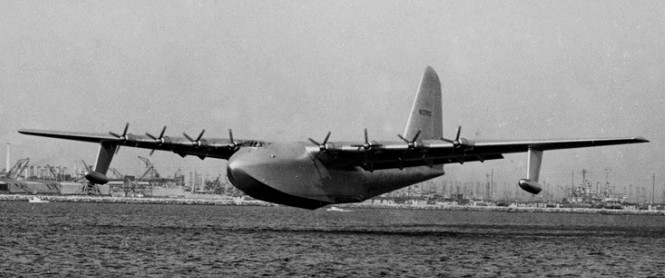
American shipbuilder Henry Kaiser introduced the Liberty ship but the vessels were being sunk prompting him to think of a massive cargo aircraft. Initially rebuffed by the US Government, Kaiser sought a partnership that would lend credence to his plan. That partner was Howard Hughes. Howard Hughes sponsored the Hughes H-4 Hercules. Made entirely of wood, almost entirely of laminated birch, this eight-engined flying-boat had the greatest wingspan (320 ft; 97.54 m) of any aircraft built to date.
The aircraft was not completed until September 1945. The design problems which Hughes and his team encountered in creating a 183 tonne (180 ton) aircraft from non strategic materials delayed the project until after the war, assembly began in June 1946.
House movers being engaged to transport its 66.75 m (219 m) laminated plywood hull along specially laid roads from Culver City, California to Terminal Island, Long Beach where final assembly began.
On 2 November 1947 Hughes boarded the Hercules, started the eight 3000 hp Pratt & Whitney Wasp Major engines and taxied out into the bay, ostensibly for water handling tests. Once on the open water, however, Hughes opened up the Spruce Goose’s and took off, flying for about 0.6 km (1 mile), for less than a minute, at a height of 70 feet (21 m) at a speed of 80 mph (128 kph).
The Hercules never flew again. It was stored in a specially constructed hangar at Long Beach, where it remains today, heavily guarded by Hughes employees, the largest aircraft ever to fly. Some say that having proved his point that the machine could fly, Hughes simply lost interest; others claim that even in those few brief moments of flight the Hercules creaked and groaned and handled so badly that Hughes never dared fly it again.
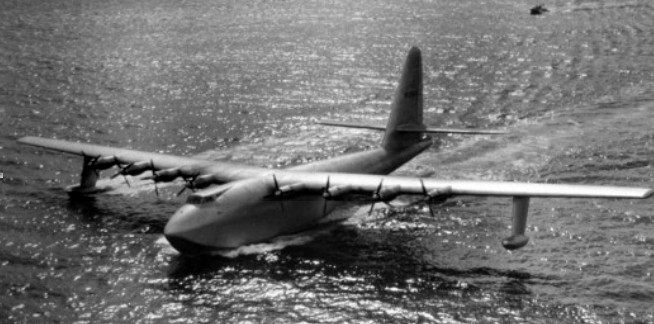
Engines: 8 x 3,000 h.p. Pratt & Whitney R-4360-4A radial. Replaced in 1951 by P&W Wasp Major TS13-3Gs.
Propellers: 8 x Hamilton Standard 24F60-35s
Prop diameter: 17ft 2in diameter (Engine No 4 had a 16ft 2in-diameter)
Wingspan: 320ft 0in
Tailplane span: 113ft 6in
Wing area: 11,430 sq.ft
Maximum wing thickness: 11ft 6in
Length: 218ft 6.25in
Height overall: 79ft 3 3/8in
Fuselage height 30ft 0in
Payload: 180,0001b
Maximum weight: 400,0001b
Internal fuel: 14,000 USgal
Maximum speed: 218 m.p.h.
Cruising speed: 175 m.p.h.
Alighting speed: 78 m.p.h.
Maximum range: 3,500 miles
Service ceiling: 24,000ft (300,0001b gross weight)
Rate of climb: 700ft/min to 1,000ft/min, depending on weight
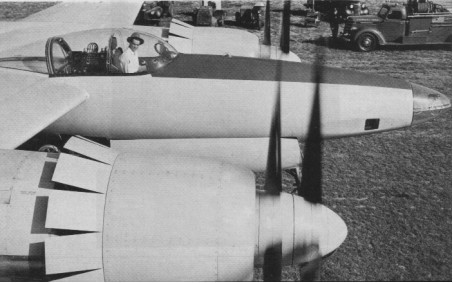
The Hughes XF-11 experimental twin-engined, twin-boom photo-reconnaissance aircraft, which had contrarotating propellers, crashed on its maiden flight, seriously injuring Hughes.
The XF 11 was a candidate for a military contract.
On July 7,1946, Hughes took his XF 11 reconnaissance airplane on its first flight. Though photographed in the plane just before the test, he intended the flight to be secret. The contra-rotating props developed problems, and the plane crashed, seriously injuring Hughes. Full power. Release brakes. Rolling. Lifting off. Climbing. Everything perfect. Power reduction. Right props slip into reverse pitch. Fierce asymmetric thrust (one second). Feathering in-op (two seconds). Try to hold heading (three seconds). Back on right, full power on left (four seconds). No good, back on both (five seconds). Crash.
On April 15, 1947, Hughes successfully test flew a second version of the XF 11, this one with single rotation airscrews, and personally conducted most of the test program.
 All Aero