HWL Pegaz

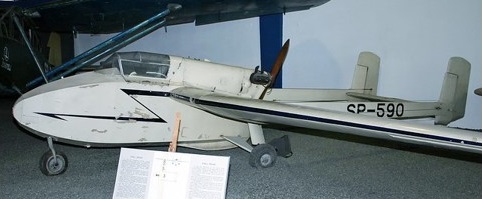
HWL Pegaz SP-590

During 1945 and 1946, Tadeusz Chyliński took part in a competition of the Civil Aviation Department for developing a training motor glider. He won first prize for his project, the HWL Pegaz motor glider. From 1946 to 1947, Tadeusz Chyliński based on an agreement with the Department of Civil Aviation (Departament Lotnictwa Cywilnego) with the help of Bronisław Żurakowski, developed the construction plans for the “Pegaz”. The motor glider was designed to train class “C” glider pilots in stand-alone (without dual-controls) motor piloting, as well as for training and pursuing aeronautic sports in inexpensive aircraft.

The engine for the “Pegaz” was designed by Stefan Gajecki, who was well known for designing skimming boat motors. Construction began on the “Pegaz” at the HWL (Harcerskie Warsztaty Lotnicze – Scouts’ Aircraft Works) in Warsaw.

In 1948, the work was taken over by Warsaw’s Gocław Aircraft Plant 6. The motor glider (one for flying and two unassembled) was finished in spring of 1948. The engineless plane was on display at the Aviation Day in 1948.

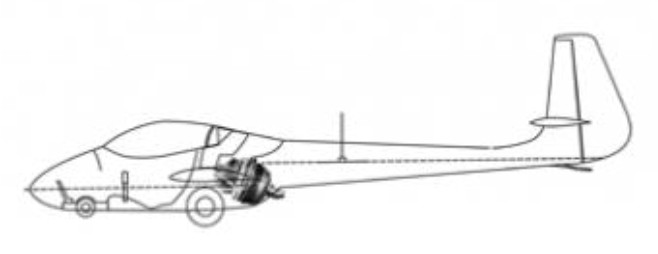
It is a dual-boom monoplane with pusher propeller, three-wheel landing gear with forward steerable wheel, all wood construction. The fuselage is composed of a laminated-wood-sheathed pod containing an enclosed cabin, the engine and two lateral laminated-wood-sheathed boom joining the wing with the directional and diving rudder. The fuselage pod is hexagonal. The instrument panel is fitted with an airspeed indicator, altimeter and vertical speed indicator, a magnetic compass, turn indicator, ignition switch and fuel pump. The cabin also features an air throttle valve and decompressor, a fuel gauge and fuel valve. The motor glider is steered by a stick and rudder bar. The pilot’s seat is made to accommodate a backpack parachute.

The wooden cantilever wing is sheathed in laminated wood and canvas. The wing is a right-angle trapezoid with rounded tips and has three structural sections: a central section and two removable outer sections joined to the central section by three pins. The dual-spar central section is unitized with the fuselage pod and tail booms. The removable monospar outer sections have an oblique auxiliary spar. The canvas-sheathed slotted ailerons are aerodynamically-compensated, differentially displaced 30° upward and 18° downward. The wing has a fixed slot at the edge of attack.

The twin vertical tail is located at the boom tips. The elevator unit is located between them. The monospar fins are sheathed in laminated wood. The control surfaces on the wooden frame are canvas-sheathed.

The three-wheel landing gear has a forward steerable wheel. The main landing gear is tri-strutted with rubber-string shock absorbers. The wheel tires are low-pressured. The aft of the fuselage pod between the wheels is protected against major deflection of the landing gear by an ashwood skin with an inner-tube shock absorber.

The motor glider is powered by an XL-GAD prototype engine. It is a four-cylinder flat two-cycle air-cooled engine. Two cylinders have a decompressor to facilitate startup. The wooden pusher propeller has a fixed pitch and diameter of 1.42 meters. The 30-liter fuel tank is located to the fore of the engine.

The “Pegaz” was painted a cream color. The wing’s edge of attack, registration number and fuselage arrow were painted navy blue.

“Pegaz” was test-flown on July 16, 1949, piloted by Bronisław Żurakowski and Jerzy Szymankiewicz. The factory and certification test were conducted at the National Aviation Institute in Warsaw and completed in May 1950. “Pegaz” was in three air shows on Aviation Day in 1949, 50, 51.

The “Pegaz” proved to be very safe and easy to pilot during testing and operation. It was stable in every axis with the controls released. By stalling and releasing the stick with the engine running, the motor glider was able to make about decreasing changes in velocity, going into a fixed climb rate of 1.5 m/s with a trajectory speed of 90 km/h. Also by stalling and releasing the stick with the engine throttled, the velocity amplitude changed two to three times, after which the aircraft went into a fixed glide at a speed of 110 km/h and a descent rate of 2.0 m/s. When stalled with the rudder released, the motor glider displayed no tendency to spin. It was hard to get the “Pegaz” to go into a tailspin. The speed necessary to go into a tailspin was 55 km/h, with an altitude loss at one spin of 75 meters. Landing speed was 130 km/h. The motor glider performed acrobatic figures with a gravity load range up to 4 g. It could do loops at a speed of 125 km/h without losing altitude and ended loops with the same speed. The “Pegaz” behaved totally normal in dives at 210 km/h.

At first, the plan was to build 80 “Pegaz” planes for various flying clubs. “Pegaz” passed the National Approval Test with a very good rating, however it was never put into production. There was the order from the USSR to stop work on national aviation projects. The “Pegaz” was assigned the registration number SP-590 and was given to the Warsaw Aviation Club to use, piloted by many glider pilots. It has been on display at Polish Aviation Museum in Kraków since August 1964.

HWL Pegaz (SP-590
Engine: 1 × XL-GAD prototype air-cooled 4-cylinder flat engine, 31 hp (23 kW)
Wingspan: 11.70 m (38 ft 4⅝ in)
Wing area: 14.80 m² (159.25 ft²)
Length: 6.85 m (22 ft 5⅝ in)
Height: 1.60m (5ft 3 in)
Empty weight: 290 kg (639 lb)
Loaded weight: 397 kg (893 lb)
Maximum speed: 129 km/h (69 kt, 80 mph)
Cruise speed: 110 km/h (59 kt, 68mph)
Stall speed: 59 km/h (32 kt, 37 mph)
Range: 275 km (148 nm, 171 mi)
Service ceiling: 3,000 m (9,843 ft)
Rate of climb: 2.0 m/s (394 ft/min)
Crew: 1, pilot
Hutter H30

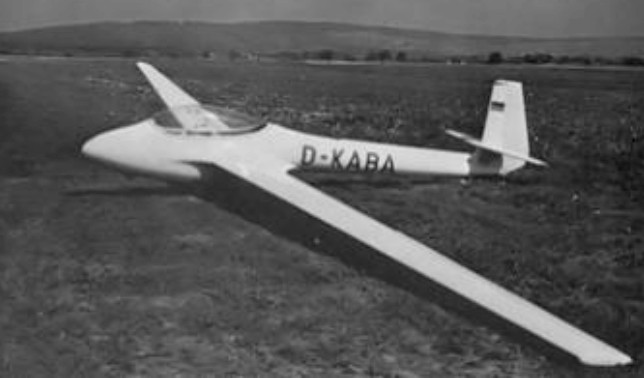
Hütter 30 TS [Turbinensegler]

In 1954 Eugen Hänle was then Assistant Professor Ulrich Hütter in a company engaged in the manufacture of large wind turbines for electricity production. The design of the 17 meter blades used fiber reinforced plastic glass.

With this experience, Eugen Hänle, established Glasflügel in 1957, to produce helicopter rotor blades for Bölkow.

Meanwhile, he began with his wife Ursula, the construction of a 1946 Wolfgang Hütter H30 glider. The plans were followed, but replacing the plywood – balsa sandwich for all the shell (fuselage, wing, fin) by a balsa sandwich – laminate, and the first unidirectional fiberglass wing and epoxy resin spar .

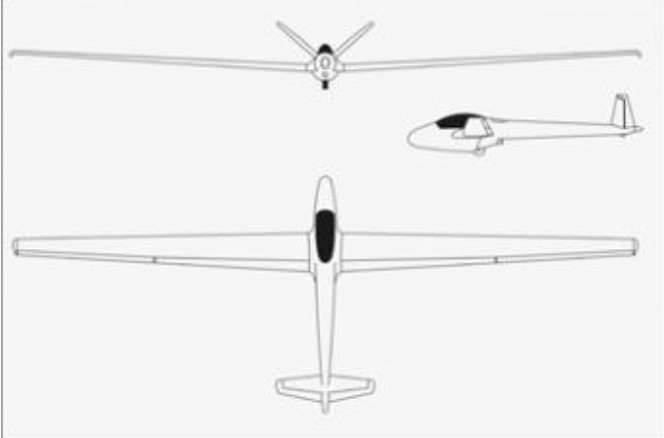
The H-30, with a 13.60 m wingspan, was started in late 1957 and finished in 1960.

Meanwhile, Eugen Hütter had developed the H-30TS glider, derived from the H-30, with a modified fuselage to accommodate a small BMW turbojet and a new wing of 15 m with plastic flaps, but with glued aluminum sheet metal spar.

Hütter 30 TS [Turbinensegler]

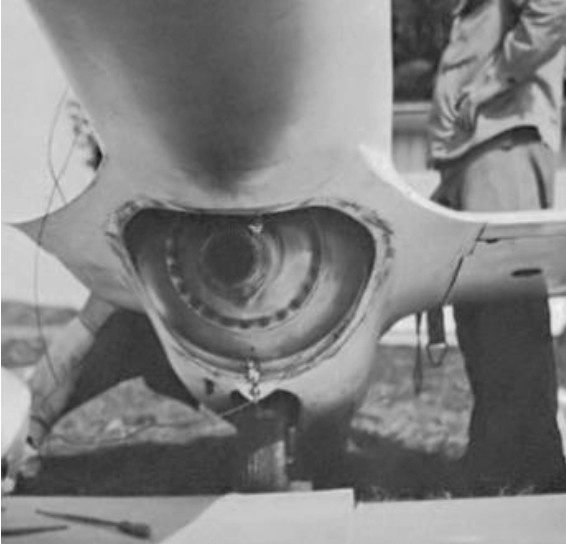
The H30 TS was first fitted with a BMW 6011 (8025) turbojet of 36 kg thrust to 45,000 rev/min in September 1959. Then, in May 1961, following major modification, it was to be equipped with a BMW 6012 (8026) 40 Kp thrust to 46,000 rev / min .

Hütter 30 TS [Turbinensegler]

Due to problems with the turbine and especially the noise it produced, the project was stopped and the unit was re- turned as a pure glider. He was lost in August 1968 following an accident during a winch launch.

Hänle then used the molds to produce wings in the Schempp-Hirth workshop. Two sets of wings with glass fiber spar were made. One of the wings was the first H-301 libel, other than the first Swiss Diamond, with its original 15 m wingspan.

Gallery

Hütter 30 TS [Turbinensegler]
Engine: BMW 6011 (8025), 36 kg thrust to 45,000 rpm
Wingspan: 15.00 m / 49 ft 2.5 in
Length: 5.70 m / 18 ft 8.5 in
Height: 1.02 m / 3 ft 4.5 in
Max rate of climb: 150 m/min / 490 ft/min
Min sink: 0.60 m/sec / 1.97 ft/sec
Practical ceiling: 2500 m / 8200 ft

Hütter 30 TS [Turbinensegler]

Hurlburt Hurricane / Camburn Special

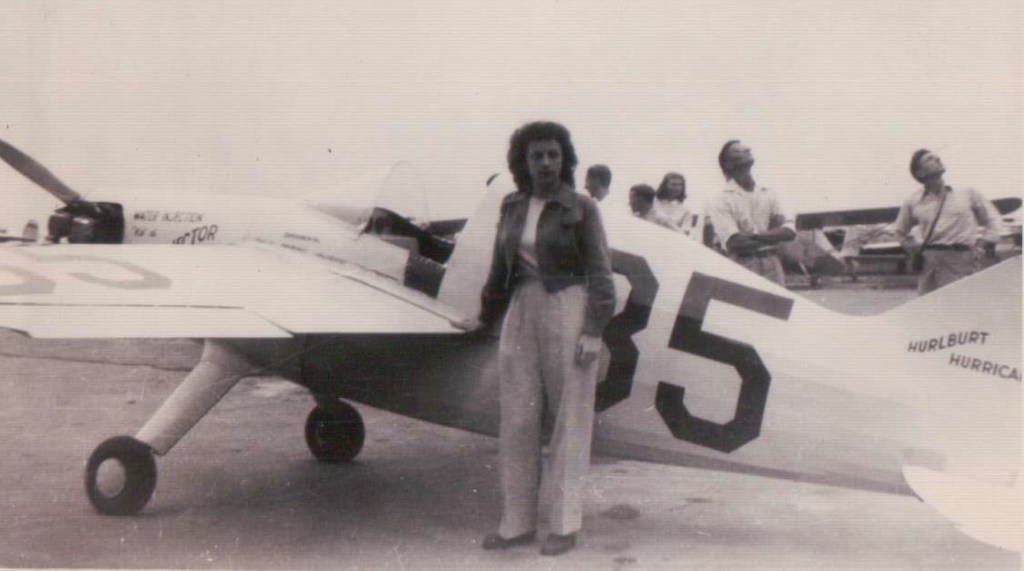
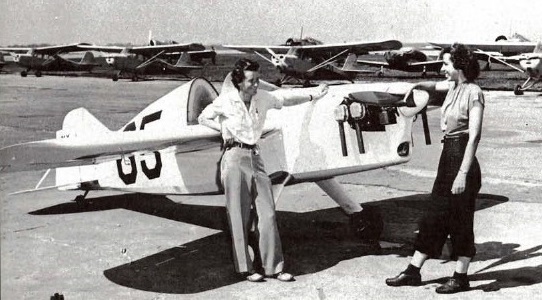
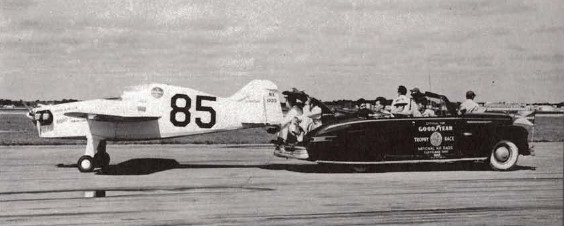
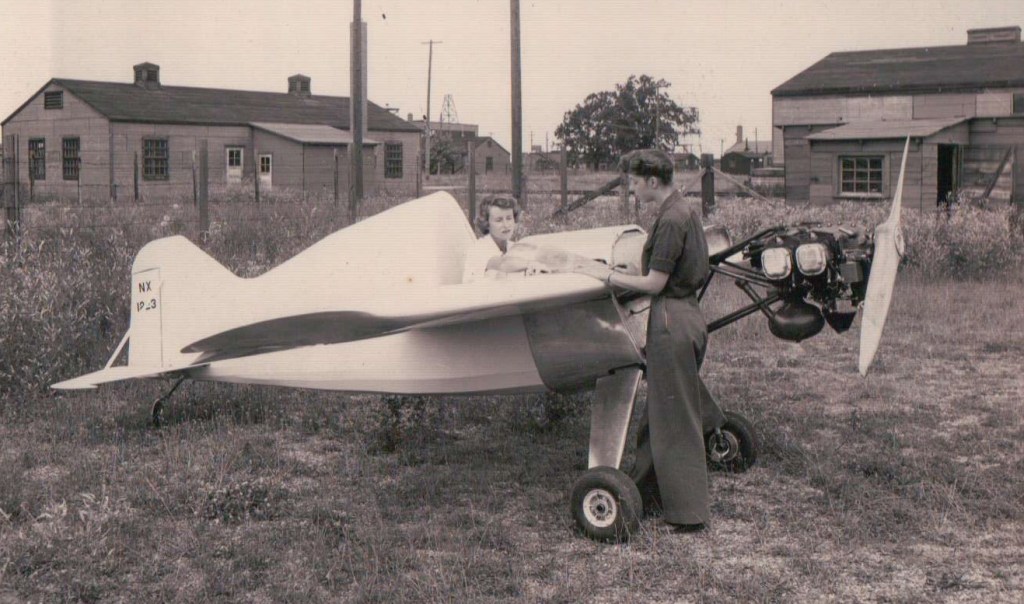
The Hurlburt Hurricane NX1223 of 1947 was designed and built by Marge Hurlburt, Anna Logan, and Duke Caldwell as midget racer #85.

Powered by an 85hp Continental C-85, the Hurricane was barred from Goodyear competition because the event was restricted to male pilots.

1947

Owned by Anna Logan and Mildred Caldwell of Cleveland, Eugene ‘Joe’ Smith flew the Hurricane in 1947.

The craft was later named the Camburn Special after Marge’s death. Eventually it was flown as Camburn Special in some competitions by Eugene “Joe” Smith.

Hurel-Dubois

France
Formed to develop Maurice Hurel’s theories on high aspect- ratio wings. His first design, the Hurel-Dubois HD- 10 single-engined research aircraft, flew in 1948 and led to a twin-engined derivative, the HD-31. Production versions included the HD-32 transport, HD-33 freighter and HD-34 photo-survey aircraft for the Institut Geographique National. While still active in the French aviation industry, the company is no longer an aircraft constructor.

Hurel Aviette

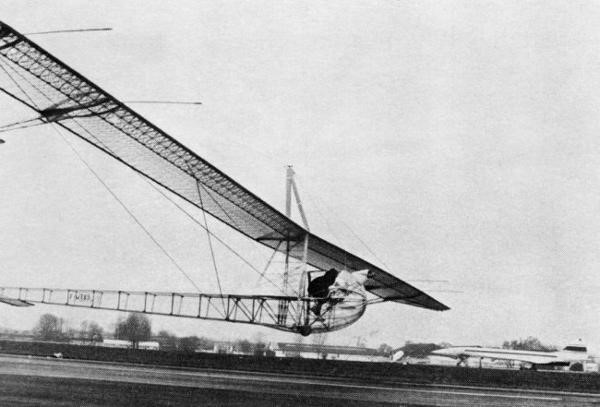
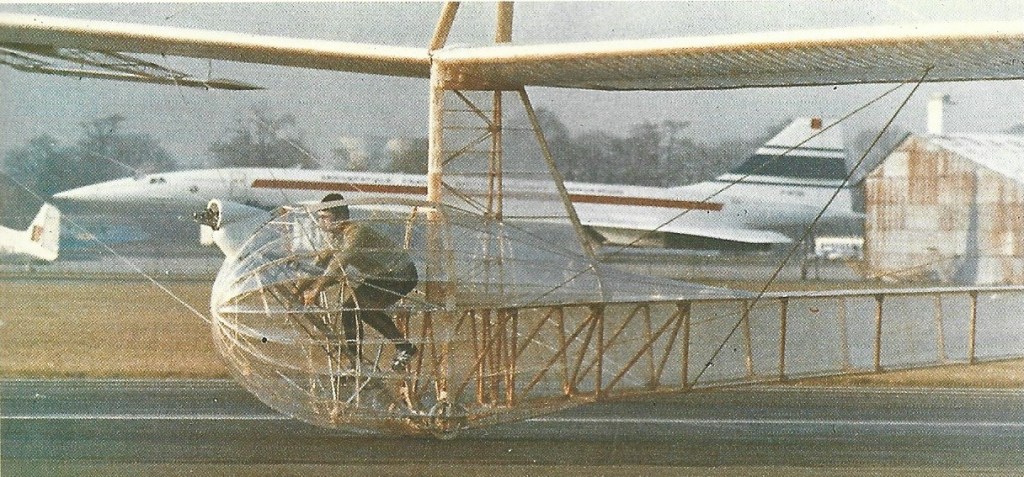
On the Aviette, Hurel used an aerodynamic solution to a structural problem. On this plane stabilising surfaces were attached on mini-tail-booms behind each outer wing. Just as the effect of a tailplane is to tend to return the entire aircraft to a level attitude from a non-level attitude, so the effect of these surfaces is to tend to hold the wing-tips at a constant angle relative to the airflow. The conventional constructional techniques of the time were used, materials being spruce, Balsa and Melinex.

Hurel’s 1976 Aviette aircraft had a 137 feet (42 m) span and a 12 feet (3.7 m) diameter propeller.

The Aviette flew at Le Bourget, largely through national recognition of the designer’s contribution to industry throughout his working life.

In 1974 the Aviette recorded flights of 1100 yards (1000 m).

The French entry to the Kremer Prize, the Hurel Aviette, might have been going into a museum. Unfortunately, at the time of the 1973 Paris Air Show, the airplane had to be moved from its hangar. Exposed to the elements, it was promptly chewed up by a dog.

Hunting H.126

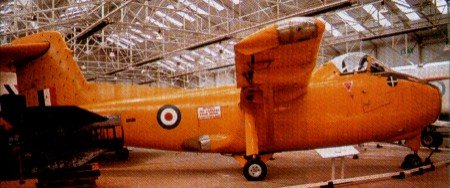
The Hunting H.126 was a one-off single-seat research aircraft with fixed tricycle landing gear designed to test the effects of directing the jet exhaust air across the flaps and control surfaces to increase lift, or as they were known in Britain, “jet flaps”. The exhaust efflux of a turbojet engine is ducted to the trailing edge of an aircraft’s wings and ejected through a narrow slit along the trailing edge. As well as being used to provide propulsion, the efflux can be deflected downward to form a “jet-flap” of high velocity gas which makes possible the achievement of lift coefficients of 10 or more. The shoulder-level wing featured a set of struts, not for support but in order to provide piping for the compressed air used in the blown flaps. A maxi¬mum of 60% of the jet exhaust can be directed to the wings and a further 10% to reaction jets in the tail and wingtips.

The H.126 first flew on 26 March 1963, being flown in a series of one-hundred test flights at the Royal Aircraft Establishment’s Aerodynamics Flight at RAE Bedford by mid-1965 with the program ending in 1967. After two years storage it was sent to the United States in 1969 for wind tunnel testing by NASA returning in May 1970. Stored for another two years it was struck off charge in September 1972 and eventually made its way to the RAF Museum at RAF Cosford.

A notice inside the cockpit reads “The airspeed must not fall below 28 knots”.

Powerplant: one Bristol Siddeley Orpheus turbojet.

Hunting

The Percival light aircraft manufacturing company became part of the Canadian-owned Hunting Group in 1954. Production was undertaken of the Percival P.56 Provost trainer for the RAF and several overseas forces. A turbine-powered derivative, the P.84 Jet Provost, flew shortly after the merger and was delivered to the RAF subsequently as its standard basic jet trainer. This eventually continued in production in much-modified form as the BAC Strikemaster. The Percival P.50 Prince twin-engined light transport was manufactured for civilian operators, as the Pembroke C.1 for the RAF, Swedish Air Force, Luftwaffe, and several other air arms, and as the Sea Prince for the Fleet Air Arm. An executive President variant was manufactured in small numbers after the company became Hunting Aircraft Ltd.
In 1957 the Hunting-Percival Company was renamed Hunting Aircraft and continued with production of the Provost, Jet Provost, Prince, Pembroke, and Sea Prince before being absorbed by the British Aircraft Corporation. BAC had a controlling interest in the company on its formation in 1960, and acquired the remaining shares in 1964.