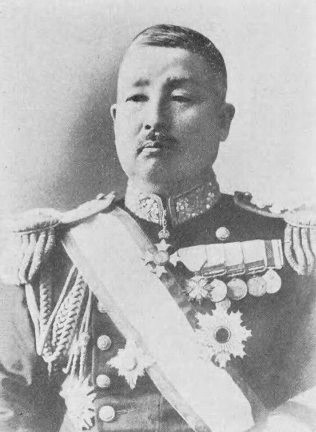
Itoh Aeroplane Research Studio / ltoh Hikoki Kenkyusho

Otojiro Itoh

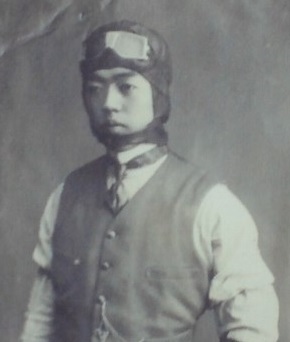
Itô was born in in southern Osaka. While employed as a young man by the Sadoshima Copper and Iron Company in his hometown of Osaka, Otojiro Itoh (伊藤音次郎, Itô Otojirô) (June 3, 1891 – December 26, 1971) became inspired with flight when seeing the Wright brothers’ success in a film. ‘

In September 1909, after reading an article about the new biplane developed by Sanji Narahara, Itô wrote a letter to Narahara pleading to be employed as a pilot. At Narahara’s urging, Itô began taking night classes on mechanical engineering at the Kôshu Gakko (now Kogakuin University). He continued to maintain a correspondence with Narahara for many years.

At the age of 19, in 1910, ltoh left home and moved to Tokyo where he worked as a mechanic at the Narahara aeroplane company. Impressed with his eagerness and interest in aviation, Narahara made ltoh an assistant to Einosuke Shirato, who had worked exclusively for Narahara as a pilot. This association was interrupted when Itoh reached the age of 20 because, like all other young Japanese men, he was conscripted for a one year term of service in the military. Upon returning to Narahara in 1912, he assisted in the manufacture of the aeroplanes and accompanied demonstration flights around Japan as a ground crewman.

In February 1915, following Narahara Sanji’s departure from the aviation community, Itô established the Itô Aircraft Research Center in present day Mihama Ward of Chiba City.
As spare-time employment, ltoh assisted Shigesaburo Torigai with the manufacture of the Torigai Hayabusa-go Aeroplane which eventually crashed in September 1913. ltoh borrowed this aeroplane, quit his job and moved with the aeroplane to Inage, on Tokyo Bay just north of Chiba City. There he made repairs and modifications to the aeroplane, and began to learn to fly with the help of two others. The sandy beach there proved an excellent runway, but its availability was dependent upon the height of the tide. After three months of flying training, maintaining and repairing his own aircraft, he had accumulated a total of a mere 3 hours of flying.

Pilot licences, or, for that matter, any regulations concerning flying and aeroplanes were yet to come. Therefore, Itoh established a flying school on the beach at Inage in February 1915, and called it the ltoh Kyodo Hiko Renshusho (Itoh Co-operative Flight Training Ground). The ltoh Aeroplane Research Studio and Training Ground were both known to the public as ltoh Airfield. For flying training, he used the Torigai Hayabusa-go Aeroplane after it had been modified. To supplement his income, Itoh joined part time with Shirato, formerly with the Narahara company, who now was building his own aeroplanes. This added income allowed ltoh to begin his commercial construction of aircraft and by the autumn of 1915 he completed his first; the Itoh Emi I.

In November 1915, Itô finished construction of an airplane named after himself and his hometown, the “Itô-Emi Type 1.” On January 8, 1916, Itô flew his aircraft over Tokyo, making him famous among Japanese aviators. After Itô’s aircraft facility suffered severe damage from winds and flooding in late September 1917, he moved his operation to Tsunanuma-chô (now Naraishino City), and reestablished his business under the name “Itô Aircraft Manufacturing.” Among the pilots that Itô trained was Tadashi Hyōdō, the first Japanese woman to earn her pilot’s license, and Inoue Chôichi, who established the Japan Air Freight Corporation.
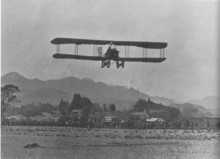
Ito-Emi type 1

When the Asahi News Corporation established the Tôsai Teiki Airlines in 1923, Itô Aircraft Manufacturing provided both aircraft and pilots, thereby contributing to civil aviation transportation. In 1930, Itô established the Japan Light Aircraft Club and appointed Sanji Narahara as club president, which contributed to the spread of lighter-than-air aircraft in Japan.

Although Itô was one of the few successful aviators to come from a purely civil aviation background, he withdrew from the world of aviation following the ban on all aviation activities from the GHQ after the Occupation of Japan. Itô established a farming cooperative with volunteers drawn from the former workers at his factory in 1948, and moved to Tôyama Village in Chiba Prefecture (now Tôhô, Narita City) to open up new farmland as part of the post-war land reclamation project.

Despite the great effort expended by Itô’s group to cultivate land that had once been bamboo forest, their farm was eventually included in the area designated for the Tokyo International Airport (now Narita International Airport). The sudden announcement of this plan was devastating for many local residents, some of whom participated in the Sanrizuka Struggle, but it was said that Itô alone of all the area’s residents welcomed the arrival of the airport. Although he had put his energy into farming, Itô willingly agreed to sell his land, and was among the first to sign a contract with the airport organization.
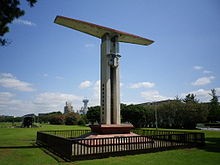
Memorial to the birthplace of civil aviation

Afterwards, Itô put his energy into the establishment of the Civil Aviation Memorial in Inage Seaside Park. The journals and written records that Itô left behind were eventually used by author Hiragi Kunio. On December 26, 1971, Itô died at the age of 80.
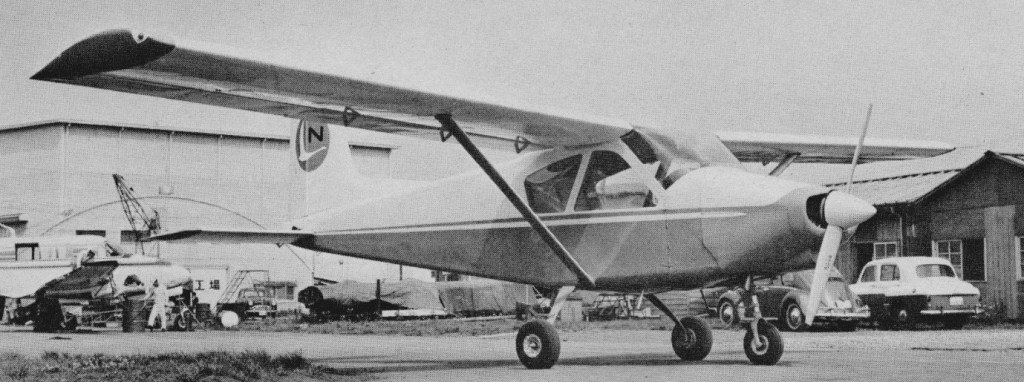
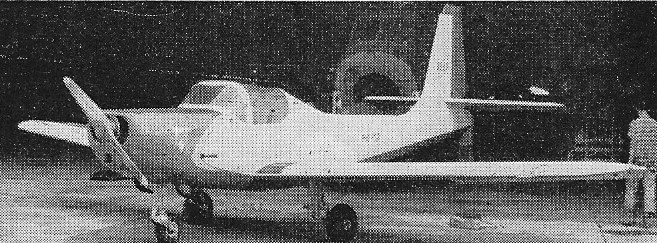
Itoh Chu Koku Seibi Kabushiki Kaisha

Japan
Established in December 1952 as Itoh Chu Koku Seibi Kabushiki Kaisha to maintain and repair light aircraft. In 1960 produced the N-58 Cygnet light cabin monoplane designed by students at Nihon University. Aided in development of, and produced, N-62 Eaglet four-seater also designed at Nihon University. Late in 1968 converted a number of North American T-6 Texan trainers to represent Nakajima B5N torpedo-bombers for film Tora! Tora! Tora! Adopted Shin Nihon Koku Seibi Kabushiki Kaisha name on May 29,1970, thereafter concentrating on manufacture of aircraft equipment.

IST/PAF ARDA XL-17 Musang

The XL-17 ” Musang” (Wildcat) is the fourth aircraft in the series designed and constructed by the Institute of Science and Technology of Manila in the Philippine Republic, and is part of a programme to test the application of local materials, such as home-grown woods, to aircraft structure. During their experiments the Institute developed a material which it called “Wobex”. “Wobex” consists of diagonally woven strips of thin bamboo glued together, made air tight and leakproof, and finished on the surface with a layer of fine sawdust and glue. Its main use is as a stressed skin covering.

In the mid-1950s the Philippine Institute of Science and Technology (I.S.T.) designed the single engine, tricycle undercarriage, low wing monoplane L-17 was one of them.

Designed by Antonio J. de Leon, its wing was a single-piece wooden structure with 5° of dihedral and a straight-tapered plan. It was plywood-covered and had split flaps inboard of the ailerons. The cantilever tail unit was similarly constructed with the straight-tapered horizontal surfaces on top of the extreme aft fuselage; the single-piece elevator carried an offset trim tab. The vertical tail was tall and straight-edged; the bottom of the horn balanced rudder was above the elevator and just aft of its hinge, with a small cut-out to allow for elevator deflection.

Fuselage is a one-piece semi-monocoque structure with wooden bulkheads and stringers covered by a “Wobex ” skin, which in turn is covered with fabric for final finishing and polishing. Fuel tanks are fitted aft of the seats and the rest of the fuselage space can be used as either a radio compartment or as baggage space. The engine mount is the standard truss-type with attachments at four points to the firewall bulkhead, which is reinforced for the attachment of the nose landing gear. The cantilever wing is trapezoid in form and of one-piece construction that tapers in chord and length. It is made up of one main and one auxiliary spar of box-type construction and reinforced diagonal spar. The leading edge is covered with a thick plywood covering to take torsional and chordwise shear loads. Overall wing covering is fabric. Slotted type ailerons are fitted and simple split flaps are located under the wings between the ailerons and the fuselage. The wing root upper section upper covering is reinforced to serve as a step and walkway to the cockpit. A tricycle undercarriage is fitted, the main gear to the main wing spars and the nose gear to the firewall bulkhead.

Cockpit seating two side by side under a single piece canopy. A 108 hp (80 kW) Lycoming O-235-C1 flat-four engine drove a two-blade propeller. The fixed tricycle undercarriage had rearward-sloping oleo legs mounted to the wings, giving a track of 2.40 m (7 ft 10 in).

The first flight of the L-17 was scheduled for May 1956.

Engine: 1 × Lycoming O-235-C1, 81 kW (108 hp)
Propeller: 2-bladed , fixed pitch, wooden
Wingspan: 9.60 m (31 ft 6 in)
Wing area: 13.40 m2 (144.2 sq ft)
Airfoil: US 35B at root, NACA 23012 tip
Length: 7.20 m (23 ft 7 in)
Height: 3.20 m (10 ft 6 in)
Empty weight: 510 kg (1,124 lb)
Gross weight: 735 kg (1,620 lb)
Fuel capacity: 68 L (15 Imp gal, 18 US gal)
Maximum speed: 210 km/h (130 mph, 110 kn)
Cruise speed: 175 km/h (109 mph, 94 kn)
Stall: 80 kph
Rate of climb: 3.8 m/s (750 ft/min)
Crew: 2

IST/PAF ARDA XL-15 Tagak

In the early 1950s in the Philippines, the Institute of Science and Technology (I.S.T., previously known as the Bureau of Science) designed at least three different prototypes, both to investigate the scope for local aircraft design and production and to examine the use of indigenous materials in their construction. One such material of interest was Wobex (Woven bamboo experimental), a reinforced woven bamboo.

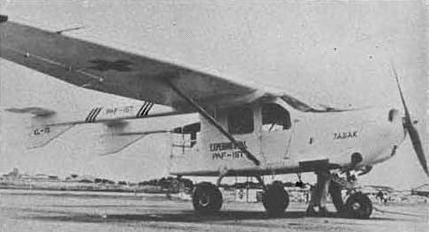
The XL-15 Tagak was the second of these prototypes, developed in collaboration with the Philippine Air Force, it was designed by Antonio J. de Leon as a utility, liaison or ambulance aircraft and as a test bed for the use of local materials in aviation. It was a single-engine, high-wing monoplane with a twin-boom layout and tricycle undercarriage to enable easy access to the fuselage pod via rear doors. The inner wing sections, fitted with slotted flaps on the trailing edges had constant chord but further out the wings tapered, with slotted ailerons. There was a single lift strut on each side between wing and lower fuselage, with an airfoil profile to add to the lift from the wings.

The fuselage of the Tagak was a wood and plywood framed semi-monocoque skinned with Wobex and ply. Its cabin, behind the 185 hp Lycoming flat six engine, was 3.26 m (10 ft 6 in) long to the rear of the pod. There were two front seats under the wing leading edge, two more behind and room for one or two (stacked) stretcher cases. The cabin had two windows on each side and the rear part of the pod, which projected behind the wing trailing edge, was also extensively glazed. The two tail booms, of all ply construction, were integral with the wing centre section. The fins, with long chord underside fillets, were integral with the booms. The tailplane was rectangular and extended beyond the fins, carrying a horn balanced elevator. The fixed surfaces were of wood and ply construction, with Wobex covering; control surfaces were fabric covered.

Flight testing of the Tagak began in October 1954. By 1956 some small modifications had been made: rudder area was increased and a shimmy-damper added to the nosewheel leg.

Only one was built.

Engine: 1 × Lycoming O-425A, 138 kW (185 hp)
Propeller: 2-bladed fixed pitch
Wingspan: 12.0 m (39 ft 4 in)
Wing area: 20.30 m2 (218.5 sq ft)
Airfoil: NACA 23012 (inner section), USA 35B outer section
Length: 9.15 m (30 ft 0 in)
Height: 2.80 m (9 ft 2 in)
Empty weight: 780 kg (1,720 lb)
Gross weight: 1,250 kg (2,756 lb)
Fuel capacity: 174 L (38 Imp gal, 46 US gal)
Maximum speed: 200 km/h (120 mph, 110 kn)
Cruise speed: 158 km/h (98 mph, 85 kn)
Range: 675 km (419 mi, 364 nmi)
Service ceiling: 4,000 m (13,000 ft)
Rate of climb: 3.0 m/s (590 ft/min)
Seats: 4

IST/PAF ARDA XL-10B Balang / Grasshopper

The XL-10B Balang (Grasshopper) was a powered glider joint project of Institute of Science and Technology (IST) and Philippine Air Force (PAF) Air Research and Development Authority (ARDA).

It first flew in 1953.

Engine: 20 hp
Wingspan: 12 m
Length: 5.20 m
Height: 1.5 m
Aspect ratio: 8.1
Wing area: 17.8 sq,m
Empty weight: 185 kg
Loaded weight: 280 kg
Max speed: 125 kph
Cruise speed: 72-80 kph
Stall: 49 kph
Glide speed: 75 mph

I.S.T.XL-14 Maya

In the early 1950s in the Republic of the Philippines, the Institute of Science and Technology (I.S.T., previously known as the Bureau of Science) designed at least three different prototypes, both to investigate the scope for local aircraft design and production and to examine the use of indigenous materials in their construction. One such material of interest was Wobex (Woven bamboo experimental), a reinforced woven bamboo.

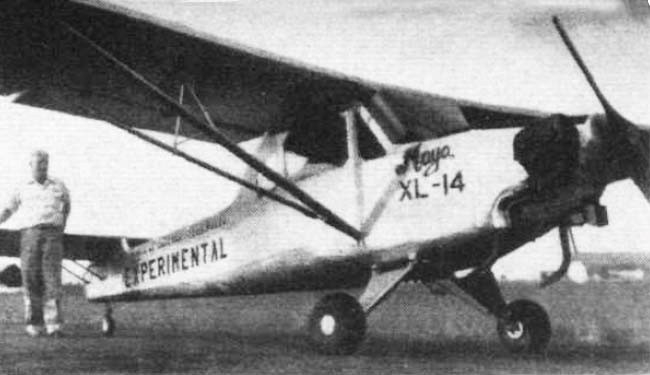
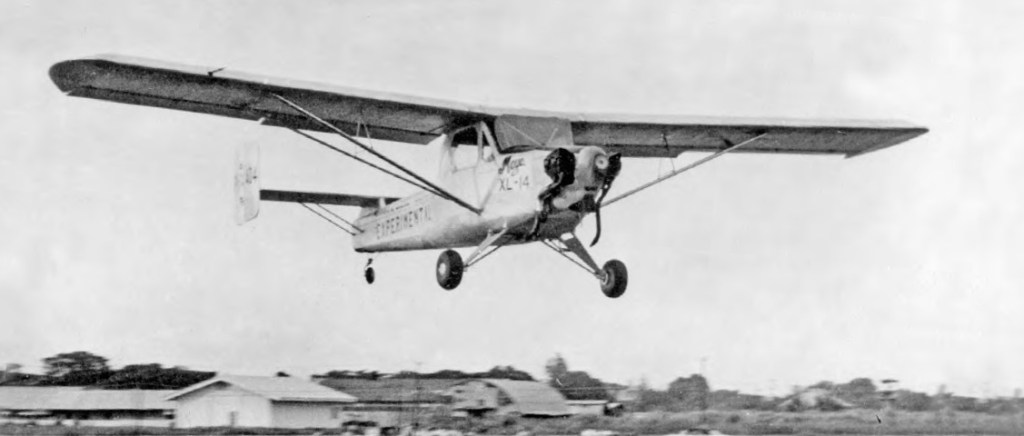
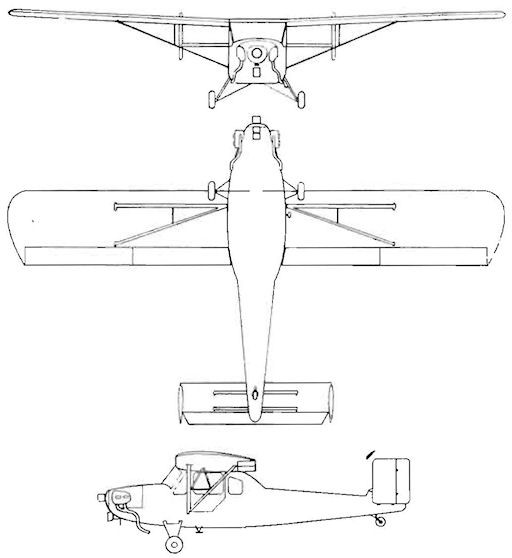
Designed by Antonio J. de Leon, the XL-14 Maya (until 1995 the Maya was the national bird of the Philippines) was the first of this series of prototypes. It was a single-engine, high-wing monoplane of standard layout except for its twin tail. The wing had constant chord and was built around two parallel, solid spars and wooden ribs. The leading edges were covered and reinforced with Wobex and the rest of the wing was fabric covered. The centre section was integral with the cabin top and the outer wings were braced on each side with V struts from the wing spars to the lower fuselage. Ailerons and slotted flaps were fitted. It had a strut braced tailplane, set slightly above the fuselage top on a short pylon. The tailplane carried almost rectangular endplate fins and rudders. The tail structure was wooden with fabric covering.

The Maya, bearing its experimental category registration PI-X-104 on its fins, had a semi-monocoque fuselage with wooden stringers and Wobex mat covering. The cabin stood above the rear fuselage line, enclosing side-by-side seats with a third, occasional seat, or luggage space, behind. In front a 75 kW (100 hp) Lycoming flat four engine, with cylinder-heads exposed, drove a two-blade propeller. It had a conventional undercarriage, with each mainwheel mounted on V-struts and half axles hinged to the fuselage central underside via rubber shock absorbers. The fixed tailwheel was steerable.

The date of the Maya’s first flight is not known, though the aircraft was complete by May 1955 and a later design, the XL-15 Tagak was being flight tested by October 1954. Only one Maya was built, for although it was described as being suitable for agricultural use and for utility and observation work, its function was always as a constructional material experimental aircraft.

Engine: 1 × Lycoming O-235-2, 75 kW (100 hp)
Propeller: 2-bladed wooden, fixed pitch
Wingspan: 10.24 m (33 ft 7 in)
Wing area: 16.0 sq,m (172 sq ft)
Length: 6.30 m (20 ft 8 in)
Height: 2.40 m (7 ft 10 in) tail up
Empty weight: 510 kg (1,124 lb)
Gross weight: 780 kg (1,720 lb)
Fuel capacity: 68 L (15 Imp gal, 18 US gal)
Maximum speed: 184 km/h (114 mph, 99 kn)
Cruise speed: 150 km/h (93 mph, 81 kn)
Range: 480 km (300 mi, 260 nmi)
Service ceiling: 3,820 m (12,530 ft)
Rate of climb: 3.6 m/s (710 ft/min) initial
Capacity: 2/3 (3rd passenger under 50kg (110 lb))