JAI / Deltaplanos Club Ikar / Ícaro

Delta Plane Club “Ikar” (Russian: Дельтапланерний клуб ХАИ Икар) – Delta flight club created in 1976 at the JAI as a section of the OSKB of Kharkov Aviation Institute.

The Ikar (Ícaro) deltaplane club was created in 1976 as a dependency of SKB JAI. Its objective was to interest students in the process of technical development of aviation in this new discipline that was only just gaining strength in those years. The decision to create the club as an independent unit within the OSKB was taken after the visit of the JHA team made up of Vladimir Selyukov and Igor Katckar at the Soviet Championship held in the USSR in 1976.

It was assigned to the new club and received a space in a workshop behind the Impulsos building, where it continues to operate. At that time students were not afraid to climb their deltaplanes to the second level via a narrow iron staircase with two landings. Nor is that a problem today, despite the fact that the new models have increased their dimensions and weights.

During the years of existence of the JAI Deltaplanes Club, more than 50 deltaplanes of all generations have been built. It is noteworthy that this club during the years of Soviet power was one of the leaders in the projection and construction of advanced deltaplanes. The club’s athletes frequently won awards and medals at Soviet and Republican events. More than 50 JAI students passed through the flight school.
After the fall of the USSR

During the process of the fall of the USSR the club did not cease its activities. Training flights were carried out every Sunday and lectures were given daily and the availability of flight material was maintained. All the weight of the training in the early 90’s fell on two copies of the Slabutich UT type, of which one had to be discharged in 1994, due to its physical condition. In 1998, the Oduvanchik sport deltaplane, designed and built by Sergei Agafonos, was also decommissioned. These deltaplanes in their time proved to be superior to most of the sports models of the time, which allowed JHA athletes to triumph in the USSR championships, Ukraine and those held in Crimea, Alma-Ata and the Caucasus. By the early 1990s, even the Sport-14 and Sport-15 models were already out of date and even with improvements, they were unable to compete with modern types. Maintained with scarce student resources, these devices managed to keep the club’s spirit alive and continue to develop the skills of the club’s new pilots.

It was clear to all that primary education could be achieved on any deltaplane, but once some experience was gained, obtaining a sports master’s degree was only possible using competitive models. With the support of the club members and with the help of several graduates of the institute, it was possible in 1998 to create the first Studient deltaplane , designed by JAI graduate Sergei Serguyev, but the enthusiasm does not generate funds, so the next The specimen could only be built after four years.
Actual state

In July 2002 another Studient was built and by August 2003 another training model could be built, this time with a smaller wing area and intended for light weight pilots.

A new sports model would only appear in October 2003 in the form of the excellent Stealth-JAI device, of which seven copies have been built.
Jacobs 104

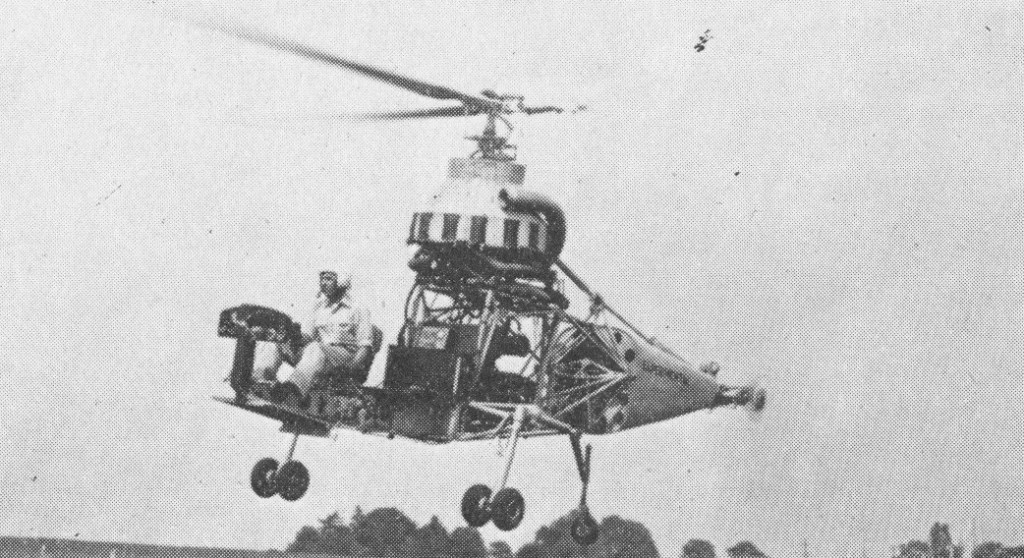
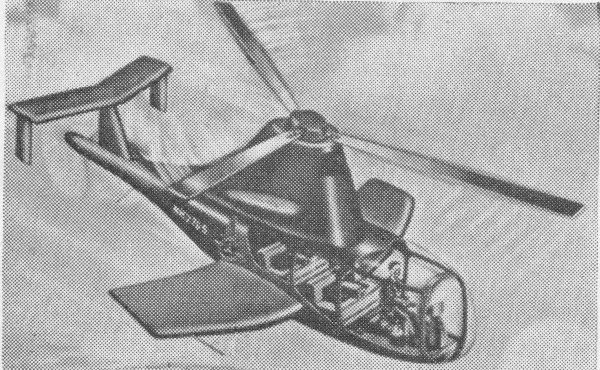
Designed circa 1958 as a high-speed short-haul aircraft, the Jacobs 104 was originally flown as a pure helicopter, as shown in the photograph above. Subsequently, a pusher propeller was fitted at the extreme tail.

It will take off as a helicopter; but in cruising flight it will be possible to transfer power to the pusher propeller, with the rotor auto-rotating and the majority of the lift coming from the fixed wings.

A feature of the Model 104 is the use of a Jacobs-designed engine “package”, consisting of the engine and complete transmission system. It is claimed to be 20 per cent lighter than conventional helicopter power plants, enabling one extra passenger to be carried. Also, by using moulded fibreglass and Plexiglass panels to cover the forward fuselage, high strength is combined with light weight, and the surface requires no painted or doped finish.

Engine: 350 h.p. Jacobs R-755EH
Rotor diameter: 36 ft.
Rotors: 3-blade main; 3-blade tail; 3-blade propeller.
Overall length: 26 ft. 4 in / 22 ft
Height: 10 ft 10 in
Empty weight: 2360 lb
Loaded weight: 3,475 lb.
Max. speed: 175 m.p.h.
Cruise: 157 mph
ROC: 1400 fpm
Typical range: 300 miles at 157 m.p.h.
Seats: 4-5.

Jackaroo Aircraft Thruxton Jackaroo

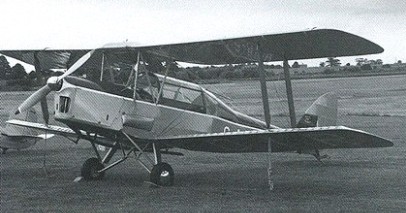
In the early 1950s Sqn Ldr J. E. Doran-Webb, managing director of the Wiltshire School of Flying at Thruxton, considered building a highwing four to five-seat touring aircraft using only Tiger Moth components. Contacts at the Royal Aero Club introduced him to Ronald Prizeman, who schemed a four-seater using the same biplane layout as a Tiger Moth but with a revised fuselage. This was accepted and formed the basis for certification as the D.H.82A (Mod) Jackaroo.
The front side frames of the Tiger Moth fuselage were moved apart by 12.5in within which four seats were installed, with the starboard pair staggered slightly forward. The basic structure and rigging of wings, tail and rear fuselage were not altered but it was necessary to increase the undercarriage track by designing a new W-shaped centre strut.
Two prototypes were built at Thruxton in 1956; G-AOEX was finished as a standard four-seater with cabin and known as a Series 1. It was test flown by Lt-Cdr Pat Shea-Simonds on March 2, 1957. The Series 2, G-AOEY, was conceived as a cargo carrier/cropduster. The cabin could be converted to carry a load of 5501b and a new low-profile superstructure neatly converted the Series 2 into a single-seater with open cockpit.

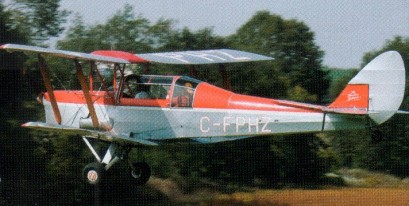
Jackaroo Aircraft Ltd was formed late 1950s at Thruxton, Hampshire, to produce the Thruxton Jackaroo widened-fuselage four-seat version of the de Havilland Tiger Moth. First “production” conversion flew on April 15, 1957, and quite a number of Tiger Moths were converted subsequently to Jackaroos. Company also designed a four-seat low-wing lightplane called the Paragon, being re-formed in early 1960s as Paragon Aircraft Ltd. to produce it under new name of Paladin.
Paragon was formed at Thruxton Aerodrome near Andover, Hampshire, from the earlier Jackaroo Aircraft Ltd., for conversion of standard two-seat Tiger Moth biplanes to four-seat configuration by inserting a new wider center fuselage and extending the top wing centre section. 18 Jackaroo conversions were carried out by the company.

By July 1957 the manufacturer was anticipating that production would reach at least six aircraft per month. An agricultural conversion kit was available at £150. Overseas owners were encouraged to convert their own Tiger Moths by purchasing a packaged kit at £600. Tiger Moths flown into Thruxton could be converted in ten days for £700.

Jackaroo Aircraft Thruxton Memories

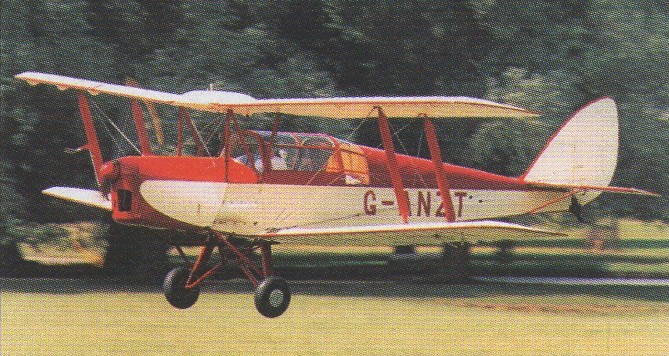
Rollason Aircraft at Croydon acquired Jackaroo G-ANZT in 1957, and incorporated a number of improvements. In April 1960 Rollason cornpleted a Jackaroo of its own, G-APOV, in which the rear fuselage faired smoothly from the wide cabin to the tail.
Although never certificated as aerobatic, the aircraft was spun on at least one occasion with all four seats occupied, an experience none of those on board ever wished to repeat.
The big prospective orders never came and import permits for five other Jackaroos already on the line at Thruxton were refused. Each was broken up for spare parts. Designer Ron Prizeman never complained however, despite never receiving his agreed royalty of £2 per aircraft

Assets acquired 1964 by Hampshire School of Flying.

Jackaroo Aircraft Ltd

UK
Jackaroo Aircraft Ltd was formed late 1950s at Thruxton, Hampshire, to produce the Thruxton Jackaroo widened-fuselage four-seat version of the de Havilland Tiger Moth. First “production” conversion flew on April 15, 1957, and quite a number of Tiger Moths were converted subsequently to Jackaroos. Company also designed a four-seat low-wing lightplane called the Paragon, being re-formed in early 1960s as Paragon Aircraft Ltd. to produce it under new name of Paladin.
Paragon was formed at Thruxton Aerodrome near Andover, Hampshire, from the earlier Jackaroo Aircraft Ltd., for conversion of standard two-seat Tiger Moth biplanes to four-seat configuration by inserting a new wider center fuselage and extending the top wing centre section. 18 Jackaroo conversions were carried out by the company, which also designed a light monoplane, the Paragon (subsequently Paladin), but this was not built. Assets acquired 1964 by Hampshire School of Flying.

Ivchenko AI-20

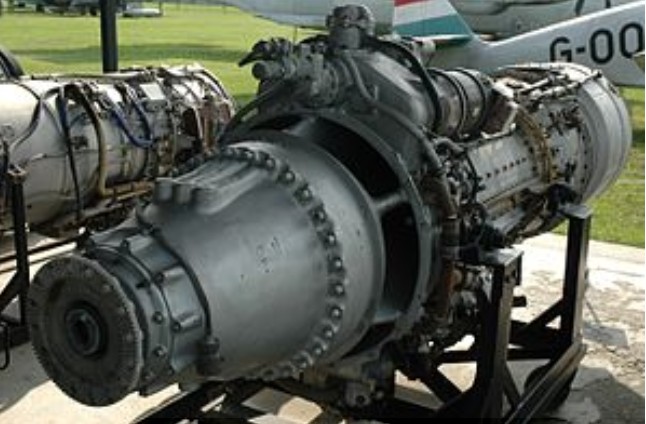
Ivchenko AI-20M turboprop

The Ivchenko AI-20 is a Soviet turboprop engine developed in the 1950s. It has been built in large numbers, serving as the powerplant for the Antonov An-12 transport and the Ilyushin Il-18 airliner.

The AI-20 was the first gas turbine engine developed by the design bureau led by Oleksandr Ivchenko based at Zaporozhye, Ukraine, which had previously concentrated on small piston engines such as the Ivchenko AI-14 and AI-26 radials. It was designed as a prospective powerplant for the new large Ilyushin Il-18 airliner and the Antonov An-10, to be powered by four turboprops, in competition with the Kuznetsov NK-4. Both engines were tried out on the pre-production batch of 20 Il-18s, but the Ivchenko engine was chosen for full production, possibly due to a crash caused by an in-flight failure of an NK-4 engine, and possibly due to the desire for the engines of the Ukrainian An-10 to also be built in Ukraine.

The AI-20 is a single shaft turboprop with a ten-stage axial compressor and a three stage power turbine, and is designed to run at a constant speed. The overhaul life of the engine was initially reported as 600–750 hours in 1964, but was later improved to 6,000–7,000 hours, with a service life of 20,000 hours.

It entered production at Zaporozhye and at Perm, USSR in 1958, also being built under licence in China as the WJ6. About 14,000 AI-20s have been built in total.

Applications:

AI-20
Antonov An-8
Antonov An-10
Antonov An-12
Antonov An-32
Beriev Be-12
Ilyushin Il-18
Ilyushin Il-38

WJ6
Shaanxi Y-8

Specifications:
AI-20M
Type: Single-shaft turboprop
Length: 3,096 mm (121.89 in)
Diameter:
Width: 842 mm (33.15 in)
Height:1,180 mm (46.46 in)
Dry weight: 1,140 kg (2,293 lb)
Compressor: 10 stage axial compressor with 4 bypass valves for starting and transient ratings
Combustors: Annular with 10 burner cones
Turbine: 3 stage axial flow
Oil system: Pressure type feed, fully recirculating
Maximum power output: 3,149 kW (4,250 ehp) (take-off), 1,938 kW (2,600 ehp) (max cruise)
Overall pressure ratio: 7.6:1 (take-off) to 9.2:1 (cruise)
Turbine inlet temperature: 900°C (1,652°F)
Power-to-weight ratio: 2.8 kW/kg (1.9 hp/lb) (take-off power)

Ivchenko AI-14 / Harbin / Dongan HS-6 / PZL-Kalisz AI-14 / Avia M462

AI-14R

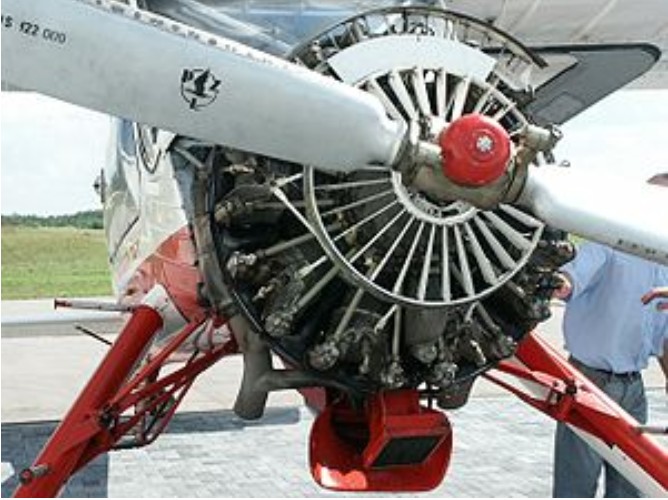
The Ivchenko AI-14 (Russian АИ-14) is a nine-cylinder, air-cooled, radial piston engine designed in the Soviet Union to power aircraft.

Its main variant is the AI-14R (АИ-14Р), which underwent state trials in December 1950 and was used in many types of light aircraft. Several thousand were built. There was also an AI-14V variant for helicopters and other applications. The AI-14R is typically used with a two-bladed propeller and is started with compressed air.

Apart from the Soviet Union, a licenced version of the AI-14R, (including the AI-14RA), has been produced by WSK-Kalisz in Poland from 1956 until 2007.

The AI-14RF was a variant uprated by Ivan Vedeneyev to 300 hp. Its further development is the Vedeneyev M14P family of engines.

Another modified version is the Czechoslovak Avia M462, which powers the Zlín Z 37 agricultural aircraft.

The Zhuzhou HS-6 was the designation for AI-14 Licence production in China.

Applications:
Aero L-60 Brigadýr (L-60S variant)
Antonov An-14 – AI-14RF
ICA IS-23 – AI-14RF
Kamov Ka-15 – AI-14V
Kamov Ka-18 – AI-14VF
Kamov Ka-26
Nanchang CJ-6
PZL-101 Gawron
PZL-104 Wilga
Sever-2 (aerosled based on GAZ-M20 Pobeda passenger car)
Yakovlev Yak-12
Yakovlev Yak-18 (Yak-18A variant)

Specifications:

Ivchenko AI-14
Type: 9-cylinder, air-cooled, radial, engine
Bore: 105mm (4.13in)
Stroke: 130mm (5.12in)
Displacement: 10.13 Liters (618 cu in)
Dry weight: 200kg (441lb)
Supercharger: Single stage, single speed, geared centrifugal supercharger
Fuel system: Carburetor
Cooling system: Air
Power output:
Power (take-off): 260 hp (194 kW)
Power (nominal): 220 hp (161 kW)
Compression ratio: 5.9:1