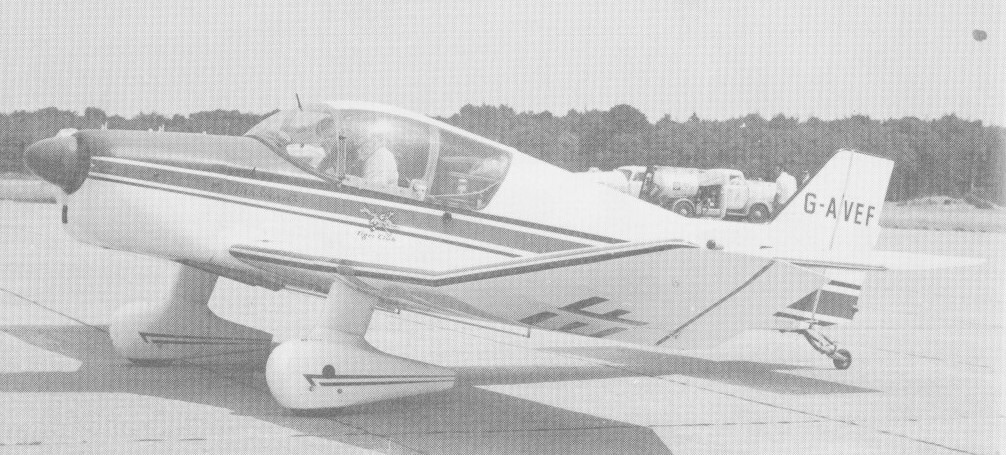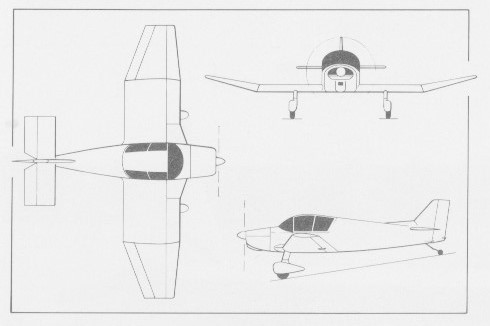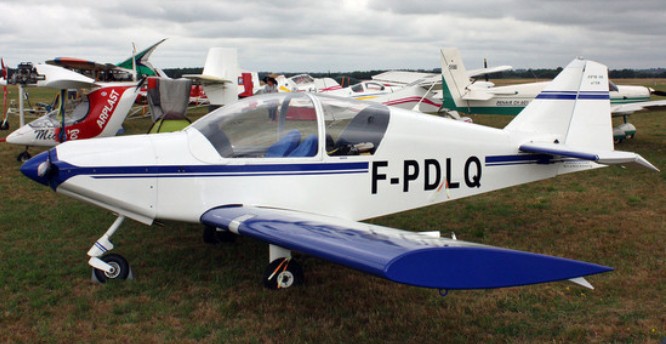
JPM 01 Médoc / Tanagra

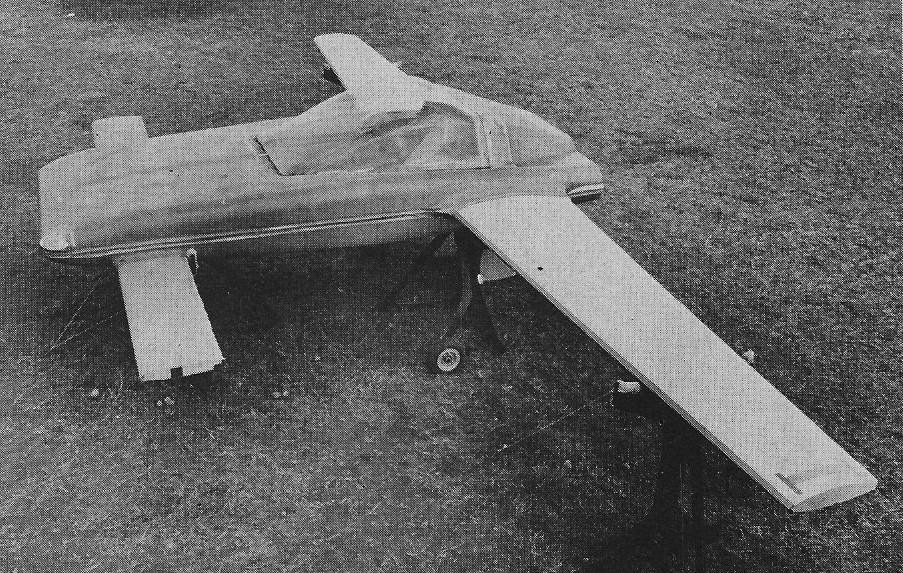
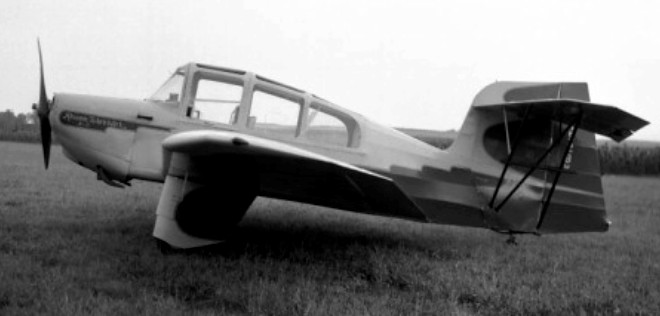
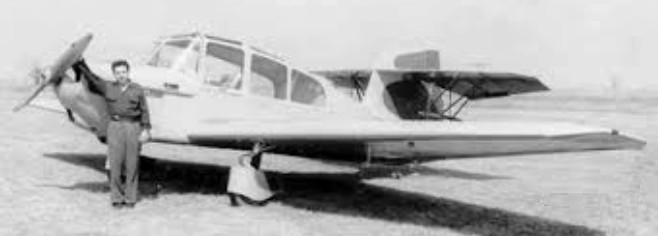
The JPM 01 Médoc is a French amateur-built aircraft that was designed by Jean-Pierre Marie in 1977 and produced by Les Avions Jean-Pierre Marie (JPM) of Le Mesnil-Esnard. The aircraft is supplied as plans for amateur construction, available in 2012 from Les Avions Jean-Pierre Marie (JPM).

The aircraft is named for the French community of Médoc.

The Médoc features a cantilever low-wing a two-seats-in-side-by-side configuration enclosed cockpit under a bubble canopy, fixed tricycle landing gear and a single engine in tractor configuration.

The aircraft is made from wood with its flying surfaces covered in doped aircraft fabric. Its 7.50 m (24.6 ft) span wing has an area of 9.30 sq.m (100.1 sq ft) and mounts flaps. Standard engines recommended are 60 kW (80 hp)-class Volkswagen air-cooled engines, including the 60 kW (80 hp) Limbach L2000 four-stroke powerplant.

The first example was completed by Pierre-Claude Guillem, and registered F-PGMB. It first flew on September 8, 1987. Originally fitted with a 65 hp JPX 4T-60A engine, it later received an 80 hp Limbach L2000 and the aircraft was winner of the 1988 SFACT Trophy for best multi place design. The JPM-01 built by the designer himself was first flown in August 1993, registered as F-PJPM.

A diesel engine powered version was designated JPM-01 Médoc Provence and the first example was completed by Didier Davenna in 2005. He had it registered as F-PDVN under the designation JPM-01 DDI. By mid-2012 at least fourteen Médocs has been built.

Almost forty years after its introduction the aircraft was redesigned and lightened, gaining slotted flaps to reduce stall speed.

JPM 01 Médoc / JPM-01 Tanagra
Engine: 1 × Limbach L2000, 60 kW (80 hp)
Length: 6 m (19 ft 8 in)
Wingspan: 7.50 m (24 ft 7 in)
Wing area: 9.30 sq.m (100.1 sq ft)
Empty weight: 286 kg (631 lb)
Gross weight: 496 kg (1,093 lb)
Fuel capacity: 60 litres (13 imp gal; 16 US gal)
Maximum speed: 210 km/h (130 mph; 113 kn)
Cruising speed: 175 km/h (109 mph; 94 kn)
Stall speed: 70 km/h (43 mph; 38 kn)
Never exceed speed: 247 km/h (153 mph; 133 kn)
Range: 700 km (435 mi; 378 nmi) with no reserve
Endurance: 4 hours plus 0.5 hour reserve
Service ceiling: 4,100 m (13,451 ft)
g limits: +3.5/–1.5
Rate of climb: 4 m/s (790 ft/min)
Wing loading: 53.3 kg/m2 (10.9 lb/sq ft)
Crew: one
Capacity: one passenger
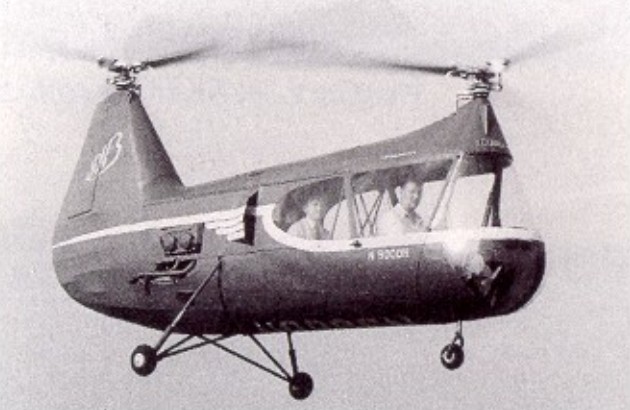
Jovair JOV-3 / Helicopter Engineering and Research Corporation JOV-3

JOV-3

Development began in 1946 with the Helicopter Engineering and Research Corporation headed by D.K. Jovanovich and F. Kozloski, where a small 2-seat prototype (N9000H) was built with the designation JOV-3. This aircraft, powered by a 125hp Lycoming O-290, was flown successfully in 1948. It had 3-blade rotors of 5.64m diameter, a gross weight of 618kg, a maximum speed of 161km/h and a range of 221km.

The JOV-3 Tandem rotor machine was powered by a 100hp Franklin engine. It had a neat fuselage of steel tube covered with aluminium and fabric, with a tricycle undercarriage and a forward cockpit for two occupants seated in tandem. The rear pylon allowed the rear rotor to turn on a higher plane than the forward rotor so that the arcs could overlap safely.

In 1949 Helicopter Division of McCulloch Motors Corporation appointed as chief designer D. K. Jovanovich, formerly of Helicopter Engineering and Research Corporation, who developed his JOV-3 as McCulloch MC-4 tandem rotor two-seat helicopter, first flown Los Angeles March 20, 1951.

Jovair / Helicopter Engineering Research Corp

The Helicopter Engineering Research Corp was formed in 1947 by D.K. Jovanovich and F.J. Kozloski who were former employees of the Piasecki Helicopter Corp. Their first design, the two-seat tandem rotor Jov-3, flew in 1947. The company was renamed J.O.V. Helicopters in 1948. The design rights were sold to McCulloch Motors in the same year for their new Helicopter Division, with Jovanovich as Chief Engineer.

The Aircraft Division of McCulloch Motors Corporation developed a slightly larger model, the MC-4C. Jovair Corporation was formed some years later and took the design a stage further, resulting in the Sedan 4E (certificated 1963), of which limited production began in 1965. In June 1962 Jovair flew the prototype J-2 two-seat light autogyro; both programs were taken over 1969-1970 by McCulloch Aircraft Corporation.

Jovanovich and Kozloski left McCulloch when the Airplane Division was closed, and formed Jovair Corp in 1957 to continue their work on helicopters.

Jongblood Primary

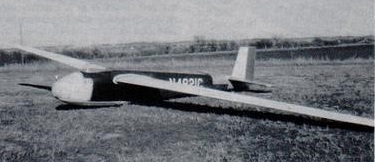
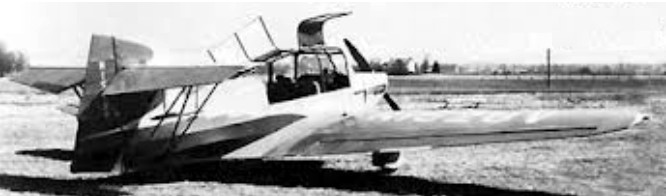
Mike Jongblood of southern California designed and built this single-seat, primary glider in 1966, with assistance from Hugh Knoop. The design was original and includes an original airfoil design as well, designated as a Jongblood II section.

The aircraft is built from wood and covered in doped aircraft fabric covering. The glider has a detachable pod to cover the pilot or can be flown open cockpit. It has a constant chord wing with a 4 ft (1.2 m) chord and a 32.5 ft (9.9 m) span. The wing features dual parallel struts and jury struts, but has no spoilers or other glidepath control devices. The tailplane is also strut-braced. Unlike most earlier primary glider designs that land on a fixed skid, this aircraft has a fixed monowheel.

The Primary had accumulated over 200 auto-tows and seven aerotows, along with nine hours of flying time, by the end of 1968 and by 1983 had flown 22 hours total. It had flown a single three-hour flight and had recorded a height gain of 8,000 ft (2,438 m).

The sole example constructed was reported as “in storage” in 1983. In May 2011 it was still on the Federal Aviation Administration registry listings, although its registration had expired on 31 March 2011.

Wingspan: 32 ft 6 in (9.91 m)
Wing area: 125 sq ft (11.6 m2)
Aspect ratio: 8:1
Airfoil: Jongblood II
Empty weight: 270 lb (122 kg)
Gross weight: 450 lb (204 kg)
Maximum glide ratio: 8:1 at 30 mph (48 km/h)
Crew: one

Johnson RHJ-6 Adastra

Johnson RHJ-6 Adastra N4921C

The Johnson RHJ-6 Adastra (English: Star) was conceived by Johnson as a mid-wing, two-place competition aircraft.

The aircraft was of mixed construction. The fuselage was built from wood and was a monocoque design. The wing had a wooden structure, with fiberglass leading edge. The tail surfaces were constructed of wood. The wings aft of the leading edge, the tail surfaces and all control surfaces were covered with doped aircraft fabric.

Originally the aircraft employed an Eppler 150 airfoil section, but Johnson later modified it by adding a 10% wing chord extension, turning the airfoil into an Eppler 151. Later new wings were built with an Eppler 414 airfoil to improve low-speed performance. The new wings used a foam-filled fiberglass leading edge. The tail was originally a “Y” tail, but this was later replaced with a conventional tail, with a low-mounted tailplane.

The individual cockpits were covered with independent bubble canopies, although the aircraft was most often flown solo, with a flat hatch replacing the rear canopy to reduce aerodynamic drag. In 1983 it was reported that a single canopy was being designed for the aircraft.

The Adastra was first flown on 3 April 1960 by Dick Johnson. Only one Adastra was built.

In its original configuration Johnson flew the Adastra in the 1960 World Gliding Championships in Cologne, West Germany and finished in 15th place. After extending the wing chord and altering the airfoil he flew it in the US Nationals to a seventh-place finish in 1961 and second place in 1962.

The aircraft was later owned by Jesse Womack of Graham, Texas. The Federal Aviation Administration registry records indicate that the aircraft was destroyed and was removed from the registry on 6 April 1992. The National Soaring Museum lists the aircraft as being part of their collection and in storage.

Adastra – later configuration
Wingspan: 56 ft 4 in (17.17 m)
Wing area: 178 sq ft (16.5 m2)
Aspect ratio: 17:84
Airfoil: Eppler 414
Empty weight: 649 lb (294 kg)
Gross weight: 1,040 lb (472 kg) when flown solo, 1,166 lb (529 kg) dual
Stall speed: 36 mph (58 km/h, 31 kn)
Never exceed speed: 140 mph (225 km/h, 121 kn)
Rough air speed max: 120.5 mph (193.9 km/h; 104.7 kn)
Aerotow speed: 120.5 mph (193.9 km/h; 104.7 kn)
Winch launch speed: 80 mph (128.7 km/h; 69.5 kn)
Terminal velocity: with full airbrakes 140 mph (225.3 km/h; 121.7 kn)
Maximum glide ratio: 42.5:1 at 60.9 mph (98 km/h; 53 kn)
Rate of sink: 120 ft/min (.61 m/s) at 57.2 mph (92 km/h; 50 kn)
Wing loading: 5.8 lb/sq ft (28.5 kg/m2) when flown solo, 6.96 lb/sq ft (34 kg/m2) dual
Crew: One
Capacity: One passenger

Johns Ra-Son Warrior

Alvis R. “Ray” Johns, of Chambersburg, Pennsylvania, USA, designed in 1947 the Rason Warrior, that was constructed in four years of part-time work, in collaboration with Paul L. Witmer, completed in 1952.

The five-seat aircraft was designed for short-field operations in remote areas and had a large wide-chord wing, fixed panted undercarriage and could easily be converted to a cargo-carrier loading through a pair of oversized gullwing cabin doors. Power came from an 185 hp Lycoming O-435-I six-cylinder horizontally-opposed air-cooled engine and can lift a 1,000 lb (454 kg) payload. The taildragger aircraft uses a large tapered low wing, with a large horizontal tail surface mounted close to the trailing edge of the wing. The fuselage is welded steel tube construction with fabric covering. The wings use wooden spars and ribs with fabric covering.

It received the EAA Award for Achievement in 1963 and was still registered in 2006 in Shippensburg, PA 17257, United States.

Construction Number (C/N): 3-1-J
Registration Number: N1528V
Engine: 1 × Lycoming O-435-1, 185 hp (138 kW)
Wingspan: 38 ft 0 in (11.60 m)
Length: 22 ft 3 in (6.78 m)
Empty weight: 1,820 lb (826 kg)
Gross weight: 3,450 lb (1,565 kg)
Fuel capacity: 45 gal (170 litres)
Maximum speed: 122 kn; 225 km/h (140 mph)
Cruise speed: 103 kn; 190 km/h (118 mph)
Stall speed: 36 kn; 68 km/h (42 mph)
Rate of climb: 1,000 ft/min (5.1 m/s)
Takeoff roll: 350 ft (107 m)
Service ceiling: 9,842 ft (3,000 m)
Capacity: 5

Johansen CAJO 59

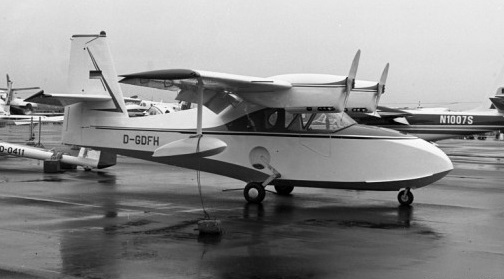
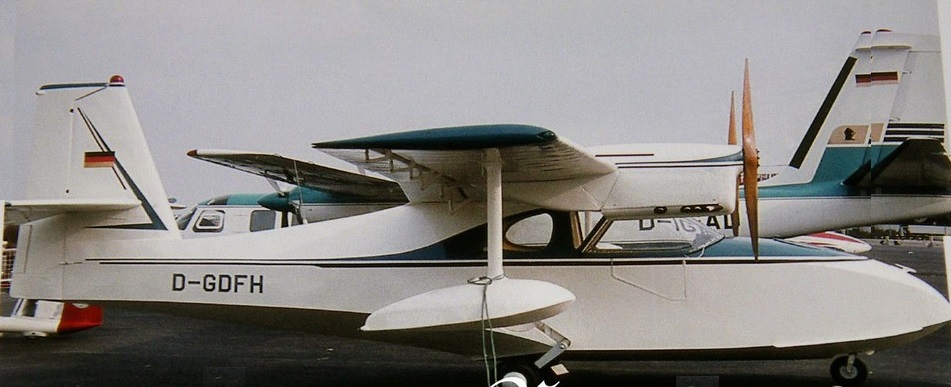
CAJO 59 (0001) D-GDFH

The CAJO 59 was designed by Carl Johansen (hence the name) as a general purpose 3-4 seat amphibious flying boat. It was a high-gull winged twin-engine monoplane with a wooden structure, mostly wooden skinned, apart from glass fibre/foam sandwich panels in the fuselage and fabric covered control surfaces. The wings inboard of the engines were built around two spars and had high dihedral (8.8°), which raised the engines well above the water. Outboard of the engines the wings had a single spar and were without dihedral. They carried full span slotted flaps and ailerons which were lowered when the flaps were fully extended.

The fuselage was flat sided with rounded decking, with the cabin under the wings. Its conventional flying boat V-shaped planing bottom had a change of curvature near midpoint but no discrete step. The vertical tail was straight-tapered, the rudder fitted with a trim tab. The cantilever variable incidence tailplane, with elevators, was mounted above the fuselage at about one third fin height.

The CAJO 59 was powered by two 65 hp (49 kW) Walter Mikron III inverted inline engines. Two fixed floats, mounted well outboard on single struts, stabilised flights off water. It had a manually retractable tricycle wheeled undercarriage, with main legs mounted on the fuselage and retracting into it above the waterline.

The first flight was made from water on 25 July 1967 and the first from land on 17 April 1968. Certification facilities were lacking in Denmark, so the CAJO 59 was taken to Germany and flew as D-GDFH during 1970.

It achieved certification but did not go into production.

Engines: 2 × Walter Mikron III, 48 kW (65 hp)
Propellers: 2-bladed , wooden
Length: 6.95 m (22 ft 10 in)
Wingspan: 9.80 m (32 ft 2 in)
Height: 2.75 m (9 ft 0 in)
Wing area: 12.80 m2 (137.8 sq ft)
Empty weight: 580 kg (1,279 lb)
Max takeoff weight: 900 kg (1,984 lb)
Maximum speed: 215 km/h (134 mph; 116 kn)
Cruising speed: 200 km/h (124 mph; 108 kn)
Range: 1,000 km (621 mi; 540 nmi) with maximum fuel
Rate of climb MAUW: 4.5 m/s (890 ft/min)
Crew: one
Capacity: two-three passengers

Jodel D.160

After the D150, a D160 prototype was built. It was to become a six seater fitted with a six cylinder 235 hp Lycoming engine. The interior was fitted with two sets of individual seats and a rear bench seat. It had an electrically actuated canopy, hinged on the port side. It featured a wing span of 10,86 meters and had a length of 8,32 meters. A version with retractable gear and a constant speed prop was envisioned, but ultimately, the D160 never saw production.

Jodel D.150 Mascaret

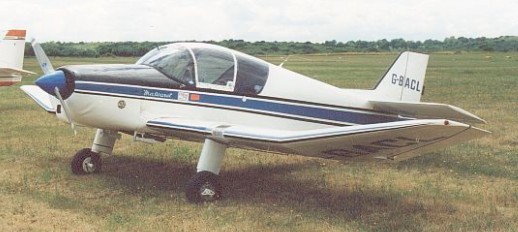
The D150 Mascaret was intended to be the successor of the D11 series. The two seater design, which was created by Delemontez for the S.A.N. factories in Normandie, leaned heavily on the DR1050. The wing was narrowed a little and the fuselage was shortened. A new tailplane construction with a two piece vertical and one piece horizontal tailplane was used. This tail was later adopted by the DR1050 series.
The aircraft was given a single large fuel tank behind the seats, carrying 110 litres of fuel. Furthermore, two tanks of 40 litres each were housed in the inboard wing leading edge, giving a total of 190 litres of fuel, good for a staggering 10 hour endurance. The tank behind the panel that is installed in the DR1050 did not reappear in the D150, resulting in much more space behind the panel, which has always been a problem in the DR1050.
The new tailplane configuration, and in particular the one piece all moving horizontal tail, is so much more powerful than the original narrower two piece version that the CG envelope has been opened quite a bit farther. This is also why Delemontez could get away with just the fuel tank under the bench seat, and without the tank behind the panel to balance it. All the models following the D150 (the DR200 series and so on) have this larger rear tank and no panel tank. It was fitted with a 100 hp Continental O-200A engine.
Interesting note is that the D150 prototype (F-BJST) was originally fitted with the new two piece vertical tail, but still had the old style two piece horizontal. The subsequent production aircraft all had the new tail configuration, which was later also retrofitted to the prototype.

D.150 Mascaret

The prototype was fitted with the rather blunt wheelpants of the DR1050 Ambassadeur, whereas production models received the sleeker Sicile pants.
2 June 1962 – First flight SAN Jodel D.150 Mascaret French two-seat single-engined light aircraft built by Société Aeronautique Normande
The D150 design proved successfull, even though only 61 of the breed were produced at S.A.N. in Bernay. S.A.N. decided to market it at a lower price than the 3/4 seater DR1050. This despite the fact that it didn’t cost less to build. In fact, S.A.N. lost money on every D150 that was produced. Among other things, this was what in the end led them into bankrupcy.
S.A.B. was still selling plans and even kits for homebuilding.

Like the DR1050 / 1051, the Mascaret is also fitted with either a Continental O-200 or a Potez 4E20 engine. The latter model being desgnated D150 A. A 135 hp Franklin engine has been tried, and a few of these have actually been built. Homebuilt D150’s usually mount O-200’s, even though an O-320 fitted “Super Mascaret” is flying in the UK.
The Mascaret is cleared for mild aerobatics.

Variant:
Kenny Jodel D 150X Governor

D150
Engine: Continental O-200, 100 hp
Length: 20.6 ft / 6.3 m
Wing span: 26.7 ft / 8.15 m
Empty weight (with oil): 900 lbs / 410 kg
Max Take off weight: 1585 lbs / 720 kg
Usefull load: 685 lbs / 310 kg
Bagage shelf: 130 lbs / 60 kg
Power loading: 15.9 lbs/hp / 7.2 kg/hp
Fuel capacity (wings): 2 x 9 imperial gal / 2 x 40 lt
Fuel capacity (rear): 24 imperial gal / 110 lt
Max speed, sea level: 165 mph / 265 km/h
Cruise speed: 130 mph / 210 km/h
Stall speed (with flaps): 38 mph / 60 km/h
Climb rate: 630 fpm / 3.2 m/s
Service ceiling: 15000 ft / 4500 m
Endurance: 10 hours
Fuel burn, 75% pwr: 5.5 gph / 21 liter/hour
Fuel burn, 55% pwr: 4 gph / 15 liter/hour
Gear: Tailwheel
Seats: 2
Controls: Stick and rudder
Material: Wood and fabric

D150 A
Engine: Potez 4E20. 105 hp

Engine: Lycoming O-320, 150 hp

D.150 Mascaret