Klimov TV3-117

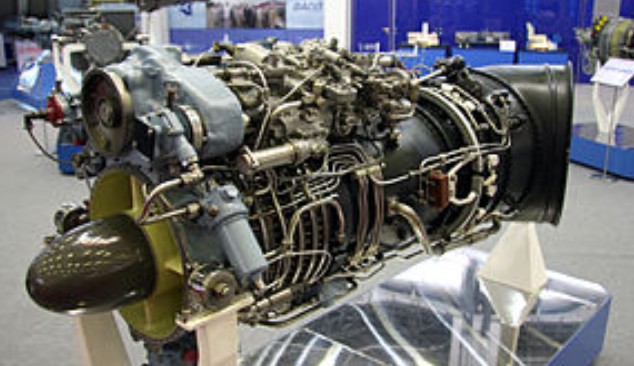
The Klimov TV3-117 is a Russian gas turbine aero engine first run in 1974. It is used in most medium lift, utility, and attack helicopters designed by the Mil and Kamov design bureaus. The TV3-117 turboshaft engine was developed in 1974 and later the TV3-117 was installed on 95% of all helicopters designed by Mil and Kamov Engineering Centre. The engine has been produced in many variants, with over 25,000 built.

Despite the similar designation, the TV7-117 engine family is new and unrelated to the TV3-117.

Variants:

TV3-117 – for Mi-24A (1972)

TV3-117M “marine”) – for Mi-14 helicopters incorporates special features to be used at sea. Mass production started in 1976

TV3-117MT “modernized, transport”) – for Mi-8MT/Mi-17 helicopters and their variants. Mass production started in 1977

TV3-117KM “Kamov, marine”) – for Ka-27 helicopters

TV3-117V (“V” stands for “high altitude”) – for Mi-24 helicopters operated in the mountains (particularly in Afghanistan). Mass production started in 1980

TV3-117VK (“high altitude, Kamov”) – a model similar to the TV3-117V engine but adapted to Ka-27, Ka-29 and Ka-32 helicopters. Mass production began in 1985. Export helicopter models were equipped with TV3-117VKR engines featuring a higher rated and cruising power (“VKR” stands for “high altitude, Kamov, power”); they were originally designed for Ka-28 machines

TV3-117VM (“VM” stands for “high altitude, modernized”) – for Mi-28 helicopters and later installed also on Mi-8MT/Mi-17 models. This engine features an automatic switch to emergency power. It was awarded type certificates by the IAC Aviation Registry, India, the Republic of China and the People’s Republic of China. Mass-produced since 1986

TV3-117VMA (“VMA” stands for “high altitude, modernized, model A”) – for Ka-50 helicopters. It is currently installed on Ka-27, Ka-29, Ka-31, Mi-24, Mi-28A/N and Ka-32 machines. This engine was awarded type certificates by the IAC Aviation Registry and by Transport Canada. Mass production started in 1986. Export models are equipped with TV3-117VMAR engines (the extra “R” stands for “power”) whose rated power and cruising power are similar to those of the TV3-117VKR engine

TV3-117VM Series 02 – a version of TV3-117VM for Mi-8MT/Mi-17 civil helicopters. Type certificates for this engine were awarded by the IAC Aviation Register, India, the Republic of China and the People’s Republic of China. Mass production started in 1993

TV3-117VMA series 02 – a version of TV3-117VMA for Ka-32 civil helicopters. Type certificates for this engine were awarded by the IAC Aviation Register, Transport Canada and Switzerland. Mass production started in 1993

TV3-117VMA-SBM1 a Turboprop version for An-140 aircraft produced by the Antonov Company

TV3-117(A) – for an unmanned reconnaissance aircraft (UAV)

VK-2500 highly modified TV3-117 also for hot and high.

Applications:
Antonov An-140
Kamov Ka-27
Kamov Ka-29
Kamov Ka-32
Kamov Ka-50
Mil Mi-8
Mil Mi-14
Mil Mi-17
Mil Mi-24
Mil Mi-28
Mil Mi-35

Specifications:

TV3-117VMA Series 2
Type: Free-turbine Turboshaft
Length: 2,055 mm (80.9 in)
Diameter: 728 mm (28.7 in) (height)
Dry weight: 294 kg (648 lb)
Maximum power output: 1,640 kW (2,200 shp) (take-off)
Overall pressure ratio: 9.4:1
Turbine inlet temperature: 920-990 C (Turbine entry temperature)
Specific fuel consumption: 0.308 kg/kW/hr (0.507 lb/shp/hr)
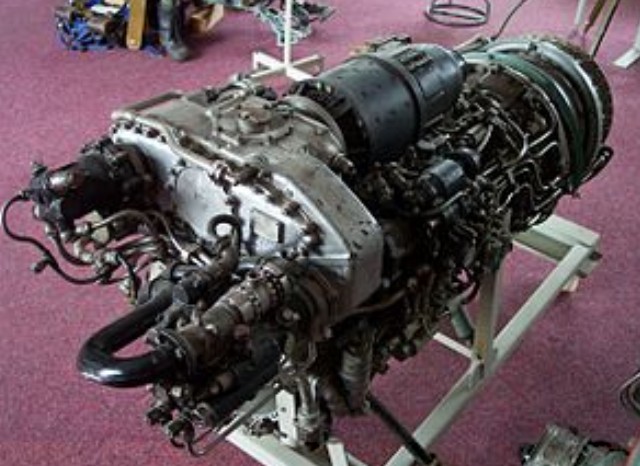
Klimov TV2-117 / Isotov TV2-117

The Klimov TV2-117 (initially Isotov TV2-117) is a Soviet gas-turbine turboshaft engine intended for helicopter use. Developed in the early 1960s from the Klimov TV3-117 by the Isotov Design Bureau the engine became the first purpose built gas turbine engine for helicopter use by the Soviet Union with previous helicopter turbines being adapted aeroplane powerplants. First run in 1962, it was later produced by Klimov, production ending in 1997.

The TV2-117 is claimed to be the most popular helicopter powerplant worldwide with 23,000 built and has accumulated over 100 million hours in service.

Variants:
TV2-117
Base variant.

TV2-117A
Improved engine with more durable compressor stator blades.

TV2-117AG
Carbon sealed shaft bearings

TV2-117F
Limited production of engine certified to FAA airworthiness standards for Japan.

TV2-117TG
Multi-fuel variant, adapted to run on liquid petroleum gas and other fuels, such as gasoline and diesel fuel, and for use in cold climates.

Applications:
Antonov An-24 (intended coupled turboprop application)
Mil Mi-8
Mil Mi-14

Specifications:

TV-2 117
Type: Turboshaft
Length: 2,835 mm (9.301 ft)
Dry weight: 330 kg (728 lb) (minus accessories)
Compressor: Ten-stage axial flow
Combustors: Eight-chamber cannular
Turbine: Two-stage compressor turbine, two-stage power turbine
Maximum power output: 1,700 hp (1,268 kW)
Overall pressure ratio: 6.6:1 at 21,200 rpm
Specific fuel consumption: 0.606 lb/hr/shp

Klimov RD-500

The Klimov RD-500 was an unlicensed Soviet copy of the Rolls-Royce Derwent Mk.V turbojet that was sold to the Soviet Union in 1947.

Producing metric drawings and analyzing the materials used in the Derwent went fairly quickly, but finding a substitute for the high-temperature, creep-resistant Nimonic 80 steel alloy was a more difficult challenge. Eventually an alloy that matched Nimonic 80’s high-temperature properties was found in KhN 80T, but it was not creep-resistant. The first Derwent copy, designated as the RD-500 (Reaktivnyy Dvigatel’ — jet engine) after the Factory No. 500 where the engine was first produced, was being tested on 31 December 1947, but problems cropped up quickly. Combustion was uneven and this cracked the combustion chambers. This may have had something to do with the modifications made by the Soviets to the fuel, speed and starter systems. But these problems were resolved by September 1948 when the engine passed its 100-hour State acceptance test.

RD-500 was a close copy of the Derwent with a single-stage centrifugal compressor, nine combustion chambers and a single-stage turbine. It matched the Derwent’s thrust of 15.9 kN (3,506 lbf) and was only 13.7 kg (30 lb) heavier. The main problem with the engine in service was with its turbine blades, 30% of which failed inspection due to recrystallization after casting. The poor creep resistance of the KhN 80T alloy resulted in dangerous elongation of the turbine blades. Up to 40% of the early production RD-500s had to be individually adjusted before delivery and the service life of the engine never approached the 100 hours demonstrated in the acceptance test.

The Soviets had enormous problems building the engines to standard, as demonstrated in the 20,000 man-hours required to build a single engine in 1947. This figure dropped to a more reasonable 7,900 man-hours by November 1948 and declined further still to 4,734 man-hours by 1 March 1949, close to the target of 4,000 man-hours. Production by Factory No. 500 totaled 97 in 1948 and 462 in 1949. Factory No. 16 in Kazan was brought into the program and built 300 engines in 1949. Production was canceled around 1950 in favor of the superior Klimov VK-1 turbojet based on the Rolls-Royce Nene.

The RD-500 was used in a number of early Soviet jet fighters including the Lavochkin La-15, the Yakovlev Yak-25, and the Yakovlev Yak-30, but only the Yakovlev Yak-23 was accepted for service, albeit in small numbers.

Applications:
Lavochkin La-15
Mikoyan-Gurevich KSK test plane
Raduga KS-1 Komet
Yakovlev Yak-23
Yakovlev Yak-25
Yakovlev Yak-30
Yakovlev Yak-1000

Specifications:
RD-500
Type: Turbojet
Length: 2.11 metres (6 ft 11 in)
Diameter: 1.09 metres (3 ft 7 in)
Dry weight: 580.7 kg (1,280 lb)
Compressor: Single-stage centrifugal compressor
Combustors: Nine
Turbine: Single-stage
Maximum thrust: 15.9 kN (3,600 lbf)
Specific fuel consumption: 1.4
Thrust-to-weight ratio: 2.73

Klimov VK-1 / RD-45 / Shenyang PF-1

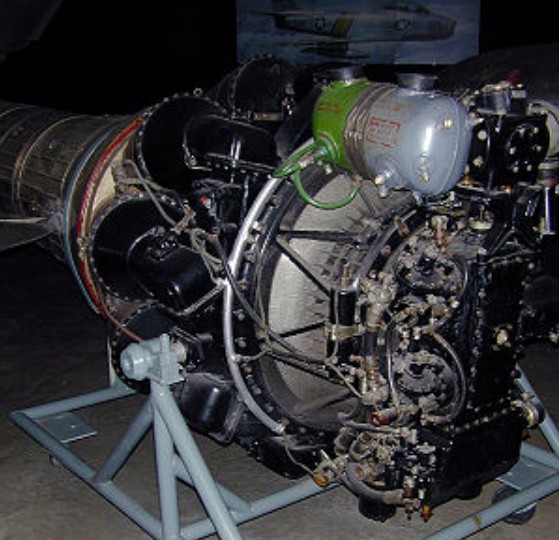
Klimov VK-1

Immediately after World War II, the Soviet Union manufactured copies of first generation German Junkers 004 and BMW 003 engines, which were advanced designs with poor durability, limited by Germany’s availability of rare metals at wartime. However in 1946, before the Cold War had really begun, the new British Labour government under the Prime Minister, Clement Attlee, keen to improve diplomatic relations with the Soviet Union, authorised Rolls-Royce to export 40 Rolls-Royce Nene centrifugal flow turbojet engines. In 1958 it was discovered during a visit to Beijing by Whitney Straight, then deputy chairman of Rolls-Royce, that this engine had been copied without license to power the MiG-15 ‘Fagot’, first as the RD-45, and after initial problems of metallurgy forced the Soviet engineers to develop a slightly redesigned (and metallurgically closer) copy, the engine had then entered production as the Klimov VK-1 (Rolls-Royce later attempted to claim £207m in license fees, without success).

It was developed by Vladimir Yakovlevich Klimov and first produced by the GAZ 116 works.

The RD-45 was further improved to produce the VK-1, which differed from the Nene in having larger combustion chambers, larger turbine, and revised airflow through the engine. The VK-1F added the afterburner.

The engine featured a centrifugal compressor, requiring a larger-diameter fuselage than aircraft featuring the more progressive axial compressor designs that had already appeared in WWII Germany and Britain. The engine was built under license in China as the WP-5.

Applications:
The VK-1 was used to power MiG-15 ‘Fagot’ and MiG-17 ‘Fresco’ fighters, as well as the Il-28 ‘Beagle’.

Specifications:
VK-1
Type: Turbojet
Length: 2,600 mm (102 in)
Diameter: 1,300 mm (51 in)
Dry weight: 872 kg (1,395 lb)
Compressor: Centrifugal compressor
Maximum thrust: 26.5 kN (5,955 lbf)
Specific fuel consumption: 109.1 kg/(kN·h) (1.07 lb/(lbf·h))
Thrust-to-weight ratio: 41.4 N/kg (4.27:1)

Klemm Kl-107 / MBB Bo.207 / Bolkow F.207

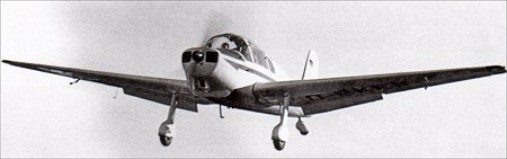
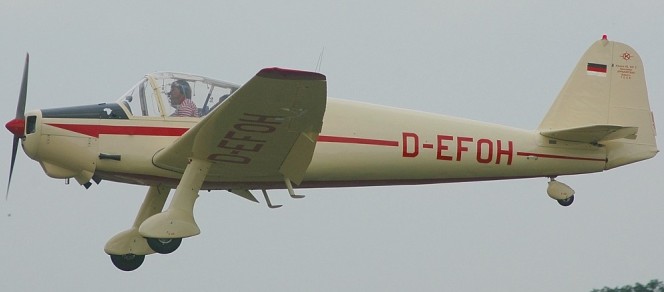
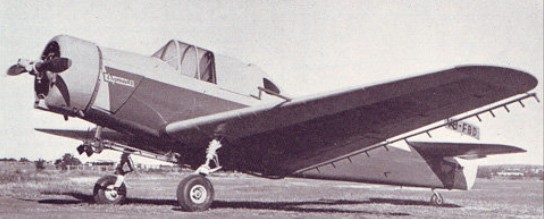
The Kl.107 low-wing, wooden-framed monoplane trainer was designed in Germany during World War II. Early versions were powered by the Hirth HM 500 100hp engine, and only a small number were completed before the factory was erased by Allied bombing. In 1956 it was decided to reintroduce the Kl-107 as a civil training/touring type, initially as the Kl-107B, but then as the three-seat Kl-107C. Rights to the design were acquired by what became the MBB consortium, and the final version became the Bo.207.

Klemm Kl-107C

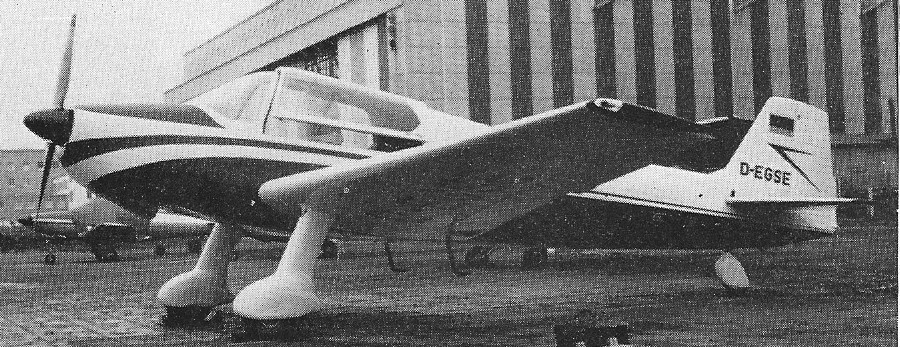
The Bolkow F.207 second prototype development of the Kl107C, originally called the Klemm Kl 107D, first flew on 21 April 1961, from Stuttgart-Echterdingen airport.

Bolkow F.207

Kl.107C
Engine: 1 x 150hp Continental O-320
Wingspan: 10.80 m / 35 ft 5 in
Length: 8.30 m / 27 ft 3 in
Max. speed: 234 km/h / 145 mph
Range: 820 km / 510 miles

Klemm

Dr Ing Hanns Klemm (1885-1961) was an eminent pioneer in the development of light aircraft. During the First World War he worked with Zeppelin, Dornier and Hansa und Brandenburgische Flugzeugwerke, and later with Daimler, for whom he designed biplanes and monoplanes, including fighters. After the war he concentrated on light and economical aircraft, sometimes called Daimler-Klemm. L15 of 1919 was originally a glider, though later powered, but had high wing. True precursor of the classic Klemm low-powered two-seat line of low-wing monoplanes was L20 of 1924. In December 1926 Leichtflugzeugbau Klemm GmbH was formed (notably associated with Bb’blingen), and L 25 was produced from 1927 with many types of engine, consolidating Klemm’s reputation. K131 and K132 of early 1930s were cabin types. Part of Klemm became Halle in 1934. Company renamed Hans Klemm Flugzeugbau August 1938, and was then making K135 cranked-wing tourer/trainer series for Luftwaffe and export. In new type-number series built Kl 105-107. During Second World War contributed to military-aircraft production, afterwards Klemm revived Kl 107 three-seat cabin model. Klemm joined Siebel in 1940.
Production ended November 1957.

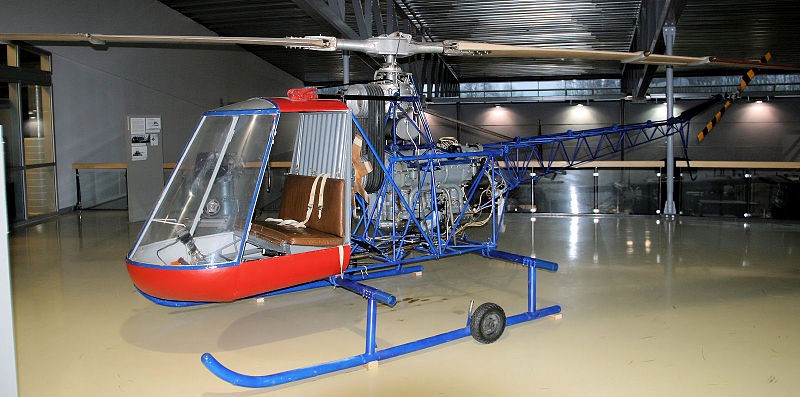
Kjeller Flyfabrikk PK X-1

The Kjeller PK X-1 was a two-seater helicopter developed at Kjeller Flyfabrikk under the leadership of engineer Paul Kjølseth. The PK X-1 first flew in 1955, but was considered a purely experimental helicopter and never evaluated in terms of performance.

Further development of PK X-1 was cancelled in 1956 in favour of the development of PK X-2. Aeronautical calculations were made by Erik Tandberg and the powertrain was made by Torbjørn Syverstad.

The PK X-1 was equipped with a 180 hp Franklin 60440-C4 (Some sources say a 200 hp Ranger) and the rotor diameter was 9.26 m.

Kjeller Flyfabrikk / Kjeller Flyvernaskinsfabrik

Lillestrømmen Aeroplanværksted (Lillestrøm Airplane Workshop)
Hærens Flyvemaskinfabrik (Army Flying Machine Factory)

This state-owned factory was established in 1914 at Kjeller airfield at Lillestrøm north of Kristiania (Oslo). The original name was Lillestrømmen Aeroplanværksted (Lillestrøm Airplane Workshop), in 1915 it become the Hærens Flyvemaskinfabrik (Army Flying Machine Factory) which had relocated from Sagene in Kristiania.
The name Kjeller Flyfabrikk didn’t appear until Aug 1927.

The Norwegian Army Aircraft Factory, located at Kjeller. Built under license during the 1930s Fokker C.V as the F.F.7 Hauk (Hawk) and de Havilland Gipsy Moth and Tiger Moth. Also did repair and overhaul of military-aircraft equipment, and experimental work.