The wing had little boost to neutral, and tends to slip if not piloted properly. Requires a correct, active steering, but light wing and very pleasant once understood.
A small modification removed the slip and made it a perfectly safe wing. Removal of the keel pocket on the front part of the mast. The return to the neutral becomes real, and the wing is more lively.
Wing area: 16.5 m² Wing span: 9 m Aspect ratio: 4.95 Hang glider weight: 22 kg Minimum pilot weight: 60 kg Maximum pilot weight: 80 kg Packed length: 5.3 m Number of battens: 8 Nose angle: 120°
Wing area: 17.75 m² Wing span: 9.7 m Aspect ratio: 4.95 Hang glider weight: 24 kg Packed length: 5.65 m Number of battens: 8 Nose angle: 120°
Wing area: 18.5 m² Wing span: 9.6 m Aspect ratio: 5 Hang glider weight: 26 kg Minimum pilot weight: 80 kg Maximum pilot weight: 110 kg Packed length: 5.65 m Number of battens: 8 Nose angle: 120°
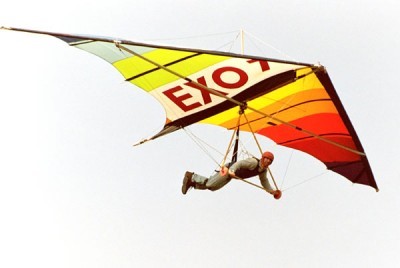
The 1982 Azur for Intermediate pilots is an interesting wing, sensitive in pitch throughout its range of speed. When tested, the Azur 15 sq.m had a disappointing drop rate.
1982 Azur
Unscaloped trailing edge fluttered at speed so they fitted ‘lolipop sticks’ as small battens but they didn’t work very well.
Azur 15 1982 Wing area: 15 m² Wing span: 10.10 m Aspect ratio: 6.8 Hang glider weight: 28 kg Minimum pilot weight: 55 kg Maximum pilot weight: 75 kg Minimum speed: 25 km/h Maximum speed: 80 km/h Max glide ratio (L/H): 10 Max glide ratio speed: 44 km/h Minimum sink rate: 0.96 m/s Packed length: 5.80 m Packed length short: 4 m Number of battens: 18 Nose angle: 119°
Azur 17 1982 Wing area: 16.5 m² Wing span: 10.6 m Aspect ratio: 6.8 Hang glider weight: 30 kg Minimum pilot weight: 65 kg Maximum pilot weight: 85 kg Minimum speed: 25 km/h Maximum speed: 80 km/h Packed length: 6.3 m Packed length short: 4.30 m Nose angle: 119°
Azur 19 1982 Wing area: 19 m² Minimum pilot weight: 75 kg Maximum pilot weight: 110 kg Minimum speed: 25 km/h Maximum speed: 80 km/h Packed length: 6.3 m
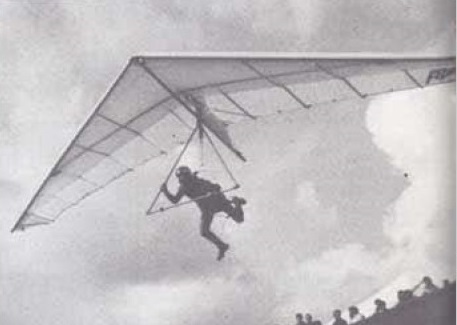
The Atlas first appeared in 1979 for novice pilots.
Primary Single Surface Glider. One of the first 30% double surface wings handling was a little heavy but the best of the 4th gen. It nly takes two quick pins to rig.
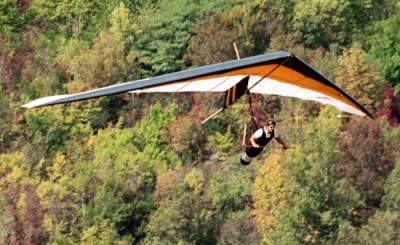
Atlas 14 A topless hang glider circa 1998. Wing area: 13.8 sq.m Hang glider weight: 24 kg Certification: DHV 2 Pilot weight: 50-75 kg Wing span: 9.3 m Nose Angle: 120 degs Aspect ratio: 6.25 Packed length: 4 m Packed length short: 2 m Price (1998) £ 1750
Atlas 16 A topless hang glider circa 1998. Wing area: 15.8 sq.m Hang glider weight: 25 kg Certification: DHV 2 Pilot weight: 65-95 kg Wing span: 9.9 m Nose Angle: 120 degs Aspect ratio: 6.2 Packed length: 4.2 m Packed length short: 2.2 m Number of battens: 12 Price (1998) £ 1750
Atlas 18 A topless hang glider circa 1998. Wing area: 18 sq.m Pilot weight: 90-140 kg Wing span: 10.5 m Nose Angle: 120 degs Aspect ratio: 6.1 Hang glider weight: 29 kg Packed length: 4.4 m Packed length short: 2.2 m Price (1998) £ 1800
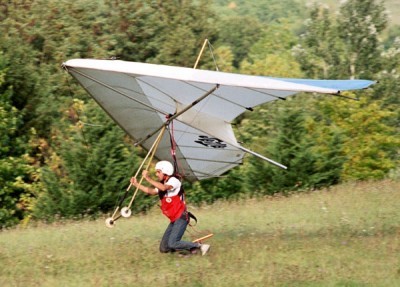
Founded in 1974 by brothers Gérard Thevenot and Jean-Marc Thevenot, the company was formed to produce versions of the American Seagull hang glider. Their glider was named La Mouette, after which the company was named. In 1979 they produced the La Mouette Atlas which remained in production through 2012 and of which there are over 8000 examples flying.
In 1986 the company started building paramotors and in 1995 introduced the “topless” hang glider, deleting the kingpost and upper flying wires.
1998: 1 rue la Petite Fin, F-21121 Fontaine les Dijon, FRANCE
In 2010-11 the company developed an electric aircraft, the Samson.
The company also built a rigid wing hang glider, the Tsunami and a powered parachute, the Skydancer under the brand Helite. Helite went on to be a company that specializes in air bag designs.
USA E. H. Lanier formed company at Newark, New Jersey, in 1943, to continue research work on semi-flying-wing STOL aircraft. Six research models were followed by single-seat Paraplane I, II and Commuter 110. Capable of sustained level flight at speeds as low as 19mph (31 kmh). The two-seat Commuter 120 was planned in 1961.
Lake Aircraft Corp marketed the Colonial Skimmer as the Lake Skimmer, and developed the aircraft into the LA4. The initial Lake prototype, the “LA-4P”, very similar to the C-2 Skimmer, performed its initial flight in November 1959; it was followed by two “LA-4A” prototypes in 1960, N1001L c/n 244 and N1002L c/n 245, which featured a 1.22 meter (4 foot) wingspan stretch and structural reinforcement. Power was a 180hp Lycoming O-360A1A pusher.
The LA-4A in turn led to the production “LA-4”, which featured a bow stretched by 43 centimeters (17 inches), with the nose gear now fully retracting. Powerplant remained the O-390-A1A. The first production model of this version flew in 1960, N261B c/n 121. Total production of the initial model of the LA-4P appears to have been about 70 aircraft, including a one-off pure seaplane with no landing gear. In 1970 Lake removed the retractable gear from some LA-4s and offered them as seaplanes with detachable beaching gear.
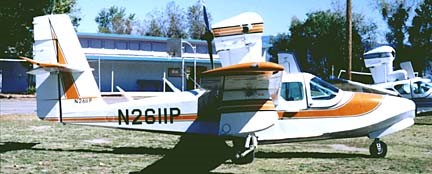
Lake LA-4 N2611P
In 1968, work began on a new model with a Lycoming IO-360-A1B engine featuring 150 kW (200 HP), with an LA-4 converted as a testbed. The “LA-4-200” went into production in 1969 and did much to raise the profile of the LA-4, with sales picking up. It featured other modest improvements, notably fuel storage in the floats, plus an optional combustion heater in a fairing above the cockpit, and also acquired the name of “Buccaneer”. Performance increased substantially, as did the price tag. Both the 180 hp and 200 hp Buccaneer versions are similar in appearance and differ only in instrument layout apart from the engine power.
Lake LA-4-200
It then generated a modestly refined version, designated the “LA-4-200EP”, the “EP” indicating “Enhanced Performance”, other interpretations being “Extended Propeller”, that being one of the features. It also had a new IO-360-A1B6 engine, same horsepower but smoother operation, a revised engine nacelle, batwings, cargo door, and fuel floats as standard equipment. An “LA-4-200EPR” was also introduced that was much the same, but with a reversible propeller. Some LA-4-180, -200, and -200EP had after-market Rajay turbochargers.
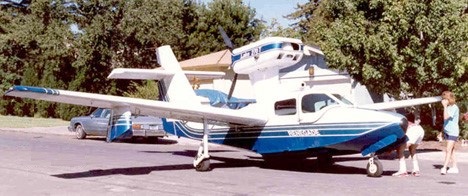
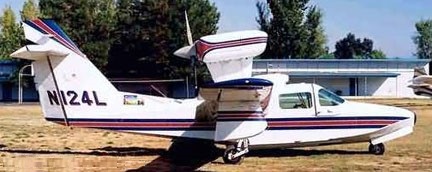
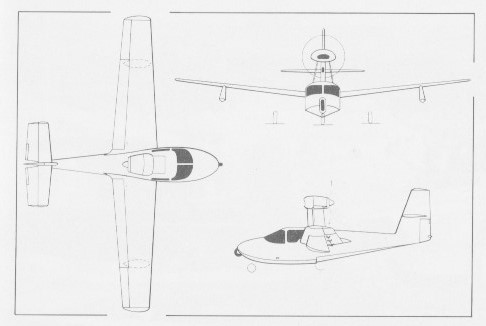
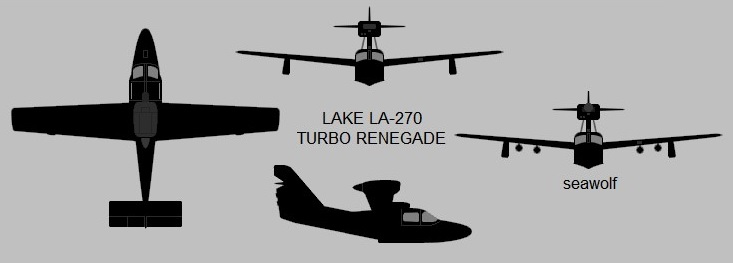
In 1984 Lake then produced the LA-250 Renegade, which featured a stretch of 1.05 meters (41 inches), permitting accommodations for four or six, with additional pop-up doors on each side of the rear cockpit; a revised and more rakish tailfin with a forward fillet of greater area; and a Lycoming IO-540-C4B5 flat-six air-cooled engine providing 185 kW (250 HP). A militarized version of the LA-250 was introduced in 1985 as the “Seawolf”, featuring four underwing pylons and radar, the radome being mounted on the front of the engine nacelle. The pylons could carry munitions including bombs and rockets, reconnaissance pods, or parachutable survival pods kitted for different environments.
Lake discontinued the LA-4 and the Seaplane and concentrated on production of the Buccaneer and the Renegade. Standard fuel tanks in the Lake were 40 gallons until someone decided that the pontoons could also be used as fuel links. The new auxiliary tanks took 7-1/2 gallons on each side, and the total capacity increased to 55 gallons. The extra 20 hp in the 200-hp Buccaneer has increased cruising speed by 12 mph and top speed by 14 mph. Allowable gross weight also increased an additional 200 pounds.
The LA-250 led in turn to the LA-270 Turbo Renegade, which was much the same but had a turbocharged TIO-540-AA1AD engine providing 200 kW (270 HP). The major visible difference was a turbocharger inlet extension at the base of the engine pylon. A militarized Seawolf version was offered as well. Sources mention a “Sea Fury”, which was an LA-250/270 with salt-water corrosion protection.
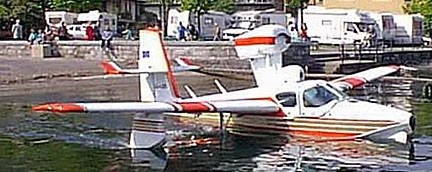
Sun Lake Renegade
The Renegade T270 is longer in the fuselage and is fitted with six seats. The model offered four to six passenger seating, improved useful load and 90 gallons of fuel on board. In 1987 turbo charging was added via the Lycoming TIO-540-AA1AB, resulting in 20 more horses to the Renegade and a ceiling of up to 23,800 ft. The Turbo 270 Renegade, which differs from previous versions in having a lengthened cabin, a turbocharged 250 shp (186 kW) Lycoming IO-540-C4B5 flat-six engine. The Seawolf is a maritime patrol version with underwing stores pylons.
Lake Aircraft’s 270 hp turbocharged Renegade has set four new world records in the light seaplane class, including an altitude record of 27,300 feet.
In 1987 the Buccaneer model was put into retirement. Latest models of the 250 and 270 hp Lakes are all marketed under the name Seafury, and incorporate improvements in corrosion protection for operation in salt water.
The LA-4 1960 base price was $26,580 and the 1968 LA-4-200 Buccaneer $31,000, rising to $53,000 in 1980. The LA-4-200EP Buccaneer $96,600 in 1983, and by 2004, $110,000-125,000. The Renegade sold for $146,000 in 1982, and $220,000 by 1986. About 135 had been built to 2005.
Twenty-four were built to 1961 and about 916 to 2005, excluding Renegade. More than 1,200 of the Lake series single-engined amphibians had sold to 1990. The LA-270T / Turbo Seafury sold for $348,000 in 1991, and $745,500 by 2001.
The four seat Lake LA 4 200EP am¬phibian, first built in 1983, has been revived by LanShe Aerospace in Florida and in 2004 was selling for US$299,000. The EP version has an IO 360 engine and a payload of around 900 lbs. It has Keelson boosters on the hull and “bat wing” wing root fillets to increase performance. The LA-270T / Turbo Seafury was priced at $348,000 in 1991, and $745,500 in 2001. The sole 1969 gearless Lake was for sale at $23,562.
The 1985 Seawolf was a military version of the LA-4-250, 2 of which reportedly were boosted to 290hp. One prototype, N1401G, was built.
The final Lake amphibian was produced in 2007. At last notice, the Lake firm was still in business, but it had been reduced to a small shop providing parts and service to the customer base.
Lake 250 Renegade Engine: Textron Lycoming TIO 540 AA2AD, 266 hp Length : 29.659 ft / 9.04 m Height: 10.007 ft / 3.05 m Wingspan: 38.320 ft / 11.68 m Aspect ratio: 8.96 Wing area: 164.043 sq.ft. / 15.24 sq.m Max take off weight: 3139.9 lb / 1424.0 kg Weight empty: 2074.9 lb / 941.0 kg Max. payload weight: 1065.0 lb / 483.0 kg Landing speed: 49 kt / 91 km/h Cruising speed: 155 kt / 287 km/h Take off distance: 879 ft / 268 m Landing distance: 607 ft / 185 m Initial climb rate: 905.51 ft/min / 4.6 m/s Service ceiling: 20013 ft / 6100 m Wing load: 19.07 lb/sq.ft / 93.0 kg/sq.m Range: 1120 nm / 2074 km Crew: 1+3
Rivard LA-4-250 Renegade / Sun Lake LA-4-250 Renegade / Sun Lake Renegade 2 1982 Engine: Lycoming IO-540-C4B5, 250hp Prop: 3 blade metal Wing span: 38’0″ Length: 28’4″ Gross wt. 3,140 lb Useful load: 1200 lb Empty wt. 1,850 lb Fuel capacity 90 USG Cruise speed: 140 mph / 122 kt Stall: 56 mph Initial climb rate: 900 fpm Ceiling: 12,500′ Takeoff run (land) 650 ft. Takeoff run (water) 1,125 ft. Landing roll (land) 475 ft. Landing run (water) 600 ft. Seats: 4-6
Sun Lake Renegade 2T Engine: Lycoming TIO-540-AA1AD Prop: 3 blade metal Wing span: 38’0″ Length: 28’4″ Fuel capacity: 90 USG Seats: 4-6
Lake formed at Sandford, Maine (pres: Jack Strayer), and purchased manufacturing rights to Colonial Skimmer in 1959, marketed initially as Lake Skimmer. Circa1961 Aerofab (Herbert Lindblad (ex-Colonial)) was founded to build Lake Amphibians for M I Alson, Lake Aircraft distributor, 5511 S Main St, Elkhart IN.
Merged with Consolidated Aeronautics 1962, continuing production as Lake LA-4A amphibian, the first under the Lake name appearing in 1960.
1978 production model was LA-4 200 Buccaneer. One LA-4 used by Bell Aerospace to test Air Cushion Landing System (ACLS) 1963-1968. In 1969 the company moved to Tomball TX. 1979: Acquired by Armand Rivard, Laconia NH and Kissimmee FL; TC to REVO.
Company became Lake Amphibian Inc. in 1983 and Lake Aircraft Inc. in 1987.
Lake Amphibian Inc. markets six-seat Renegade amphibian (first flown 1983), four-seat Turbo-Renegade with turbocharged piston engine, Seafury and Turbo Seafury as variants for salt water operations, and military Seawolf with underwing NATO pylons for stores. Over 1,300 amphibians manufactured by all Lake companies, past and present.
LanShe Aerospace in Florida bought the Lake Aircraft Company in 2002 (pres: Wadi Rahim). TC to Global Amphibians. Renamed as Sun Lake Aircraft, Ft Pierce FL.
The LAK-9 Lietuva (or Lithuania) single-seater Open Class sailplane was developed by LAK – Litovskaya Aviatsionnaya Konstruktsiya (or Lithuanian Aircraft Construction) from an earlier plastics sailplane, the BK-7, also named Lietuva, designed by Balis Karvyalis which made its first flight in December 1972. At this time the LAK factory was known as the Experimentalnii Zavod Sportivnoi Aviatsii (or Experimental Sports Aviation Factory), and a small experimental production batch of Lietuvas, designated BK-7A, was built and two of these participated in an international contest between Communist countries at Kishinev in April 1976. As a result of this competition a number of modifications were introduced in a developed version, the LAK-9, designed by Kestutis Gechas and which was then under construction; the prototype of this took part in the World Championships in Finland in June 1976 flown by O.Pasetsnik, but this particular aircraft withdrew from the last two days of the competition because of aileron damage.
The LAK-9 was the first Russian sailplane to compete in the World Championships since 1968 and at the time it was reported that the three LAK-9s then built had not, at that time, completed their flight testing. The type is now in production and the fourth series batch, begun in the winter of 1976-77, is reported to be designated LAK-9M (M for Modernised). The LAK-9 is a cantilever shoulder-wing monoplane of glassfibre/epoxy construction, with single-spar wings and provision of up to 397 lb of water ballast, and trailing edge flaps. The landing gear consists of a retractable monowheel and a tailwheel.
Span: 65 ft 8.25 in Length: 23 ft 10.25 in Height: 5 ft 0.25 in Wing area: 161.35 sqft Aspect ratio: 26.8 Empty weight: 842 lb Max weight: 1,477 lb Max speed: 130 mph (in rough air) Max aero-tow speed: 87 mph Min sinking speed: 1.67 ft/sec at 46 mph Best glide ratio: 48:1 at 64 mph
The plastics BK-7 single-seater Open Class sailplane was developed by LAK – Litovskaya Aviatsionnaya Konstruktsiya (or Lithuanian Aircraft Construction), named Lietuva, designed by Balis Karvyalis, and made its first flight in December 1972. At this time the LAK factory was known as the Experimentalnii Zavod Sportivnoi Aviatsii (or Experimental Sports Aviation Factory), and a small experimental production batch of Lietuvas, designated BK-7A, was built and two of these participated in an international contest between Communist countries at Kishinev in April 1976. As a result of this competition a number of modifications were introduced in a developed version, the LAK-9.
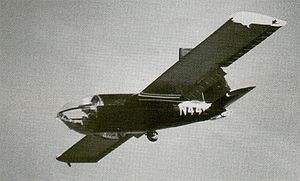
Philip Lamson designed and built the single-seat PL-1 Quark in 1964 as a lighthearted experimental aircraft project to create a prone position-pilot glider. To this end the pilot was accommodated lying down with his head in the nose bubble.
The PL-1 is constructed from fiberglass, with the wings made from a balsa-fiberglass sandwich that was laid up in a female mold. The wing was originally of 20 ft (6.1 m) span, but this was quickly increased to 30 ft (9.1 m) with tip extensions and finally the aircraft received a new 40 ft (12.2 m) three-piece wing. The airfoil was an Irv Culver modification to the NACA 0012. The landing gear was a monowheel, with small wing tip skids. Soaring Magazine described the aircraft as “purely a lark and a quirky lark at that”. The designer described the performance as “somewhere between a Nimbus and a Rogallo”.
Only one Quark was built and it was registered with the US Federal Aviation Administration in the Experimental – amateur-built category.
The aircraft logged about 300 hours in its 30 ft (9.1 m) wingspan version. The Quark was removed from the FAA registry on 13 August 2002 and the aircraft likely no longer exists.
Length: 10 ft (3.0 m) Wingspan: 40 ft (12 m) Wing area: 88.89 sq ft (8.258 sq.m) Aspect ratio: 18:1 Airfoil: Irv Culver modification to the NACA 0012 Empty weight: 340 lb (154 kg) Gross weight: 504 lb (229 kg) Crew: one Wing loading: 5.67 lb/sq ft (27.7 kg/sq.m)

 All Aero