Lavochkin’s Bureau produced La-17, the first Soviet turbojet fighter with reheat, but was disbanded on Lavochkin’s death in 1960.
Post WW2
Lavochkin La-174TK
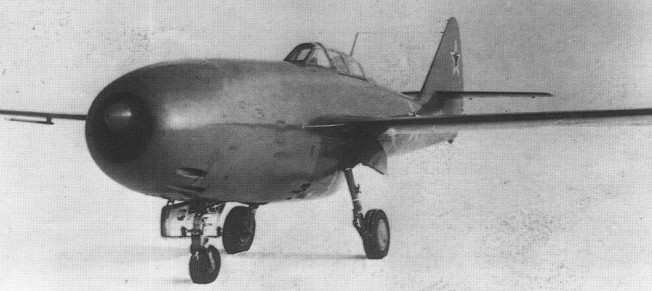
The final development of this straight-winged series was the La-174TK, which first flew January 1948 as a research type for the investigation of very thin, straight wings as an alternative to swept wings in overcoming compressibility problems.
The wing possessed a thickness ratio of only 6% (the “TK” suffix indicating Tonkoye Krylo, or Thin Wing) which the Lavochkin bureau believed might offer most of the advantages of a thicker sweptback wing while avoiding some of its disadvantages. The 6 per cent thickness/chord ratio was the smallest in the world at that time, and yielded performance benefits over the La-56. The basic configuration of the La-174TK reverted to that of the earlier La-152 series fighters, although the relationship was confined to a common design origin, with the single 1590kg NII-1 (RD-500) turbojet exhausting under the rear fuselage. Armament comprised three 23mm NS-23 cannon and flight testing commenced early 1948. Although lighter than the La-172, the La-174TK demonstrated inferior handling and performance characteristics, further development being discontinued.
The La-174TK was intended only for research and no production was ever planned.
La-174TK
Engine: 1590kg NII-1 (RD-500) turbojet
Wingspan: 8.64 m / 28 ft 4 in
Length: 9.41 m / 30 ft 10 in
Wing area: 13.52 sq.m / 145.53 sq ft
Max take-off weight: 3315 kg / 7308 lb
Empty weight: 2310 kg / 5093 lb
Max. speed: 970 km/h / 603 mph
Range: 960 km / 597 miles
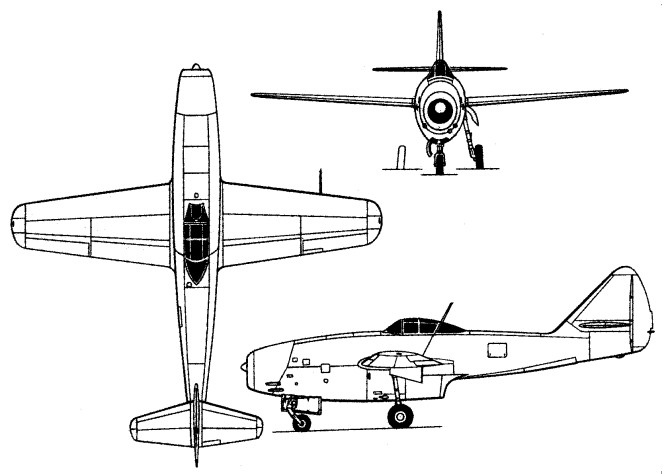
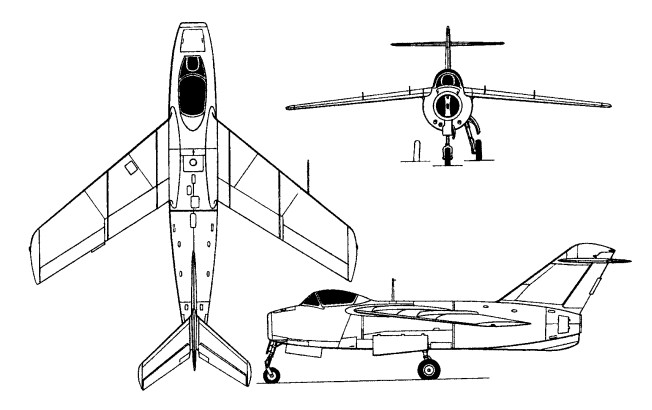
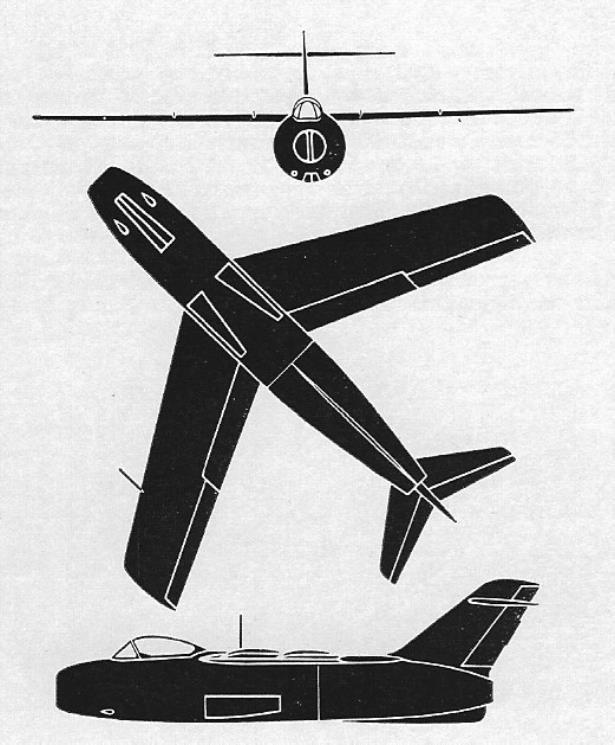
Lavochkin La-15 / La-174D / La-180
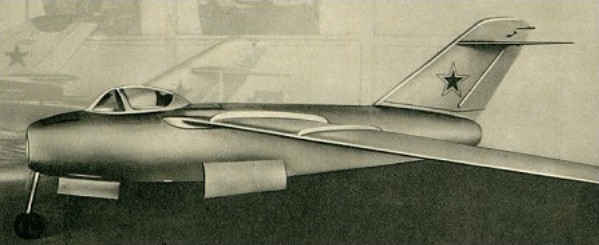
A replacement prototype for the La-172 was designated La-174D (the suffix signifying dubler, literally “replacement”), and entered flight test in August 1948. Lavochkin scaled down the basic La-174TK design to produce the La-174D tailored round the smaller Rolls-Royce Derwent turbojet. This differed in only minor respects from the preceding prototype, and series production was ordered during the same month as the La-15, armament being reduced from three to two 23mm NS-23 cannon, and 6 degrees of wing anhedral being added.
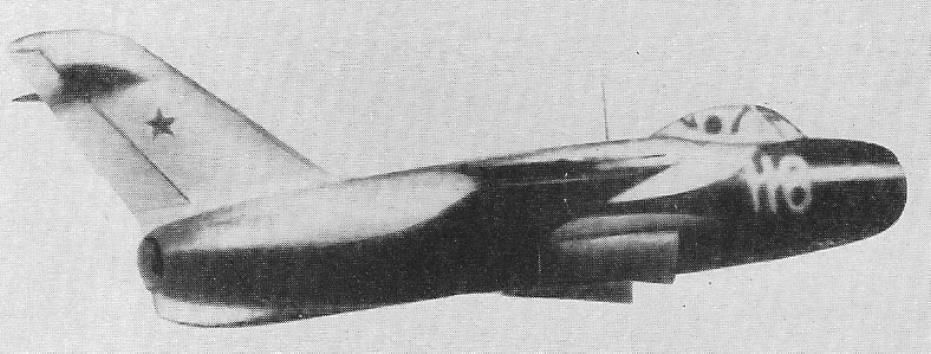
The La-15 was powered by the RD-500 turbojet, the Soviet series version of the Derwent, deliveries to the VVS commencing in the late autumn of 1949.
Production plans for the La-15 were, in the event, scaled down because of difficulties experienced in manufacturing in sufficient quantity the numerous milled parts employed in the structure, but about 400 were produced, these remaining in VVS service until 1954.
A tandem two-seat conversion trainer version was evolved as the La-180, but only two examples of this variant were built.
La-15
Engine: RD-500 turbojet, 3527-lb (1600-kg) thrust
Max take-off weight: 3850 kg / 8488 lb
Empty weight: 2575 kg / 5677 lb
Wingspan: 8.8 m / 28 ft 10 in
Length: 9.0 m / 29 ft 6 in
Wing area: 16.2 sq.m / 174.38 sq ft
Max. speed: 1025 km/h / 637 mph
Ceiling: 13000 m / 42650 ft
Range: 1170 km / 727 miles
Lavochkin La-11 / La-134
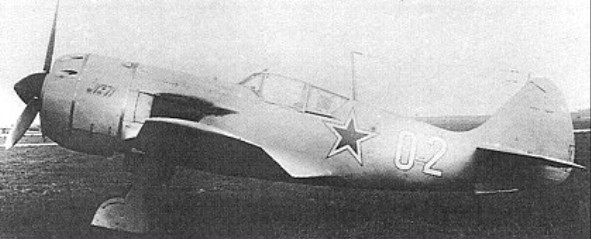
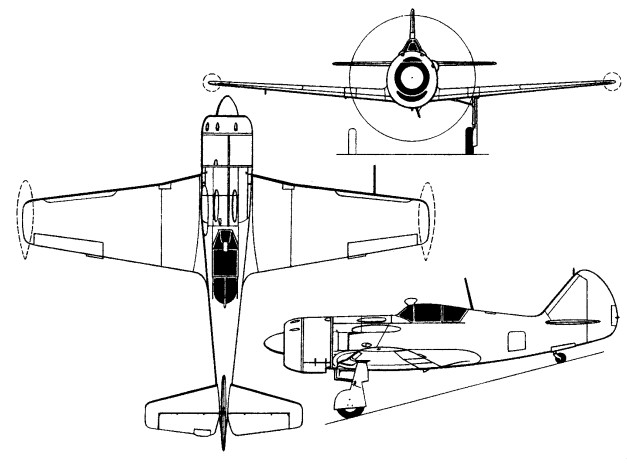
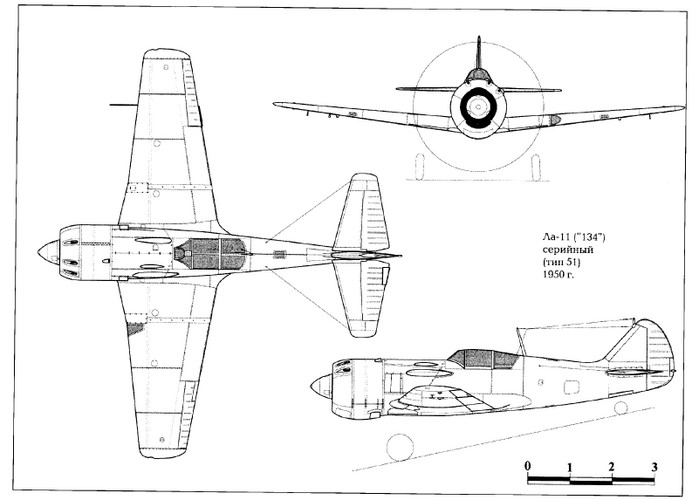
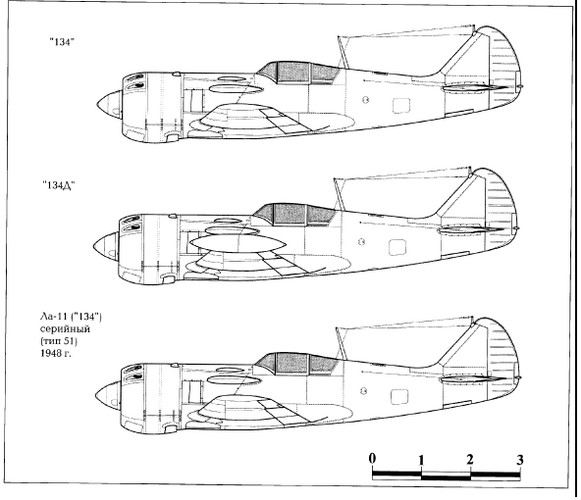
Evolved from the La-9 to meet a requirement for a fighter with sufficient range to fulfil the escort role, the La-11 was destined to be the last piston-engine fighter from the Lavochkin bureau. It had a wing fundamentally similar to that of the La-9 and retained the ASh-82FN engine, but provision was made to attach auxiliary fuel tanks at the wingtips, the ventral oil cooler was incorporated in the engine cowling and armament was reduced to three 23mm NS-23 cannon. The first prototype was flown in June 1947 under the design bureau designation La-134, and production (1947-51) at Gor’kiy was to total 1,182 aircraft.
The La-11 was supplied in some numbers to both the Chinese and the North Korean air forces, and saw operational use during the Korean conflict. It was finally phased out of first line VVS service in the early 1950s.
Engine: Shvetsov Ash-82FNV, 1850 hp
Max take-off weight: 3990 kg / 8796 lb
Empty weight: 2770 kg / 6107 lb
Wingspan: 9.8 m / 32 ft 2 in
Length: 8.7 m / 28 ft 7 in
Max. speed: 674 km/h / 419 mph
Ceiling: 10250 m / 33650 ft
Range w/max.fuel: 2550 km / 1585 miles
Lavochkin
Semyon Alexse’evich Lavochkin headed a design bureau formed for fighter production under the 1938 program. The first aircraft, the I-22, flew in 1939; also called LAGG-1 (Lavochkin, Gorbunov, Gudkov). Alterations on the production line 1940-1941 resulted in LAGG-3 with wood construction, with phenoform-aldehyde impregnated fuselage. Superseded by La-5 with radial engine in 1942. Followed by 1943 La-7,1945 La-9,1946 La-11.
This latter allmetal aircraft was the last piston-engined fighter in Soviet Air Force. Bureau later produced La-17, the first Soviet turbojet fighter with reheat, but was disbanded on Lavochkin’s death in 1960.
Lascurain Aura
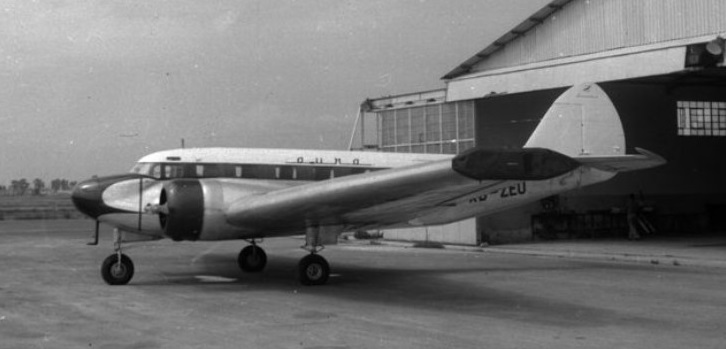
Ángel Lascurain y Osio wanted to manufacture an aircraft designed for the regional airlines of some parts of Mexico that required short airstrips in rugged terrain.
Lascurain determined that regional airlines required a twin-engine plane with fixed landing gear that was affordable, capable of landing at low speed on short runways. The aircraft had to have a high rate of climb to overcome the mountainous areas.
In 1955 Ángel Lascurain went with the architect Juan Cortina Portilla, beginning the design of the aircraft based on the Turkey Buzzard, a bird for which Lascurain had fascination.
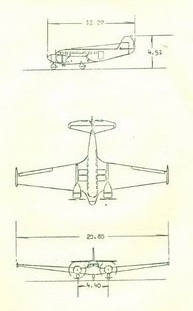
The aircraft was a twin-engine monoplane with a mid-wing monocoque fuselage built in duralumin that was capable of holding 12 people in 2 rows of 6 seats plus a bathroom lobby, with the option of 14 seats without the bathroom, plus two pilots. The fuselage was part of the wings through beams. Each wing had between the engine and the fuselage two compartments for luggage of 0.65 cubic meters each, the aircraft had two tanks of fuel of 200 liters each that fed to the Jacobs R-755 engines by gravity and pumps besides two auxiliary tanks located at the outer wing of 50 liters each.
It was the largest aircraft designed and built in Mexico.
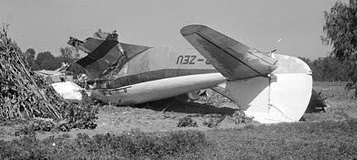
On December 24, 1957, during a routine flight of the Lascurain Aura XB-ZEU at the Mexico City Airport for no apparent reason, both engines of the aircraft were stopped and the pilot attempted to land at the airport. planning for runway 13, they crashed a few meters before the runway, killing the pilot Carlos Castillo Segura and Angel Lascurain.
Powerplants: 2 × Jacobs R-755-A1, 245 hp (183 kW)
Wingspan: 68 ft 3 in (20.8 m)
Length: 40 ft 1 in (12.22 m)
Height: 14 ft 10 in (4.51 m)
Gross weight: 4,409 lb (2,000 kg)
Fuel capacity: 132 USgal. (500 L) (with reserves)
Maximum speed: 120 kn (140 mph, 220 km/h)
Cruise speed: 107 kn (123 mph, 198 km/h) at 75% thrust
Minimum control speed: 30 kn (35 mph, 56 km/h)
Range: 430 nmi (500 mi, 800 km)
Service ceiling: 26,900 ft (8,200 m)
Rate of climb: 1,033 ft/min (5.25 m/s)
Crew: two
Capacity: 12 or 14 passengers
Larson Model C Speedbird
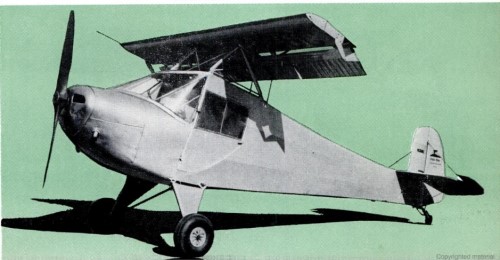
The Model C Speedbird (N38C or NX38C) by Merle Larson of Oakland, Ca. had a small wing (wingspan 12ft) designed to work within the slipstream of the propeller and featured very large flaps for lift.
The Speedbird aircraft was modified from a Taylorcraft BC-12.
The aircraft flew, but on that first flight on 7 December 1953 the engine stopped and the aircraft stalled. Larson escaped serious injury and later designed the (Larson-Holmes) D-1 Duster.
Larson F.12 Baby
The Larson F-12 Baby was a sports biplane built in the US in the early 1960s. It was intended to produce it ready to fly or homebuilt from kits or plans but only one was completed.
The Baby was a single bay single engine, single seat biplane with stagger. The wings were wooden structures with two spars and fabric covering; the upper wing had 1° of dihedral and the lower one 3°. There were ailerons on both wings, with aluminium frames and again fabric covered. The fuselage and empennage were fabric covered, welded steel structures. It had fixed conventional landing gear with rubber sprung main legs, aluminium wheels with brakes and a sprung tailwheel.
The Baby was powered by an 85 hp (63 kW) Continental C85, its fuel tank in the fuselage behind the engine and in front of the single seat, open cockpit, anf firdt flew in 1961.
Powerplant: 1 × Continental C85, 85 hp (63 kW)
Propeller: 2-bladed McCauley aluminium, fixed pitch
Wingspan: 17 ft 0 in (5.18 m) upper and lower
Wing area: 73 sq ft (6.8 m2)
Aspect ratio: about 7 on upper wing, 6 on lower
Airfoil: NACA 4412 modified
Length: 17 ft 0 in (5.18 m)
Height: 5 ft 6 in (1.68 m)
Empty weight: 500 lb (227 kg) weights estimated
Gross weight: 800 lb (363 kg)
Fuel capacity: 12 US gal (10.0 imp gal; 45 l)
Maximum speed est: 130 mph (210 km/h, 110 kn)
Cruise speed est: 110 mph (180 km/h, 96 kn)
Rate of climb est: 2,000 ft/min (10 m/s)
Crew: One
Larson F-2 Baby
An ultralight single-seat biplane in 1960.
Larson D.1
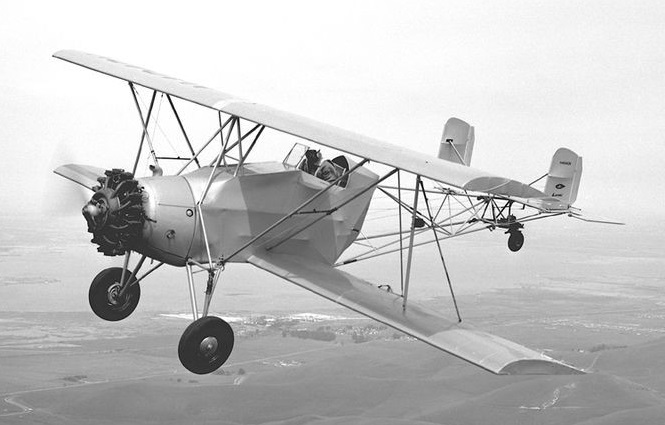
In 1955, Merle Larson designed the D-1 with updated features to improve cropdusting compared to the popular Boeing Stearman in use at the time. The aircraft used only 25 percent of the number of parts as a Stearman.
The biplane featured a steel tube fuselage, and aluminum covered wings. The fuselage was fabric covered only to behind the cockpit, leaving the rest of the tail structure exposed, preventing dust buildup in the tail. The aircraft had twin rudders mounted outboard of the spray trail. Each of these were all-moving with anti-servo tabs. Standard automotive wheels and tires were employed to reduce cost as low-cost World War II surplus was becoming too old, and new aviation tires cost nearly five times as much.
Powerplant: 1 × Lycoming R-680, 225 hp (168 kW)
or 220 hp (164 kW) Continental R-670
or 245 hp (183 kW) Jacobs R-755
Propeller: 2-blade McCauley ground-adjustable propeller
Upper wingspan: 30 ft 0 in (9.14 m)
Lower wingspan: 33 ft 0 in (10.06 m)
Wing area: 315 sq ft (29.3 m2)
Aspect ratio: 6
Airfoil: Göttingen 365
Length: 25 ft (7.6 m)
Height: 11 ft 00 in (3.35 m)
Empty weight: 1,700 lb (771 kg)
Gross weight: 3,600 lb (1,633 kg)
Fuel capacity: 30 US gal (25 imp gal; 114 l) fuel ; 4.4 US gal (3.7 imp gal; 16.7 l)
Cruise speed: 90 mph (140 km/h, 78 kn) at sea level
Landing speed: 40 mph (35 kn; 64 km/h)
Stall speed: 40 mph (64 km/h, 35 kn)
Rate of climb: 1,400 ft/min (7.1 m/s) at sea level, empty
Wing loading: 11.4 lb/sq ft (56 kg/m2)
Take-off run, empty, nil wind: <200 ft (61 m)
Take-off run, 1,000 lb (454 kg) payload, nil wind: 600 ft (183 m)
Crew: 1
 All Aero