1961: Departemen Angkatan Udara Reaublik Indonesia
Lembaga Persiapan Industn Penerbangan Husein Sastranegara Air Force Base Bandung
In 1953, the Indonesian Air Force began the development of a series of light combat and training aircraft at its research, development and production depot near Bandung.
The first was a single-seat light ground support aircraft named the Sikumbang, of which two prototypes were built. It has been followed by the Belalang, a major conversion of the Piper L-4J, and an ultralight single-seater called the Kunang.
The Belalang was in production at the depot in 1961, which was renamed the Lembaga Persiapan Industri Penerbangan (Institute for the Preparation of an Aircraft Industry) in August 1961.
Formed at Bandang in 1966 from the Institute for Aero Industry Establishment. LIPNUR built a prototype series of light aircraft and from 1963 began production under license of the Polish PZL 104 utility aircraft under the name of Gelatik (Rice Bird). It was hoped to assemble DH Canada Otters at the Institute.
Also manufactures the LT-200, a modified Pazmany PL-2 light aircraft, for military and civil training.
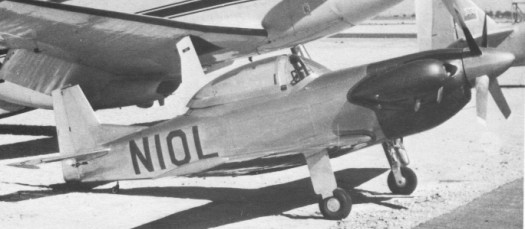
The Mini Mustang was designed and built by Mr. Charles C. Linn and despite the small dimensions, the aircraft featured a retractable undercarriage. The Mini Mustang was built to approximately 45-50% scale of the P-51. The L-1 was the first example built by Mr. Linn and it first flew on 14 January 1962. It won the 1962 EAA Most Popular Aircraft award, but was lost in an accident. To replace the L-1, Mr. Linn then constructed a second example, the L-2 (also named Linns Mustang) with the same N10L registration. This second aircraft differed slightly in having a 4-bladed (instead of 3-bladed) propeller, larger tail surfaces, a smaller engine air intake, longer canopy and it was also a bit shorter with 13.5ft (against 13.833ft). Both aircraft were powered by a 125hp Lycoming O-290-G engine. Plans were marketed for amateur construction, but maybe 2? were built.
The Schweizer SGS 2-32 also formed the basis of another quiet observation aircraft, the LTV Electrosystems L450F, which first flew in prototype form in February 1970 and was powered by a Pratt & Whitney PT6A-29 turboprop derated to 680shp.
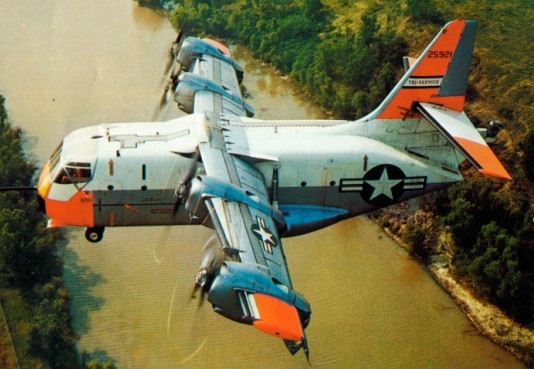
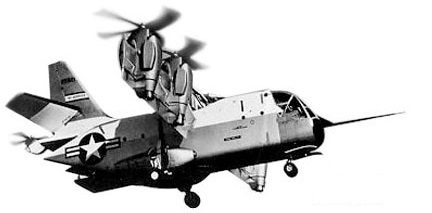
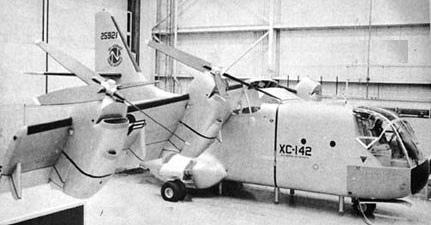
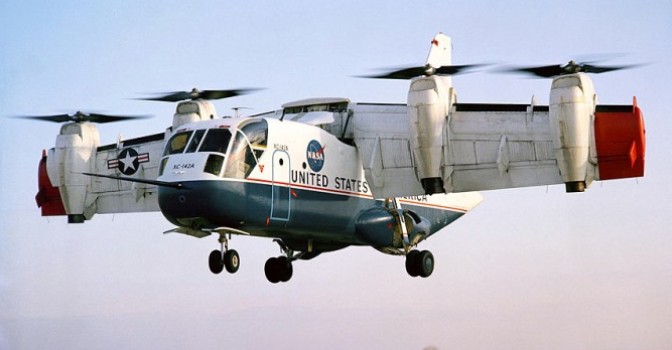
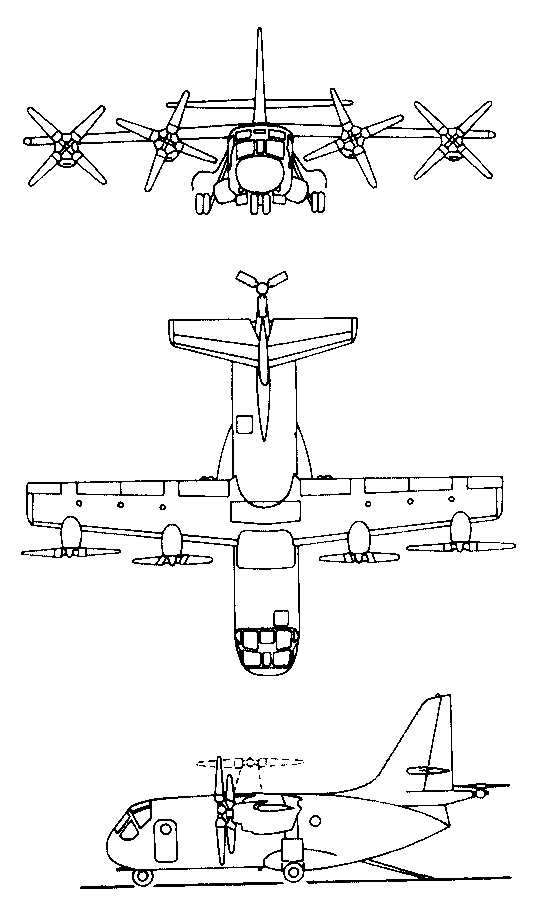
A government advisory group in 1959 recommended that a full-size V/STOL aircraft was required, with specific requirements for the Navy and Army. Previous VTOL programs had been built to illustrate a particular principle, but few of these concepts had any operational military capabilities. With the XC-142, it was decided that this system would be tested in an operational environment. It was decided that the system would fulfill requirements for all three military services. The first tri-service VTOL. In 1961, a Request for Proposal was released, and in September, the proposal from Vought-Hiller-Ryan was announced as the winner. It was also announced that the Air Force would manage the program with the cost of the program to be shared equally by each of the services. Vought Aeronautics Division of Ling-Temco-Vought was the prime contractor, with Hiller and Ryan serving as the major subcontractors. Vought subcontracted the design and fabrication of the empennage, aft section, engine nacelles, and wing to Ryan. The overall transmission system and selected components were subcontracted to Hiller, which was also responsible for the flap and aileron fabrication. The XC-142 grossed out at about 16900kg loaded with an empty weight of about 10780kg. The plane had a fuselage length just exceeding 17.7m, with a maximum height of 7.9m and a sizable wing span of 20.6m. The model carried a single tall vertical tail that provided 12sq.m of area. The wings carried large trailing double-slotted flaps the entire length of each wing and were mounted high on the fuselage. The fuselage was designed to carry significant cargo, with the cargo compartment being 9.15m in length with a 2.1m height and width. That volume equated to about 32 full-loaded troops and gear, or four tons of cargo. In addition to that capability, there was also the ability to carry 370 litres of fuel. There was also a planned capability for auxiliary tanks which would greatly add to the range.
XC-142 62-5921
Power consisted of four 3080hp General Electric T64-GE-1 engines, mounted in nacelles on the wings, which were all cross-linked together. Each drove a four-bladed 4.7m Hamilton-Standard fiberglass propeller, the tips of each practically overlapping each other. Later in the program, Hamilton Standard would provide an improved version of the propeller using the 2FF blade design, which featured a wider planform, rounded tips, and a more pronounced twist than the earlier 2EF blades. The goal of the new design was to improve aerodynamic load distribution and overcoming a static load problem. The four engines also drove a fifth propeller, a three-bladed fiberglass type, in the tail through an interconnected gear and shaft train. Therefore, power was available to turn all five propellers when one, two, or three engines were shut down. The tail propeller rotated in a horizontal plane and was declutched and braked for cruise flight. Through cross-shafting gearboxes, the rotation from each engine was brought together at the top of the fuselage. The power was then sent back to the tail rotor through a tail propeller shaft, into the tail propeller gearbox, and on to the variable pitch tail propeller. The propulsion system of the XC-142 was over powered. The plane could lose an engine on take-off and still clear a 15.25m barrier in 122m carrying a 4500kg payload. Also, with all engines operating, the plane had a rate of climb at sea level of 34.5m/s. On a hot day, even with an engine out, the XC-142 showed a climb rate of 17.8m/s. Roll control was by differential propeller pitch. Pitch control was accomplished by the eight-foot, three-bladed variable pitch tail rotor. Yaw control was provided by ailerons powered by propeller slipstream deflection, actually a second VTOL concept being employed in the XC-142. The craft main lift system in the wing was capable of rotating through 98 degrees instead of the expected straight-vertical position. The wing tilt mechanism consisted of two screw-jack actuators driven by a centrally-located hydraulic motor. The tilt was controlled by a variable rate switch on each collective lever, or by a constant rate switch. This allowed the plane to hover in a stationary mode in a tailwind condition. The trailing edge of the wings carried three-section, double-slotted flaps in three sections, with the center and outboard sections operated also as ailerons. The flaps were programmed automatically with changing wing tilt, although the pilot had an override capability. Leading edge slats were used for stall suppression, and were mounted outboard of each engine nacelle and operated automatically as a function of flap position. The vertical tail was operated as a standard rudder-and-fin set-up, which supported the slab-type unit horizontal tail assembly. A fully-powered irreversible type with artificial feel forces and powered by dual independent hydraulic systems was fitted. Dual cockpit controls, consisting of conventional rudder pedals, control sticks, and collective levers for all take-offs and landings, provided the highest technology of the system. The tail rotor was rigged to fold to the port side to reduce the storage length and protect against damage during a loading operation.
The first XC-142 was rolled out in early 1964 with its first conventional flight being made in September 1964, its first hover three months later, and the first transition from hover to horizontal flight and return on 17 January 1965. The Air Force extensively tested the XC-142’s capabilities with cargo flights, cargo, and paratrooper drops, along with desert, mountain, rescue, and carrier operations.
XC-142 62-5921
In 1966, one of the XC-142s passed operational tests to prove the model in carrier operations. In quick succession, the plane accomplished 44 short take-offs and landings, along with six vertical take-offs and landings from the USS Bennington.
The carrier trails were accomplished using the number five prototype, which was crewed by both USMC, Navy, and Army pilots. The flight regime covered VTOL operations at a variety of speeds, which occurred at wind conditions from 10 to 55km/h. A large variety of wings and flap tilt angles were used during the testing. Also, there were landings accomplished with three and six degree glide slopes. In an amazing demonstration, the plane negotiated a 360-degree turn within the width of the flight deck. That same year, one of the prototypes was also tested in an overwater pickup operation. The plane lifted a man from a life raft to determine its capability for rescue and recovery. A standard Navy horse collar sling was attached to 38m of cable and then lowered through a floor hatch just aft of the cockpit. The tests proved that there were no problems with effects of the propeller downwash or slipstream turbulence.
The program called for the building of five prototypes, 62-5921-5925, but cross-shaft problems, along with some operator errors, resulted in a number of hard landings causing damage to the complete fleet.
The most serious of the mishaps, resulting from a tail rotor driveshaft failure, caused three fatalities. The May 1967 accident took place near the Dallas, Texas, LTV plant and occurred in a heavily-wooded area where fire started after the impact. The flight plan for the ill-fated prototype included a rapid decrease in altitude from 2440m to 915m, effectively simulating a pilot rescue under combat conditions. A nose-over at low altitude followed, from which the crew could not recover. The crash aircraft was XC-142 #1 which had flown 148 times at the time of the crash. The pilots on the fatal flight were Stu Madison, Charlie Jester, and John Omvig.
Other incidents included the following:
Aircraft #2 – On October 19, 1965, this craft experienced a ground loop causing extensive damage to the wing and propeller.
Aircraft #3 – On January 4, 1966, this model made a hard landing in the vertical mode. There was significant damage to the fuselage. The wing of this plane was late mated to the Number #2 for further testing.
Aircraft #4 – On January 27, 1966, an engine turbine failure caused the overriding clutch to engage, causing extensive damage to the wing, outboard aileron, the number two nacelle, aft engine shroud, and fuselage. It was later used by NASA for further research.
Aircraft #5 – ln December of 1966, a ground accident caused major damage to the fuselage, nose, wing, and propellers. The incident was caused by pilot error who failed to activate the hydraulic system, which resulted in no brakes or nose wheel steering.
The final decision on the disposition of the aircraft occurred during the Category II Operational Suitability Program, which was conducted at the Air Force Flight Test Center. The testing consisted of 113 flights, totaling 163.9 hours, which was accomplished between July 1965 and August 1967. Three of the XC-142s also participated in a major operational test demonstration during the program, where the planes participated in demonstrations of VTOL, STOL, and movement of Jeep-mounted 106mm recoilless rifles, unloading of three-quarter ton trucks with towed 105mm Howitzers, dump trucks, and 450-kg A-22 containers. For a typical XC-142 design mission, the plane could operate with a gross weight of 16900kg, including a four-ton payload. At that weight condition, the plane could take off vertically, cruise 370km near 480km/h, hover for ten minutes, and then land. One of the limitations found in the plane, even though the overall test results were very positive, was an instability between wing angles of 35 and 80 degrees which was encountered at extremely low altitudes. There were also high side forces which resulted from yaw and weak propeller blade pitch angle controls. Another XC-142 complaint was the excessive vibration and noise in the cockpit, when coupled with an excessively high pilot workload, and which presented a considerable challenge in the cockpit. The program involved 39 different pilots flying the prototypes for a total of 420 hours.
The greatest national exposure the XC-142 received during its flight test program occurred when the #4 prototype participated in the 1967 Paris Air Show.
The only remaining XC-142, #2 62-5924 / NASA522, was on display at the Air Force Museum at Wright-Patterson Air Force Base near Dayton, Ohio.
XC-142A Crew: 2 Passengers: 24-44 Engines: 4 x General Electric T-64 turboshaft, 2095kW Wingspan: 20.6m Length: 17.8m Height: 8.0m Wing area: 49.7sq.m Empty weight: 10250kg Max speed: 667km/h Ceiling: 7620m Range with max fuel: 756km Range with max payload: 370km
Lindstrand Balloons is a manufacturer of hot air balloons and other aerostats. The company was started by Swedish-born pilot and aeronautical designer Per Lindstrand in Oswestry, England, after he left Thunder & Colt in 1978. Lindstrand Balloons is known for its leading-edge engineering, which includes sophisticated testing and production facilities.
Of note, Lindstrand Balloons designed and built all of the hot air balloons flown by Per Lindstrand and Richard Branson on their record breaking flights first across the Atlantic Ocean in 1987 and then the Pacific Ocean in 1990. Lindstrand’s then designed and built three Rozière balloons that Per Lindstrand and Branson (and others, including aeronautical engineer Alex Ritchie, and adventurer, Steve Fossett) used in their unsuccessful attempts to circumnavigate the Earth by balloon. Per Lindstrand played an instrumental role in making these flights possible, and was pilot for all of them.
In the late-1990s, Cameron Balloons and its owner Don Cameron acquired two-thirds ownership of Lindstrand Balloons. Cameron bought the majority stake in Lindstrand Balloons from Rory McCarthy, a British industrialist associated with Richard Branson, who had invested in Lindstrand to support Branson’s series of record-setting balloon flights. The remaining third of the company is owned by its founder Per Lindstrand.
Despite Cameron’s ownership, Lindstrand Balloons continues to operate as an independent company with separate management and its own distinct designs and products. Per Lindstrand also independently operates a separate company, Lindstrand Technologies, which designs and builds gas balloons, innovative buildings, specialized aerospace equipment (including an advanced parachute for the Beagle 2 Mars-lander) and inflatable structures including aircraft hangars, plugs for fire-containment for road tunnels and flood prevention systems.
In 2011 Lindstrand Hot Air Balloons Ltd, based in Oswestry, Shropshire in the UK, had been building lighter-than-air craft on the same site for over 25 years and had its designs certified in 48 countries.
Lindstrand Balloons design special shaped envelopes. Once approved, computer aided technology turns the visual into a full working drawing which manufacture uses. All these envelopes are fully EASA approved.
Limbach Flugmotoren (Limbach Flightmotors) is a German company that produces aircraft engines. The company is named after Peter Limbach who expanded his father’s engine repair business in the 1970s in Königswinter.
1998
By May 2006, Limbach had produced more than 6000 engines for light aircraft, ultralight aircraft and airships. Many Limbach engines are based on the Volkswagen flat-4 boxer unit with displacement of up to 2.4 litres, and up to 160 BHP in the turbocharged model.
In a letter dated 25th August 2011, the company announced that it would be closing by late 2011, saying “Years of ever increasing regulations and requirements have been choking us. Our efforts to operate in that environment were not successful because we cannot provide the necessary resources. Additionally there are government activities that hinder our current business and we cannot make plans for the future.”
In late 2012 it was announced that the Limbach assets had been sold to Mr. Chen Shuide.
1998-2012: Kotthausener Str. 5, Konigswinter, Germany, D-53639
Limbach produce 2-stroke and 4-stroke engines from 15 to 125 kW for paragliders to cruising aircraft.
The engines have electronic engine management with electronic fuel injection, no mixture control, no choke, and no carburettor preheating. With an electrically adjustable propeller, you only need to preselect the speed and accelerate.
USSR Formed 1975 and marketing hang gliders, motorgliders and the X-32 Bekas tandem two-seat ultralight suited to recreational, training and agricultural uses (first flown 1993).
Formerly known as the KB-17, this Yugoslav two seater high performance trainer was designed and built by the Letalski Institut Branko Ivanus, Slovenija – LIBIS at Ljubljana.
Of largely wooden construction, with a fabric covered welded steel tube fuselage, the LIBIS-17 has a cantilever single-spar high-set wooden wing, with a plywood covered leading edge torsion box supported by Styrofoam, the remainder of the wing being fabric covered. The fabric covered wooden Frise ailerons are also filled with Styrofoam, and there are Hiittertype wooden plate spoilers in the wing upper surfaces immediately aft of the spar. The angular tail unit is also a wooden structure filled with Styrofoam, and is made up of an all-moving one-piece fin and tailplane, each with a servo tab. The landing gear consists of a non-retractable unsprung Borovo main wheel and nose sheel in tandem, with a LIBIS mechanical brake. The two pilots are seated in tandem under a forward-hinged one-piece blown canopy; a ventilation system is provided and blind flying instrumentation, radio and oxygen equipment can be fitted if required.
It is cleared for looping, spinning and cloud flying as well as normal flight; it is also suitable for flying solo up to the Silver and Gold C standards.
The prototype LIBIS-17 first flew on October 1961, and the first production aircraft flew in June 1963; by 1972 there were 23 examples of the type on the Yugoslav civil register.
Span: 55 ft 9 in Length: 25 ft 1 in Height: 8 ft 11.5 in Wing area: 237.9 sqft Aspect ratio: 13.0 Empty weight: 739 lb Max weight: 1,135 lb Max speed: 138 mph (in smooth air) Max aero-tow speed: 87 mph Min sinking speed: 2.82 ft/sec at 47 mph Best glide ratio: 27:1 at 58 mph
The LIBIS KB-11 Branko was a 1950s Yugoslavian four-seat monoplane. The aircraft design office of the Letalski Institut Branko Ivanus Slovenija brought together teachers and students of the Ljubljana technical high school for the KB-11 Branko.
The KB-11 Branko was a development of the earlier two-seat KB-6 Matajur. First flown in December 1959 the KB-11 was an all-metal cantilever low-wing monoplane with retractable tricycle landing gear and an enclosed heated and ventilated cockpit for four persons. Intended for use as an air-taxi our business use but only small numbers were built.
Engine: 1 × Lycoming O-435-1, 138 kW (185 hp) Wingspan: 10.59 m (34 ft 9 in) Length: 8.23 m (27 ft 0 in) Height: 2.45 m (8 ft 0 in) Wing area: 1.152 sq.m (12.40 sq ft) Aspect ratio: 7.76:1 Airfoil: NACA 3415 at root, USA 35B at tip Empty weight: 800 kg (1,764 lb) Gross weight: 1,250 kg (2,756 lb) normal loaded without tip tanks Maximum speed: 214 km/h; 116 kn (133 mph) at sea level Cruise speed: 171 km/h; 92 kn (106 mph) at 1,525 m (5,000 ft) and 75% power Stall speed: 98 km/h; 53 kn (61 mph) Range: 950 km (590 mi; 513 nmi) Service ceiling: 5,334 m (17,500 ft) Rate of climb: 4.3 m/s (850 ft/min) Crew: 1 Capacity: 4 total

 All Aero