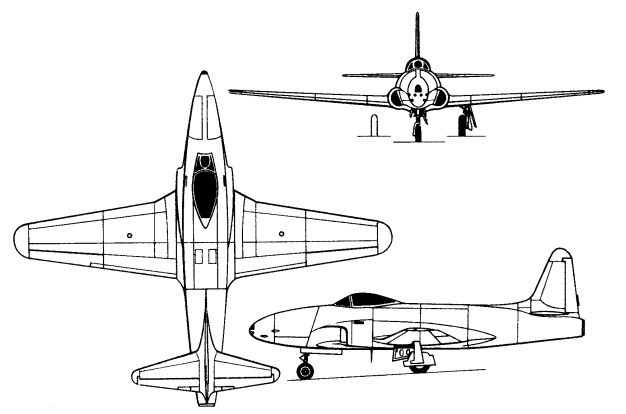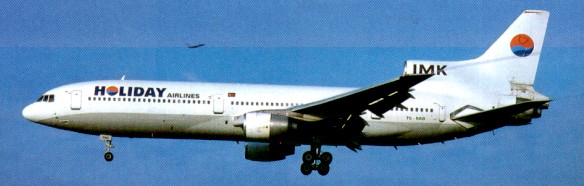
Lockheed L-1011 Tristar

Lockheed L-1011 Tristar

In the 1960s, American Airlines approached Lockheed and competitor Douglas with a need for an aircraft smaller than the existing 747, but still capable of flying to distant locales such as London, the Caribbean, and Latin America from company hubs in Dallas/Ft Worth and New York. The Model L-1011 was designed to enter this category with optimum payload-range performance and short-field characteristics. The Model L-1011 is powered by three 42,000-lb. s.t. turbofan engines, two of which are mounted in pods underneath each wing, and the third is located in the rear of the fuselage at the base of the tail unit. The TriStar’s engine is integrated into the tail through an S-duct for improved quietness and stability. Fuel is carried in two integral wing tanks and an inboard tank. With a full load, the TriStar can travel a maximum of 4,467 miles. Accommodations provide for 256 passengers in a mixed coach and first-class arrangement or a maximum of 400 passengers in a high density all-economy configuration.

Lockheed L-1011 Tristar Article

First flown on November 16, 1970, the twin-aisle TriStar’s design schedule closely followed that of its competitor, the DC-10, Douglas beat Lockheed to market by a year due to delays in powerplant development. Rolls-Royce, the maker of the TriStar’s RB211 turbofan engines, had filed for bankruptcy, halting L-1011 final assembly. The first flight was powered by Rolls Royce RB.211 high by pass ratio turbofan engines, from Palmdale, California.

The British government did not approve the large state subsidy used to restart Rolls-Royce operations until after the U.S. government had guaranteed the Lockheed loans previously provided to Rolls for the extensive engine contract. (The UK Goverment also took the contentious step (for a Conservative administration) of taking the aero-engine side of RR into public ownership, to maintain national defence capability). Its first revenue flight, for Eastern Air Lines, was made on 26 April 1972.
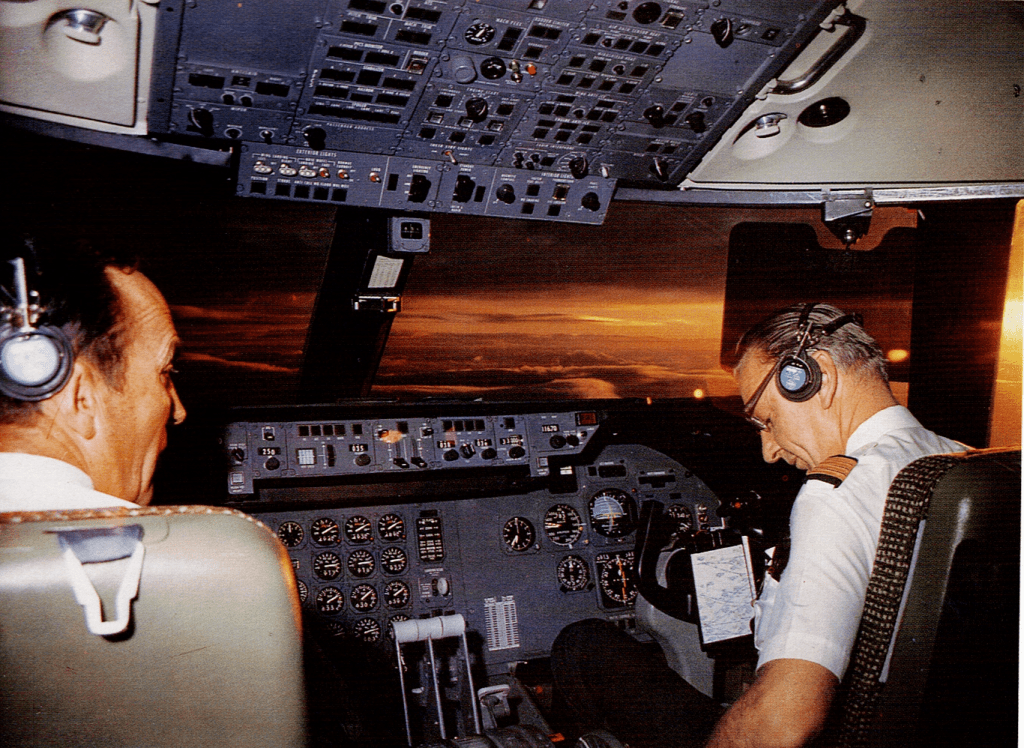
A longer-range variant of the standard-length L-1011 was developed in the late 1970s. Designated the L-1011-500, the fuselage length was shortened by 14 feet (4.3 m) to accommodate higher fuel loads.

Ironically, American Airlines never flew the “Ten Eleven,” purchasing many DC-10s instead.

Lockheed manufactured a total of 250 TriStars, ceasing production in 1984. Lockheed needed to sell 500 planes to break even. Failing to achieve profitability in the civilian airliner sector, the TriStar was to be Lockheed’s last commercial aircraft.

Flying all of its life on test and development work, the prototype was acquired by Aviation Sales of Ardmore in August 1986.

Gallery

L-1011 Tristar
Engines: 3 x Rolls Royce RB.211 22B turbofan, 42,000 lb / 180.5kN
Wing span: 155 ft 4 in (47.34 m).
Length: 178 ft 8 in (54.35 m).
Height: 55 ft 4 in (16.87 m).
Wing area: 312.1 sq.m / 3359.41 sq ft
Empty wt. 102000 kg / 222,941 lb
Max TO wt: 430,000 lb (195,045 kg).
Fuel capacity 23,814 USG
Max level speed: M0.9.
Cruise 474 mph.
Stall 144 mph.
Initial climb rate 2,800 fpm
Ceiling: 42,000 ft.
Range w/max.payload: 5000 km / 3107 miles
Pax cap: 345.
Takeoff run 7,590 ft
Landing roll 5,660 ft
Crew: 2-3
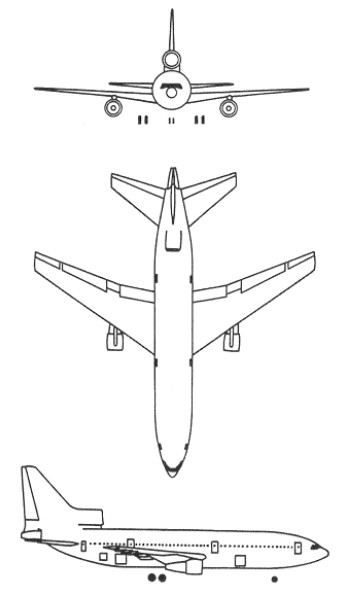
Lockheed L-1011 Tri Star

Lockheed L-1649 Super Constellation / Constellation Starliner

L.1649A Super Constellation

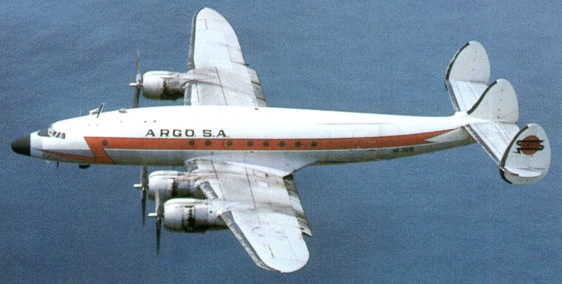
Lockheed built 286 Super “Connies,” then followed with production of the L.1619 Starliner. This development of the Model 649 standard Constellation actually started in when Lockheed were attempting to meet the requirements of TWA. Modified into a military transport during the Second World War, the design was reconverted into an airliner which came at the right time to equip airlines starved of new aircraft by the war.

The Super Constellation was first introduced on transatlantic services by KLM in 1953.

With a range of 7,200 miles, the Starliner became popular on long international routes for TWA and Air France. Only 43 Starliner Constellations were built, and most of those were short lived, bowing out gracefully for the introduction of the jet age. A historical note about the Connie’s heritage: the tri-tailed airliner was the first Air Force One.

US Navy designation – Lockheed R7V-1 Super Constellation.

In 1963 Flying Tiger VP Fred Benninger required a Super H Connie for less than the going price of $500,000. Finding two Navy surplus Elations, Connies with Electra engines, the fuselages were right but not the wings. Two cheap South American 1049G’s and four months of fitting parts produced two cargo planes for less than the price of one.

1988

Gallery

Lockheed Super Constellation
Engines: 4 x Wright, 3250 hp.
Wing span: 123 ft 0 in (37.49 m).
Length: 113 ft 7 in (34.65 m).
Height: 24 ft 9 in (7.56 m).
Max TO wt: 133,000 lb (60,380 kg).
Max level speed: 352 mph (563 kph).

EC 121K Warning Star
Engines 4 x 3,400 h.p. Wright R 3350 turbo compound piston engines.
Length 113.6 ft. (34.62 m.)
Wing span 123 ft. (37.47 m.)
Weight, max 137,500 lb. (62,370 kg.)
Crew 6.
Pax cap: 65 89
Max cruise 310 m.p.h. (500 km.p.h.)
Range 4,800 miles (7,700 km.) with 18,000 lb payload

Lockheed L.1049 Constellation

A stretched version of the L.749, the L.1049 Super Constellation, was introduced in 1950. Gross weight was increased substantially when the fuselage was expanded by 18.4 feet and 3,250-hp Wright engines were fitted. The stretched “Connie” held up to 91 passengers; with tip tanks, range was increased to 5,840 miles.

The first prototype Super Constellation (a conversion of the original C-69 prototype) flew for the first time on 13 October 1950. First in commercial service (on 15 December 1951) was one owned by Eastern Air Lines. This version could accommodate 71 first-class or 95 coach-class passengers (14 delivered to Eastern and ten to TWA during 1951-52).

Lockheed L.1049 Constellation Article

The L.1049C model had structural modifications to allow a gross weight of 150,000 pounds, provided that more powerful engines were available. Lockheed built 286 Super Connies.

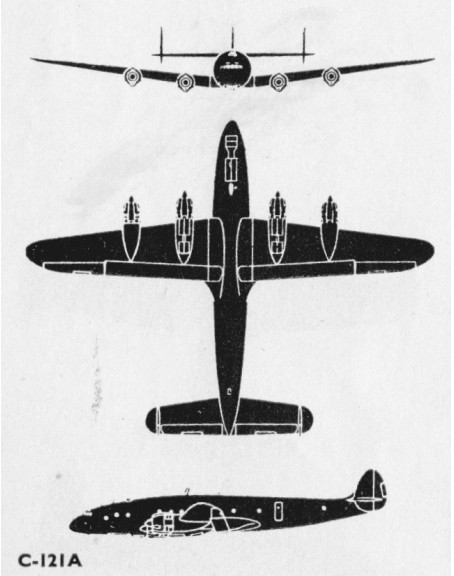
L-1049 Super Constellation were in use by both the USAF and US Navy under a variety of C-121C and R7V-1 designations respectively.

Gallery

Lockheed C 121G Super Constellation
Engine: 4 x Wright R 3350-91, 3501 hp
Length: 116.175 ft / 35.41 m
Wingspan: 122.999 ft / 37.49 m
Max take off weight: 144917.0 lb / 65722.0 kg
Max. speed: 320 kt / 592 km/h
Range: 1825 nm / 3380 km
Crew: 5
Payload: 72 Pax

L-1049G
Engines: 4 x 3400hp Wright R-3350-972T-C18DA-3
Max take-off weight: 130,000 lb
Empty weight: 33119 kg / 73015 lb
Wingspan: 37.62 m / 123 ft 5 in
Length: 35.41 m / 116 ft 2 in
Height: 7.55 m / 24 ft 9 in
Wing area: 154.40 sq.m / 1661.95 sq ft
Cruise speed: 589 km/h / 366 mph
Ceiling: 6950 m / 22800 ft
Range: 6700 km / 4163 miles
Crew: 4
Passengers: 62-109

RC-121
Max Take Off Weight: 142,000 lb

Lockheed L-1049 Super Constellation / EC-121

Lockheed L.749 Constellation / C-121 / WV-2 / R7V

749A Constellation

The Lockheed Constellation L.749 variation was a long-range version of the earlier L.049. The first Constellation placed in airline service was the L.749 series. This aircraft differed from earlier versions in its increased fuel capacity and takeoff weight. The L.749 provided for 44 to 64 passengers and was powered by four 2,500-hp Wright Cyclone 18-cylinder air-cooled engines.

The 749 Constellation was operated by the military as the C-121A and C-121B.

EC-121

In service with both the U.S. Navy (WV-2) and U.S.A.F. (RC-121C) in 1955 as high-altitude early-warning radar picket. The WV-2 has very large dorsal and ventral radomes, which are not found on R7V transport versions. Basically-similar transport versions are the R7VA (U.S.N.) and C-121C. Experimental turboprop powered R7V-2 also flying. Earlier C-121A and VC-121B with shorter (95 ft. 1 in) fuselages were also in service in 1955.

Lockheed L.749 Constellation / C-121 Article

WV-2

Gallery

WV-2
Reconnaissance and early-warning aircraft
Engines: 4 x Wright R3350-34W Turbo-Cyclone, 2,250 h.p.
Wingspan: 123 ft
Length: 113 ft. 7 in
Loaded weight: 130,000 lb
Max. speed: 350 mph
Max. range: over 4,000 miles at 330 mph
Crew: Up to 31

Lockheed L.188 Electra

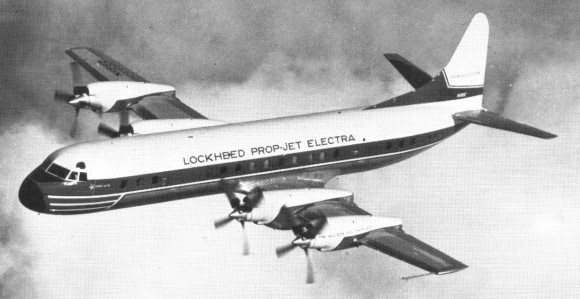
The design of the Lockheed L-188 Electra began in 1954, and in the following year the company received a launching order from American Airlines.

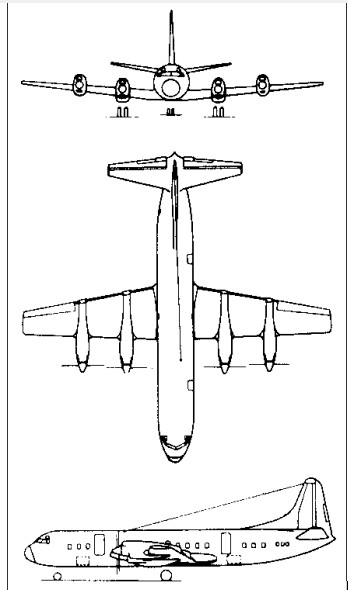
By the first flight, 144 were already on order. The prototype, first flown on 6 December 1957, was a low-wing monoplane of conventional configuration with retractable tricycle landing gear and powered by four Allison 501D-13, 501D-13A or 501D-15 turboprop engines. Standard accommodation was for 66 to 80 passengers, but a high-density arrangement was available optionally to seat 98.

Several crashes occurred in 1959 that caused Lockheed Corp. to make a few improvements including a stronger wing structure and engine nacelles plus thicker wing skins.

Built initially as the L-188A, the Electra became available also as the longer-range L-188C with increased fuel capacity and operating at a higher gross weight. A total of 170 had been built when production ended unexpectedly early as a result of passenger loss of confidence in the type after two had disintegrated in flight, and by the time remedial modifications had been, incorporated customer airlines were interested in turbojet- rather than turboprop-powered aircraft. About half of the total built remained in service in 1992, many of them converted by Lockheed Aircraft Service for convertible passenger/cargo or all-cargo use.

Gallery

L-188A Electra
Engines: 4 x Allison 501D-13, 2796kW / 4600 hp
Propellers: Hamilton Standard
Max take-off weight: 51256 kg / 113001 lb
Empty weight: 26036 kg / 57400 lb
Wingspan: 30.18 m / 99 ft 0 in
Length: 31.85 m / 104 ft 6 in
Height: 10.01 m / 32 ft 10 in
Wing area: 120.77 sq.m / 1299.96 sq ft
Cruise speed: 652 km/h / 405 mph
Ceiling: 8655 m / 28400 ft
Range: 3541 km / 2200 miles
Crew: 5
Passengers: 44-98

Engines: 4 x 4,050 h.p. Allison 501 D15 turboprop.
Length 104.5 ft. (31.81 m.)
Wing span 99 ft. (30.18 m.)
Weight empty 57,300 lb. (25,990 kg.)
MTOW: 113,000 lbs (51,227 kg).
Pax cap: 99.
Max cruise 405 m.p.h. (650 km.p.h.)
Ceiling 28,400 ft. (8,655 m.)
Range 2,770 miles (4,458 km.) with 18,000 lb. (8,165 kg.) payload
Cabin width: 10 ft 8 in.
Takeoff run 4,720 ft
Landing roll 4,300 ft

Lockheed L-188 Electra

Lockheed L-731 / L-1329 JetStar / C-140 / FanStar

JetStar

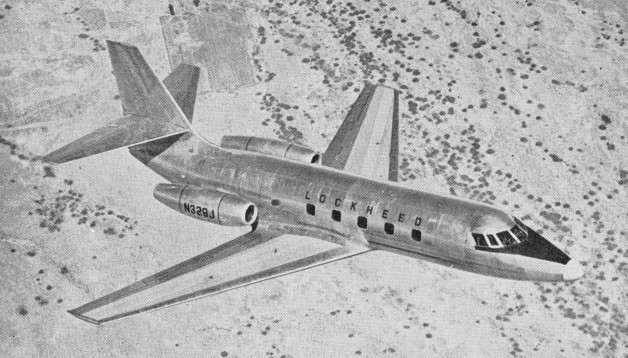
To meet a US Air Force requirement for an ‘off-the-shelf’ high-performance light transport, Lockheed developed the Lockheed 1329 JetStar. A low-wing monoplane with swept wings and swept tail surfaces, the JetStar was powered in prototype form by two 2200kg thrust Bristol Orpheus 1/5 turbojet engines. The JetStar flew 241 days after design began, in 1957. The first of two prototypes was flown on 4 September 1957, with flight testing proving satisfactory, but when planned licence-production of the Orpheus engine could not be finalised.

Lockheed L-731 / L-1329 JetStar Article

Lockheed chose to power the initial production version by four 1361kg thrust Pratt & Whitney JT12A-6 engines, mounted in pairs on each side of the rear fuselage. The anticipated military demand failed to materialise in any significant numbers, with the result that the majority of the 204 JetStars that were built, before production ended in 1980, were sold as business/executive aircraft.

As advertised – Dec 2011

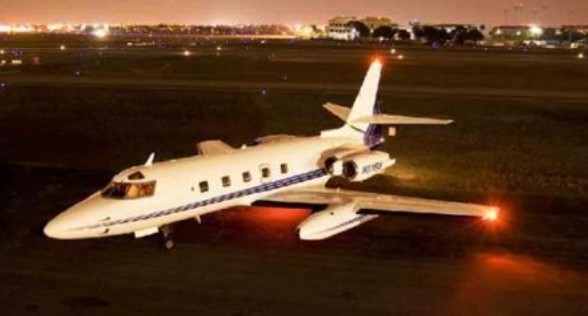
1977 LOCKHEAD JETSTAR II; A truly one-of-a-kind 12 passenger aircraft (including crew of 2 pilots and 1 flight attendant), powered by four 3,700 lbf (16.5 kN) thrust Garrett TFE731-3 turbofan engines and fitted with revised external fuel tanks. This is one of only 40 produced between 1976-1979, hand built in Marietta, Georgia USA; 30 still flying!

AiResearch Aviation Company’s 731 JetStar made its first flight on July 10 1976 from San Antonio, Texas.
The TFE 731 is 10 inches larger in diameter than the JT12A, so the drag produced from the larger nacelles needed to house it would lessen the benefits of its lower fuel consumption. Also, the modified aircraft weighs 1,750 pounds more than its predecessor, so the gross weight would have to be increased in order to retain the same payload, but a high¬er gross weight means more drag. The TFE731 3 turbofan produces only 400 pounds more takeoff thrust than does the JT12A 8 turbojet, so there was not a significant amount of extra power to overcome drag.

Ed Swearin¬gen designed a TFE 731 installation for the JetStar. He also warped both ailerons so that the outer portions are biased slightly upward in neutral position to act as “reverse” flaps, thus forcing the inboard section of the wing to carry a greater share of the lifting loads. By designing a new fuel tank below the wing instead of wrapping it around the airfoil, Swearingen was able to reduce the size of the pod without sacrificing any fuel capacity and eliminate all nacelle flow disturbances caused by the tanks.

Wind tunnel studies showed that despite its larger nacelles, the overall drag of the 731 JetStar would be slightly less than that of the original JT12A powered version.

A supplemental type certificate for retro¬fitting Garrett TFE 731 3s to JetStars was granted to AiResearch on June 10, 1976, nearly two years after the aircraft’s first flight. Flight tests had demonstrated that the turbofan 731 JetStar exceeded the performance of its turbojet predecessor in take¬off, rate of climb, initial cruise altitude and cruise speed at altitude. The 731 JetStar will go 2104 nm with full IFR reserves.

Pro¬duction JetStar IIs differs only slightly as, because the aircraft is newly manufactured, the aft fuselage bulk¬heads can be relocated, rather than modified (as they must be on the 731 JetStar), to ac¬commodate the Garrett engines; thus the na¬celle installation is about 175 pounds lighter than the AiResearch arrangement. The first production example (N5527L) of the Lockheed 1329 25 JetStar II 12 seat executive transport made its first flight at Marietta, Georgia on 18 August 1976.

American Aviation Industries, founded 1985 and offered Lockheed JetStar business jet re-engining program as the FanStar.

Gallery

Variants:

JetStar I
Original production version, differing from the first prototype by having increased fuel capacity provided by a permanently attached streamlined JuelI tank at mid-span of each wing, de-icing of wing and tail unit leading edges and Pratt & Whitney JT12A-6 engines; a slightly lengthened fuselage provided executive standard accommodation for a crew of two and 10 passengers; late production aircraft had 1497kg thrust JT12A-8 turbojet engines

JetStar 731
Conversion developed by AirResearch, replacing the Pratt & Whitney powerplants of Jet Star I aircraft with more fuel-efficient Garret TFE731-1 turbofan engines; about 60 JetStar Is were converted to this standard

JetStar II
New production version incorporating Garrett TFE731-3 engines as standard and a number of refinements

C-140A
Five aircraft for USAF, similar to early production JetStar Is and equipped for calibration of navigation beacons

C-140B
Convertible cargo/passenger version for USAF, five built; generally similar to C-140A

VC-140B
Designation of six additional production aircraft, generally similar to C-140A, except equipped as VIP transports; the five C-140Bs were also converted to this configuration

Specifications:

Lockheed JetStar II
Engines: 4 x Garrett TFE731-3 turbofans, 1678kg
Max take-off weight: 20185 kg / 44501 lb
Loaded weight: 11294 kg / 24899 lb
Wingspan: 16.59 m / 54 ft 5 in
Length: 18.41 m / 60 ft 5 in
Height: 6.22 m / 20 ft 5 in
Wing area: 50.4 sq.m / 542.50 sq ft
Max. speed: 880 km/h / 547 mph
Ceiling: 13105 m / 43000 ft
Range: 4820 km / 2995 miles

Lockheed 731 Jetstar-6, -8 Jetstar II (Airesearch conversion)
Engines: 4 x Garrett TFE 731 3, 3,700 lbs
Length: 60 ft. 5 in
Height: 20 ft. 5 in
Wingspan: 54 ft. 5 in
Wing area: 542.5 sq. ft
Airfoil: NACA 63A1 12 at root, NACA 63A309 modified at tip
Aspect ratio: 5.27
Passenger seats: 10
Takeoff weight: 43,750 lbs
Operating weight: 24,178 lbs
Useful load: 19,572 lbs
Payload with full fuel: 1,750 lbs
Zero fuel weight: 27,000 lbs
Fuel capacity: 2,640 USG/17,822 lbs
Wing loading: 80.6 lb/sq.ft
Power loading: 2.96 lbs/ft.sq
Baggage area: 104.9 cu.ft
Cabin pressure differential: 8.9 psi
Cabin altitude @ 43,000 ft: 7,500 ft
Balanced field length: 6,250 ft
Takeoff safety speed: 145 knots
Initial rate of climb: 4,200 fpm
Gross takeoff climb rate, one engine out: 2,400 fpm @ 220 kt
Engine out service ceiling: 37,000 ft
Maximum operating altitude: 43,000 ft
Maximum operating Mach: 0.82 M
Maximum cruise: 475 kt / 0.82 M
Normal cruise: 0.76 M
Long range cruise: 438 kt / 0.72 M
Maximum range, 45 minute reserve 2,770 nm
Range max fuel/cruise: 2331 nm/4.9 hr
Range max fuel / range: 2956 nm/ 6.8 hr
Maneuvering speed (@ 20,000 ft. and 35,000 lb): 220 knots
Stall speed, landing configuration: 108 knots
Stall clean: 138 kt.
1.3 Vso: 140 kt
Vmc: 103 kt

Lockheed Experimental Stealth-Tactical (XST) / Have Blue

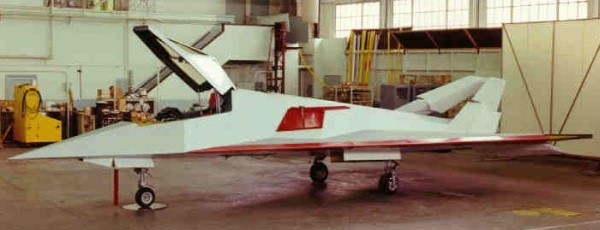
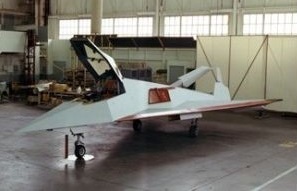
Lockheed was one of at least five US aerospace companies which apparently received contracts in 1973 from the US Defense Advanced Projects Research Agency (DARPA) to study signature reduction techniques and their potential application to a manned combat aircraft. The effort was code-named Have Blue.

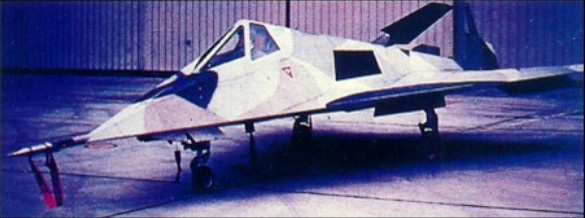
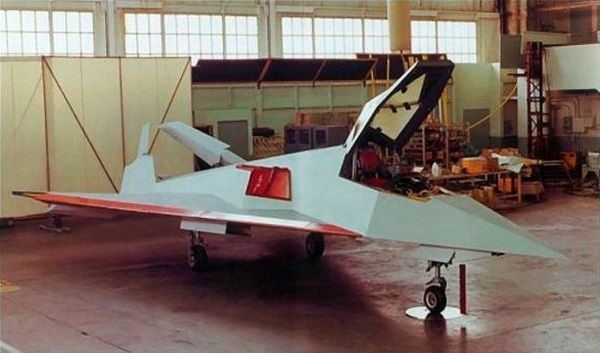
Lockheed’s Advanced Development Projects organisation at Burbank (ADP), more commonly known as ‘The Skunk Works’, already had practical experience in the design of stealth aircraft; low radar signature had been a significant consideration in the Blackbird family of Mach 3.0 reconnaissance aircraft. But rivals, such as General Dynamics, McDonnell Douglas and Northrop, were the then current manufacturers of fighter aircraft for the US military. Even to this day it has not been officially confirmed that Lockheed was the only Have Blue contractor to be funded as far as the hardware stage of an Experimental Stealth-Tactical (XST) prototype. It seems unlikely. It is known, however, that funding for this and other stealth projects was accelerated in 1977, and that the Lockheed design was airborne from the secluded and top secret Groom Lake airfield, on the Nevada test range in December 1977, flown by ADP chief test pilot Bill Park. Although only half the size of the F-117A, this aircraft’s configuration was broadly similar, except for the vertical tail surfaces. Apparently these were individually-mounted and inwardly canted, similar to those of the Blackbird series. The prototype Lockheed stealth aircraft was powered by two General Electric J85 turbojets and used an adapted F-16 fly-by-wire system.

Using special-access, fast-track procedures, the programme developed rapidly, despite the crash of a prototype at Groom Lake on 4 May 1978. After a hard landing which damaged the starboard undercarriage member, Bill Park elected to apply power and climb away in order to assess the damage. Following another abortive approach, he was obliged to eject, but sustained serious injuries and never flew the aircraft again. The landing problem was attributed to faulty fly-by-wire software; Ken Dyson took over as the contractor’s chief test pilot. There were at least two other Lockheed prototypes, however, and they were evidently flown with great success against various radars on the Nevada range. Ground test vehicles were sent for radar cross-section measurement on large-scale outdoor ranges, with similarly encouraging results. By the end of 1978, Lockheed had received a USAF contract to develop a full-scale production version. It contained warranties covering the aircraft’s range, weapons delivery accuracy and radar cross section.

Both prototypes ultimately crashed, one in May 1978 and the other in 1980, with their pilot’s ejecting.

The wreckage of the two Have Blue aircraft was buried within the Nellis Test Range. One was reportedly buried at the Groom Lake site just south of the hangar complex. Lockheed engineers have since searched for the buried Have Blue with a view to restoring it for display purposes, but despite their best efforts have been unable to locate the wrecked aircraft.

Gallery

XST
Engine: 2 x General Electric J85, 1270kg
Max take-off weight: 5440 kg / 11993 lb
Wingspan: 6.86 m / 22 ft 6 in
Length: 11.58 m / 37 ft 12 in
Height: 2.29 m / 7 ft 6 in
Crew: 1

Lockheed XF-90

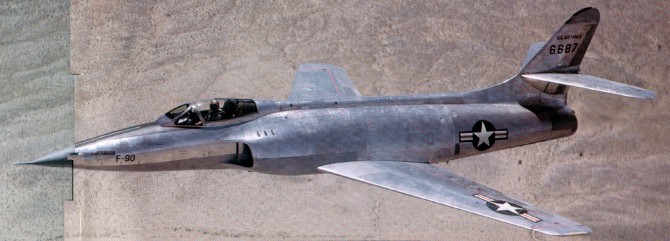
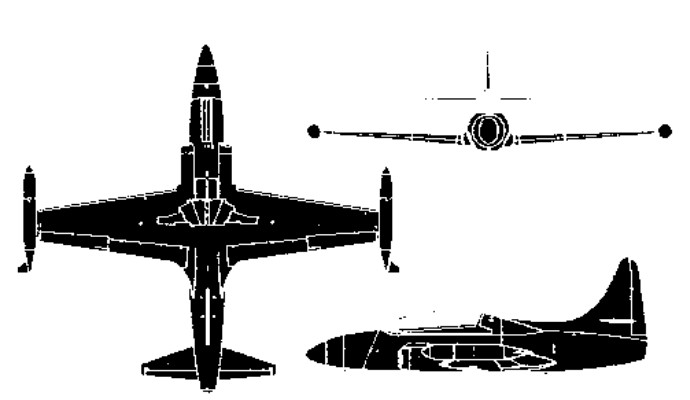
In 1946 the new Strategic Air Command of the USAAF placed an order for the development of a so-called penetration fighter; a long-range fighter able to fly ahead of the bomber force and sweep aside all fighter opposition. The XF-90 evolved over two years and resulted from 65 different designs created by Johnson’s engineers. These included butterfly-tailed aircraft, three-engine aircraft, ‘W’ winged designs. Lockheed’s Model 153 submission was thought to offer great potential and was ordered in the form of two XF-90 prototypes. The two prototypes were to be tested in a fly-off competition with the McDonnell XF-88 and North American YF-93A designs.

Developed by Clarence L. (Kelly) Johnson’s Lockheed fighter team, the design had a number of similarities to the company’s F-80 Shooting Star, but was of more advanced aerodynamic concept. It had a finely tapered forward fuselage, two laterally mounted 4200-lb (1905-kg) afterburning thrust Westinghouse J34-WE-11 turbojets, and flying surfaces swept at 35 degrees. A radius of about 1100 miles (1770-km) was provided by considerable internal fuel supplemented by jettisonable wingtip tanks. This was calculated to provide an escort capability into the western USSR from bases in West Germany, and a potent offensive punch was provided by a combination of four 20-mm cannon with six 0.5-in (12.7-mm) machine-guns. The final XF-90 had 12.7mm rivets in the wings and weighed as much as a DC-3.

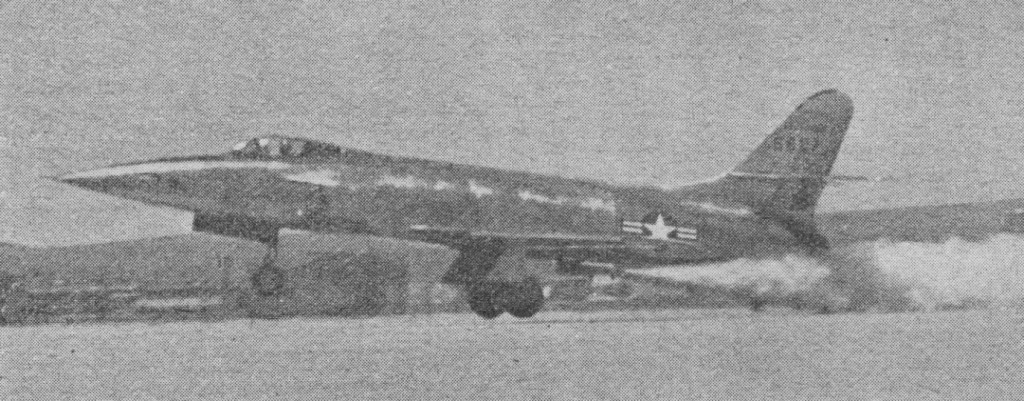
The first aeroplane flew on 4 June 1949 at Muroc, piloted by Tony LeVier. It cruised around 15,000 ft for 37 minutes. The twin Westinghouse J-34 were assisted by a pair of externally mounted JATO rockets for the gross weight of 26,000 lb.

XF-90 first take-off

It was immediately revealed to be drastically under-powered with twin 1406kg thrust Westinghouse J34-WE-11 turbojets. The XF-90 reached 1070km/h at 9784m in level flight and could easily be pushed through the sound barrier in a shallow dive. Throughout April and May 1950, above Muroc Dry Lake, Lockheed test pilot Tony LeVier put the XF-90 through high-speed dive tests. LeVier dived the XF-90 to Mach 1.12 on 17 May 1950.

The XF-90 stalled at 204km/h, making it no easy machine to control on the approach. Its take-off performance enabled it to clear a 15m obstacle in 2629m without the rocket-assisted take-off (RATO) units used in some tests. In the 1949 fly-off, the XF-88 came in first, the XF-90 second, and the YF-93A third, but by then the results were academic. With the September 1949 detonation of the Soviet Union’s first nuclear weapon, the USAF’s requirement was changing at this time, so the project was cancelled.

The second XF-90 was rigged with instruments on the ground and destroyed in the 1952 atomic bomb tests at Frenchman’s Flat, Nevada. Lockheed records indicate that the first XF-90 was shipped in 1953 to a National Advisory Committee for Aeronautics (NACA) laboratory in Cleveland, Ohio. Apparently, it was eventually broken up in tests at that NACA facility.

Engines: 2 x Westinghouse J34-WE-11 turbojets, 1406kg thrust
Max take-off weight: 12300 kg / 27117 lb
Empty weight: 8400 kg / 18519 lb
Wingspan: 12.19 m / 39 ft 12 in
Length: 17.12 m / 56 ft 2 in
Height: 4.8 m / 15 ft 9 in
Wing area: 32.05 sq.m / 344.98 sq ft
Max. speed: 1070 km/h / 665 mph
Ceiling: 11800 m / 38700 ft
Range: 3700 km / 2299 miles

Lockheed XF-90

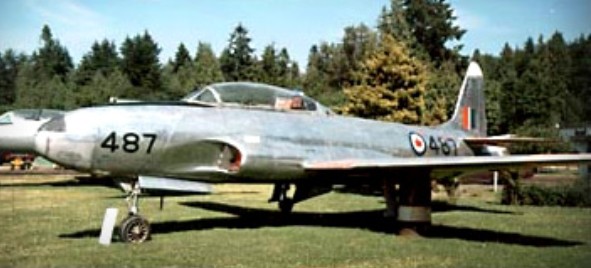
Lockheed T-33 / TF-80C / T-1 Seastar / TV-2 / Canadair Ltd CL‑30 Silver Star

T-33

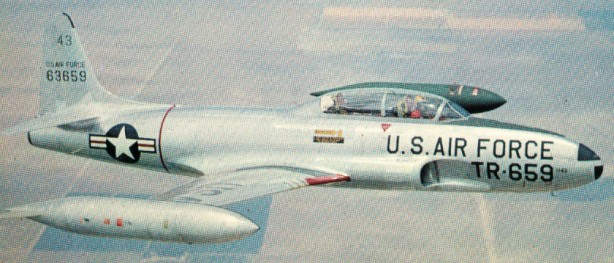
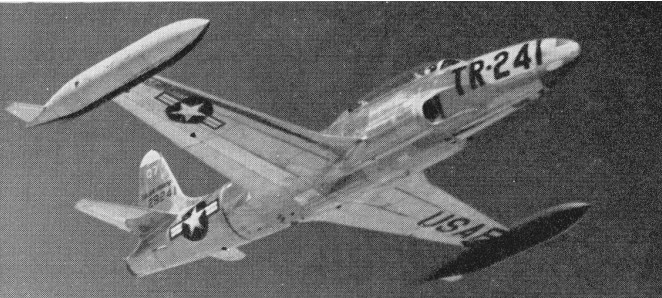
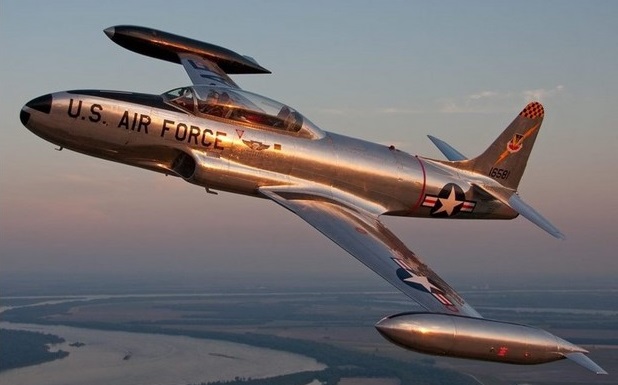
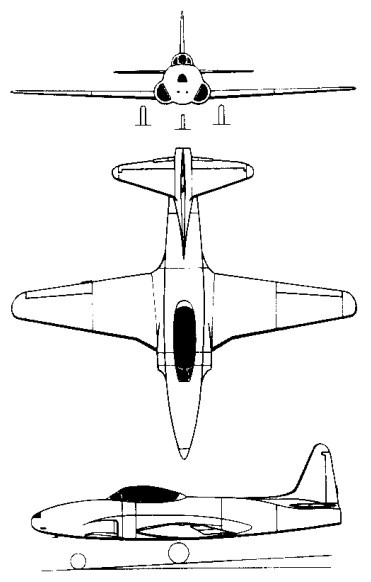
In December 1945 the USAAF began to receive its first jet fighter, the Lockheed P 80 Shooting Star, and it soon became clear that a trainer version was essential. Lockheed’s P-80 Shooting had developed into a lengthened-fuselage two-seat trainer version, designated originally TF-80C. The first of these flew on 22 March 1948.

Lockheed T-33 / TF-80C / T-1 Seastar / TV-2 Article

In addition to the fuselage ‘stretch’, a second cockpit in tandem was provided with dual controls, the transparent canopy was extended to cover both cockpits and the armament of the F-80 was deleted. Original engines were Allison J33-35 single-shaft turbojet engines with a thrust rating of 5,200 lbs.

Test pilot Jim Fitzgerald was killed during an approach to landing in the first T-33 that Lockheed built.

T-33A

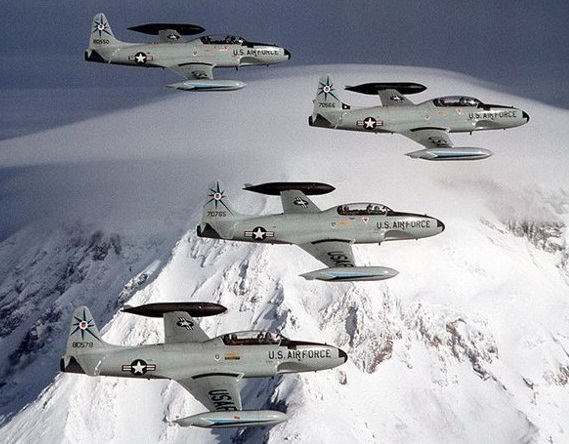
The type eventually became the USAFs standard jet trainer, many being supplied to foreign nations under the Military Aid Program. 1,058 were supplied to friendly nations under the program. They were also built for service with the US Navy and Marine Corps under the designation TV-2, later T-33B.

TV-2 Seastar

A total of 128 TF-80C were built before the designation was changed to T-33A in May 1949.

Derived from T 33 as shipboard trainer, a total of 271 T-1 Seastar trainers were built for U.S. Navy during 1957 58.

Variants included small numbers modified as DT-33A drone directors and AT-33A armed close-support aircraft.

After a production run of 11 years the 5691th and last Lockheed T-33A Shooting Star was delivered by Lockheed at the beginning of August 1959.

A total of 5,691 were built by parent company, 656 built in Canada (by Canadair Ltd as CL 30 Silver Star with Nene 10), and 210 built in Japan (by Kawasaki). The aircraft was supplied to the air arms of some twenty-five countries.

In 1963 Libya started its own Air Force when the US turned over two T-33 and a C-47 at Wheelus AFB.

Canadair was given a contract in September 1951 to manufacture the T-33 with the first flight being in December 1952. The Canadair CL-30′ Silver Star’, later designated CT-133, was a tandem two-seat, armed trainer version of the T-33A, powered by a Rolls Royce Nene 10 turbojet, delivering 5,400 lb thrust. 636 were built under licence for the Royal Canadian Air Force from 1952. It was used as an instrument flight trainer whilst in service with the Canadian forces in Germany.
The Silver Star Mks. 2 and 3 differed from the U.S. manufactured T-33A in being powered by a Rolls-Royce Nene 10 turbojet.
Armament consisted of two nose-mounted 12.7 mm (0.5 in) machine-guns plus various light bombs, rockets and machine-gun pods. It had a service ceiling of 48,000 feet, a maximum speed of 600 mph at sea level and a cruising speed of 455 mph. The normal range was 1,025 miles and the maximum range was 1,275 miles.
Canada gave T-33s to Bolivia, France, Greece, Portugal and Turkey under the Mutual Aid programme.

CL-30 Silver Star

By the end of 2000, 7 nations in the world still listed the T-33 as “in service.”

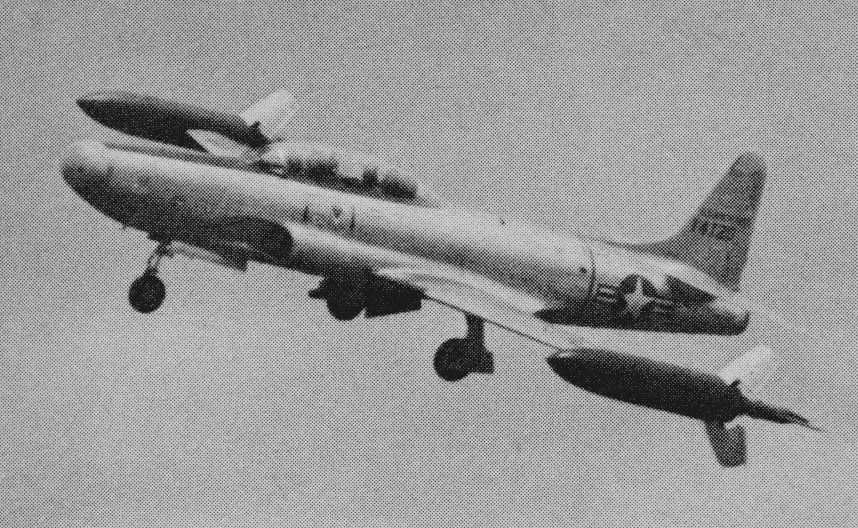
Circa 1964 a T-33, modified and operated for USAF Flight Dynamics Lab at Wright Patterson AFB, by Cornell Aeronautical Laboratory, has a variable drag system provided by servo-driven petals mounted on wing tanks. Simulation of flight path and handling qualities of lifting-body re-entry vehicles was made on both front and back of the power curve.

Cornell Aeronautical Laboratory modified T-33

Cornell Aero Lab at Cornell University in Ithaca, New York, had a variable-stability aircraft, a Lockheed NT-33A Shooting Star, which Neil Armstrong flew, testing experimental sidestick controller.

Gallery

Scale replica:
StarGate YT-33
Windstar YF-80

T-33
Engine: 1 x Allison J-33-A-5, 24.0kN
Max take-off weight: 5900 kg / 13007 lb
Empty weight: 3810 kg / 8400 lb
Wingspan: 11.9 m / 39 ft 1 in
Length: 11.5 m / 37 ft 9 in
Height: 3.6 m / 11 ft 10 in
Wing area: 22.0 sq.m / 236.81 sq ft
Max. speed: 965 km/h / 600 mph
Ceiling: 14700 m / 48250 ft
Range w/max.fuel: 2150 km / 1336 miles
Crew: 2

T-33A
Engine: 5,400 lbs.t. (2450 kgp) Allison J33 A 35.
Max level speed: 543 mph (874 kph).
Max speed, 600 mph (966 kph) at sea level
Cruise, 430 mph (692 kph)
Initial climb, 5,525 fpm (28 m/sec)
Service ceiling, 47,500 ft (14,477 m)
Range, 1,345 mls (2164 km).
Empty weight 8,084 lb (3 667 kg)
MTOW, 11,965 lb (5428 kg).
Wing span, 38 ft 10.5 in (11.85 m)
Length 37 ft 9 in (11.49 m)
Height: 14 ft 4 in (3.45 m)
Wing area, 237 sq.ft (22 sq.m).

T-33A
Engine one 5,400-lb. Allison J-33-A/4 turbojet with w/water-alcohol injection.
Gross wt. 16,800.
Empty wt. 8,440.
Total fuel: 813 USG; 230 in each tip tank.
Max Speed 525 mph.
Long range cruise 455 mph.
Range 1,000 nm.
Ceiling 47,000′.
Seats (ejection) 2.

T 1A Seastar
Engine: 6,100 lbs.t. (2 767 kgp) Allison J33 A 22 turbojet.
Max speed, 580 mph (933 kph) at 35,000ft (10 668 m)
Cruise, 410 mph (660 kph)
Initial climb, 6,330 fpm (32.1 m/sec)
Service ceiling, 40,000ft (12 192 m)
Range, 967 mls (1566 km).
Empty weight, 11,965 lb (5 428 kg)
Loaded weight, 15,500 lb (7 031 kg).
Wing span, 42 ft 10 in (13.05 m)
Length, 38 ft 6.5 in (11.73 m)
Wing area, 240 sq.ft (22.3 sq.m).

Canadair CL-30
Engine: Rolls Royce Nene 10 turbojet, 5100 lb (2,315 kg)
Span: 37 ft 7 in (11.48 m) without tip tanks
Wing Span: 38 ft 10.5 in
Length: 37 ft 9 in (11.49 m)
Height: 11 ft 8 in (3.6 m)
Wing area: 238 sq ft (22.11 sq m)
Empty weight: 8,440 lb (3,832 kg)
Loaded weight: 18,400 lb (8,217 kg)
Maximum speed: Mach .787
Armament: Two .50 calibre Browning machine guns

Lockheed T-33
T-1 Seastar

Lockheed P-80 / F-80 Shooting Star

P-80 Shooting Star

In the spring of 1943 Allied intelligence became aware of the ME262 jet fighter, little was known about it but under the direction of Henry H. Arnold, the Commanding General of the U.S. Army Air Forces the decision was taken to bring the USA into the jet age. The development of the earlier XP59 Airacomet had not inspired confidence in the turbojet jet but with the reliability and power of the British developed engines increasing by the day the Americans decided that they could not afford to be left behind.

Arnold went to Lockheed and convinced them to build an airframe around the de Havilland Halford H1 (Goblin) which was already produced almost 2,300 lbs of thrust of the drawing board with promise of a great deal more. A design was submitted by what would be known as the ‘Skunk Works’ team led by Kelly Johnson claiming that the airframe could be built and ready for testing in 180 days, in the end it took just 143 being delivered to Muroc field (now Edwards AFB) on the 16th November 1943.

The design proved acceptable to the USAAF was a low-wing cantilever monoplane with a knife-edge laminar-flow wing section; engine within the rear fuselage; air intakes on each side of the fuselage forward of the wing leading edge; and retractable tricycle-type landing gear. Equally attractive was the company’s proposal to complete an initial prototype within 180 days and little time was lost in awarding contracts for three prototypes and 13 service trials aircraft. Work on the first prototype began in August 1943 and just 143 days later (on 8 January 1944) this aircraft flew for the first time.

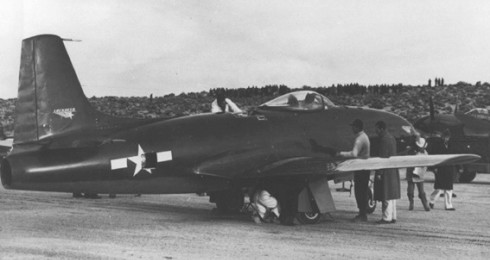
XP-80

The first flight was delayed by foreign object damage which destroyed the engine on the first run up. A new engine was shipped from Britain allowing the first prototype (44-83020) nicknamed Lulu-Bell to get airbourne on the 8th January 1944. It was flown by Lockheed test pilot Tony LeVier. Service designation of the prototype was XP-80. Its power plant was a 13.34kN de Havilland H-1 turbojet.

Lockheed F-80 Article

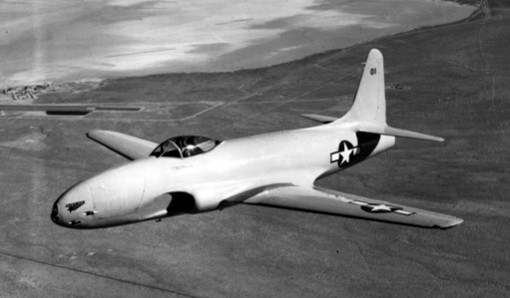
Plans for this engine to be built by the Allis-Chalmers Company in America did not happen, so the next two prototypes each had a 16.68kN General Electric 1-40 turbojet, based on the Rolls Royce Derwent and also built by Allison as the J33. This was a larger and more powerful engine than the intended Allis-Chalmers J36, involving redesign which included increased span and length, a taller fin and strengthened landing gear. The exercise cost five months, for it was not until 10 June 1944 that the first of these two XP-80A was flown, by Tony Le Vier. Its first flight performance was not impressive and even with the technical difficulties rectified it was still considered worse than the H1 powered XP-80.

XP-80A 44-83021 Gray Ghost

The XP-80A’s were primarily testbeds for bigger engines and intake duct design, and consequently were larger and 25% heavier than the XP-80, a big factor in their poor performance. The P-80 testing program proved very dangerous. Milo Burcham was killed on 20 October 1944 while flying the third YP-80A, 44-83025 while the “Gray Ghost” was lost on a test flight on 20 March 1945, although pilot Tony LeVier escaped being able to bail out when the engine failed due to a turbine blade failure.

These two prototypes were designated XP-80A and were powered by the Allison-developed General Electric J33 engine of 1814-kg (4,000-1b) thrust, with low-set equi-tapered laminar-flow wings and engine air intakes set into the fuselage just forward of the wing roots, this version had a top speed of 898 km/h (558 mph) at sea level.

Thirteen development YP-80A aircraft for service trials, with J33-GE-9 or J33-GE-11 engines and an armament of six machine guns in the nose, started delivery to test establishments in October 1944 and it was aircraft of this type that arrived in Italy in May 1945. Two examples reached the Italian war zone just before VE-day, but failed to fly an operational sortie.

Ordered into quantity production during April 1944, the Shooting Star subsequently suffered cancellations after VJ-Day, but was proceeded with and as the P-80A attained operational service with the 412th Fighter Group during 1946, although poor serviceability and a very high accident rate significantly reduced its value. Production P-80A had wingtip tanks and provision for bombs, rockets and fuel tanks to be carried beneath the wings, plus six 12.7mm guns mounted in the fuselage nose.

Production deliveries of the P-80A did not start until December 1945, four months too late to see action against the Japanese.

The Shooting Star made a number of important flights, these including the first west-to-east trans-atlantic crossing by jet which was accomplished by 16 F-80s of the 56th Fighter Group in July 1948. One Shooting Star has set a world speed record of 1,003.91km/h on 19 June 1947.
The P-80 designation changed to F-80 in 1948.

The second model to enter production was the F-80B, which featured numerous refinements such as thinner wing section with thicker skin, stronger bulkheads in the nose section to support greater fire-power, more power, stainless steel armoured engine compartment, provisions for JATO, and provision for rocket launchers. But only 240 of this model were completed before manufacture switched to the definitive F-80C. This possessed even greater power and also better armament and increased underwing weapons capability, no less than 670 being completed by the end of 1950, by which time the USA was in the Korean War.

The RF-80C being an unarmed photographic reconnaissance sub-variant.

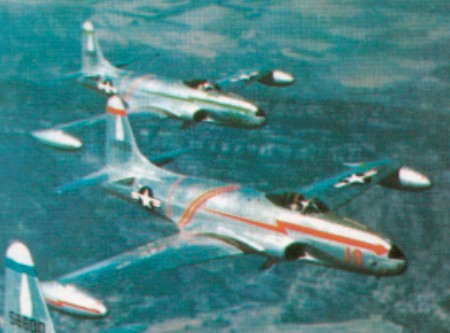
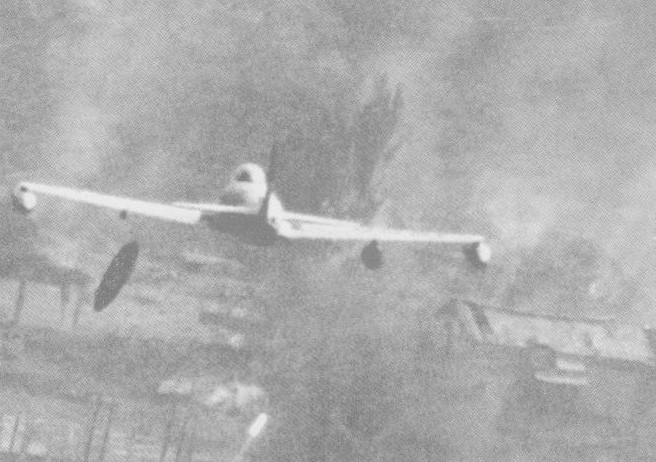
The F-80C saw extensive action in the Korean War, one highlight occurring on 8 November 1950 when an F-80C flown by Lieut Russell J. Brown succeeded in downing a MiG-15 in what was believed to be the first conclusive aerial combat between jet fighters. On the whole, though, the Shooting Star possessed inferior performance and was mainly employed as a fighter-bomber. For Korea, F-80 were adapted to carry two 227kg and four 118kg fragmentation bombs or two 450kg bombs plus eight rockets or four 40 US gallon napalm bombs.

F-80 Shooting Star, Suan, Korea

Variants have included reconnaissance RF-80, QF-80A and QF-80F drones, and one F-80C was converted as a prototype two-seat trainer.

Gallery

XP-80
Engine: de Havilland Goblin centrifugal flow turbojet, 3000 lb
Max speed: 502 mph.

P 80A Shooting Star
Engine: one 1814 kg (4000 lb) thrust General Electric J33 A 11 tur¬bojet.
Max speed 933 km/h (580 mph) at 8535 m (28,000ft)
Initial climb rate 1395m (4,580ft) per minute
Service ceiling 13715 m (45,000 ft)
Range 870 km (540 miles)
Empty weight: 3593 kg (7,920 lb)
Maximum take off weight: 6577 kg (14,500 lb)
Wing span 12.17 m (39 ft 11 in)
Length 10.52 m (34 ft 6 in)
Height 3.45 m (11 ft 4 in)
Wing area 22.11 sq.m (238.0 sq.ft).
Crew: 1
Armament: six 12.7mm (0.5 in) machine guns in the nose, 2 x 454kg Bomb / 10x 5″ Rockets.

F-80C Shooting Star
Engine: one 2449-kg (5,400-lb) thrust Allison J33-A-35 turbojet
Wingspan 12.15 m (39 ft 10.5 in)
Wing area 22.02 sq.m (237 sq ft)
Length 10.52 m (34 ft6 in)
Height 3.45 m (11 ft 4 in)
Wheel track: 8 ft 7 in
Empty weight: 3738 kg (8,240 lb)
Maximum take-off weight: 7646 kg (16,856 lb)
Maximum speed 956 km/h (594 mph) at sea level
Initial climb rate 2094 m (6,870 ft) per minute
Service ceiling 13030 m (42,750 ft)
Range 1706 krn (1,060miles)
Max endurance: 3 hr 12 min
Crew: 1
Armament: six 12.7-mm (0.5-in) M3 machine-guns, 907 kg (2,000 lb) external ordnance or 16 127-mm (5-in) rockets.

Lockheed F-80 Shooting Star