
The Loose Special was built by Chester Loose, flown by Warwick Siem. Both from Davenport, Iowa.
The Loose Special was built by Chester Loose, flown by Warwick Siem. Both from Davenport, Iowa.

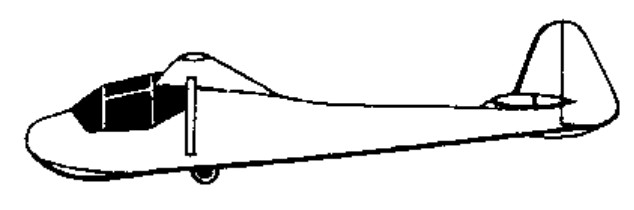
The “Lehrmeister” is a 1953 wooden training soaring glider that was in use for basic and advanced
training. Some parts were made from polyester.
Length : 26.083 ft / 7.95 m
Height : 6.89 ft / 2.1 m
Wingspan : 55.774 ft / 17.0 m
Aspect ratio : 15.2
Wing area : 204.516 sq.ft / 19.0 sq.m
Max take off weight : 1102.5 lb / 500.0 kg
Weight empty : 661.5 lb / 300.0 kg
Max. weight carried : 441.0 lb / 200.0 kg
Max. speed : 108 kts / 200 km/h
Landing speed : 31 kts / 58 km/h
Cruising speed : 39 kts / 72 km/h
Wing load : 5.33 lb/sq.ft / 26.0 kg/sq.m
Glide ratio : 28.0
Crew : 2

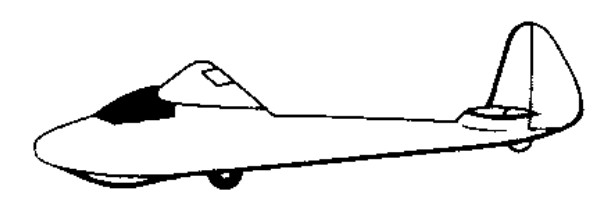
Soaring Plane, Germany, 1961
Length : 22.113 ft / 6.74 m
Wingspan : 49.213 ft / 15.0 m
Aspect ratio : 18.15
Wing area : 133.474 sq.ft / 12.4 sq.m
Max take off weight : 738.7 lb / 335.0 kg
Weight empty : 496.1 lb / 225.0 kg
Max. weight carried : 242.6 lb / 110.0 kg
Max. speed : 119 kts / 220 km/h
Landing speed : 38 kts / 70 km/h
Cruising speed : 51 kts / 95 km/h
Wing load : 5.54 lb/sq.ft / 27.0 kg/sq.m
Glide ratio : 38.0
Crew : 1
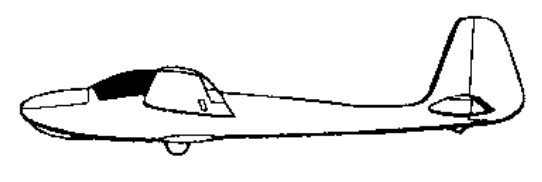
Soaring Plane, Germany, 1959
Length : 23.95 ft / 7.3 m
Wingspan : 49.213 ft / 15.0 m
Aspect ratio : 15.0
Wing area : 161.46 sq.ft / 15.0 sq.m
Max take off weight : 705.6 lb / 320.0 kg
Weight empty : 463.1 lb / 210.0 kg
Max. weight carried : 242.6 lb / 110.0 kg
Max. speed : 108 kts / 200 km/h
Landing speed : 31 kts / 58 km/h
Cruising speed : 40 kts / 74 km/h
Wing load : 4.31 lb/sq.ft / 21.0 kg/sq.m
Glide ratio : 26.0
Crew : 1
The 1958 “Libelle-Laminar” (Dragonfly) is a high performance glider that can be used for all kinds of
gliding and soaring including aerobatics. It is built of wood.
Length : 21.654 ft / 6.6 m
Height : 6.89 ft / 2.1 m
Wingspan : 54.134 ft / 16.5 m
Aspect ratio : 18.35
Wing area : 159.845 sq.ft / 14.85 sq.m
Max take off weight : 837.9 lb / 380.0 kg
Weight empty : 595.4 lb / 270.0 kg
Max. weight carried : 242.6 lb / 110.0 kg
Max. speed : 119 kts / 220 km/h
Landing speed : 30 kts / 55 km/h
Cruising speed : 48 kts / 88 km/h
Wing load : 5.33 lb/sq.ft / 26.0 kg/sq.m
Glide ratio : 36.0
Crew : 1
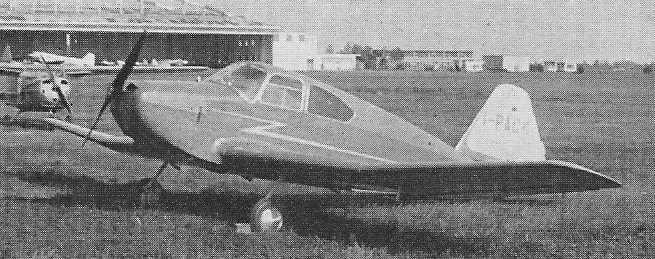
Derived from the L.M.5 Aviastar and designed by Pieraldo Mortara, the L.M.7 is a three-seat cabin monoplane of all-wood construction, the prototype was produced in 1949.
The L.M.7 was powered by a 60 hp C.N.A. D.4 engine and its cabin accommodated two side-by-side in front and a single seat behind.
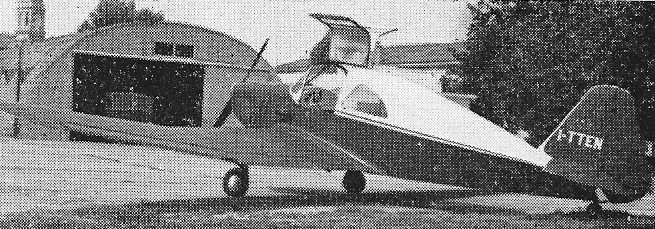
No production was undertaken as Lombardi & C. abandoned aircraft manufacture shortly after completion of the prototype.
Engine: 60 hp C.N.A. D.4
Wingspan: 38 ft 6 in
Wing area: 156.3 sq.ft
Length: 20 ft 10 in
Height: 6 ft 3 in
Empty weight: 770 lb
Loaded weight: 1386 lb
Max speed: 117 mph
Cruise: 103 mph
Climb to 3280 ft: 8 min 21 sec
Service ceiling: 12,530 ft
Range: 530 mi
Italy
This Vercelli company took over in 1947 from the 1939 Avia (Azionaria Vercellesi Industrie Aeronautiche), continuing production of the light FL-3 and building an experimental attack glider. Also subcontract work on Fiat G-50. Post-war resumed production of FL-3 and small number of the LM-5 Aviastar, and 1949 LM-7. This latter was a prototype only; company then ceased aeronautical work and production taken over in 1953 by Meteor SpA.
Italy
Most Aeronautica Vittorio Bonomi construction was carried out by Aeronautica Lombarda – hence the common use of Aeronautica Lombarda BS-28, etc
In 1937, Lombarda bought out Aeronautica Vittorio Bonomi, building light aeroplanes and gliders. After the Abyssinian War turned to military aircraft production. During Second World War built Heinkel He 111 and Loire 130.
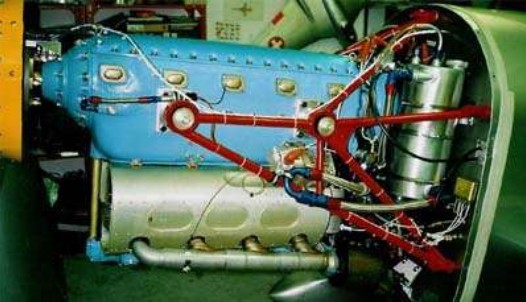
The Avia M 332 (originally known as the Walter M332) is an air-cooled four-cylinder inverted inline engine. It was designed by Bohumil Šimůnek, of Motorlet Walter Aircraft Engines, as a more powerful replacement for the four-cylinder Walter Minor engine, going into production in 1958. Piston aircraft engine production was transferred from Walter to Avia in 1964, the engine becoming the Avia M 332.
Applications
Aero 145
Carlson Criquet
Fry Esprit VFII
Orličan L-40 Meta Sokol
Rolandas Kalinauskas RK-5 Ruth
Specifications
Type: 4-cylinder inverted air-cooled supercharged inline engine
Bore: 105 mm (4.13 in)
Stroke: 115 mm (4.53 in)
Displacement: 3.98 L (247.9 in³)
Length: 1,102 mm (43.4 in)
Width: 425 mm (16.7 in)
Height: 628 mm (24.7in)
Dry weight: 102 kg (225 lb)
Valvetrain: two camshaft operated valves per cylinder, sodium filled exhaust valve
Supercharger: Centrifugal
Fuel system: Low pressure fuel injection
Fuel type: Min 72 octane unleaded or 80 octane leaded
Oil system: Dry sump pressure feed
Cooling system: Air-cooling
Power output: 104 kW (140 hp) at 2,700 rpm (take-off)
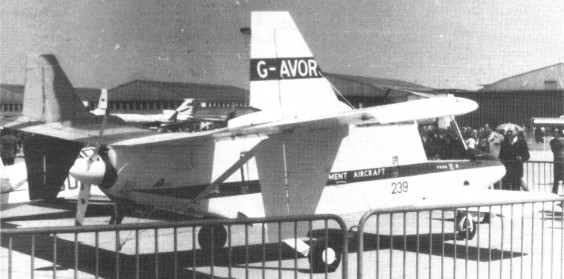
David Lockspeiser attempted to develop LDA (land development aircraft) general utility aircraft over two decades up to mid-1980s, with rear-mounted main wings and large canards, and rear-mounted engine with pusher propeller. A 70 percent-scale prototype flew 1971 as G-AVOR c/n LDA-01 and given PFA number 1346.
Construction was started at Shalford, UK, and the final assembly was done at Wisley. The two rear wing sections are interchangeable with each other and with the forward wing, which is mounted underneath the fuselage. The angular fuselage was capable of taking an underslung cargo pannier. A four unit undercarriage was fitted.
It was flown for the first time at Wisley on 24 August 1971 powered by a Continental C85-12. Initially it flew with a twin fin/rudder assembly but later a non-moving central fin was added.
In 1974, after a period of testing, the prototype was re-engined with a Lycoming O-320-D1A and given a conventional three unit undercarriage. The provision for the pannier was also removed. It appeared at the 1975 Paris Salon at Le Bourget France.
The intended full-size LDA-500 Boxer and larger LDA-1000 Boxer were designed.
Span: 29.00 ft
Fore plane span: 13.00 ft
Length: 22.06 ft
 All Aero