Manuel Condor

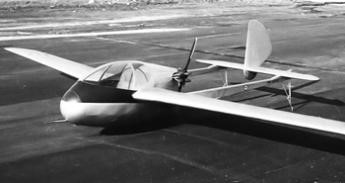
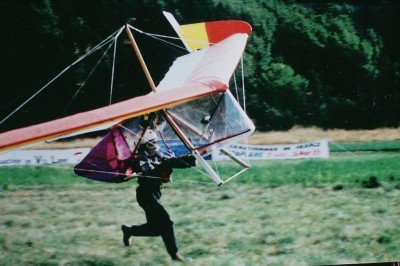
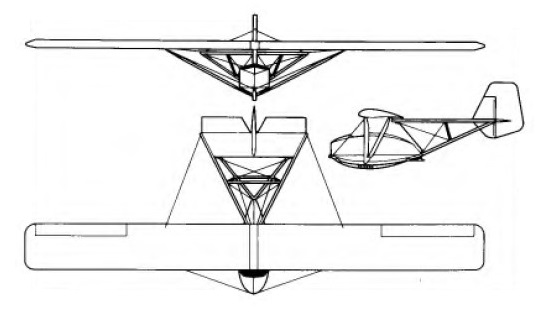
One of the pioneer British sailplane designers before the war, Mr W. L Manuel became concerned at the number of fatal accidents in hang gliding, and in the Condor has designed a simple two-seater sailplane intended especially for hill soaring and aimed at meeting the needs of those who would like to fly but who could not afford the price of a modern high performance sailplane, and who do not have the skills or the time to construct one of the homebuilt designs now on offer.

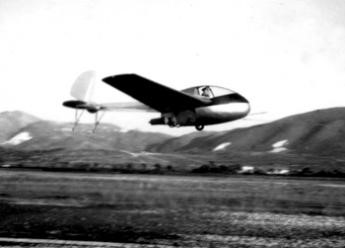
Resembling the primary trainers of the early 1930s in appearance, the Condor has a short boat-shaped fuselage nacelle of metal tube construction with comfortable side-by-side seating for two in an open cockpit; at the rear of the nacelle is a pylon on which the high constant chord wings are mounted, these being braced by V-struts on each side to a keel running under the cockpit. The tail unit is carried on an open girder-type rear fuselage of aluminium tubing, the tail surfaces being of generous area with fabric covered ribs and widechord elevators. The landing gear consists of a bow shaped ash skid under the fuselage nacelle, with rubber rollers as shock absorbers.

The prototype Condor made its first flight in August 1976 and in addition to local soaring has made a number of longer distance flights.

Span: 50 ft 2.5 in / 15.3 m
Length: 21 ft 0 in / 6.4 m
Wing area: 250.0 sq ft / 23.23 sq.m
Aspect ratio: 10.0
Wing section: Gottingen 462
Empty weight: 492 lb / 223 kg
Max weight: 899 lb / 408 kg
Water ballast: None
Max wing loading 17.57 kg/sq.m / 3.6 lb/sq ft
Max speed: 86.5 mph / 75 kt / 139 km/h
Stalling speed: 32 kt / 59 km/h
Best glide ratio: 14:1
Manuel Hawk

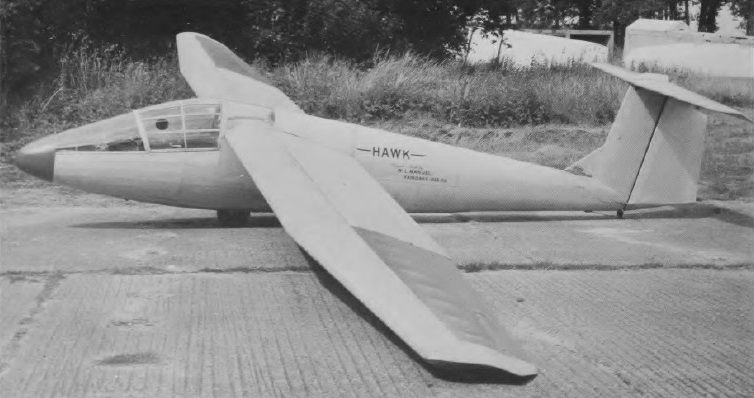
Mr W. L. Manuel, who designed the Willow Wren and other gliders during the 1930s, continued working during retirement by designing (1968) and building (1969 at Fairoaks aerodrome, Surrey) the Hawk single-seater, intended for soaring in weak thermals.

The Hawk has a wing of rather low aspect ratio (11.88) and a fuselage that, although well steamlined, is not as slim as some contemporary types. The cantilever shoulder wing is a three-piece wooden structure with a centre section and two outer panels; the single spar is of spruce with a plywood leading edge torsion box and fabric covering aft of the spar, and there are air brakes in the wing upper surfaces. The semi-monocoque fuselage is of spruce covered by plywood, with a non-retractable monowheel for landing. The T-tail is of wooden construction, with a trim tab in the starboard elevator and a small dorsal fin. Instead of the conventional one-piece cockpit canopy, a three-piece one is fitted in which the front and rear sections are fixed one-piece single-curvature transparencies and the hinged middle section is a framed double curve segment.

The undercarriage is a fixed centre main wheel plus a tail skid.

The prototype BGA.1778 c/n 1 was built at Fairoaks in Surrey during 1968-70 and made its first flight at the College of Aeronautics airfield at Cranfield on 25 November 1972. Initial flight tests revealed the need for some modifications, including revised aileron controls, removing the air brakes from the wing under surfaces and increasing the rudder area; further flight testing followed these changes.

Span: 42 ft 0 in / 12.8 m
Length: 20 ft 6 in / 6.25 m
Wing area: 149 sq.ft / 13.84 sq.m
Aspect ratio: 11.88
Wing section: Wortmann FX-61 -184/210
Empty weight: 406 lb / 184 kg
Max weight: 639 lb / 290 kg
Water ballast: None
Max wing loading: 20.95 kg/sq.m / 4.29 lb/sq ft
Max speed: 90 mph / 78.5 kt / 146 km/h
Stalling speed: 31 kt / 57.5 km/h
Max rough air speed: 64 kt / 118.5 km/h
Min sinking speed: 2.53 ft/sec / 0.77 m/sec at 38 mph / 33 kt / 61 km/h
Best glide ratio: 25:1 at 41.7 mph / 36 kt / 66.5 km/h

Manuel, W. L.

W.L.Manuel designed and built the first four types of gliders while he was serving in the RAF. He was the Channel Gliding Club instructor in 1932. In 1933 he established a small workshop at the London Gliding Club, Dunstable (which was known as the Wren Works) and built the second Willow Wren there. At that time he advertised for sale complete Wrens at £90 and Primary gliders at £45 each. In January 1935 he joined the Dunstable Sailplane Co and built a developed version of the Willow Wren which was named the Dunstable Kestrel.
In January 1968, W.L.Manuel retired from the position of Chief Planning Engineer with A.C. Cars Ltd, and, having already designed the Hawk, built this at Fairoaks aerodrome, Surrey.

Mantelli AM 12 Palas

Although its origins are reminiscent of the Alaparma AM-10, the AM-12 was a glider. It was powered by a 38 hp CANC and finally with a 4-cylinder Praga 75 D HP. Three, with a long wing were built Guidonia (near Rome) by the Italian military center of gliding.

The fourth built with a shorter wing, was first flown as a glider before being changed to receive a Turbomeca Palas turbojet of 160 kgf. This engine had been recovered from the prototype of the jet Caproni F-5.

It is with this engine Mantelli, on February 17, 1962, beat the world record for altitude for jets of less than 500 kg, with 6700 m, and earn the 1962 Bleriot prize.

Later the aircraft was re-engined with a Walter Praga – D 75 piston engine. It is in this that Adriano Mantelli took the world record altitude for aircraft less than 500 kg, with 8763 m on April 16, 1964

Wingspan: 12 m
Length: 5.5 m
Height: 1.4 m
Wing area: 34.48 m²
Empty weight: 210 kg
Maximum weight: 500 kg
Maximum speed: 220 km / h
Minimum speed: 50 km / h

Mantelli, Adriano

Born 13 February 1913, in 1929 Mantelli competed in flying competitions with aircraft that were self-designed and built. In 1931 he started designing gliders.

In the summer of 1936, Adriano Mantelli was the leading Italian fighter pilot in the Spanish Civil War serving in the Regia Aeronautica. Mantelli shot down a Dewoitine piloted by British pilot Edward Hillman. Flying under the alias “Arrighi”, he would later share the title for highest scoring Ace with Mario Bonzano at fifteen victories.

In 1945 Mantelli designed the AM-6 twin boomed pusher aircraft derived from previous glider designs. Mantelli co-founded the company Alaparma with Livio Agostini to produce the AM-6, and later the AM-8 and AM-10 aircraft.

In 1951 Mantelli designed and built two gliders, the AM-10 and AM-12 “Albatross”, in Buenos Aires, Argentina In 1954, Mantelli set an Italian record for altitude in a glider in a two-seat CVV-6 Canguro glider.

Mantelli received the FAI Louis Blériot Medal in 1962, and 1964. Mantelli reached the rank of General.

He died on 6 May 1995 while waiting for a train at Firenze Santa Maria Novella railway station.

Manta Fledgling / Fledge / Voyager

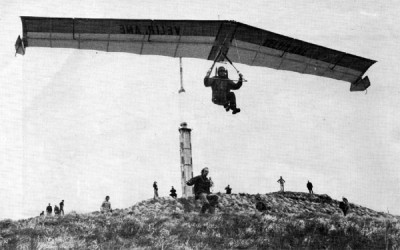
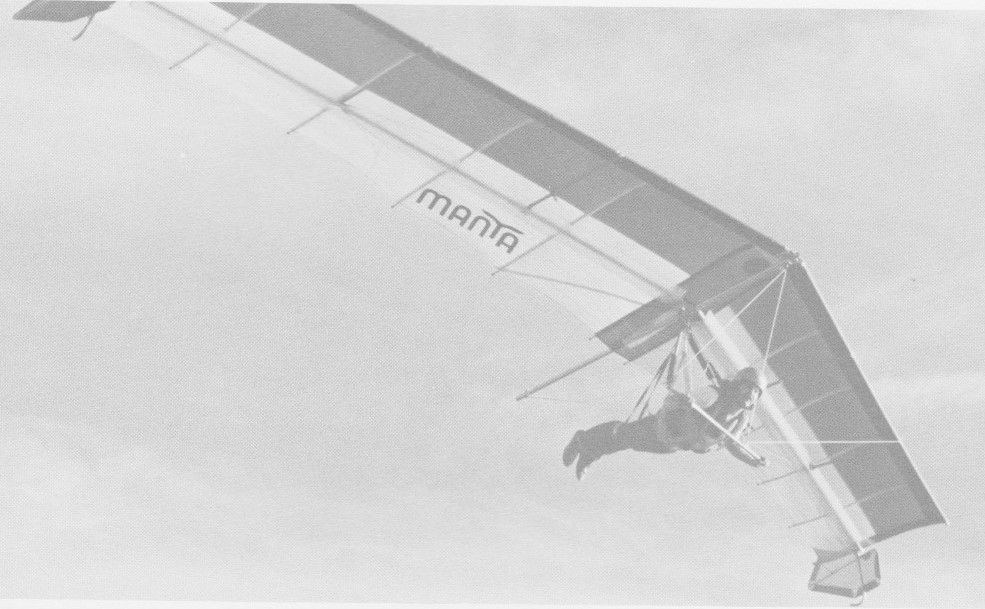
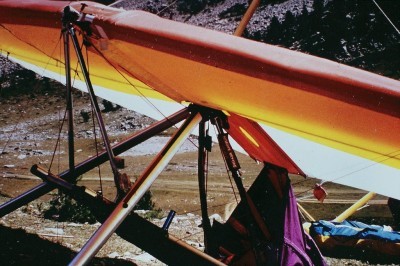
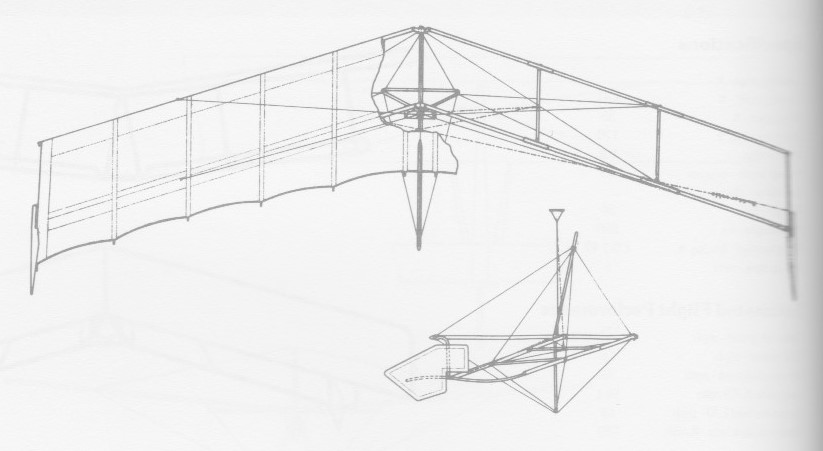
A 1974 hang glider for advanced pilots. The Fledgling uses two identical spars that carry equal loads. The rear spar is in a streamlined pocket. The Fledgling is completely self-launchable and folds down to a Rogallo size package. The rudders that aid stability and turning are actuated by control cables attached to the swing seat, harness or by twist grip, supine.

Fledgling

The airfoil remains rigid in flight by use of pre-formed, removable ribs. No tools are required for set-up. The spars are made from 6061-T6, 1.5in x .049 tubing and rigging cable is 3/32in 7 x 7 stainless steel. All hardware is aircraft quality.

Manta Fledgling Article

The sail is made from 3.8oz stabilised dacron, then available in 11 colours. A flying supine seat with individual leg straps, or prone harness were optional.

Some of the greatest characteristics of the Fledge was the ability to penetrate high winds. It was always fun to spin.

Fledge 2

The Fledge 2 was a 1980 hang glider.

The Fledging IIB was motorized to give the Pterodactyl Fledging, one of the first ULM.

The 1983 Fledge 3 was nasty in a spin when the center of drag (the Fledge) traded places with the center of mass (the pilot). Next thing, flying upside down at 1 negative G. Some say it was an absolute bitch to rig and weighed a ton and ground handling was terrible, trying to get used to yaw induced roll.

Fledgling 3

The Fledge Voyager was a 1980 version for advanced pilots.

Fledge Voyager

The 3ET (extending type) has 1.50 m extra on each side plus and Casper shutters that augers the potence at the wingtip in turn it turns flat, does perfect loops at + 6g positive and negative.

Gallery

Fledgling A
Chord length: 5.5 ft
Wing span: 29 ft / 8.85 m
Wing area: 142 sq,ft / 13.2 m²
Aspect ratio: 6
Sweep angle: 18˚
Hang glider Weight: 50 lb / 28 kg
Pilot weight: 120-170 lb / 54-70 kg
Takeoff speed: 18 mph
Stall speed: 16 mph / 23 km/h
Max speed: 55 mph / 75 km/h
Best glide ratio (L/D): 11-1
Best L/D speed: 28 mph
Min sink: 225 fpm / 1 m/s

Fledgling B
Chord length: 5.5 ft
Wing span: 33 ft / 10.07 m
Wing area: 162 sq,ft / 15.05 m²
Aspect ratio: 6.8
Sweep angle: 18˚
Hang glider Weight: 56 lb / 28 kg
Pilot weight: 160-220 lb / 70-100 kg
Takeoff speed: 18 mph
Stall speed: 16 mph / 23 km/h
Max speed: 55 mph / 75 km/h
Best glide ratio (L/D): 11-1
Best L/D speed: 28 mph
Min sink: 225 fpm / 1 m/s

Fledge 2 A
Wing area: 13.2 m²
Wing span: 8.9 m
Aspect ratio: 6
Hang glider weight: 26 kg
Minimum pilot weight: 50 kg
Maximum pilot weight: 70 kg
Number of battens: 6
Nose angle: 144°

Fledge 2 B
Wing area: 15 m²
Wing span: 10.7 m
Aspect ratio: 6.8
Hang glider weight: 29 kg
Minimum pilot weight: 60 kg
Maximum pilot weight: 100 kg
Number of battens: 7
Nose angle: 144°

Fledge III

Fledge III ET

MFI MFI-15

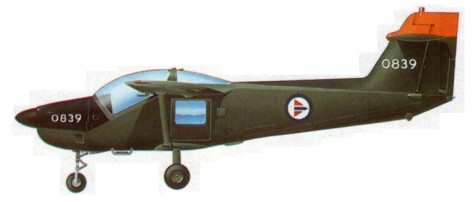
MFI had been developing an airplane for some time, for artillery spotting and liaison operations and training, and which made its maiden flight on 11 July 1969 (SE-301), promised to be ideal for both of these purposes. Designed by Bjorn Andreasson, the plane could easily be equipped either with a nose wheel (this version being known as the MFI-15A trainer) or with a tail wheel (the artillery spotting version designated MFI-15B). The Swedish Air Force decided to purchase the Beagle Bulldog while the MFI-15, later renamed Safari, test program was still in progress. The plane was converted into an efficient weapons carrier by increasing the engine power and making some structural modifications as the MFI-17.

MFI MFI-10 Vipan

Employing formed honeycomb skins to carry virtually all structural loads in the external surface iof the airframe, the Vipan (Peewit) has no wing spar as such and features a continuous, one-piece cantilever undercarriage of glass-fibre reinforced plastic.

A four-seat cabin monoplane, the first prototype, powered by a 160 hp Lycoming O-320-B2B engine, flew on 25 February 1961.

Two further prototypes, with 180 hp Lycoming O-360 engines, were produced under a Swedish Army contract, the first flying on 27 June 1962.

MFI-10B
Engine: 180 hp Lycoming O-360-A1D
Wingspan: 35 ft 1.5 in
Length: 26 ft 1 in
Height: 6 ft 5 in
Wing area: 168.993 sq.ft
Empty weight: 1433 lb
Normal loaded weight: 2280 lb
MTOW: 2590 lb
Max speed: 142 mph at 7500 ft
ROC: 950 fpm
Range: 620 mi at 130 mph

MFI / Malmo Flygindustri / Malmo Forsknings & Innovations AB

MFI was founded 1959 as AB Malmo Flygindustri as a subsidiary of Trellborgs Gummifabric AB, with Bjorn Andreasson as designer. His independently-designed BA-7 developed as MFI-9 two-seat light aircraft, production prototype flown May 17,1961, license production by Bolkow as 208C Junior. MFI-10 Vipan short-field four-seater flown February 25,1961. Company acquired by Saab-Scandia in 1961 and evolved MFI-15 multipurpose two/three-seat military aircraft, flown 11 July 1969, later renamed Safari and then further developed into MFI-17 Supporter armed ground-support version, first flown July 6,1972.

Malmo Forsknings & Innovations AB founded by Bjorn Andreasson after original MFI. Produced MFI-18. Intended to put MFI-11 lightplane into production (first flown 1992) as modern version of MFI-9B, but program halted. Production of BA-14B lightplane (first flown 1988) was also then delayed.

Makina Ve Kimya Endustrisi Kurumu / MKEK

Turkey
Full name Makina ve Kimya Endustrisi Kurumu. In 1952 MKEK took over THK factory at Ankara, together with existing designs. THK-15 became the MKEK Model 1, THK-16 the Model 2, THK-5 and 5A the Models 5 and 5A, THK Prototype 14 the Model 6 and THK-2 the Model 7. Developed Model 4 Ugur tandem two-seat primary trainer for Turkish Air Force, three presented to Royal Jordanian Air Force.