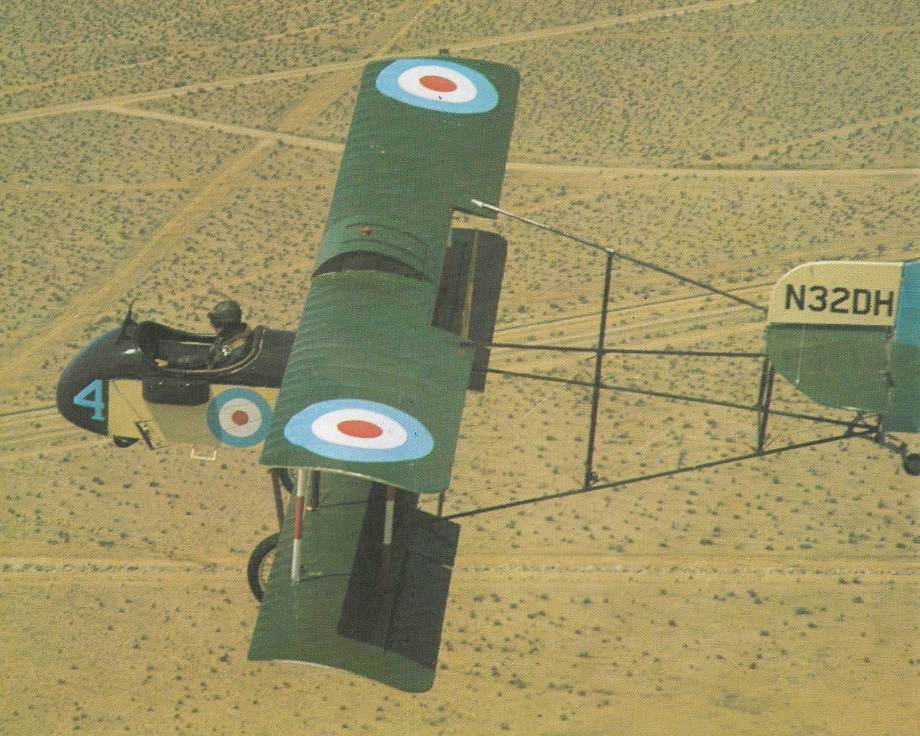
Joe J Mason built the 4/5-scale replica of an Airco DH‑2, registered N32DH cn JM‑3, beginning in 1971, and first flying on 1 March 1975.
The single-place DH-2 was powered by a 90hp LeBlond 5F engine.
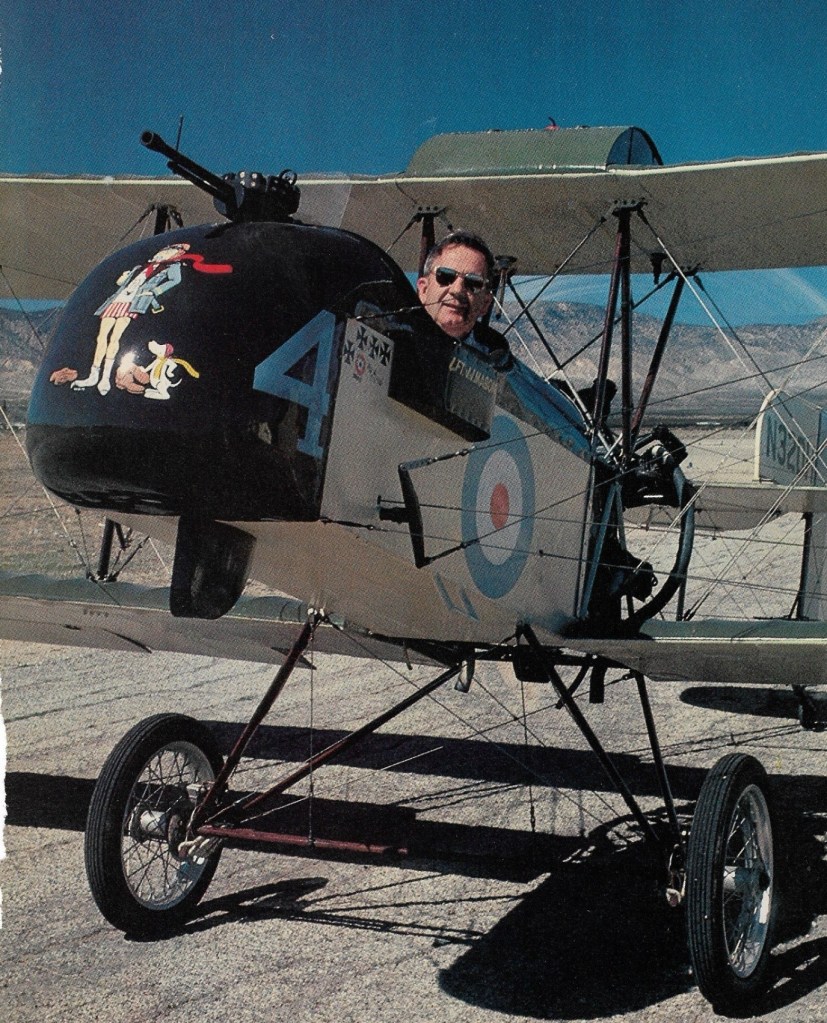
Joe J Mason built the 4/5-scale replica of an Airco DH‑2, registered N32DH cn JM‑3, beginning in 1971, and first flying on 1 March 1975.
The single-place DH-2 was powered by a 90hp LeBlond 5F engine.
Woodland Hills CA.
USA
Built a DH 2 replica circa 1971.
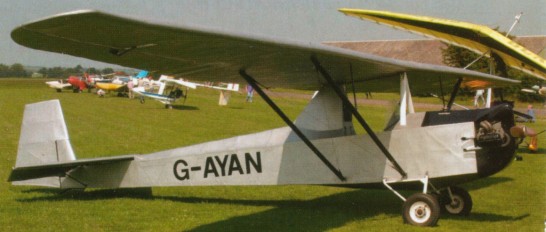
Another motorised version of the basic Cadet/Tutor airframe was the Slingsby/Martin Motor Cadet Mk 3, which was a T31B Tandem Tutor acquired from the Dorset Gliding Club in 1970 and converted by P. J. Martin and D. R. Wilkinson at Twinwood Farm aerodrome, Bedfordshire, to have a 1,600cc Volkswagen engine in the nose. It was now a single seater ultra-light, the front seat being replaced by a 6.5 gallon fuel tank, and a Luton Minor’s undercarriage was fitted to give airscrew clearance.
Registered G-AYAN and named ‘Thermal Hopper’, the sole Cadet Mk 3 received its Authorisation to Fly on 15 January 1971.
Engine: VW 1600cc
Fuel capacity: 6.5 Imp Gallon
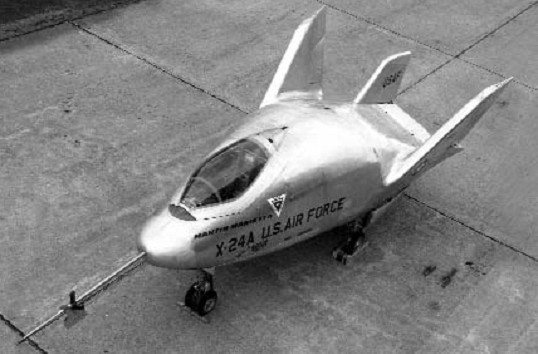
The X 24A and X-24B were the forbears of the Orbiter because they were conceived, designed, built, and flown as part of the Air Force NASA effort to develop a vehicle which could re enter the earth’s atmosphere from space and be flown without power to a selected landing site.
Both vehicles were lifting bodies. They do not use wings to achieve lift, but rely entirely on body shapes to produce lift with as little drag as necessary. What was needed was a type of aerodynamic shaping to cope with the high heat of re entry, while still producing a flying machine that could be control¬led by the pilot. The X 24 flight test programmes proved that the designs were correct.
In the form of the Martin Marietta Corporation, Martin returned to piloted aircraft production in 1965 with SV-5 piloted lifting body research vehicle, built as SV-5J with J-85 or J-60 jet engine and as SV-5P or X-24A with XLR-11 rocket engine. The X 24A and B, designed to be carried aloft by a Boeing B 52 and launched at about 45,000ft, made a ¬total of 64 successful flights and landings, sometimes using rocket power to go up to 60,000 or 70,000ft and increase their speed to simulate re entry conditions before starting their approach to a powerless landing.
The X 24A had medium lift to drag ratio (4.5 at subsonic speeds and 1.3 at hypersonic speeds), and could land anywhere within an area 8,000 nm long and 4,000nm wide from the point of re entry.
The flights of the two aircraft pro¬vided research data in the lower end of the re entry flight corridor, from low supersonic speeds through tran¬sonic and subsonic, speeds to landing. This data simplified the task of de¬signing and building the Space Shuttle Orbiter.
The X-24A/SV-5P represented the low-speed end of the test spectrum for the START program that had also tested the X-23A. The X-24A was used in project PILOT (piloted low-speed tests). The rocket-powered X-24A was specifically designed to explore the low-speed flight characteristics of a maneuverable lifting-body design. The design was essentially identical to the SV-5D used in project PRIME as the X-23A, allowing both ends of the flight spectrum to be tested on the same shape. The X-24A decisively demonstrated that lifting-bodies could consistently make precision landings onto a hard runway, proving the concept for the future Space Shuttle.
The X 24A project began in 1966, while the Air Force and Nasa were already testing two earlier lifting bodies, the M 2 and the HL-10, de¬signed by Nasa and built by Northrop. The X 24A was built for the Air Force by the Martin Marietta Cor¬poration under the management of the Flight Dynamics Laboratory. The design called for a bulbous fuselage, no wings, and a triple tail. The aircraft was 24.5ft (7.47m) long, with a single cockpit well for¬ ward, and had a span of 111.5ft (3.51m).
It was designed to, use the Thiokol XLR-11 RM 13 rocket motor, the same type as that used on the first rocket powered aircraft, the Bell X 1, and which produced 8,600 lb of thrust, burning a mixture of water, alcohol and liquid oxygen. The X 24A car¬ried enough fuel for a maximum burn of 137sec, but this was in-creased to almost 160sec later in the programme. The rocket and fuel brought the maximum launch weight of the X 24A to 11,450 lb, but the rocket was not used in the early flights.
Although it was delivered to Edwards AFB in August 1967, the X 24A did not make its first manned captive flight until April 4, 1969. The first free flight, with Maj Gerry Gentry of the Air Force in the cock-pit, was made on April 17, when it was launched at 45,000ft and an air speed of 174kt with a launch weight of 6,344 lb. The flight lasted 3min 37.4sec, did not go above the launch altitude, and achieved a maximum speed of Mach .718 (411 kt true air speed).
The X 24A made seven more free flights between May and November without using the rocket motor. Gentry was in control for all but one, which was flown by John Manke of Nasa. In January 1970, the engine was run in the aircraft for the first time, but it was flown without the rocket once more before the first powered flight was made by Gentry on March 19.
On that flight, the launch was made at 40,000ft and 175kt at a launch weight of 11,320 lb. The aircraft went up to 44,384ft and achieved a maxi¬mum speed of Mach 0.865 (469 kt) in a flight which lasted 4min 4.25sec.
The X 24A achieved supersonic speed f or the first time on the eighteenth flight, on October 14, with Manke at the controls. It was launched at 42,000ft and 185kt, and went up to 67,900ft and Mach 1.186 (681 kt) before landing after a flight of 6min 51.1sec. On March 29, 1971, it achieved the highest speed of the entire programme, Mach 1.6 (900kt), during the 25th flight, again with Manke at the controls.
The highest altitude the X 24A ever attained was 70,947ft, which it reached during the 26th flight, on May 12. Maj Cecil Powell of the Air Force was the pilot, making his second free flight in the aircraft, and the flight lasted 7min 2.7sec.
The longest flight of the pro¬gramme, lasting 8min 37.2sec, was the 28th and final flight on June 4, 1971, with Manke in the cockpit. When the flight test programme ended after almost two years, the X 24A had flown a total of 2hr 53min.
Only a single X-24A was manufactured, but two extremely similar jet-powered SV-5Js were also built. The SV-5Js were to be powered by a single J60 turbojet engine and used as trainers to introduce pilots to the low-speed handling characteristics of lifting-bodies, but in the end neither aircraft ever flew. One of the SV-5Js is on display at the Air Force Academy near Colorado Springs, Colorado, while the other has been superficially modified into an X-24A and is on display at the Air Force Museum. The X-24A itself was heavily modified to become the X-24B.
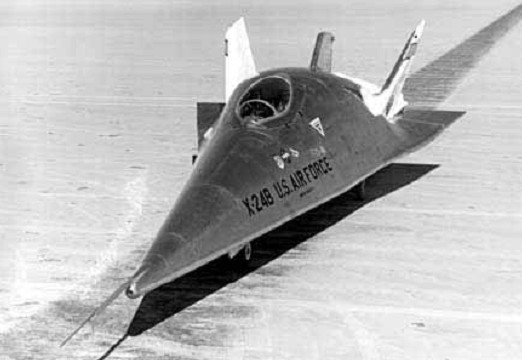
Although the X-24A program successfully met all of its objectives, engineers and scientists at the Air Force Flight Dynamics Laboratory (FDL) wanted to conduct similar tests on an even more advanced lifting-body shape called the FDL-7/FDL-8. The original plan was to convert one of the jet-powered SV-5Js into the advanced testbed, but since this would have entailed extensive modifications to fit a rocket engine in place of the turbojet, these plans were shelved. As the rocket-powered X-24A was nearing the end of its test program, it was finally decided to utilize it instead since the modifications were expected to be less extensive.
The X 24A was returned to the Martin Marietta plant late in 1971, and the lumpy looking fuselage was literally engulfed by a sleek, needle ¬nosed, wedge like structure. All sub¬systems of the X 24A, with one excep¬tion, were retained in the new vehicle, including the rocket motor. The exception was the nose gear, which had to be beefed up to take the increased weight; it was replaced with the nose gear from a Navy F11F. Strakes just large enough to accommodate ailerons were added outboard of the triple tail.
Underneath the sleek shell of the X-24B lived the original X-24A. The new skin was essentially “gloved on” to the original aircraft designed by the Air Force Flight Dynamics Laboratory as the FDL-7/FDL-8. Most systems were retained intact. Although the X-24B was intended to evaluate the flight characteristics of the FDL-7 shape, in reality it spent most of its 36 flights demonstrating precision landing techniques that would be used on the forthcoming Space Shuttle.
The X 24B had a high lift drag ratio (4.8 at subsonic speeds and 2.5 at hypersonic speeds), and had a landing footprint about double that of the X 24A.
The X 24B which rolled out of the plant on October 11, 1972, was 37.5ft (11.4m) long, with the cockpit almost half way back in the fuselage, and had a span of 19.1ft (5.82m). It had a maximum launch weight of 13,800 lb and a landing weight of 8,5001b.
The X 24B flight test programme began in July 1973 with John Manke of Nasa (who had flown 12 of the X 24A flights) and Lt Col Mike Love of the Air Force as primary test pilots, but four other pilots flew the aircraft before the programme ended two years later.
Before Manke made the first free flight on August 1 the craft was taken aloft on two captive flights. The free flight launch was made from 40,000ft at 175kt, and the air¬craft achieved a maximum speed of Mach 0.652 (400kt) and gained no additional altitude before landing in 4min 11.5sec. The first flight to use rocket power was the sixth, on November 15, which was launched at 40,000ft and 185kt and went up to 52,7164ft and Mach 0.917 (519kt) dur¬ing a flight which lasted 6min 44.7sec. Manke was at the controls on that flight and also on the first supersonic flight, the 9th, on March 5, 1974, when Mach 1.086 (615kt) and an altitude of 60,334ft were achieved after a launch from 45,000ft at 184kt.
The highest speed attained by the X 24B was Mach 1.76 (1,164kt) on its 16th flight, on October 25, with Love at the controls. Launched at 45,000ft and 200kt, the aircraft went up to 72,440ft during the 7min 47.6sec flight. The highest altitude reached was 74,130ft on the 23rd flight, on May 22, 1975, with Manke in the cockpit. The launch was at 45,000ft and 195kt and the maximum speed during the flight was Mach 1.63 (942kt). The flight lasted 7min 40. 9sec.
The basic research programme ended on September 23, 1975, with William Dana of Nasa making his second flight as pilot and the air¬craft making its 30th flight, Three other pilots then flew the X 24B for two unpowered flights apiece before it was finally grounded on Novem¬ber 26, 1,975. It had flown 36 flights, the longest of which was 8min 1.9sec, accumulating a total of four flying hours.
The X-24B is currently on display at the Air Force Museum, alongside one the the SV-5Js configured as the X-24A.
X-24A
Power: Thiokol XLR-11 RM 13 rocket, 8,600 lb thrust
Fuel: water, alcohol and liquid oxygen
Maximum burn: 137-160sec
Length: 24.5ft (7.47m)
Span: 11.5ft (3.51m)
Maximum launch weight: 11,450 lb
First Flight: 17 April 1969
Last Flight: 4 June 1971
Fastest Flight: Mach 1.60 (1,036 mph)
Total Flights: 28
Highest Flight: 71,400 feet
X-24B
Length: 37.5ft (11.4m)
Span: 19.1ft (5.82m)
Maximum launch weight: 13,800 lb
Landing weight: 8,5001b
First Flight: 1 August 1973
Last Flight: 9 September 1975
Total Flights: 36
Fastest Flight: Mach 1.76 (1,164 mph)
Highest Flight: 74,140 feet
In the form of the Martin Marietta Corporation, Martin returned to piloted aircraft production in 1965 with SV-5 piloted lifting body research vehicle, built as SV-5J with J-85 or J-60 jet engine and as SV-5P or X-24A with XLR-11 rocket engine. Vehicle was launched from Boeing B-52 mother plane.
In March 1995 Martin Marietta merged with Lockheed Corporation to form Lockheed Martin Corporation.

In World War lithe USAAF made widespread and effective use of the attack bomber for battlefield tasks. For post¬war service the USAAF wanted a higher-speed successor, and the specification produced two types in the Douglas XB-43 and Martin Model 234 XB-51.
The Martin was designed originally to meet a US Army Air Force requirement for a close-support bomber, being allocated the designation XA-45. However, it was developed instead as a medium bomber with turbojet power-plant and two prototypes were ordered under the designation XB-51.
The XB-51 featured a tandem-unit landing gear arrangement, a thin variable ¬incidence wing whose leading edges were swept at 35 degrees, a swept T-tail. It was powered by three 2640kg thrust General Electric J47-GE-7 or -13 turbo-jets, one pylon-mounted low on each side of the forward fuselage and the third within the rear fuselage.
Other features included pressurised accommodation for the two-man crew, provisisions for JATO (jet-assisted take-off) units, and a braking parachute.
The first of two aircraft flew in October 1949, Martin’s Director of Flight O.E. (Pat) Tibbs making the first flight, taking off from Baltimore and lading at Naval Air Test Centre at Patuxent, in a flight of 35 minutes.
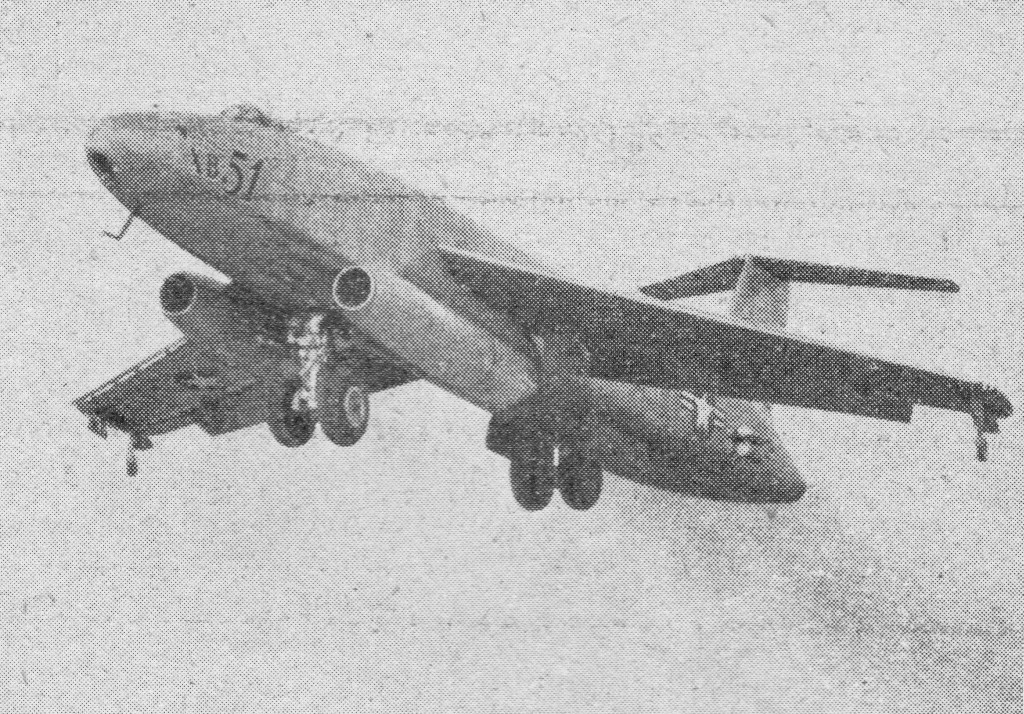
Although flight trials confirmed that the XB-51 had very good performance, they revealed that the type had poor handling qualities in the air. The XB-51 did not proceed past the prototype stage and the USAF opted instead for licence-production of the English Electric Canberra as the Martin B-57.

Engines: 3 x 2360kg General Electric J47-GE-13
Max take-off weight: 25393 kg / 55982 lb
Empty weight: 13431 kg / 29610 lb
Wingspan: 16.18 m / 53 ft 1 in
Length: 25.93 m / 85 ft 1 in
Height: 5.28 m / 17 ft 4 in
Wing area: 50.91 sq.m / 547.99 sq ft
Max. speed: 1038 km/h / 645 mph
Cruise speed: 857 km/h / 533 mph
Ceiling: 12344 m / 40500 ft
Range: 2576 km / 1601 miles


During 1944 the US Army Air Force issued its first specification for a large jet bomber. By December 1944 proposals had been received from Boeing, Convair, Martin and North American for medium bomber for tactical- and operational-level use. The Martin Model 223 XB-48 being one of the contenders to meet this requirement.

Two XB-48 prototypes were ordered, the first of them flying on 14 June 1947 as a large shoulder mounted, straight wing monoplane with the capability of carrying up to 9072kg of bombs. Power was provided by six 1701kg thrust Allison J35-A-5 turbo-jets, three mounted beneath each wing. The landing gear was of the new bicycle form with main units ahead of and behind the bomb bay. The 33.02m span Model 223 failed to achieve the performance required and failed to win a production contract.
Engines: 6 x General Electric J35-C-7, 16.7kN
Wingspan: 33.02 m / 108 ft 4 in
Length: 26.14 m / 85 ft 9 in
Wing area: 120.77 sq.m / 1299.96 sq ft
Max take-off weight: 46539 kg / 102601 lb
Empty weight: 26578 kg / 58595 lb
Max. speed: 830 km/h / 516 mph
Armament: 9000kg of bombs


The prototype of an improved Martin 3-0-3 had been flown on 20 June 1947, but with it was decided instead to develop a new Martin 4-0-4. This incorporated the wing structural revisions and introduced a pressurised and slightly lengthened fuselage, accommodating as standard a crew of three or four and 40 passengers.
The airliner was unveiled in 1949 and immediately ordered by a variety of air carriers, gaining 101 orders from TWA and Eastern. The subsequent 4-0-4 was introduced in 1950 with a fuselage 39 inches longer, slightly more powerful engines than the 202, and pressurization.
The onset of the Korean War suddenly made airplane materials significantly more expensive, and Martin found itself filling orders at a loss and stopped production.
Two or these 40-passenger transports were in service with the U.S. Coast Guard in 1955 as the RM-1, similar to the civil Martin 4-0-4 airliner.

A total of 148 of the 2-0-2, 3-0-3, and 4-0-4 types were built until 1952. Examples served well into the 1980s with commuter airlines.
RM-1
Engines: two 2,400 h.p. Pratt & Whitney R2800-34W
Span: 93 ft. 3 in.
Weight: 44,900 lb.
Max. Speed: 312 m.p.h.
4-0-4
Engines: 2 x 2400hp Pratt Whitney R-2800 CB-16
Max take-off weight: 20366 kg / 44900 lb
Empty weight: 13211 kg / 29125 lb
Wingspan: 28.42 m / 93 ft 3 in
Length: 22.73 m / 74 ft 7 in
Height: 8.66 m / 28 ft 5 in
Wing area: 80.27 sq.m / 864.02 sq ft
Cruise speed: 502 km/h / 312 mph
Ceiling: 8840 m / 29000 ft
Range: 3058 km / 1900 miles
Seats: 52

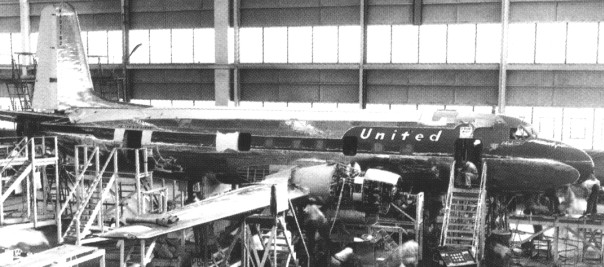
Along with the unpressurized Model 202, Martin offered a companion pressurized model, known as the Model 303. United Air Lines was the primary sponsor of the 303, having invested one million dollars of its own money in the development. In addition to the 50 slated for delivery to United, Martin also had orders from Northwest Airlines, Braniff Airways, and Pan American-Grace Airways (PANAGRA) for 59 more.
Apart from cabin pressurization, the 303 differed from the 202 in that the wing span was shortened by about 4ft (1.2m) in an attempt to gain cruise performance at the expense of takeoff and climb performance. The 303 made its first flight on July 3, 1947; however, United canceled its large order a short time later.
Because of prevailing market conditions and serious stability problems encountered with the 202 and a need to redesign the wing structure, Martin dropped the 303 program the following December with a reported loss of more than $15 million. The prototype and almost all records were then scrapped for tax purposes.
A total of 148 of the 2-0-2, 3-0-3, and 4-0-4 types were built until 1952.
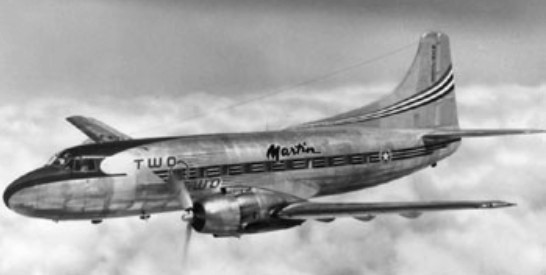
Attempting to gain a share of the post-World War II demand for civil airliners, the Glenn L. Martin Company flew on 22 November 1946 the prototype of a twin-engine 36/40-seat unpressurised transport designated Martin 2-0-2.
Power was provided by twin Pratt & Whitney 18-cylinder air cooled radial engines capable of developing a normal output of 1,800 hp, 2,100 hp for takeoff or 2,400 hp with water injection. The engines turned Hamilton Standard three-blade reversible-pitch airscrews.
The “Two- O-Two” was the first twin-engine airliner of postwar design to receive certification for airline use. Accommodations provided for a crew of three or four plus 36 to 40 passengers. A version of the 202 was outfitted with larger fuel tanks to increase its range to 2,365.
The first of these entered service in October 1947, but the loss of a 2-0-2 in 1948 as a result of wing structural failure led to modification of other in-service aircraft and production of this version was brought to an end.
When production ended in early 1953 a total of 103 had been built, this number including two supplied to the Coast Guard as staff transports under the designation RM-1G (later RM-1Z and finally VC-3A); they were subsequently transferred to the US Navy.
A total of 148 of the 2-0-2, 3-0-3, and 4-0-4 types were built until 1952.
Martin 202
Engines two 2,100-hp Pratt & Whitney R-2800 CB-16.
Wingspan: 28.42 m / 93 ft 3 in
Length: 21.74 m / 71 ft 4 in
Height: 8.66 m / 28 ft 5 in
Wing area: 80.27 sq.m / 864.02 sq ft
MTOW 19504 kg / 42999 lb
Empty wt. 26,930 lb
Top speed 311 mph.
Cruise 286 mph.
Stall 76 mph.
Initial climb rate 2,200 fpm
Range 3220 km / 2001 miles
Ceiling 33,000 ft
Takeoff distance (50′) 1,565 ft
Landing distance (50′) 1,720 ft
Seats 40.

 All Aero