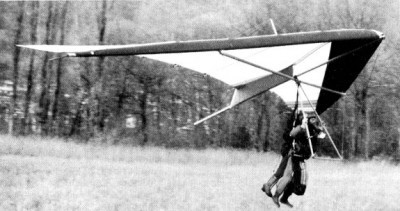
Single seat single engined high wing mono¬plane with two axis control (unconventional three axis control optional). Wing has un¬swept leading and trailing edges, and constant chord; V tail. Pitch/yaw control by elevon; no separate roll control (roll control by spoilers optional). Control inputs through stick for pitch/yaw (and pedals for roll optional). Wing braced from above by kingpost and cables, from below by cables; wing profile; double surface. Undercarriage has three wheels in tail dragger formation; steel spring suspension on all wheels. Tailwheel steering connected to yaw control. Optional brakes on main wheels. Aluminium tube framework, with optional pod. Engine mounted below wing driving pusher propeller. Main boom made from 6061T6 aluminium. Wing covering is Dacron.
Maxair Hummer Article
A high-wing monoplane with upright V-tail and spoilers (no ailerons), it was designed as an ultralight and not as a hang glider, with the engine as an afterthought. It features a non-welded, pop-riveted, bolted-together, wire-braced airframe of aluminum tubing. The wire-braced wings are built from aluminum tubing and covered with presewn Dacron, so no dope, glue or rib stitching is necessary. The V-tail is equipped with movable ruddervators acting as rudder and elevator. The main fuselage boom is 5’-diameter 6061 -T6, aluminum, to which the wing and engine support structures are attached. The pilot is seated forward of the wing and controls flight with conventional stick and foot pedals.
In August 1977 Klaus Hill had begun design studies for the Hummer and started work on a prototype in October. Thirty hours of labour and $2000 later in November of the same year, the first prototype was complete. The first production models appeared on 17 March 1978, but the machine did not seem an immediate success as only a dozen were flying by the beginning of the 1980 season.
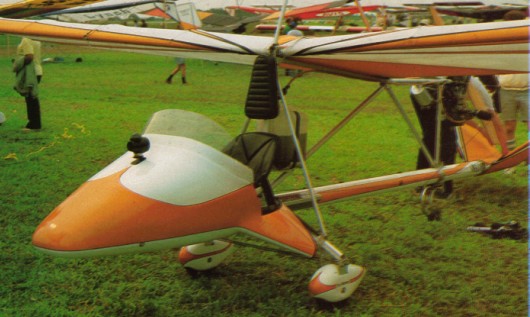
Maxair has since 1982 offered as an option a nose fairing, made of glass fibre with a windscreen, and a fairing for the main undercarriage legs.
Originally a two axis design, a new innova¬tion presented on the Hummer at Sun ‘n’ Fun in March 1983, was a wing covering with spoilers sewn in place on the upper surface. Operated by pedals (absent on the two axis machine), these spoilers can also be used together as air brakes to obtain a high sink rate for steep approaches and short field landings. Also available as an option are main wheel brakes, a reduction drive for the Zenoah G25B engine and floats. Price is $4395 in 1982.
Worthy of note are two developments of the Hummer, a tandem two seat produced in Switzerland by ULAC and in the USA Maxair’s own Hummer B single seater. In¬tended for heavier pilots, this had its payload increased from 170 to 210 lb (77 to 95 kg) and its maximum gross similarly increased, but the standard 1983 Hummer shows such an improved performance over earlier versions that the type B is no longer required.
Engine: Chaparral snowmobile, 20-hp
Top speed: 45 mph
ROC: 400 fpm
Takeoff dist: 150 ft
Ldg dist: 100 ft
Engine: 22 hp Zenoah G25B1 1 cylinder 2 stroke (242cc)
Wing span: 10.36m
Wing area 128 sq.ft
Wing loading 2.5-3.0 lbs/sq.ft
L/D power-off glide ratio, 9:1
Aspect ratio 7:8
Length: 5.48m
Empty wt: 84kg
MAUW: 199kg
Max cruise: 72 kph
Cruise speed (85 % power) 40 mph
Stall speed 24-26 mph
Approach speed 30 mph
Lift¬off speed 28 mph
Takeoff roll distance 100ft
Rate of climb 600+ fpm
Range: 160km
2 axis controls, stick operated V-tail elevons
Fuel capacity 5 USG
Engine displacement 250cc
Rated hp 22
Static thrust 180 lb
Engine: Zenoah 925B, 22 hp at 6000 rpm
Propeller diameter and pitch 52 x 32 inch, 1.32 x 0.81 m
V belt reduction, ratio 2.2/1
Max static thrust 160 lb, 73 kg
Power per unit area 0.16 hp/sq.ft, 1.7hp/sq.m
Fuel capacity 5.0 US gal, 4.2 Imp gal, 18.9 litre
Length overall 18.0 ft, 5.48 m
Height overall 8.3ft, 2.54m
Wing span 34.0ft, 10.36m
Constant chord 4.4ft, 1.32 m
Sweepback 0 degs
Tailplane span 8.2 ft, 2.50 m
Total wing area 138 sq.ft, 12.8sq.m
Wing aspect ratio 8.3/1
Wheel track 3.6 ft, 1.08 m
Tailwheel diameter overall 6 inch, 15 cm
Main wheels diameter overall 10 inch, 25 cm
Empty weight 185 lb, 84kg
Max take off weight 440 lb, 199 kg
Payload 255 lb, 171 kg
Max wing loading 3.18 lb/sq.ft, 15.5 kg/sq.m
Max power loading 20.0 lb/hp, 9.0kg/hp
Load factors +4.0, 3.0 design
Max level speed 60 mph, 97 kph
Never exceed speed 97 mph, 101 kph
Max cruising speed 45 mph, 72 kph
Economic cruising speed 30mph, 48kph
Stalling speed 22 mph, 35 kph
Max climb rate at sea level 400 ft/min, 2.0 m/s
Min sink rate 300ft/min, 1.5m/s
Best glide ratio with power off 9/1 at 28mph, 45kph
Take off distance 60ft, 18m
Landing dis¬tance 100ft, 30m
Service ceiling 10,000ft, 3050 m
Range at average cruising speed 100 mile, 160 km
Engine: Rotax 277 (268 cc) 28 hp
Empty wt: 185 lbs
Wing span: 34’
Wing area: 138 sq.ft
Height: 8’4”
Length: 18 ft
Fuel cap; 5 USG
Construction: Aluminium, Dacron
Static thrust: 220 lb
Max wt: 440 lb
Stall speed: 24 mph
Max speed: 60 mph
Vne: 63 mph
Climb rate: 600 fpm @ 32 mph
Design limit: +5, -3g
Glide ratio: 9-1
Wing loading: 3.19 lbs/sq.ft
Power loading: 15.71 lbs/hp


 All Aero