Messerschmitt Flugzeugbau GmbH / Bayerische Flugzeugwerke (BFW)

Founded by Willi Messerschmitt at Bamberg in 1923 as Messerschmitt Flugzeugbau and became GmbH April 28,1926.

Willie Messerschmitt Article

It was in Augsburg that on 30 July 1926, the Bayerische Flugzeugwerke (BFW) was incorporated and established itself in the former Rumperwerke factory.

S-16 powered glider flown 1924; M-18 three-passenger, single-engined airliners built for Nordbayerische Verkehrsflug AG and others 1925. Developed into M-20 and M-20b built for Lufthansa 1928. Highly successful M-23 two-seat sporting monoplane introduced 1929.

A number of crashes led Lufthansa to refuse to accept any more M20s, which resulted in the Messerschmitt company, Bayerische Flugzeugwerke (BFW) going bankrupt on 1 June 1931. An agreement was reached with all creditors in December 1932 and on 1 May 1933 the BFW AG was able to start a new career. Renamed Messerschmitt AG 11 July 1938.

Messerschmitt airplanes are variously coded with the letters Bf and Me; they refer to Bayerische Flugzeugwerke and Messerschmitt AG, respectively firm names under which he did business. The Bf designation was dropped in 1938, but designs executed before that time properly carry the prefix Bf.

After being renamed in 1938 continued production of BFW’s Bf 108 and of Bf 109 fighter, Bf 110 twin-engined long-range fighter. Rocket-powered Me 163 fighter first flown August 1941, and first of Me 262 twin-jet fighters on 18 July 1942. Bf 110 developed into Me 210 fighter-bomber first flown September 2,1939, built up to 1944, and reengined Me 410, which made maiden flight in late 1942. Me 321 Gigant troop carrier/cargo glider (54.68m wingspan) introduced 1941; 175 built together with 201 of Me 323 powered version with six Gnome- Rhone radial engines.

Reconstituted postwar company formed Flugzeug-Union Sud with Heinkel in August 1956, building Fouga Magister under license and later taking part in programs for Fiat G.91, Lockheed F-104G, Transall C.160 and Bell UH-1D.

Amalgamated with Bolkow as Messerschmitt Bolkow GmbH 1968 and then with Hamburger Flugzeugbau to form Messerschmitt-Bolkow-Blohm 14 May 1969.
Merville

France
Propeller manufacturer established in 1919, began aircraft production 1959 with SM.30 single-seat sailplane; improved SM.31 prototype flown January 11,1960. Also developed D.63 two-seat light aircraft based on Druine Condor, first flown March 23,1962, with tricycle landing gear and Potez 4 E-20 engine.

Merkel Mark II

This two-seat aerobatic biplane is stressed to a +6G and -3G limit, and +9G to -4.5G ultimate. It was first flown in 1973, and its designer, Edwin Merkel, planned to produce the biplane in a two-seater trainer version and a single-place competition model. The Mark II is completely covered with a light alloy skin outside, and underneath the fuselage is welded steel tube while the wings feature a single-spar tor¬sional structure. Other extras include an antiservo tab, ground-adjustable trim tab and optional cockpit canopy.

Gross Wt. 1540 lb
Empty Wt. 1200 lb
Fuel capacity 18 USG
Wingspan 25’6”
Length 22’9”
Engine 220-hp Franklin
Top speed 206 mph
Cruise mph 160
Stall 55 mph
Climb rate 2500 fpm
Takeoff run 300 ft
Landing roll 300 ft
Range 250 miles

Merckle SM-67

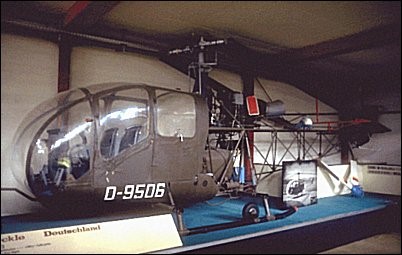
First turbine-powered helicopter built and flown in Germany, the five-seat Merckle SM 67 development began as a private venture in 1956, but the third prototype, which flew for the first time on April 12,1961, was bought by the Federal Government and spent much of last year undergoing an official flight test and evaluation programme.

More refined than its predecessors, it has a fully enclosed cabin and is powered by a 406shp Turbomeca Artouste IIC shaft turbine, driving a three-blade main rotor and two-blade tail rotor.

SM-67
Engine: 406shp Turbomeca Artouste IIC
Rotor diameter: 10.49m
Overall length: 12.75m
Height: 2.8m
Gross weight: 1700kg
Empty weight: 1037kg
Max speed: 220km/h
Cruising speed: 190km/h
Hovering ceiling OGE: 3500m
Range with full payload: 360km
Payload: 300kg

Melsheimer FM-1

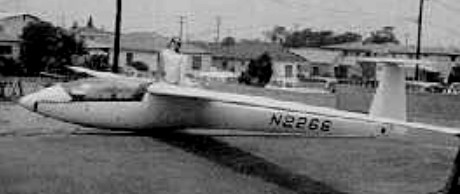
First flown in 1968, the FM-1 featured seating and a steel tube and fiberglass front fuselage with steel tubing, plywood aft fuselage and wings. Designed by Frank Melsheimer.

Wing span: 15.54 m / 51 ft
Wing area: 11.61 sq.m / 125 sq.ft
Aspect ratio: 21
Empty Weight: 227 kg / 500 lb
Payload: 103 kg / 250 lb
Gross Weight: 340 kg / 750 lb
Wing Load: 29.28 kg/sq.m / 6 lb/sq.ft
L/DMax: 35 97 kph / 52 kt / 60 mph
MinSink: 0.55 m/s / 1.8 fps / 1.07 kt
Airfoil: NACA 4400R
Seats: 1