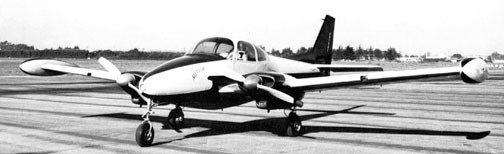
Successor to Monocoupe Airplane and Engine Corporation of Melbourne, Florida, developed Meteor four/five seat cabin monoplane with two Lycoming O-320 engines.
The first Mong Sport was built as a personal aircraft by the designer Ralph Mong, Jr, first flown on May 1, 1953 and plans for homebuilding were provided afterward, due to demand.
Mong Sport
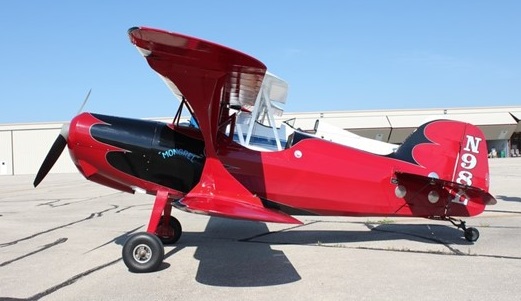
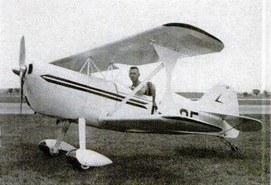
The original Mong MS1 Sport biplane was built around a Continental A65 65 hp (48 kW) engine. The biplane has an A frame shaped centre wing support. The biplane did not require expensive, drag producing support wires, using steel tubing instead. All Mong models use lift struts connected to the outer sections of the wings instead of flying and landing wires. Some builders installed the centre pylon support as an alteration to the design. But this alteration is not supported, recommended or condoned by Mong Aircraft. The fuselage is steel tube with aircraft fabric covering.
Costing approximately $1750 to build in 1971, original plans were still available for $100.00, plus shipping, out of the USA. Over 400 sets of plans for the aircraft had been sold.
Ed Fisher of Raceair Designs purchased the design rights in 1993 and designed a new set of wings that have 12 square feet more wing area, aimed at lower stall speeds. A new MS-3 airframe puts the control column under the longerons, which lowers the seat about 2″.
By 2019 Michael Stewart was owner of Mong Aircraft.
A Mong is a loop/roll/spin positive maneuver sport Biplane. For a sportplane Mong, recommended is the O-200 Continental for power.
In the mid-1960s, a biplane class was added to the Reno Air Races. The Mong Sport met the basic qualifications, and has been extensively modified over the years by builders to be used as a biplane racer. In 1965, Bill Boland won with his “Boland Mong” at 148 mph and again in 1967 and 1970 with speeds of 151 mph and 177 mph respectively. The Mongster won the 1968 Biplane class of the Reno National Championship. Long Gone Mong won in 1987 and 1989.
A highly modified Mong Phantom of Andrew Buehler and Tom Aberle with carbon fibre wings won in 2005 piloted by Andrew Buehler with 230,8 mph ( a 10 mph lead to the second place), and in 2006 with a speed of 251.958 mph, and has since raised the record to 284.454mph.
The Mong is the basis of the Micro Mong that Ed Fisher designed.
Mong MS1 Sport Engine: 1 × Continental A65, 65 hp (48 kW) Length: 14 ft 1 in (4.29 m) Wingspan: 16 ft 10 in (5.13 m) Height: 5 ft 6 in (1.68 m) Wing area: 80 sq ft (7.4 m2) Empty weight: 550 lb (249 kg) Gross weight: 970 lb (440 kg) Fuel capacity: 16 US gallons (61 litres) Maximum speed: 100 kn; 185 km/h (115 mph) Cruise speed: 96 kn; 177 km/h (110 mph) Stall speed: 43 kn; 80 km/h (50 mph) Service ceiling: 13,000 ft (4,000 m) Rate of climb: 1,000 ft/min (5.1 m/s) Crew: 1
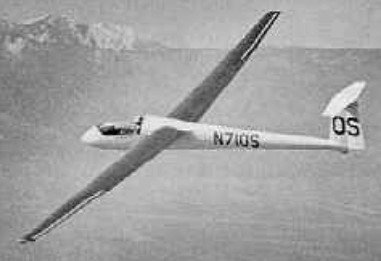
Designed by Richard Monaghen, the Osprey, a Standard Class sailplane which made its first flight in 1973, featuring retractable gear, 90 degree flaps and a T-tail. The structure was all-aluminum except for a fiberglass-foam-sandwich cockpit area.
The Soviets began constructing this spacecraft in response to a 1972 announcement by President Nixon that NASA would try building its own new spacecraft. The shuttle’s first launch attempt came on October 29, 1988 but ended with a mechanical failure.
NPO Molniya was created 1976 to develop the Buran, Russia’s first reusable spacecraft. With less work on Buran in later years, began developing civil aircraft.
NPO Molniya was created 1976 to develop the Buran, Russia’s first reusable spacecraft. With less work on Buran in later years, began developing civil aircraft. First to fly was six-seat Molniya- 1 general-purpose transport with twin booms and pusher engine (first flown December 1992); Allison turboproppowered version proposed as Molniya-3. Projects include twin-engined Aist general-purpose transport in six- and nine-seat versions; Lagoda 10-seat amphibian; Molniya-100 19-passenger transport; Molniya-300 6/15-passenger high-performance business/commuter transport; Molniya-400 combi transport or freighter with twin turbofans, in combi configuration carrying 250 passengers on upper deck and freight containers on lower deck; Molniya- 1000 Heracles twin-fuselage super-heavy freighter with a 450-tonne payload (or possible 1,200-seat passenger capsule) and 6-10 engines; and Vityaz smaller variant of Heracles.
Subsidiary of Allegheny Airlines Inc., Washington D.C., formed to control conversion program for Mohawk 298, UACL PT-6A-45-powered Nord 262 airliner, being undertaken by Frakes Aviation Inc. First example flew January 7,1975.
AC.4 single-seat autogyro dated from 1970s as a design of Altair Coelho. Marketed by this company after purchase of rights and many sold in assembled and kit forms.


 All Aero