Pakistan Aeronautical Complex was established 1978. Comprises four factories: Aircraft Manufacturing Factory constructs the Saab MF117 Safari Supporter under license as the Mushshak and Super Mushshak, and is partnered with Hongdu and AVIC of China in developing and producing the K-8 Karakorum jet trainer and light-attack aircraft. Other factories are Kamra Avionics and Radar Factory, Mirage Rebuild Factory and F-6 Rebuild Factory (the last being the oldest factory of the group), for manufacturing components and overhauling Pakistan’s Chinese-supplied combat aircraft.
Post WW2
Painter Super Sport

The Super Sport was a single-seat homebuilt sport biplane attributed to Ivan Painter of Hollister, California, USA. The engine was reported as a 150 hp Lycoming O-320 series and year of manufacture as 1966. The sole example built was deregistered on August 10, 2012.
Paine Texan
In 1957 Sim Paine built a single place, closed cockpit, high wing monoplane, registered N2747A.
Engine: 65hp Continental A-65-8
Wingspan: 24’0″
Length: 17’9″
Useful load: 158 lb
Max speed: 115 mph
Cruise speed: 95 mph
Stall speed: 50 mph
Paine, Sim
Sim Paine, Booker TX.
Circa 1957 airplane builder
Packard-Le Pere LUSAO-11
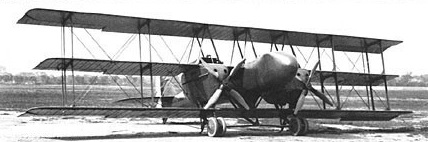
The 1919 LUSAO-11 (LUSAC = LePere US Army Observation) was a high-altitude long-range three seat open cockpit triplane observation aircraft for the Signal Corps.
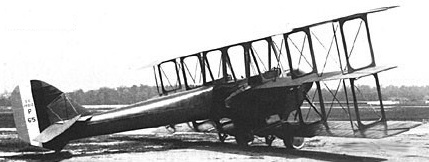
Only one prototype was built, SC40012.
Engines: 2 x Liberty 12, 400hp
Props: four-blade
Wingspan: 54’6″
Length: 38’2
Useful load: 3122 lb
Mas speed: 112 mph
Cruise speed: 106 mph
Stall: 60 mph
Range: 475 m
Ceiling: 17,300′
Packard XJ41
In 1943, Packard leased a government-owned manufacturing plant located on the outskirts of Toledo, Ohio. The plant was previously operated by the defunct Aviation Corporation. Packard used the leased plant to manufacture parts for the Rolls-Royce Merlin engine, and referred to it as its Toledo Division. In the early-summer of 1944, the Army Air Force Material Command contracted with Packard to carry out “advanced aircraft engine development” on both the Merlin and gas-turbine engines. To oversee the new project, Packard hired Allison Engine Company’s Robert M. Williams as their chief design engineer at the Toledo facility in July of that year. In early 1945 the Power Plant Lab at Wright Field asked Packard to take on a research project to develop an expendable jet engine of 4,000 pounds thrust weighing no more than 1,000 pounds. Design work for the engine designated as the Packard XJ41 began in May 1945.
After studying existing turbojet engines it was decided to design an engine which would be a significant advancement over conventional turbo-jet engines, have a low manufacturing cost, minimum use of strategic materials and be a light-weight design.
The Packard XJ41 met those requirements with a combination of a mixed flow compressor, a light weight annular combustion chamber and hollow turbine blades for both rotor and stator. The engine’s most outstanding design characteristic was the use of an air inlet that operated at supersonic speed that produced more thrust per pound of weight than designs using low velocity inlet air. The XJ41 weighed 1,100 pounds and produced 4,000 pounds of thrust, where the GE J33 weighed 1,820 pounds at the same thrust. The engine was completed and operating on a test stand on January 8, 1946.
Packard’s investment for production of the new turbojet engine design was extensive. By the end of 1946 the installation of fabrication and testing equipment was valued at $10,000,000. In addition, flight testing, shop and hangar facilities at Willow Run, Michigan was valued at $1,000,000, and an additional $3,500,000 in laboratory and testing equipment was installed by spring of 1947.
Serial numbers V-500001 to V-500007 were allocated indicating that at least seven engines were built. Development continued on the engine over three years, with Packard assigning model numbers PT-103 and PT-104 to military engine designations XJ41 serial number V-500001 and XJ41 serial number V-500003. A design study for an engine suitable for high acceleration, such as a catapult launched take-off, was assigned model number PT-106 in February 1947. Between September 1947 and July 1948 an XJ41 engine attached to a North American B-25J Mitchell bomber was flight-tested several times.
Development of the XJ41 stopped when Packard engineers came up with a radical redesign that differed so much that military model XJ49 was assigned. All work on the earlier design was terminated and funding was transferred to the new design.
Specifications:
XJ41-V-500003
Dry weight: 1,100 lb (499 kg)
Compressor: single-stage Mixed-flow (combined axial and centrifugal)
Combustors: annular combustion chamber
Turbine: single stage hollow blades
Fuel type: Aviation Kerosene jet fuel
Oil system: pressure fed scavenged spray system with dry sump
Maximum thrust: 4,000 lbf (18 kN)
Thrust-to-weight ratio: 3.64
Pack C / Li’l Rebel / Wilson Li’l Rebel
Built in 1948, the single place, low wing monoplane midget racer ‘Li’l Rebel’ N66317 achieved a race average of 191 mph piloted by Jimmy Wilson.
Rebuilt as ‘Wilson Li’l Rebel’ after being damaged.
Engine: 85hp Continental C-85
Wingspan: 16’0″
Length: 16’10”
Pack B / Rebel Raider
Built in 1948 as midget racer ‘Rebel Raider’ N97M the craft was destroyed on a test flight. Pilot Garland Pack was uninjured. The model B was a single place low wing monoplane.
Engine: Continental C-85, 85hp
Wing span: 13’0″
Length: 16’0”
Pacific Kites Lancer 4
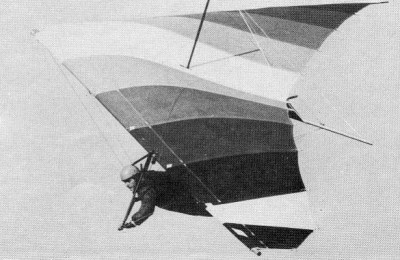
The Lancer IV was one of the great fun gliders of the 70s. Originally produced in New Zealand from 1979, designed or co-designed by Graeme Bird.
The Lancer was brought to the U.S. by Marty Alameda. Marty started Flight Designs in Salinas, California and began producing the Lancer under license in 1979.
Lancers, even the smaller size, were well known for their wonderful ability to float like a butterfly in the lightest breeze, while still retaining control and having, for the day, decent top end speed without falling out of the sky.
The Lancer was a dream to fly: it had both float and responsiveness. It wasn’t too fast. While still exploring the sport and its wonders, the Lancer was a real step forward in that it was a terrific all-around glider.
It was solid, responsive, thermalled beautifully without any nasty tricks, yet could float really well with gliders that were ten or 20 square feet larger.
Bar pressure in pitch was solid but not stiff. Roll pressures ditto. It came around in a turn with solid feedback but without working your arms to death. There wasn’t any of the yaw you associate today with bigger, higher-aspect gliders. But you could stall the inside tip and spin around for real tight climbing turns, and the planform of the glider would give you a climb rate that would take you up through the middle of thermal stacks like you were on an elevator.
It was a breeze to land: very predictable, again with wonderful feedback from the bar. Flare timing wasn’t an issue in most gliders of those days…you just waited for the right wind noise, the glider started to settle, you shoved the bar out and she dropped you smoothly onto the ground, even in no wind.
It is suitable for both intermediate and high-level pilots, thanks to its ease of handling, pleasant handling and excellent performance.
André Chayrou, Pacific Wings, was responsible for the construction of the Lancer IV in France, with sails made in New Zealand. The Lancer IV made in France were clean and well finished. Fitted with deflectors and flexible slats, an original system allows the umbrella to lock automatically, which avoids the possible forgetfulness of the famous push-pin. It was quick to rig having 7 flexible plastic battens per side.
Takeoffs were easy, but they did require a good committed hard run in light conditions.It was a great glider for ridge soaring but didn’t have great penetration into a strong wind. It went down quickly with the bar pulled right in without a great deal of forward motion. Though this was handy for landing in tight fields as you could quickly get onto the ground and the energy retention wasn’t great so you quickly washed off the speed ending in an easy flare and one or two step landing.
Some pilots experienced their Lancers tip stalling and developing a full spin, some speed being required when going into turns.
Some consider those made by Rithner in Switzerland a dangerous wing.
Lancer 16
Wing area: 15.5 m²
Wing span: 9.8 m
Aspect ratio: 6.2
Hang glider weight: 23 kg
Minimum pilot weight: 60 kg
Maximum pilot weight: 110 kg
Packed length short: 4 m
Nose angle: 120°
Lancer 18
Wing area: 17.6 m²
Wing span: 10.4 m
Aspect ratio: 6.2
Hang glider weight: 25 kg
Packed length short: 4 m
Nose angle: 120°
Lancer 190
Lancer 4S
Wing area: 175 sq.ft
Pacific Kites Zephyr
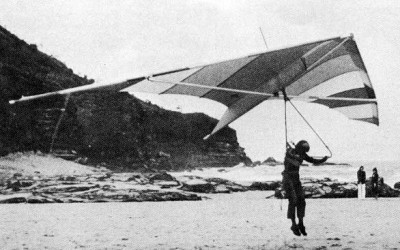
A 1979 hang glider, it had 10 battons, and a brick-like glide ratio of 7-1
Wingspan: 21ft
Length: 18ft
Weight: 45 lbs

