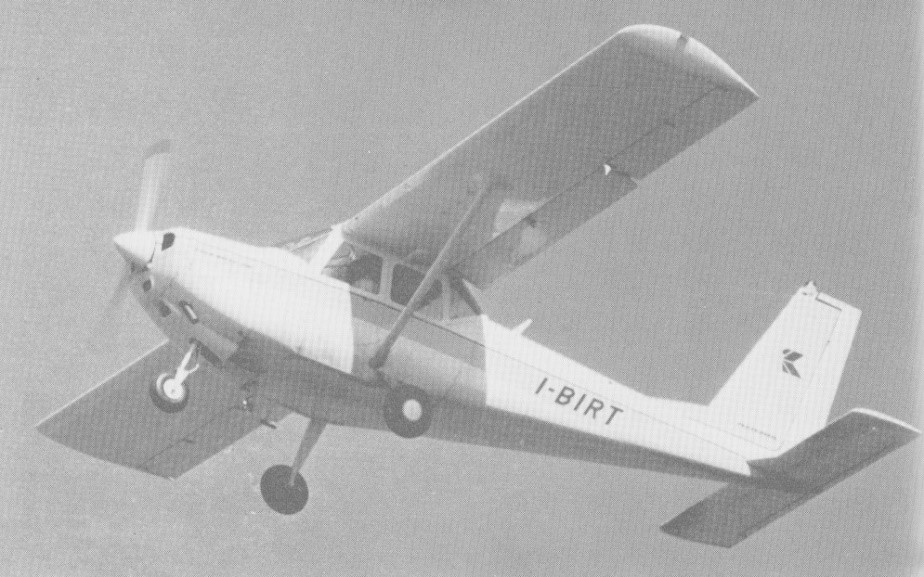
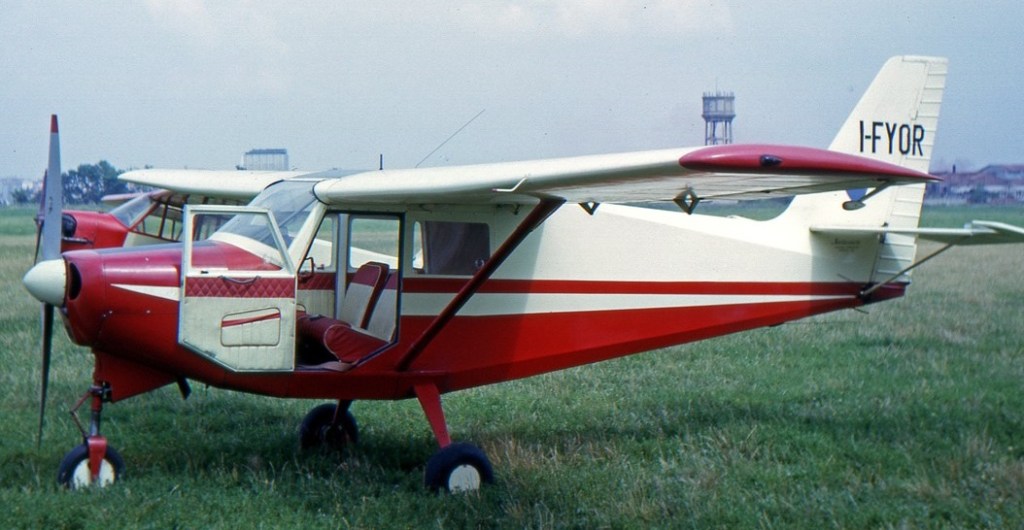
The P.57 was successful enough to consider a re-thought version of all-metal construction, with the “P.64 Fachiro III” taking to the air for the first time on 2 April 1965. After some rethinking of the prototype design, mostly to add a rear window and a cut-down rear fuselage, it went into production as the “P.64B Oscar B” — the “Oscar” effectively meaning “Type O” — to then be renamed the “P.64B Oscar 180”.
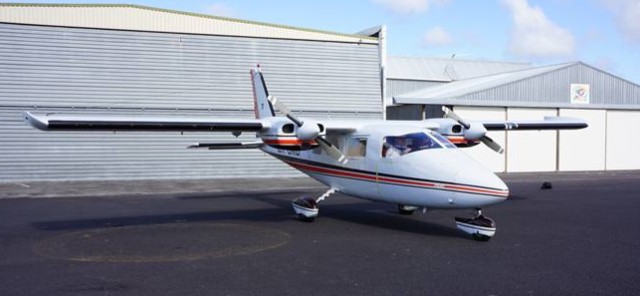
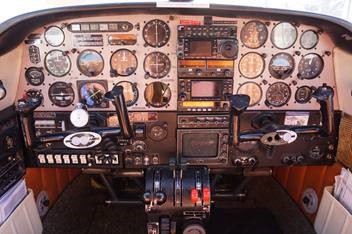
The aircraft was designed by Professor Luigi Pascale, professor of aeronautics at Naples University, and his influence over the marketing department is there to see in the P68B’s very clean aerodynamic shape. Six place, powered by two 200hp Lycoming 10-360’s, with room for 400lbs of passenger baggage. The aircraft is designed for optimum aerodynamic efficiency, and this com¬bined with a simple but robust struc¬ture and its fixed undercarriage are factors that have endeared it to operators, who range from outback freight carrying outfits to third levels and executive users. The aerodynamic streamlining is demonstrated in the fuel economy; at optimum performance at 65 percent power (160 kts) the P68B can get through close on 900 miles at a fuel flow rate of some 15 gallons an hour. Entry to the aircraft is by a single door on the port side; simple enough for your average passenger but some¬what small to load any freight. A baggage door is also provided on the starboard side.
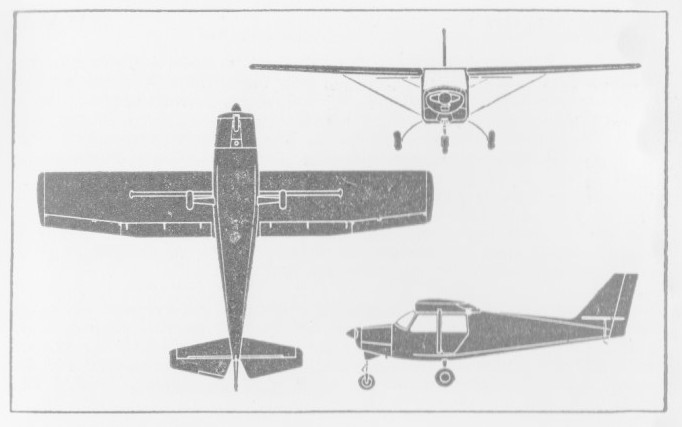
The P.68 Victor first flew in May 1970 with two 200-hp (149-kW) 10-360 engines as the prototype of a six/seven-seat lightplane. The type has an unusual appearance, with a racy fuselage and swept fin/rudder assembly married to fixed tricycle landing gear (with attractive speed fairings) and a straight wing and tailplane.
The first production P-68 Victor featured a six-inch fuselage stretch and higher gross weight among modifications developed as a result of field and customer-acceptance trials.
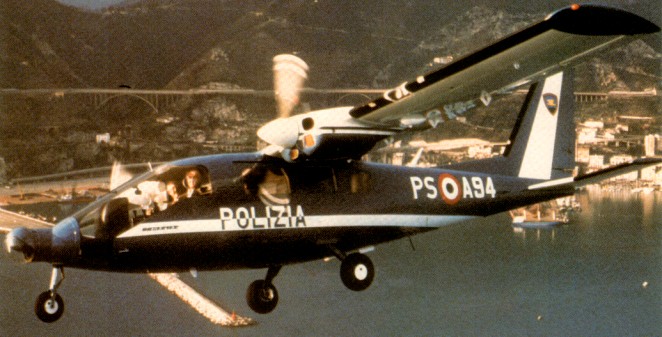
With the Victor established in production and further development, Partenavia then collaborated with a West German company, Sportavia-Putzer, in the development of a patrol and observation version.
In 1980, turbocharging was added for a slight increase in speed and a significant boost in service ceiling.
The Observer has a new forward fuselage incorpo¬rating a Plexiglas nose that offers forward and downward fields of vision comparable with those of a helicopter. The first Observer flew in West Germany during February 1976, and aircraft emerged from the Italian production line from July 1980. Since that time small but useful sales have been made to several police and para-military air arms. The Italian police use the type with the ATAL video surveillance system developed in France by Aérospatiale.
The P-68C features a lengthened nose, oleo-type nosewheel strut, an integral fuel tank in each wing and other refinements. Some featured a crew door.
Partenavia P68C
The certification RAI A-365 came from Registro Aeronautico Italiano for the P-68B, P-68C, and P-68C-TC.
Partenavia P68C
AD’s include “Extended safe life” kit 68-038 (Spar Caps replaced) and Max takeoff weight increase kit P68-051.
The Partenavia P.68R’s main wheels fold into the fuselage fairings with a speed gain averaging about eight knots. The version provided so little improvement over the standard that it never went into production.
Several versions of the P.68 are offered for military and paramilitary roles, including the P.68 Observer twin-piston-engined observation/surveillance aircraft, the AP.68TP-300 Spartacus for coastal patrol, troop transport, and medevac with two 240 hp Allison 250-B17C engines and underwing hard-points; and the AP.68TP-600 Viator, which is similar to the Spartacus but has a lengthened fuselage and a retractable undercarriage. The AP-68TP being jointly developed with Aeritalia.
Taneja Aerospace & Aviation Ltd in India undertook to set up a project for manufacture of P-68 aircrafts with three variants: P-68C (twin piston engine, non pressurised), P-68 C-TC (twin piston engine turbo Charged) and P-68 Observer (same as P-68 C-TC with forward and downward view equal to that of a helicopter). It has an empty weight of 1320 Kgs and payload of 764 Kgs, with a capacity to attain a maximum speed of 322 Kmph, 1550 ft./min rate of climb, landing run of 215 mtrs and an optimum cruising range of 2170 Kms at 12000 ft.
The aircraft was manufactured by Taneja Aerospace in India, while Aerocosmos, which held the production rights, was purchased by Air Samanta in 1998.
Vulcanair S.P.A of Naples, Italy, were manufacturers of Partenavia P68 aircraft in 2004. Vulcanair was converting one of its P68 Observer airframes to diesel power with an SMA engine. This was due to fly in September 2003 and if successful will be offered onto the light twin market.
More than 500 P68s had been built to 2003, of which some 35 are of the Observer vari¬ant for law enforcement and paramilitary use.
P-68B Observer Engines two 200-hp (149-kW) Lycoming IO- 360-A1B6 Wing span 39 ft 4.5 in / 12.00 m Length 30 ft 8 in / 9.35 m Height 11 ft 1.75 in / 3.40 m Wing area 200.2 sq ft / 18.60 sq.m Gross wt. 4,321 lb / 1,960 kg Empty wt. 2,822 lb / 1,280 kg Max Speed 174 kts / 200 mph / 322 km/h at sea level Max Cruise 165 kts Initial climb rate 1,160 / 488 m fpm Range 920 nm / 1,358 miles / 2,186 km Service ceiling 20,000 ft / 6,095 m Armament: none Seats 7
P.68 Observer 2
P-68C Engines: 2 x 200 hp Lycoming IO-360-A1B6 Seats: 6/7 Empty Wt: 2787 lbs Gross wt: 4387 lbs Useful load: 1600 lbs Max Cruise: 175 mph Max range: 900 sm
P-68TC Engines two 210-hp turbocharged Lycoming IO-360C-1A6D Gross wt. 4,387 lb Empty wt. 2,866 lb Fuel capacity 137-196 USG Max Speed 190 kts Max Cruise 175 kts Initial climb rate 1,130 fpm Range 1,040 nm Ceiling 27,000 ft Seats 7
AP-68TP Engines: 2 x 240 hp Allison 250 Seats: 7/8 Empty Wt: 3415 lbs Gross wt: 5787 lbs Useful load: 2372 lbs Max Cruise: 240 mph Max range: 820 sm
AP 68 TP 600 Viator Engines: 2 x Allison 250 B17C, 222 shp Length: 35.761 ft / 10.9 m Height: 11.811 ft / 3.6 m Wingspan: 39.37 ft / 12.0 m Wing area: 200.21 sq.ft / 18.6 sq.m Max take off weight: 6284.3 lb / 2850.0 kg Weight empty: 3616.2 lb / 1640.0 kg Max. weight carried: 2668.1 lb / 1210.0 kg Max. speed: 220 kts / 408 km/h Landing speed: 70 kts / 130 km/h Cruising speed: 170 kts / 315 km/h Initial climb rate: 1929.13 ft/min / 9.8 m/s Service ceiling: 25000 ft / 7620 m Wing loading: 31.37 lb/sq.ft / 153.0 kg/sq.m Range: 445 nm / 824 km Crew: 2 Payload: 9-12pax
Partenavia’s next effort was the “P.59 Jolly (Joker)”, a two-seater with fixed taildragger landing gear and a Continental O-200 flat-four engine with 75 kW (100 HP). The structure wooden/metal.
It was designed in response to a competition for a trainer for the Italian Aero Club in 1960 but the P.59 lost to the Aviamilano P.19 Scricciolo, and the P.59 remained a one-off.
Engine: Continental O-200, 75 kW / 100 hp Max speed: 105 kt
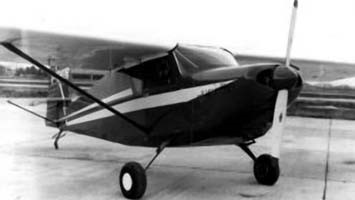
The P-57 Fachiro of 1957 was a touring aircraft of conventional configuration, with a high braced wing, four seats, forward-hinged doors on each side, fixed tricycle landing gear, of mixed steel tube / fabric construction.
First flown on 7 November 1958 with a 150 hp Lycoming O-320 engine, the Fachiro was Pascale’s first production machine, introduced in 1958 by Partenavia, which the Pascales had set up the year before to mass-produce their aircraft.
The P.57 The first machine, the “Fachiro I” was powered by a Lycoming O-320 with 112 kW (150 HP); it was followed by three “Fachiro II” machines with an O-360-B2A engine with 125 kW (168 HP).
Then 33 “Fachiro III” machines, with an O-320-A2A engine providing 134 kW (180 HP) and swept vertical tail surfaces.
The P.57 was successful enough to consider a re-thought version of all-metal construction, with the “P.64 Fachiro III” taking to the air for the first time on 2 April 1965.
Partenavia P-57 Fachiro III Engine: Lycoming O-320-A2A. 180 hp Wingspan: 30 ft 0 in Length: 21 ft 9 in Height: 7 ft 11 in Wing area: 144.2 sq.ft Empty weight: 1367 lb Loaded weight: 2315 lb Max speed: 152 mph at SL Max cruise: 135 mph at 3280 ft Econ cruise 65%: 127 mph ROC: 985 fpm Service ceiling: 13,780 ft Range: 560 mi at 127 mph
In the postwar period, Luigi “Gino” Pascale and his brother Giovanni “Nino” Pascale of Naples, Italy, having been enthusiastic flying model aircraft makers, decided to work on full-scale aircraft. The first, built while the brothers were college students, was the “P.48 Astore (Goshawk)” — a two-seat aircraft, with the seats in tandem, featuring a high strut-braced wing, fixed taildragger landing gear, and a Continental O-170 / A65 flat-four air-cooled engine with 48 kW (65 HP).
One Astore was built, performing its initial flight in 1952 — by which time Luigi Pascale had become an instructor in mechanical engineering at Naples University, where he would become a full professor and help establish a department of aeronautical engineering. The Astore was followed by other one-off designs: P.52 Tigrotto (Tiger Cub) P.53 Aeroscooter P.55 Tornado P.57 Fachiro The Fachiro I was followed by three “Fachiro II” and then 33 “Fachiro III”.
Partenavia Costruzioni Aeronautiche Spa, a Naples company formed in 1949 to build series of light aircraft. First to enter production was the P-57 Fachiro of 1957, a four-seat high-wing monoplane with Lycoming engine. This was followed by various developments including the P.64 Oscar (first flown April 1965), also produced in South Africa under license as the RSA.200 by AFIC (Pty) Ltd, and the P.66 Charlie. Partenavia’s first twin was the P.68 six-seat light transport, first flown in May 1970. It was subsequently placed into production in several forms, including the Observer 2 for observation and patrol. AP.68 TP-600 Viator 11 seat transport followed in March 1985. New projects in the early 1990s included PD.93 Idea four-seat trainer and utility monoplane, but in March 1998 Partenavia ceased work and its P.68 series was bought via auction by VulcanAir SpA.
After financial difficulties the company reappeared, in 1986, as Costruzioni Aeronautiche Tecnam (see Tecnam).
In 2008, Partenavia, an Aeritalia division, announced a decision to transfer manufacturing of single engined aircraft, including the mosquito, to fellow Aeritalia subsidiary Aviolight, which was floated at the end of February 2008.
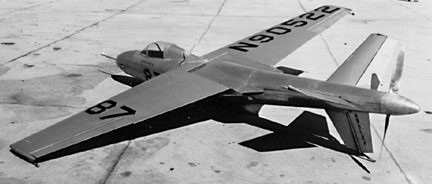
Designed by George Owl, the PAR Special N90522 of 1950 was a single place racer powered by an 85hp Continental C-85 pusher, with a variable-incidence wing.
The 1952 TRW Special midget racer N2948 was built partially from the PAR Special. Raced as a midget racer ‘Mixmaster’ with Y-tail and aft-mounted prop, after unsuccessful competitions, it was rebuilt in 1952 as Trefethan TRW Special, using the wings, aft fuselage and tail.
PAR Special Engine: Continental C-85, 85hp Span: 20’0″ Length: 20’0″
TRW Special 1952 Engine: 85hp Continental C-85 Seats: 1
In 1947 Robert Parks built two single place open cockpit low wing monoplane midget racers. Both were powered by a 65hp Continental C-65, and one, registered N2E, disappeared c.1967 over the Gulf of Mexico. That registration was transferred to the Parks P-3.