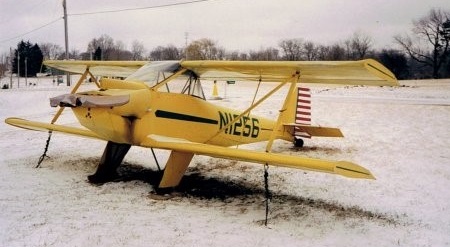
Elton L. Patterson was designer and builder of the unique single-seat Pipsqueek. The aircraft had negative stagger, a retractable undercarriage and was powered by a 40hp VW1500 engine. The construction was started in 1963 and N1256 made the first flight on 26 February 1968.
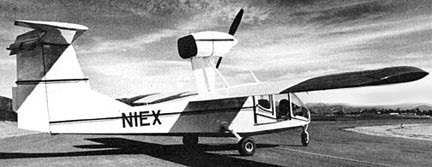
Only one Patchen Explorer was ever built, in the 1960s, registered N1EX.
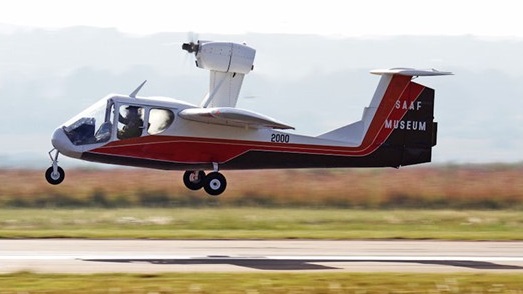
By 1982 the prototype was shipped to the Republic of South Africa and evaluated by the SAAF’s test flight and development centre for use as a light recon forward air control aircraft, but was not quite what was required. As a result it languished in a hangar for many years before being donated to the SAAF Museum.
National Dynamics (Pty) Ltd, South Africa, was formed 1975 after acquiring the prototype and all production rights of the Patchen Explorer/Observer four-seat cabin lightplane conceived originally by Thurston Aviation Corporation in the U.S.A., as a landplane development of the Teal amphibian.
The aircraft is still alive and well, operated by the South African Air Force Museum. Why only one prototype was ever built I do not know, as it is a great little aircraft with a fantastic helicopter-type view from the cockpit. I will admit that it does not have the greatest control harmony (sensitive rudder and elevator, heavy ailerons), but it goes well with a 200hp Lycoming and variable-pitch prop. I served with the SAAF Museum during 1999 as a display pilot and flew the Patchen at many airshows. It looks so weird that it attracts far more interest at airshows than many of the vintage aircraft! (James R Feuilherade 11/15/00)
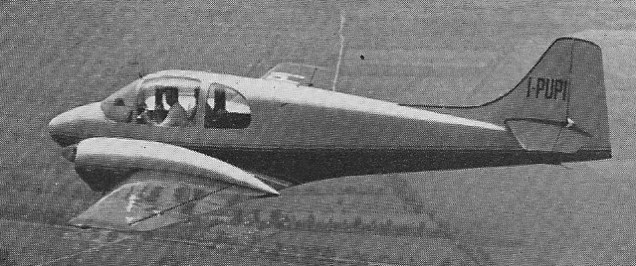
Designed by Stelio Frati and built by Legnami Passoti, the F.6 Airone is a four-seat low wing twin engine monoplane with dual controls.
A cabin monoplane with two Lycoming engines.
First flown on 13 July 1954, the prototype was powered by two 90 hp Continental C90-12Fs.
Engines: two 90 hp Continental C90-12F Wingspan: 34 ft 9 in Wing area: 163.6 sq.ft Length: 23 ft 9.5 in Empty weight: 1984 lb Loaded weight: 3196 lb Max speed: 198 mph Cruise: 168 mph Service ceiling: 21,325 ft Range: 714 mi
Italy In early 1950s built four-seat F.6 Airone cabin monoplane with two Lycoming engines, followed by a single-engine version, the F-9 Sparviero, with Hirth engine.
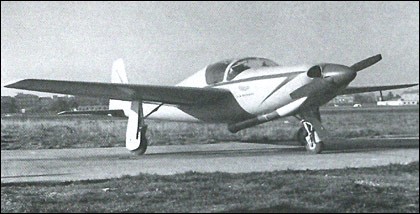
A one off designed specifically to enter and win the “Giro de Sicilia”, the Tour of Sicily, the P.55 Tornado was a two-seat sport competition aircraft, with a mid-mounted wing, retractable tricycle landing gear, a Lycoming O-320 flat-four engine, and side-by-side seating.
First flying in 1955, the only example (I-REGJ) winning the Tour of Sicily in 1956, to be lost in a crash on 13th June 1958.
Engine: 1 x Lycoming O-290-D2, 140 h.p. Span: 23′ 7.5″ Wing area: 86.1 sq.ft Length: 19′ 9.75″ Height: 6 ft 10.75 in Empty weight: 868 lb Loaded weight: 1367 lb Max speed: 211 mph Cruise: 186 mph Time to 3280ft: 3 min Max range: 497 mi
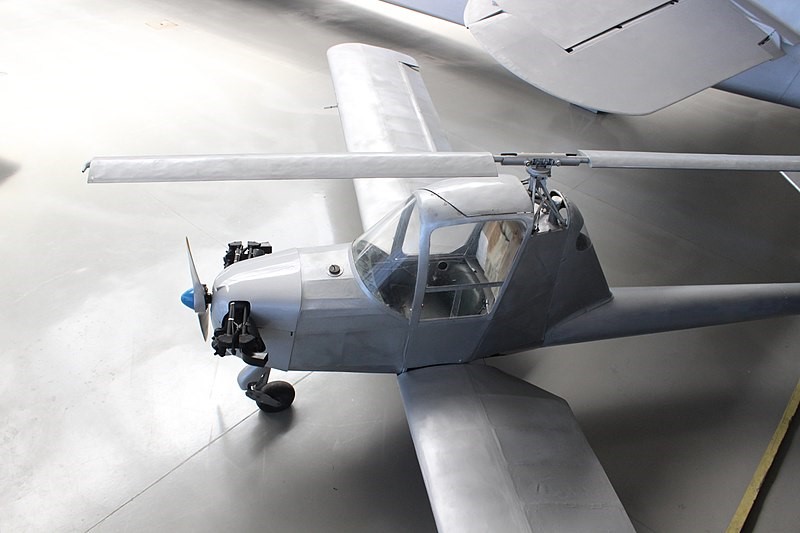
The Partenavia P-53 Aeroscooter was designed by Luigi Pascale, expressly for Mario de Bernardi, winner of the previous year’s d ‘Annunzio Trophy on a Partenavia P-55 Tornado.
The Aeroscooter is constructed of metal, and represents the minimum safe structure required to unite pilot, engine and flying surfaces. It fitted with a two-bladed rotor to reduce descent rate and stall in the event of an engine failure.
It flew in 1951.
It was built in collaboration with one Mario de Bernardi, who went on to build a two-seat version of the Aeroscooter; but he then died of a heart attack, and that was the end of it.
Engine: Ambrosini P-25, 16 kW (22 HP) Prop: two-blade wooden Wingspan 27 ft. 2 in / 8.28 m Wing area: 8.3 m2 (89 sq ft) Airfoil: NACA 63-series Length 16 ft. 9 in / 5.12 m Height 5 ft. 7 in / 1.70 m Empty weight: 180 kg / 397 lb MTOW: 280 kg / 617 lb Maximum speed: 93 m.p.h. / 150 km/h / 81 kn Cruising speed: 74 m.p.h. / 120 km/h / 65 kn Stalling speed: 37 m.p.h. / 32 kn / 60 km/h Service ceiling: 11,500 ft / 3,500 m Range: 500 km / 310 mi / 270 nmi Seats: 1
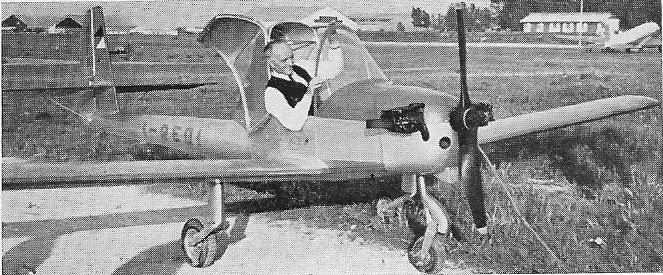
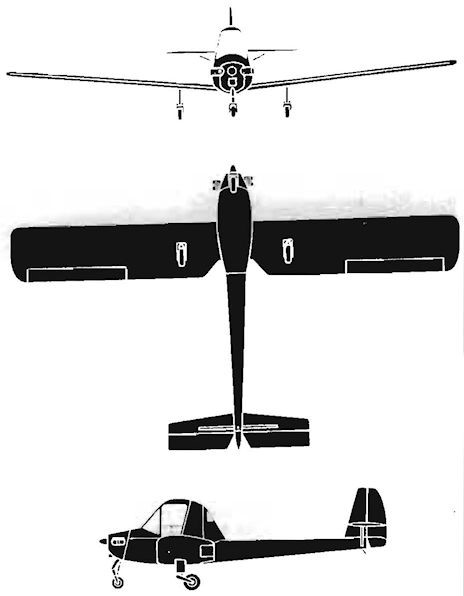
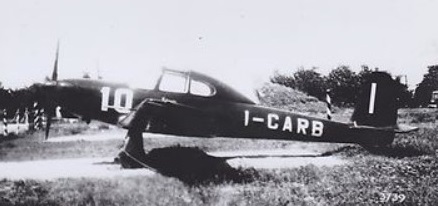
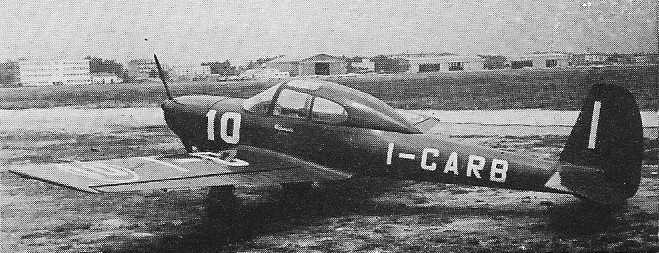
The Astore was followed by the Tigrotto was a low-wing cabin monoplane with a retractable tailwheel landing gear. It had two-seats side-by-side and was powered by an 85 hp (63 kW) Continental C85 engine.
The all-wood prototype, and only Tigrotto, registered I-CARB, first flew in 1953.
Engine: Continental C85-12F, 63 kW (85 hp) Wingspan: 29 ft 6.5 in Length: 19 ft 3.5 in Height: 5 ft 7 in Maximum speed: 235 km/h (146 mph, 127 kn) Cruise speed: 200 km/h (124 mph, 108 kn) Ceiling: 14,764 ft Range: 597 mi Empty weight: 948 lb Loaded weight: 1598 lb Crew: 1 (pilot) Capacity: 1 (passenger)
Luigi “Gino” Pascale and his brother Giovanni “Nino” Pascale of Naples, Italy, having been enthusiastic flying model aircraft makers, decided to work on full-scale aircraft. The first, built while the brothers were college students, was the “P.48 Astore (Goshawk)” — a two-seat aircraft, with the seats in tandem, featuring a high strut-braced wing, fixed taildragger landing gear, and a Continental O-170 / A65 flat-four air-cooled engine with 48 kW (65 HP).
The Astore had two seats in tandem and was powered by a 65 hp (48 kW) Continental A65 engine. The prototype and only Astore, registered I-NAPA, was built in a garage in Naples and first flew in 1952, piloted by Mario de Bernardi.
P-48-B Engine: 1 × Continental A65, 48 kW (65 hp) Wingspan: 26 ft 9.5 in Length: 20 ft 11.75 in Height: 5 ft 10.5 in Maximum speed: 185 km/h (115 mph, 100 kn) Cruise: 99 mph Time to 3280 ft: 5 min 50 sec Service ceiling: 10,827 ft Range: 342 mi Empty weight: 617 lb Loaded weight: 1036 lb Crew: one Capacity: one passenger