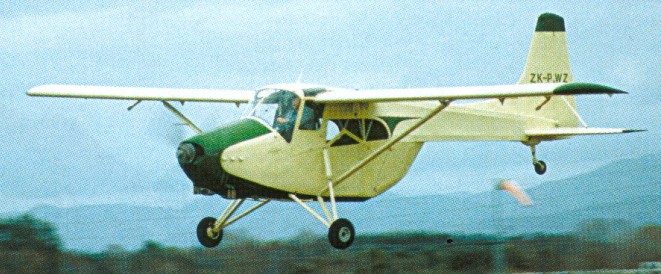
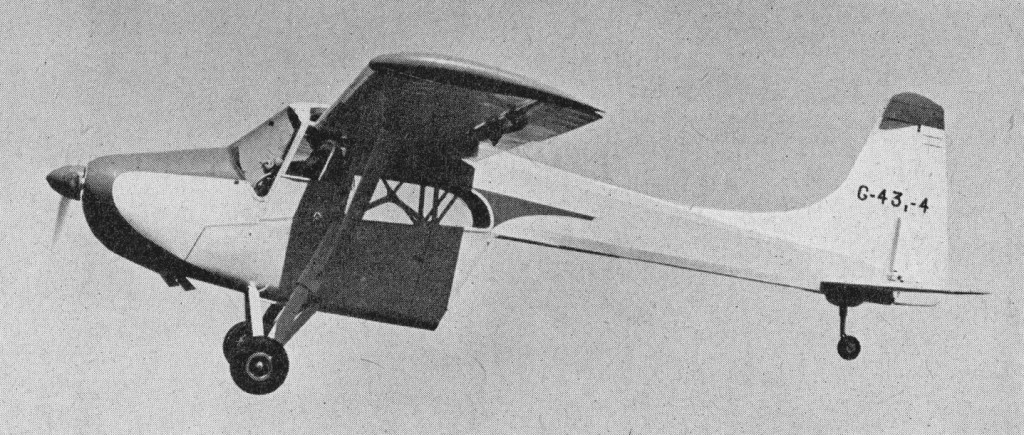
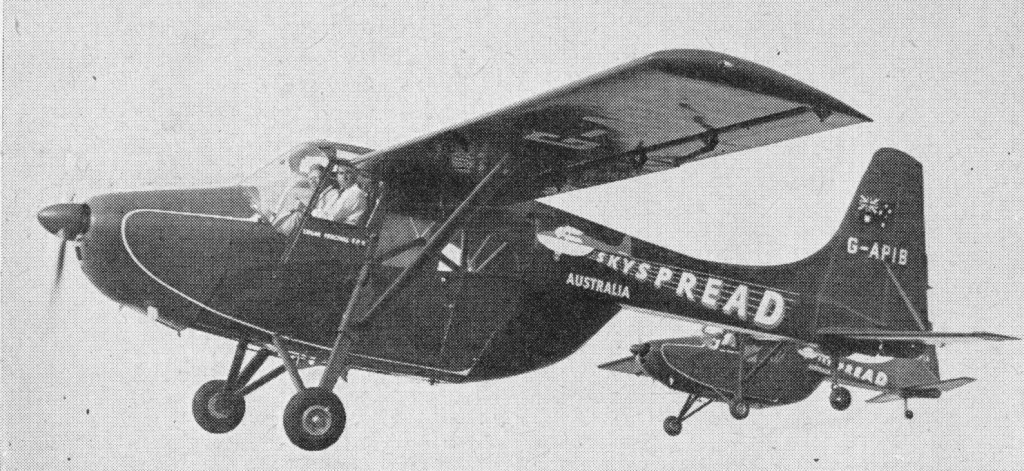
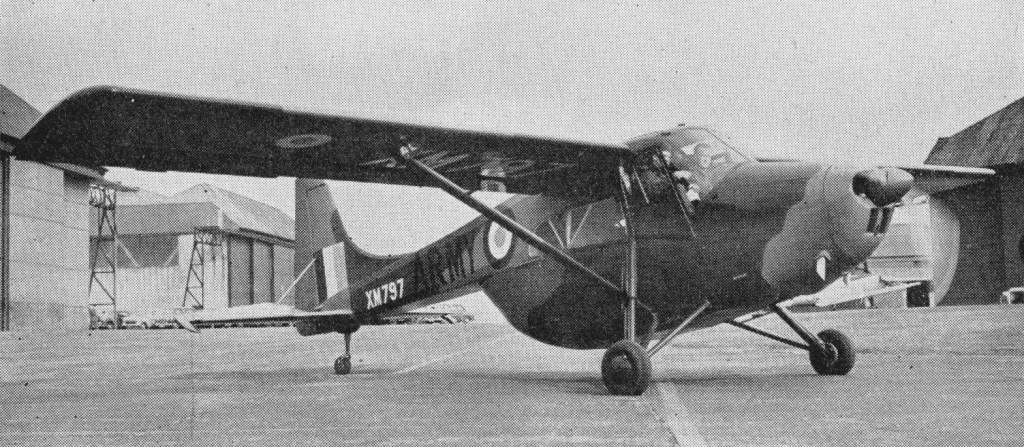
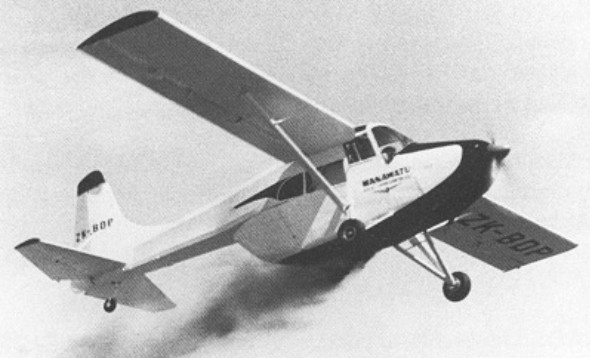
In 1959, Edgar Percival founded Edgar Percival Aircraft Limited at Stapleford in the United Kingdom and built as a private venture a high wing utility aircraft known as the EP 9. It was intended for use as a light transport and top dressing aircraft with a 170 Imp.Gal tank.
The prototype first flew on 21 December 1955 piloted by Edgar Percival, and construction of the first group of twenty aircraft commenced soon after. Edgar Percival built twenty-one EP9s fitted with the 270hp Lycoming GO-480-B engine.
Aircraft were sold to Australia, Canada, France, Tasmania, and a single example to New Zealand.
Two Percival EP.9s were delivered at the end of 1957 to Skyspread Pty Ltd in Australia.
The British Army purchased two in 1958 for evaluation, and they served for several years before being declared surplus and disposed of on the civil market.
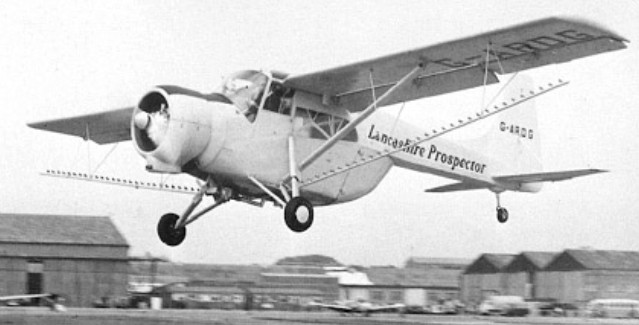
The last aircraft was not com¬pleted by him and was finished by the Lancashire Aircraft Company who then went on to build four more aircraft. The rights for the EP.9 were acquired by Samlesbury Engineering Ltd in 1958, including assembled and partly assembled aircraft. The EP.9 was renamed the Lancashire Prospector EP.9 and three built with Lycoming engines. Lancashire built aircraft standardised on the Lycoming GO-480 295 hp engine.
The first of these was registered G-APWZ on 5-11-1959. It first flew on 23-02-1960 and attained its C of A on 22-04-60. Lancashire named the aircraft the Prospector and five aircraft were fitted with a 295 hp Lycoming GO-480-G1A6 and a three-bladed propeller before production ceased in 1960.
Kingsford Smith Aviation Services in Australia converted a number of aircraft to take the 375 hp Armstrong Siddeley Cheetah 10 during 1961-62.
The last aircraft built (G-ARDG) was fitted with a 375 hp Armstrong Siddeley Cheetah 10 and was dubbed the Prospector 2. In all, only twenty-seven aircraft ever flew.
Certification is by UK Manufacturer’s Type Record.
Percival Aircraft Ltd formed in 1932 by Australian born aircraft designer Edgar. W. Percival and E. W. B. Leake at Gravesend, Kent, moving to Luton, Bedfordshire, in 1937. Built series of successful light aircraft beginning with the single-engine Gull and later twin-engine Q-6 six/seven seat cabin monoplane. Percival Gulls were used for a number of record-breaking flights, and the type was developed into the Proctor light communications aircraft. Several Mew Gull racers were built in the late 1930s. After Second World War, production of the Proctor continued for civilian customers, while a new three-seat trainer, the Prentice, appeared in 1946 and was built in quantity for the RAF and several overseas air forces. It was followed by the Provost trainer, ordered for the RAF in 1951. Following the experimental Merganser light transport of 1946, a larger version, the Prince, flew in 1948 and was produced in civil and military versions. During 1944 the Percival Company was absorbed by the Hunting Group in the UK.
A change of name is announced in April 1954, by Percival Aircraft, Ltd. who will be known as Hunting Percival Aircraft, Ltd. The change of name was to provide more complete identification with the parent Hunting Group, and then Hunting Aircraft in 1957.
Model 101, 1946 A second version of the Strap-on with a motor-cycle saddle acting as a seat and a tubular tripod assembly with three wheels as landing gear, and also a hanging stick to control the aircraft was tested later.
Model 102, 1947 Tests of the Model 101 revealed the need for several improvements, so that the 102, while somewhat resembling its predecessor, had a more powerful engine. Besides a directly engaging clutch, there was also a freewheeling device for auto-rotation in case of engine failure.
The two rotors, set at a distance of 2 feet (61 centimetres) from each other, consisted of a 4-foot (1.32-metre) tubular metal section centred at the hub; to these tubular sections the two spruce blades were attached.
The controls included collective, cyclic and differential pitch, the latter being obtained by rotating the stick handle which made the helicopter turn on its vertical axis.
Model 103, 1947 This model was similar to the previous ones, except that the rotor diameter was slightly increased and the distance between the two rotors somewhat greater.
Model 104, 1948 Once again this was an ultra-light single-seater helicopter with two co-axial contra-rotating two-bladed rotors of the same lineage as the firm’s previous products. Model 104 was sent to the United Kingdom, where it remained, to be tested for the British Ministry of Supply under the aegis of a British company, Hoppicopter Ltd.
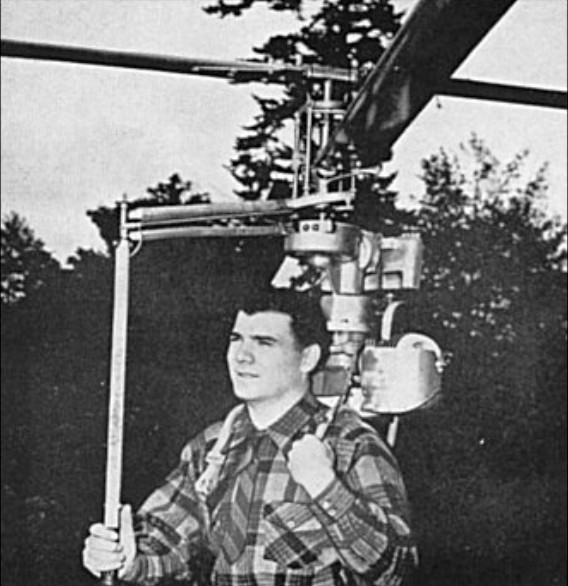
The Pentecost Hoppi-Copter was a 41kg personal helicopter pack designed to be strapped to an infantryman’s back to make it possible for him to surmount terrain obstacles, but had no landing gear. Conceived by Horace Pentecost, it first flew in 1945, but landing shock problems proved insurmountable.
This ultra-light individual helicopter had two co-axial contra-rotating two-bladed rotors powered by a small two-stroke horizon-tally opposed engine developing about 20 h.p.
The body consisted of a tubular aluminum frame curved to fit over the pilot’s shoulders and attached to the body by harness of the type employed in parachutes; the pilot’s legs were used for landing.
Some twenty hops were made with the use of safety cables attached to the pilot, but this strap-on helicopter ended its career at the Smithsonian Institution in Washington.
Capital Helicopter Corp was established January 1954 for continued development of C-1 Hoppi-Copter, took over the patents in 1954, and flew a Hoppi-Copter with rotor blademounted pulse jets.
Horace Pentecost became President of the Capital Helicopter Corporation, founded in 1954, on leaving the Hoppicopter concern and retaining his rights in his inventions.
A new type of helicopter, powered by small pulse-jet engines at the blade tips, was also developed by Horace Pentecost.
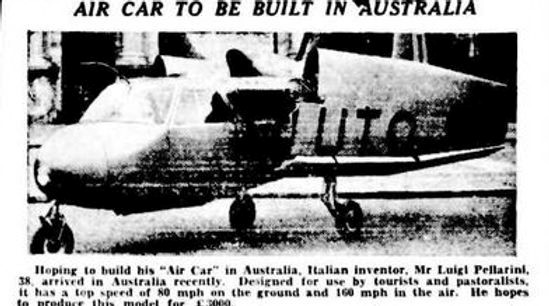
Luigi Pellarini was about 30 years old when in 1944 he partnered with Carrozzeria Colli, a Milan motor vehicle and coach-building company, to build his first prototype flying car, the PL 1.
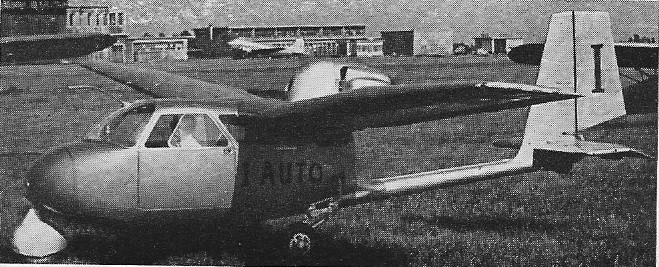
He kept improving his prototypes and put out a new and improved model each of the next several years. L’Ala, an Italian magazine, published a description of his PL-2C, dubbed the Aerauto, in its October 1946 issue.
The PL 2 C is an entirely metal touring aircraft, with folded wings, its dimensions are about 2.20 m width for 6 m of length it can easily move on normal roads, always with the propeller thrust.
The PL 2C structure is the fuselage, with a real chassis, consisting of a tubular beam in welded sheet steel and durall bodywork. On the beam are welded the castle in tubes that support the wing and the engine, as well as all the controls, the undercarriage, the seats and the empennages.
There durall fairing covers the front of the beam and provides a to connect the wing to the engine and to the beam, as well as to form the cabin equipped with two side doors and is easily removable. The wing is cantilever monoplane divided into a fixed centre, and in two collapsible semis. The folded wing remains suspended with the front attachment to the central trunk of the wing. Structure the wing is entirely durall and the cover is 8/10 mm. The attachments are steel. Rivets were widely used in the wing tubulars, rather than bolts. The ailerons have a metal frame in durall and a cover in canvas; they can be simultaneously lowered so as to work as flaps. The horizontal plane is of a similar structure to the wing; there fixed part (whose incidence is adjustable in flight with handwheel) is covered in durall. The vertical plane, split, is structurally similar to the horizontal. The undercarriage is tricycle with low pressure wheels, the rear wheels are equipped with brakes, while the front is connected to the pedals for steering.
The prototype engine is a 60-hp Valter that drives a fixed propeller. The controls are of the usual bar and pedal type, the instrument panel the usual equipment of instruments, the brake is a pedal. The cost is 460,000 L without engine.
The following year’s PL-3C also got magazine coverage, this time in Wing.
The Aerauto PL3 C is a small-powered tourism aircraft, single engine, high wing with propeller and tricycle undercarriage. It is a two-seater side by side, with the possibility of a third place. The fuselage beam, in high strength steel sheet with a circular section, formed by two half-shells welded is of simple and easy construction, it represents the longitudinal frame of the aircraft and comes to it welded directly, support for controls, undercarriage, ribs for the support of the fairing, engine frame that also makes to the connection to the wing.
The power train consists of a Walter Micron III engine from 80hp air-cooled, operating a two-bladed propeller with variable pitch. The motor is installed behind the side member of the central trunk, raised from the tail beam in order to allow the propeller rotation. It is supported by the same framework in pipes of welded steel that supports the wing. The tail is built with two side members covered in durall sheet and canvas. The rudders are statically balanced. The undercarriage is tricycle with independent rear wheels and wheel front adjustable.
The aircraft is equipped with the regulatory instrumentation for in-flight and the landing light, installed at the bow of the aircraft, taillights and signalling etc are powered by a 12V battery.
The PL-4 was publicly known as the Aerauto AER-1. L’Ala had a more consumer-oriented article in its July 15, 1948 issue.
PL-5C Aerauto
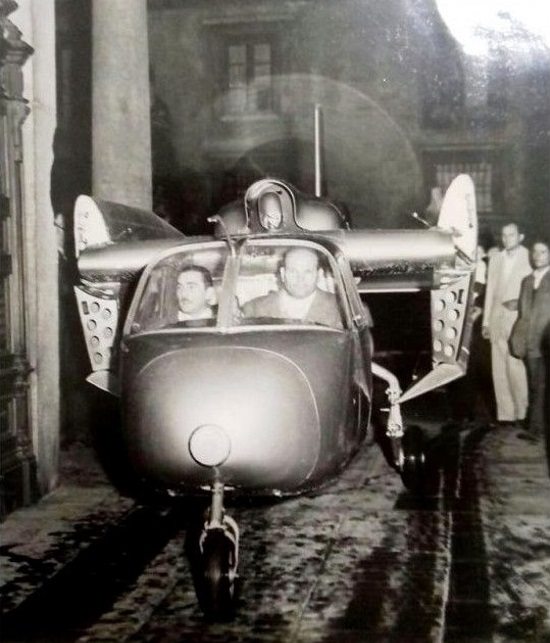
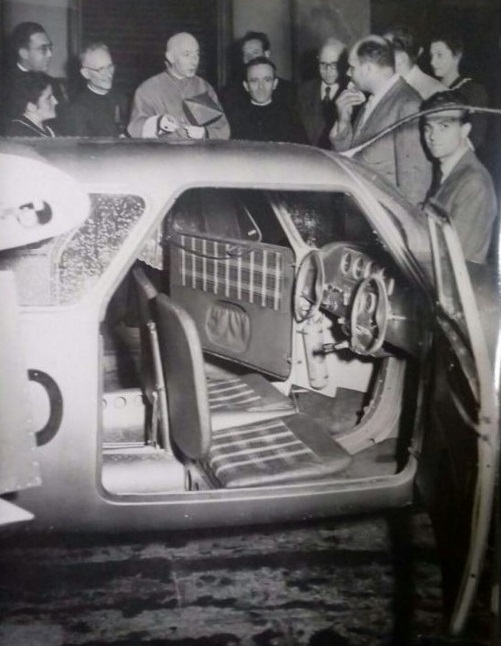
By 1949, Pellarini thought that his new model, the PL-5C, was ready for the public. Piloted by Leonardo Bonzi and Maner Lualdi, the Aerauto drove and flew across Italy from late 1949 to early 1950, 1800 km in the air and 2200 km on the ground, stopping at Turin, Florence, Pisa, Rome, Naples, Bari, Ancona, Rimini, Venice, Treviso, Vicenza and Milan. The Aerauto would fly to a location outside of a city, fold up its wings, and drive into the city proper, exactly as a commercial flying car was supposed to work. At the end, Pellarini grandly presented the Aerauto to the Archbishop of Milan, Cardinal Schuster.
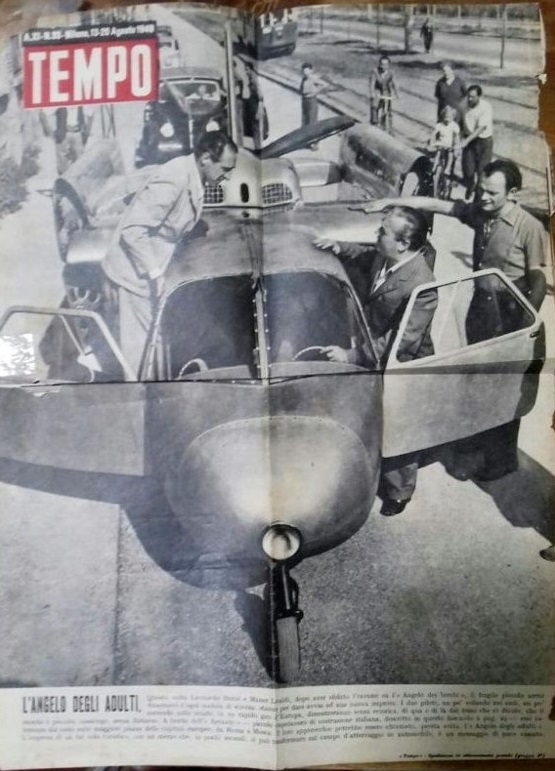
Naturally, this great stunt garnered even more publicity, with Tempo magazine displaying a picture of the Aerauto, Pellarini, Bonzi, and Lualdi on a public street, taking up no more room than the cars behind them.
A British Pathé newsreel documented the Aerauto on the ground and in the air.
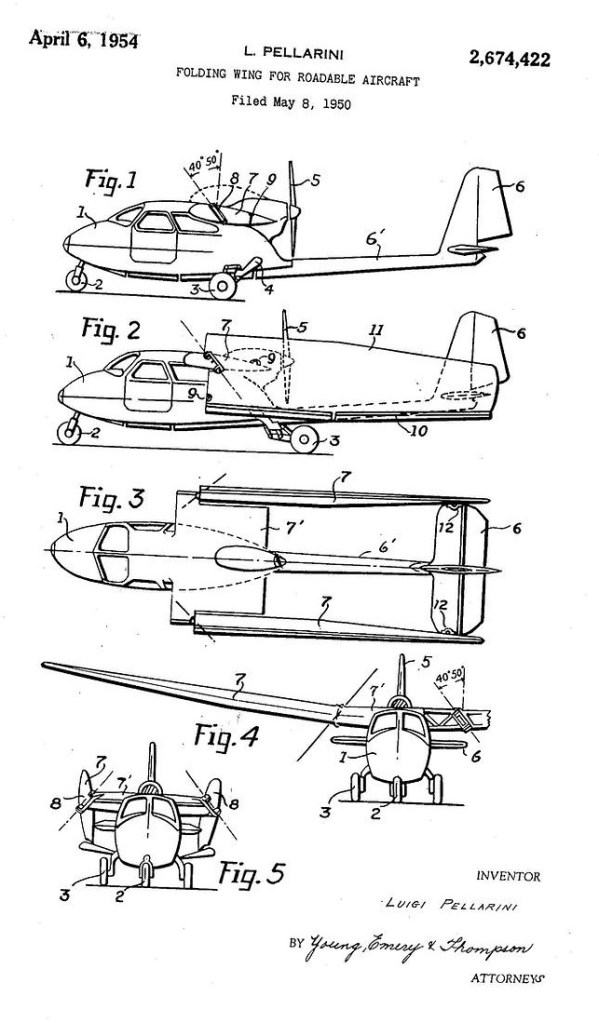
Pellarini immediately filed a U.S. patent application for a “Folding Wing for Roadable Aircraft,” which was granted after much delay in 1954.
Flying cars are hard to sell at the best of times, and with Italy’s economy in 1950 Pellarini got no orders at all. He gave up and emigrated to Australia. The Australian press showered him with articles as soon as he arrived.
PL 2C Wingspan: 9,80m Wing area: 12sq.m Length: 5,70m Height: 1,60m Empty weight: 340kg Payload: 210 kg Total weight: 550kg Wing load: 45.8kg / sq m Maximum speed: 190 kph (at 2000m) Cruise: 160kmh Stall: 70kmh Road speed: 60kmh Ceiling: 4000m Range cruise: 600km Max range: 750km Take-off dist: 120m Landing dist: 60m Fuel consumption: 15 lt/ hr
PL-5C Engine: 85 hp Continental C85 Max speed: 112 mph Cruise: 100 mph ROC: 535 fpm Service ceiling: 13.120 ft Range: 500 mi Empty weight: 1012 lb Loaded weight: 1540 lb Wingspan: 33 ft 5.5 in Length: 20 ft 4 in Height: 5 ft 9 in
Built by Pedal Aeronautics at the Handley-Page plant at Radlett, the Toucan used a Mellinex covered metal tube fuselage of egg-shaped section. Two pilots were seated in tandem under a fully enclosed canopy in the extreme nose.
The mid-set, high aspect ratio wing, was tapered from mid-span. Fitted with a four-unit tails surfaces, with a pusher propellor mounted behind them. A tandem undercarriage was fitted.
It was first flown from Radlett on 23 December 1972.
Mr P.R. Street established Peak Sailplanes Ltd at Chapel-en-le-Frith, Derbyshire, in 1962 to build Peak 100 two-seat sailplane that had previously been designed by the Bedford Sailplane Group. It was built in a converted cotton mill in Chapel-en-le-Frith and had its first flight at Cranfield, Bedfordshire on 5 February 1963.
It was the intention to put the Peak 100 into production and work commenced on the jigs that would be required.
Mr Street joined Slingsby Sailplanes as Managing Director in 1964 and Peak Sailplaned changed its name to Sailplane & Engineering Services Ltd, specialising in glider repair and trailers, from Holmfield Rd, Burbage, Buxton, Derbyshire.
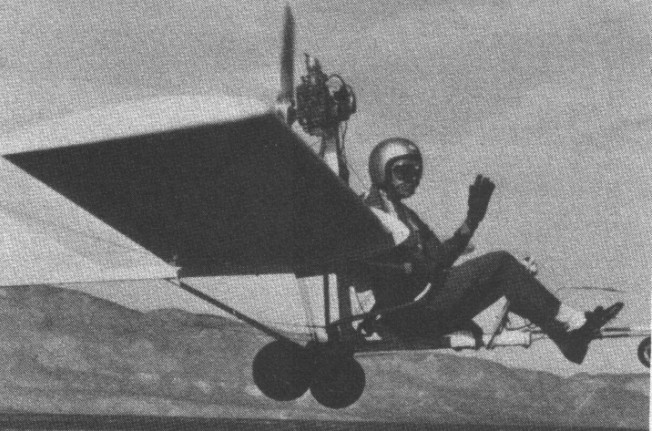
Back in the early 1970’s Wayne Ison designed the P.D.Q. The PDQ-2 is a sort of strap-on monoplane with shoulder-high wings, a tiny tricycle gear and a pylon-mounted JLO snowmobile engine that swings a two-bladed pusher prop. The pilot sits up front biting bugs at a Vmax of 80 mph. On a cold day vertical velocity is 400 fpm. The I-tail is hung at the end of a boom borrowed from the Bensen gyrocopter. The wings are made from Styrofoam bonded over plywood ribs at root and tip of each panel, with seven foam ribs in between. The foam is then covered with Dynel, bonded at the edges and heat¬shrunk, with resin squeegeed into the cloth and sanded light¬ly. Finally, the direct-driven prop develops 45 hp at 5500 rpm or 35 hp at 5000 rpm.
Engine: 1385cc VW, 40hp Wingspan: 22 ft Length: 14 ft 6 in Max wt: 600lbs Empty wt: 340 lb Max speed: 80mph Cruise: 70mph Climb rate: 500 fpm
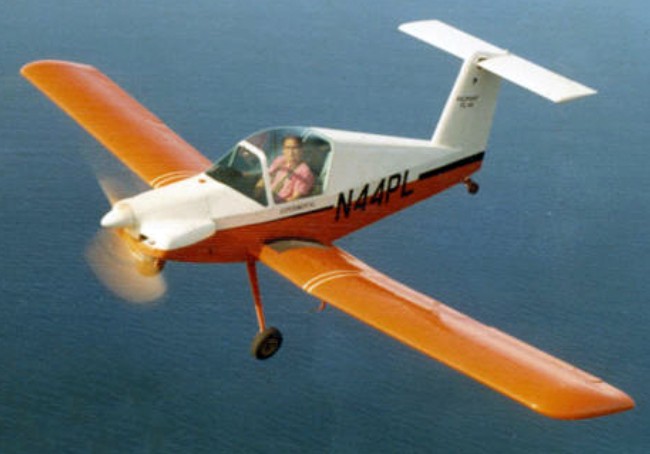
When designer Ladislao Pazmany was encouraged to come up with an easy-to-build, simple, safe, inexpensive, metal plane that could carry a Volkswagen 1600-cc or Continental A-65 engine in the early l970’s, he came up with the PL-4A. The fuselage is made up from formed sheet metal channels and standard extruded aluminium angles for the longerons with sheet metal skins. The wing consists of a centre section and two outer panels which can be folded back along the fuselage. Each panel incorporates a metal spar, a Zed section rear spar, pressed metal ribs and metal skins. Pop rivets are used extensively. Plain ailerons, but no flaps or trim tabs are fitted to the wing. The empennage is of “T” tail configuration with an all moving tailplane at the top of the fin with a large anti-servo tab. The tailwheel undercarriage consists of spring steel main legs with 3.50 x 6” tyres and brakes and a steerable tailwheel. A 9.5 Imperial gallon moulded fibreglass fuel tank is fitted behind the firewall. Engines from 50 to 75 hp may be installed.
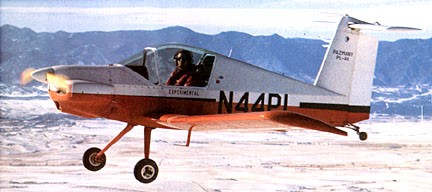
Pazmany PL-4A N44PL
The prototype was flown on July 9, 1972 and plans were made available. The plane is roadable (folding wings), and Pazmany did supply the fiberglass pieces, plexiglass windscreen and canopy, landing gear, welded engine mount, and control stick.
The PL-4A has been built by air cadets in Argentina and Canada.
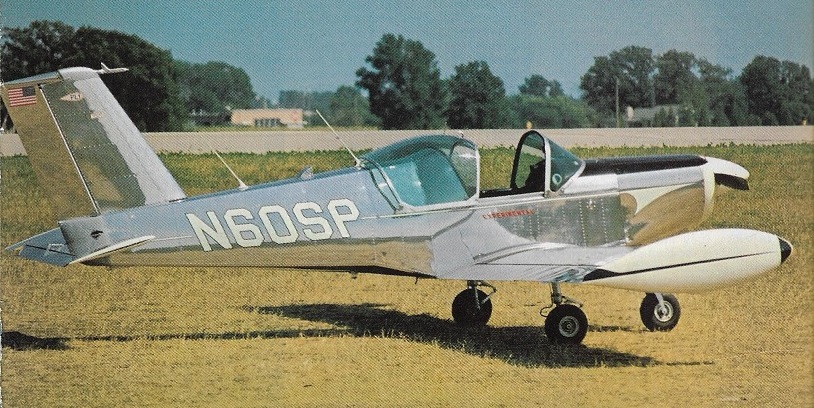
Developed from the PL.1 “Laminar”, the PL.2 is a side by side two seater, all metal tricycle undercarriage, dual control aircraft. The parallel chord wing panels incorporate flanged aluminium ribs, a main spar with machined extruded booms, a metal false rear spar and aluminium skins. The fuselage is built up of conventional pressed metal frames longerons and skins. The curved sides of the cockpit are designed to break outwards in a crash. The all flying tail is equipped with an anti-servo tab for trimming and providing adequate stick forces. The main undercarriage is attached to the wing spar and the steerable nosewheel to the engine mount. Shock absorbers are of the oleo pneumatic type. Brakes are fitted to the main wheels. All fuel is carried in two 10 Imp. gallon wing tip tanks. Cabin width is 3’ 4”. Engines from 100 to 150 hp may be fitted. And, it is stressed for aerobatics. The design followed his earlier PL 1 but with improvements in construction techniques in¬tended to make the aircraft easier for amateur engineers to build. Noticeable changes in¬cluded an increase in dihedral for the PL 2 from 2.5 to 5 degrees and a change in the fuselage to provide for 5cm of increased cabin width.
The first one flew on April 4, 1969.
Along with the PL-1, the PL-2 is for amateur builders. The external shape and flight characteristics are almost identical to the PL-1, but the construction has been simplified. The PL-2 offers a wider cockpit, better canopy and fuselage lines, simplified dihedral and the possibility of using engines from 90 to 150-hp, Despite its aerodynamically clean lines, there are no compound curves anywhere in the skin. This is partly the result of the use of a fiberglass cowl to streamline the nose. Pilots who have flown the PL-2 say it is an airplane flown with the fingers and not the fist. And, like the PL-1, it is stressed for aerobatics.
The Vietnam, Royal Thai and Korea Air Forces have each built a prototype. So, also, has the Miyauchi Manufacturing Company in Tokyo, which hoped to market this ‘homebuilt’ as a production aircraft.
The PL 2 has been evaluated by the air forces of Indonesia, Korea, Thailand and Vietnam as a trainer. Fifty PL 2, known as the LT 200, were built in 1976 by Indonesia’s Lipnur Aircraft Industry. The Indonesian air force’s production facility, Lembaga Industri Penerbangan Nurtanio, flew the prototype (IN-200) of the LT-200 two-seat lightweight trainer on 9 November 1974; this was based on the PL-2.
PL-2A Engine LYC-235 Power Range 108-100-150 hp Height 7.7 ft Length 19.3 ft Wing Span 27.8 ft Wing Area 116 sq. ft Empty Weight 875 lb Gross Weight 1,416 lb Fuel Capacity 25 USG Top Speed 138 mph Cruise 119 mph Stall 52 mph Range 492 mi Rate of Climb 1200 fpm Take-Off Distance 700 ft Landing Distance 600 ft Service Ceiling 18,000 ft Number of Seats 2 Landing Gear Trigear Information Package PDF 2009 $9 Information Package printed 2009 $12 Plans 2009 $425
PL-2B Engine: Lycoming O 320 E2A, 150hp Propellor: Ian Henry 69×66 Span: 9.0m Length: 6.0m Height: 2.2m Empty weight: 423kg MAUW: 625 kg Baggage: 18kg Fuel capacity: 2 x 50 lt Endurance: 3 hr Fuel consumption: 32 lt/hr VNE: 162 kts Cruise 2450 rpm: 115 kts Max struc cruise: 130 kts Vfe: 88 kts V approach: 65 kts Vs: 45 kts ROC: 350 ft/min at 2450 rpm Manoeuvre envelope: +6, 3g