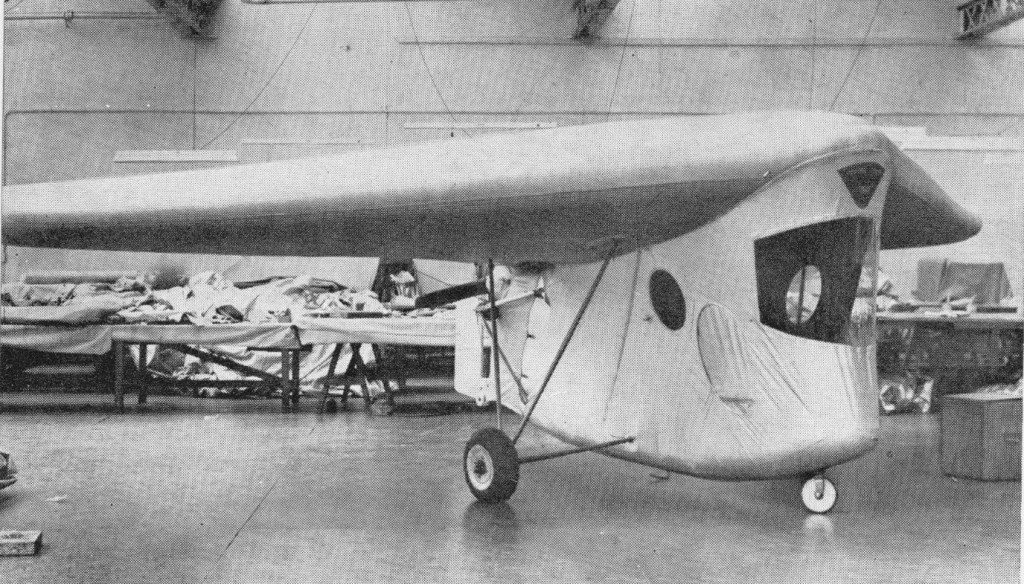
Designed and built by D. Perkins and A. Lock in 1958, the New Horizon was a tail-less, parasol wing monoplane, with a pusher propellor and tricycle undercarriage. It featured an inflatable wing.
Man-powered, it was unsuccessful in flight trials inside the Cardington airship hanger.
Development of the inflatable wing concept did lead to the ‘Reluctant Phoenix’.
After gaining experience with his ‘New Horizon’, D. Perkins went on to design a tail-less delta inflatable man powered aircraft which he called ‘Reluctant Phoenix’.
It first flew inside the Cardington balloon hanger on 18 July 1966 and went on to make 97 similar flights, all of which were only in ground effect.
The Perkins Inflatable was built and flown in Britain pre-1960. The entire airframe, apart from the engine and undercarriage, was deflate able and could be packed into a 14 inch diameter bundle, 4 ft 3 in long.
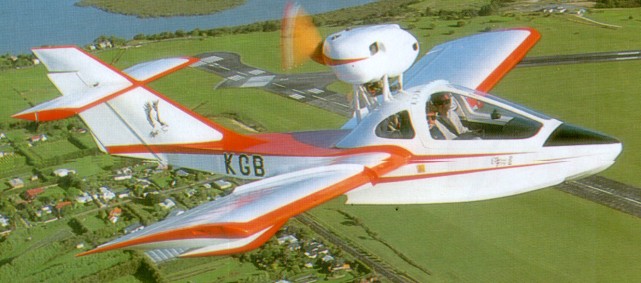
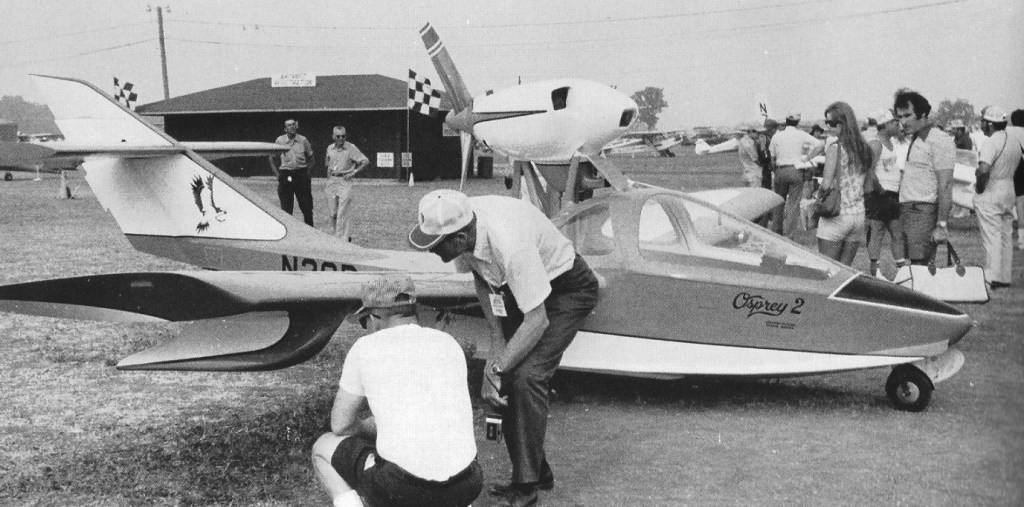
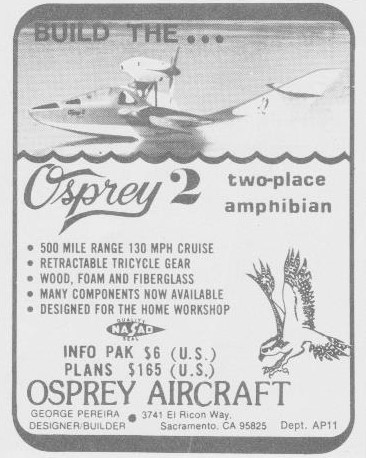
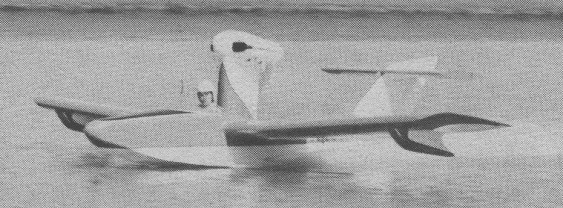
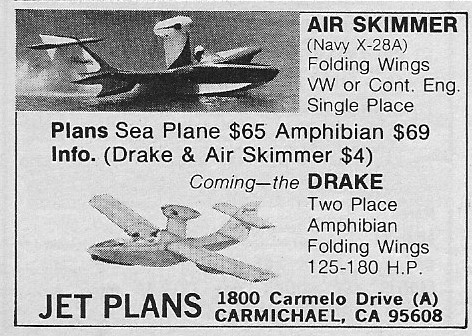
Design and construction of the two place Osprey 2 amphibian began early in 1972 following development of a military version, the U.S. Navy X-28A Air Skimmer, for civil police use in Southeast Asia. The designer, George Pereira, evolved a unique construction technique for the single-place Osprey I by coating the underside of the all-wood fuselage structure with polyurethane foam, later sculptured to the desired shape and covered with several protective layers of fiberglass bonded with resin. The result is a light, strong structure able to resist the shock of hard water landings.
The pusher engine is a Lycoming O-320 flat-four of 160 hp mounted on a pedestal so the prop wash blows directly over the cruciform tail surfaces. Wings are of all-wood construction with a single box spar, while the landing gear for use on land is of the retractable tricycle type. The wings just outboard of the main gear are removable for towing and home storage.
The Osprey 2 was designed to be built, in its entirety, in a workshop with no molds required, and first flew in 1973.
Detailed construction plans are available. They consist of 46 sheets, drawn with amateur builder in mind, plus step-by-step, photo illustrated, construction manual. Price 1982: $3,690 (Excludes engine, propeller, Instruments and paint). Units delivered to June 1981: 500.
The Osprey 1 is a single-seat flying boat designed and built by George Pereira in 1970. First flown on 12 August 1970 it is built from fir and pine, with the vertical fin an integral part of the structure. The hull is skinned with mahogany plywood and glassed. The steel-tube pylon mount for the engine is bolted to the wing center section. A simple wing-folding mechanism holds the wings in position with the same steel pin which locks them in the ex¬tended position. Power is provided by a 90-hp Continental.
N3337 was re-named X-28 158786 when the US Navy commissioned the Naval Air Development Center to do a study for reconnaissance flights in the Mekong Delta during the Viet Nam war. The aircraft was evaluated with three other entries and selected for production in South East Asia. George was asked to help set up production; however, the war ended before production plans were finalized. The X-28A is on display in the Kalamazoo Aviation History Museum.
The Osprey 1 was designed with folding or removable outboard wings and launched from a boat type trailer. It is very light weight (600 lb), and 90 hp gives remarkable water and climb performance.
Feb 74
Complete plans (including the trailer) were available for $150 U.S. plus $20 U.S. for overseas.
Engine: Continental C-90-12, 90 hp Length: 17’ 9” Wingspan: 24’ 9” Height: 5’ 3” Wing area: 103 sq.ft Empty: 600 lb MTOW: 900 lb Fuel capacity 16 USG Maximum speed: 135 mph Top level speed: 120 mph Cruise 105 mph Stall 55 mph Range: 370 miles Service ceiling: 17,994 ft Rate of climb: ft/min 2,200 Takeoff run: 200 ft Wing loading: lb/sq.m 9 sq. ft. Crew: 1
In 1951, a Helicopter Division was formed by Hunting Percival and design work commenced on a medium-sized helicopter designated P.74.
The P.74 was intended as a demonstrator for a new type of helicopter. It worked on the tip-jet principle, but the P.74 had a gas generator under the cabin floor which fed compressed air through triple ducts to the three-bladed rotor, each blade of which had triple ejector ducts. The hot and noisy gas pipes running up the cabin walls between rows of seats. The rotor blades were not adjusted by actuators at the hubs as on most helicopters but by ailerons on the trailing edges. Pitch was controlled with a screw jack.
This machine had a teardrop-shaped fuselage with the two-seat cockpit in the nose and a large cabin running the full length of the fuselage. The P.74’s undercarriage consisted of four wheels, the forward two of which were castoring. There was no entrance door or escape hatch near the cockpit. The only way in or out was the door at the rear of the port side of the fuselage.
The prototype was completed in the spring of 1956, carrying the military serial number XK889. Months of testing in a static rig showed up many problems with the power system, which refused to develop full power and maximum gas flow. Finally these problems were fixed and a first flight attempted. Despite the efforts of two pilots on the very stiff controls, the P.74 resolutely refused to fly. One engineer associated with the project says that a consultant designer used the wrong formula for calculating lift. All the figures added up but the P.74 went nowhere. It was ordered to be towed across the airfield out of sight, and that is about the last anyone heard of it.
Plans to fit a more powerful Rolls-Royce RB.108 turbine engine (which should have got the P.74 into the air) were abandoned when the helicopter industry was rationalized. A proposed 10-passenger model called P.105 using the Oryx system was never built.
Hunting Percival P.74 Engines: 2 x Napier Oryx Rotor diameter: 16.77 m Max take-off weight: 3518 kh Cruising speed: 178 kph Ceiling: 8530 m Range: 530 km
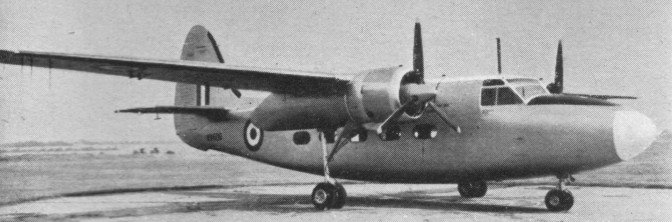
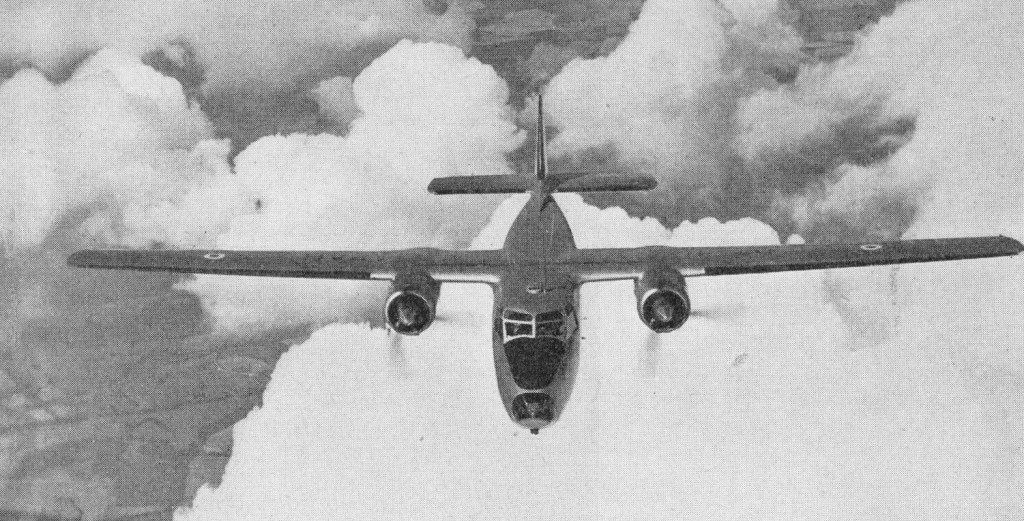
The Percival Pembroke was a British high-wing twin-engined light transport aircraft built by the Percival Aircraft Company, later Hunting Percival.
The Pembroke was a development of the Percival Prince civil transport. The Pembroke is basically an eight seat Service transport developed from the Prince 3 and Sea Prince, with increased span and rearward facing passenger seats. The prototype flew on 21 November 1952.
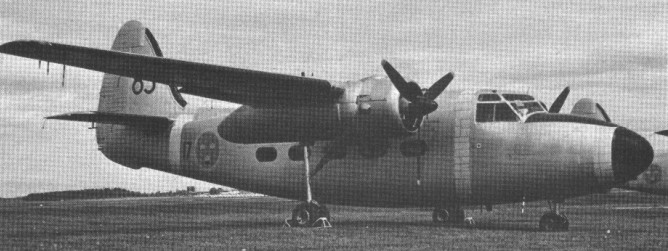
Production for the RAF and the Air Forces of Belgium, Southern Rhodesia and Sweden was complete in early 1958. Sixteen Pembroke C.52s were obtained by the Swedish Air Force in 1955 and designated Tp-83s.
The Pembroke C.1 were used as eight seat communications aircraft and a version with a clear-view nose and camera stations in the main cabin fr air survey and photography was in service in the Belgian Air Force in 1956.
Belgian Air Force Pembroke
Pembroke C.52
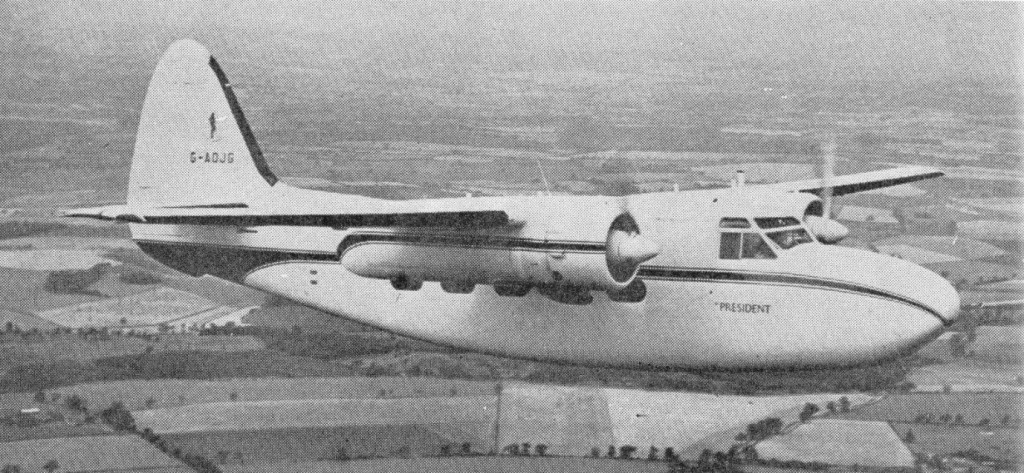
A civil version known as the Prince Series 5 was under development. Appearing as the President, the first airline order for Presidents was placed in 1957 by a Spanish local operator.
Percival Pembroke C Mk.1 Engine : 2 x Alvis Leonides 127, 533 hp Length : 46 ft 0 in / 14.02 m Height : 16.076 ft / 4.9 m Wingspan : 64 ft 6 in / 19.66 m Max take off weight : 13503.4 lb / 6124.0 kg Max. speed : 162 kt / 300 km/h Service ceiling : 21982 ft / 6700 m Range : 999 nm / 1850 km Crew : 2 + 8
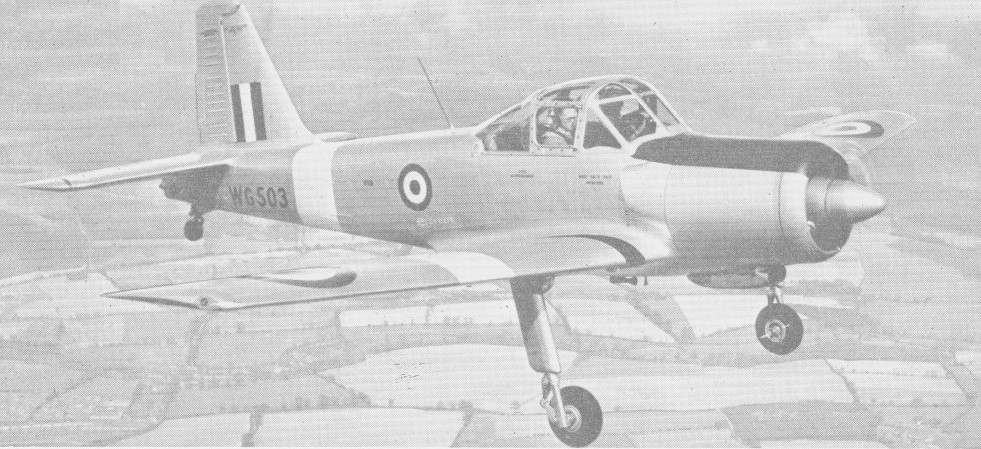
Designed by Percival Aircraft before it became part of the Hunting Group in 1954, the Provost was selected as the standard RAF trainer in the early 1950s having been designed to fulfil the requirements of specification T.16/48. A cantilever low wing monoplane with fixed tailwheel landing gear and powered by an Alvis Leonides 126 engine, it provided side by side seating for instructor and pupil.
The Percival P.56 Provost was the last piston-engined basic trainer used by the RAF. The prototype WE522 first flew on 23 February 1950 and was powered with a Cheetah 17 radial engine, as was the second prototype.
The third prototype was powered with the tightly cowled Alvis Leonides nine-cylinder radial. Both the earlier aircraft were re-engined and all the production T Mk 1 aircraft used the Alvis engine. This 11.9-litre supercharged engine is a smaller than usual 550-hp radial; the higher power is achieved by running at high revolutions (3,000 rpm) and +8 lb/sq inch of boost. Cruise power of 330 hp is at 2,600 rpm at 11,000 ft (RAF settings). A three-blade constant speed propeller is driven through a reduction gear, and it has side-by-side seating under a sliding canopy.
In 1953, the RAF introduced two new trainers into service, the piston engined Percival Provost T.1, which replaced the Prentice, and the jet powered DH Vampire T.11 which replaced the Harvard and the Meteor T.7 with the Advanced Flying Schools. As the RAF Prentice replacement, the Percival P.56, which became the Provost, powered by a 240 hp Cheetah 18 engine, its top speed was 178 mph at 2,500 ft. Entering service under the designation Provost T Mk 1, the aircraft were first delivered to the Basic Training Squadron of the Central Flying School of the RAF at South Cerney.
In armament training form it is fitted with two 7.9 mm. machine guns with 1,200 rounds of ammunition and a camera gun, and carrying three 60 lb rocket projectiles beneath each wing. Despite this load the Provost was rolled with abandon and climbed inverted under the continuous running of its Alvis Leonides engine. Alternative armament of the Provost is two 250 lb. bombs or eight 25 lb. bombs on light series racks or eight 25 lb. bombs plus four 60 lb. R.P.s.
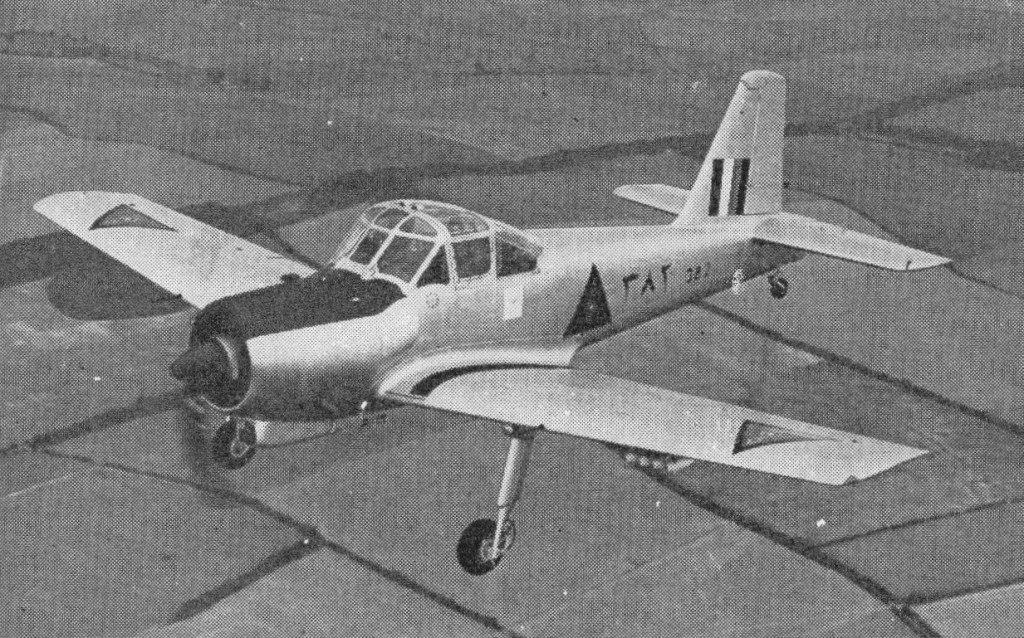
T.Mks.51, 52 and 53 are export versions serving with six air arms. Mks.52 and 53 carry light armament. As the T.53, the type was also supplied to Burma, Iraq and the Sudan, while the T.51 and T.52 were used by Eire and Rhodesia/Zimbabwe.
Iraqi armed Provost
When production ended in 1959, a total of 461 had been built, including a number armed with machine guns and bombs. They also served in the air arms of Sudan, Malaysia and Muscat.
The last active RAF Provost was retired in 1969, some going to training establishments as instructional airframes, with only a few of these eventually reaching civilian operators.
T Mk 1 Engine: Alvis Leonides 126, 550 hp / 410kW Span, 35 ft 2 in (10.9 m) Length, 28 ft 8 in (8.8 m) Height: 3.70 m / 12 ft 2 in Wing area, 214 sq.ft (19.8 sq.m). Empty weight, 3,350 lb (1521 kg) Max take off weight, 4,400 lb (1996 kg) Max speed, 174 kt / 200 mph / 322 kph at 2,300 ft (700 m) Cruise, 177 mph (283 kph) at 11,500 ft (3510 m) Initial climb, 2,200 fpm (11.18 m/sec) Service ceiling: 7620 m / 25000 ft Range, 650 mls (1046 km) Crew: 2
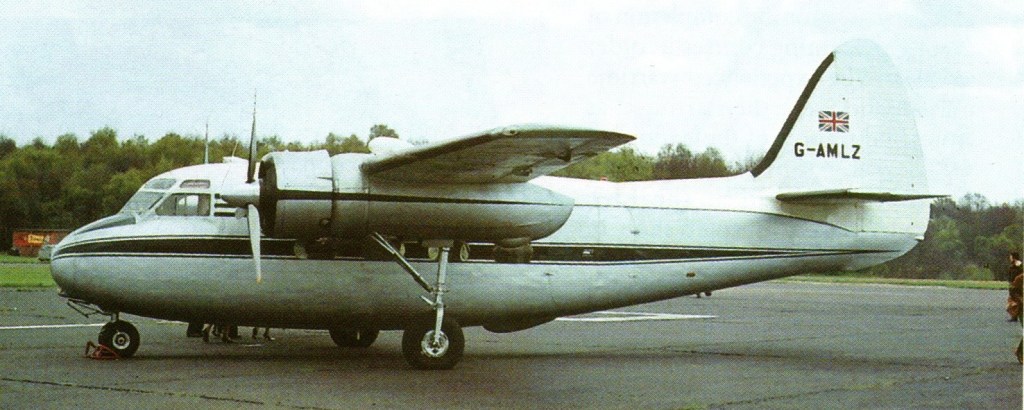
The 1948 Percival Prince was a British light transport of the early post-war period. It was a twin-engine, high-wing, cantilever monoplane of all-metal stressed-skin construction; the undercarriage was of retractable, tricycle type. The design of the Prince followed on from the solitary Merganser.
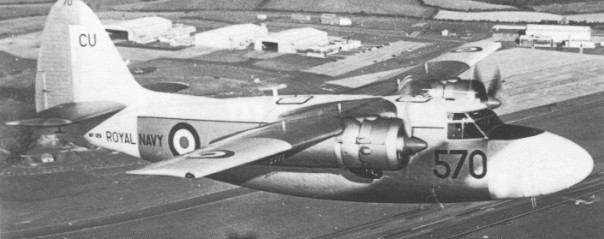
Further development of the type led to the Survey Prince survey aircraft and the Sea Prince. The official designation of the Naval communications version of the Percival Prince was given as Sea Prince C.2.
August 1950
An improved version of the Prince 3 with an increased wingspan and engine and undercarriage modifications was developed for the Royal Air Force as the Percival Pembroke. The Percival Prince 5 the transport variant of the Pembroke.
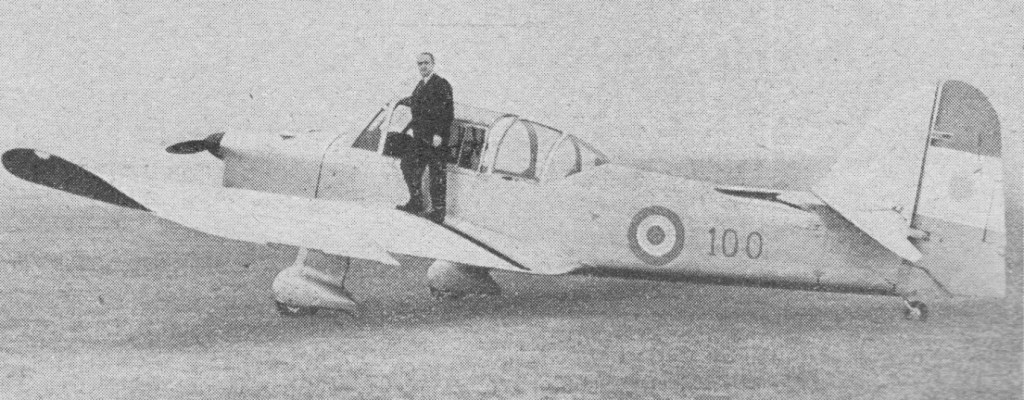
In 1949 Percival celebrated the 100th Prentice for the Argentine Air Force built and tested at Luton. In addition to being the RAF’s standard trainer, they were used by the Indian Air Force and the Lebanese Air Force.
100th Prentice for the Argentine Air Force
The Prentice 3, intended for the Indian Air Force, has a 344 hp Gipsy Queen 70-2 engine. The empty weight is 3427 lb, but the all-up weight remains at 4000 lb aerobatic and 4200 lb normal. The maximum speed is 171 mph at 5000 ft.
During 1958, Aviation Traders obtained a CoA for their four seat touring version of the Prentice.
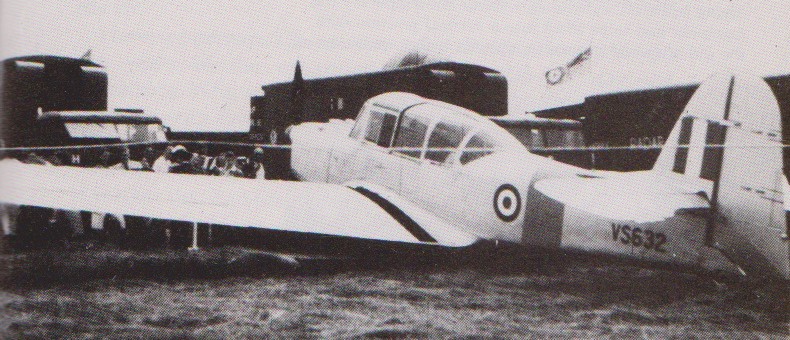
The Prentice T.Mk.I certification is by UK Manufacturer’s Type Record.
Percival Prentice T Mk I VS632
Engine : DH Gipsy Queen 51, 292 hp Length : 31.234 ft / 9.52 m Height : 12.795 ft / 3.9 m Wingspan : 45.997 ft / 14.02 m Max take off weight : 3790.4 lb / 1719.0 kg Max. speed : 134 kt / 249 km/h Service ceiling : 17995 ft / 5485 m Range : 432 nm / 800 km Crew : 2