Piasecki PV-3 / HRP / PV-17

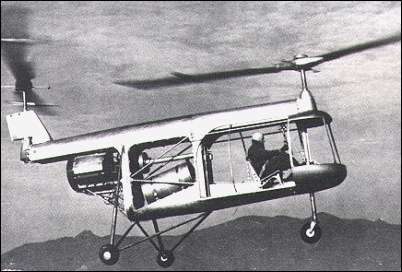
On 1 February 1944 Piasecki received a contract to develop a tandem-rotor utility transport and rescue aircraft for the U.S. Navy.

Given the factory designation PV-3, this machine was a development aircraft for the US Navy’s HRP Rescuer transport and rescue helicopter. Powered by a Wright R-975 piston engine, the tandem-rotor PV-3 first flew at Morton, Pennsylvania on 7 March 1945. The first of its kind, initially flew as a bare metal frame and was covered later. It was followed by two XHRP-1airframes, 37968 and 37969, one of which was used for static tests while the other undertook the U.S. Navy flight development programme, during the course of which the company changed its name to Piasecki Helicopter Corporation.
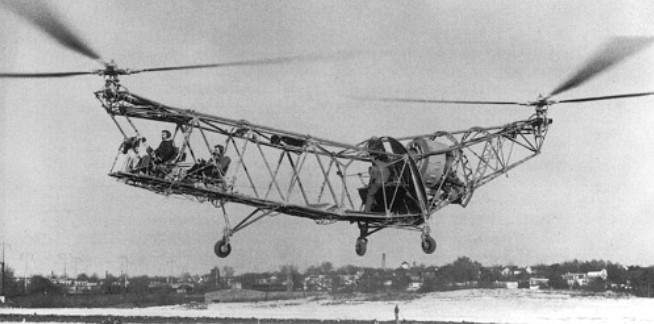
The XHRP-1 SDTA hovers the morning after its first flight

In June 1946 Piasecki received an initial order for 10 production HRP-1 helicopters. The test programme was completed in the spring of 1947, by which time work had already begun on an initial batch of ten HRP-1 Rescuers, 111809 to 111828. The first of these flew on 15 August 1947, powered by a 447kW / 600hp Pratt & Whitney R-1340-AN-1 engine

A second batch of ten was built later, 111834 to 111848, the final machine being delivered in 1949, with a metal-skinned rear fuselage and fabric covering over the main cabin section, although they were often flown with the fabric removed.

Service evaluation was undertaken by US Navy Squadron VX-3 and US Marine Corps Squadron HMX-1. Twelve of the HRP-1’s were eventually assigned to the U.S. Marine Corps for assault training, while three others, as HRP-1G’s, were used as rescue craft by the U.S. Coast Guard. After withdrawal of the Rescuer from military service in the early 1950s, about six appeared on the U.S. civil register.
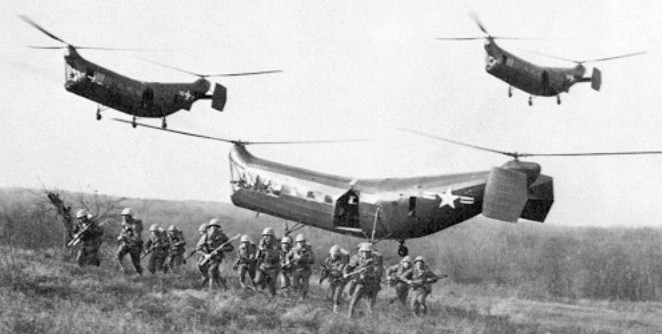
HRP-1, Quantico, Va., in November 1948.

The HRP-1 (redesignated as PV-3) carried a crew of 2 sitting in tandem, and its 11.33cu.m cabin could accommodate 8 passengers, 907kg of cargo or 6 stretchers. The single engine was mounted in the rear part of the fuselage, with a clutch and gearbox amidships from which drive shafts ran to reduction gearboxes below each of the rotor hubs.

In June 1948 the U.S. Navy ordered five examples, 111829 to 111833, of the much-developed PV-17 with the designation HRP-2. The much-improved HRP-2 (PD-17) featured a streamlined metal fuselage offering better visibility for two pilots, who now sat side by side ahead of the front rotor. The most significant improvement was the HRP-2’s all-metal stressed-skin construction, and modified rotor heads. The length was 54’9″.

It used the same engine and rotors as the HRP-1, but was slightly shorter and lighter. The Piasecki team used a thinner skin and had the longitudinal members shaved down, as well as other extruded parts that could not be manufactured thinly enough. Produced by Boeing-Vertol in 1948.

Jim Ryan lifted the new Navy helicopter into the air for the first time October 29, 1949. While it was indeed better than the HRP-1, the fast pace of helicopter technology had already passed it by, and better helicopters could now be built. With a gross weight of 3260kg, the HRP-2 was simply too light to offer much utility and only five were built.

The HRP-2 formed the basis of the later PD-22 model which became the military Vertol H-21 series.
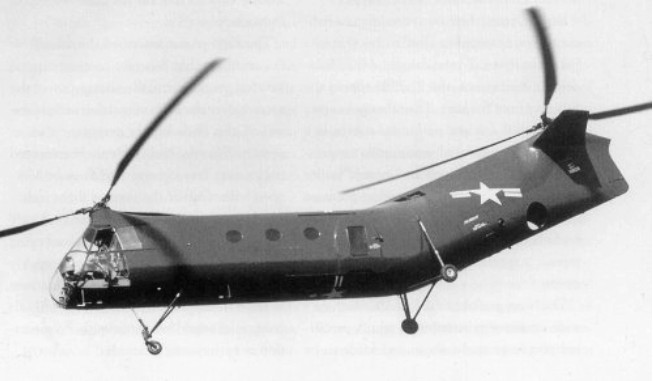
HRP-2

Robert Cummings, 23.02.2009
As a U.S.Navy pilot I was stationed in VX-1 at Key West. We had 12 of the HRP-1s and developed the dunking sonar for helicopters. Lt. Lockwood and I were later assigned to a project at Mine Counter-Measures station at Panama City, Florida where we developed towing mine sweeping gear with an HRP-1. George Spratt from Piasecki was the head engineer on that project. The time period for these projects was 1951 to 1953.

Gallery

HRP / PV-3
Engine: 600hp P&W R-1340
Rotors: 41’0″
Length: 48’0″;
Capacity: 12 passenger

HRP-1 / PV-14
Engine: 1 x Pratt & Whitney R-1340-AN-1, 600 hp / 445kW
Rotors: 2 x 3-blade main rotors in tandem
Rotor diameter: 12.50m / 41 ft
Fuselage length: 14.63m / 47 ft 2 in
Height: 3.81m
Take-off weight: 3629kg / 6,900 lb
Max speed: 193km/h
Service ceiling: 3658m / 12,000 ft
Normal range: 483km
Typical range: 264 miles at 85 mph with 100 USgals fuel
Seats: 10

HRP-2 / PV-17
Engine: 1 x Pratt & Whitney R-1340, 600 hp
Seats: 10
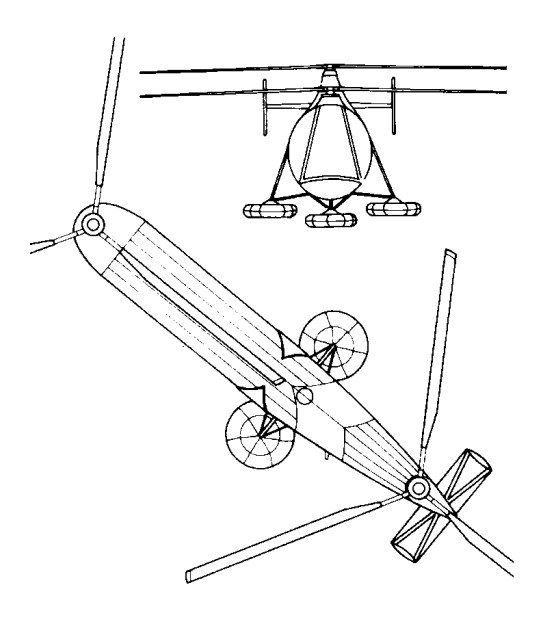
Piasecki HRP-1

Piasecki / P-V Engineering

Piasecki Aircraft Corporation
Piasecki Helicopter Corporation

Towards the end of 1943, Frank Nicholas Piasecki also appeared on the scene. Piasecki had worked for the Kellett Autogyro Company and Budd Aircraft. He had previously been involved in development of the Platt-LePage XR-1 and had undertaken a small-scale project of his own. Frank N. Piasecki, President of the PV-Engineering Forum, an organization he formed with F.M.Vinsie and Elliott Daland for the purpose of building his helicopter. Records show he is the first American to be granted a license to fly a helicopter before first qualifying to fly a conventional airplane. He did, however, previous to flying his own helicopter design, get in some flying time in a light plane. This helped him, too, in building the PV.

P-V Engineering Forum had completed several rotary-wing contracts for NACA and the U.S. Navy. The latter ordered an XHRP-1 helicopter which flew in 1945; following successful tests it was placed in production. Further orders followed for XHJP-1 tandemrotor helicopters for USN shipboard operations and the large XH-16, which had a fuselage of DC-4 size.

P-V Engineering became Piasecki Helicopter Corp in 1946, formed by Frank Piasecki, who was concerned in development of vertical-lift aircraft and flew the Model 59K Sky-Car flying jeep with an Artouste turboshaft engine in 1958 under a US Army contract.

Technical interchange agreements signed with Breguet Aviation in 1957 included sales rights for that company’s STOL transports in the U.S.A. and Canada, but these were dropped in 1962. Also provided engineering assistance to Agusta from 1960 for the AZ-101G and AZ-105 helicopters.

Built prototype of PiAC 16H-1C Pathfinder compound helicopter in 1962, continuing development under a U.S. Navy contract, but no production. Work included developing vectorod-thrust ducted propeller system for attack helicopters under U.S Army contract, definition of a possible U.S. Marine Corps medium-lift replacement type, and marketing the PZL Swidnik W-3A in the Americas and Pacific Rim regions.

After F N Piasecki was forced out of his company in 1955, he founded Piasecki Aircraft Corp, and his original company became Vertol Aircraft Corp, which in turn became a division of Boeing Co in 1960.

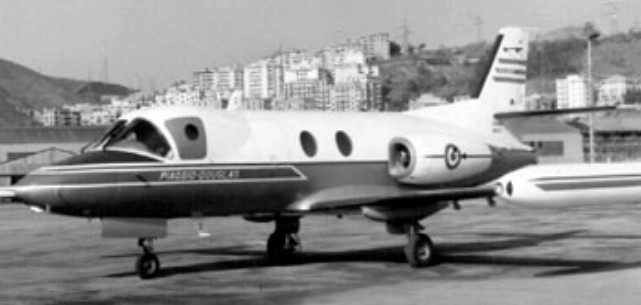
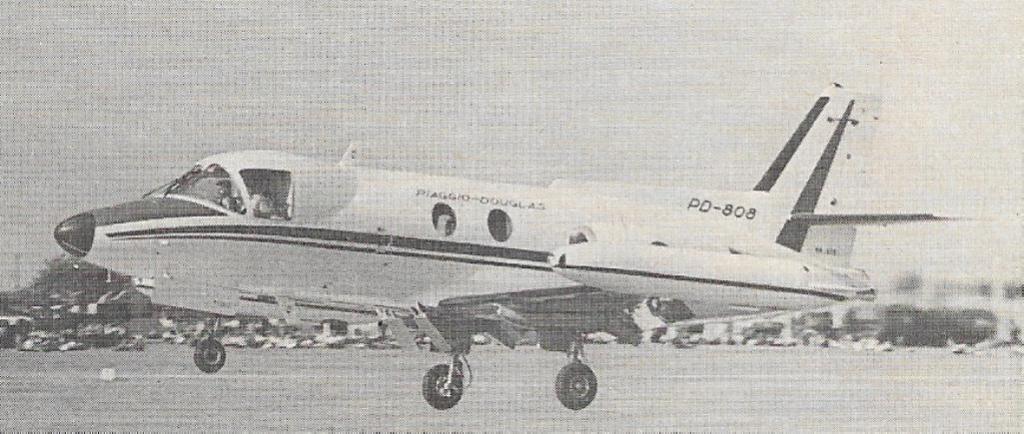
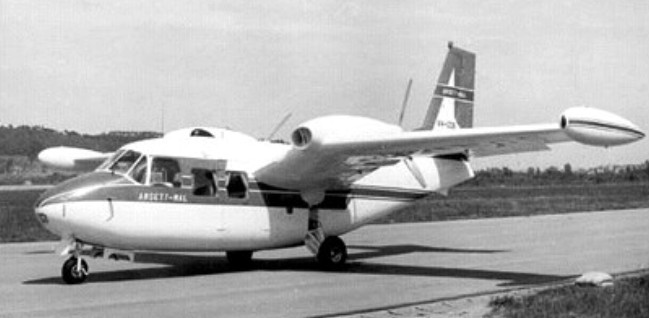
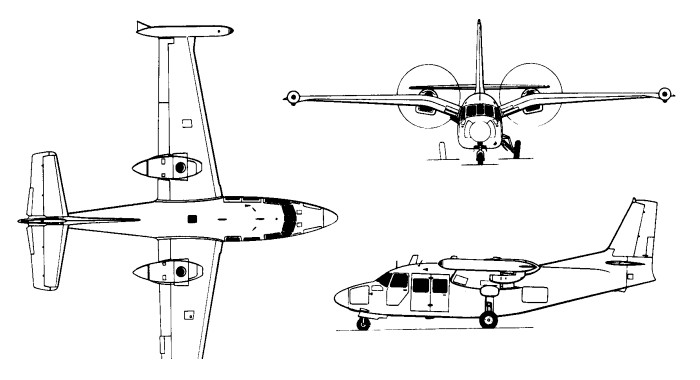
Piaggio PD-808

Under an agreement signed in 1961, Piaggio and Douglas Aircraft developed the PD-808 for military and commercial use. Originally designed by the Douglas Aircraft Company of Long Beach, California, as a business jet. No orders were received, and the complete project was bought by Piaggio, which flew the first prototype in 29 August 1965.

Piaggio PD-808 Article

The PD-808 was powered by Bristol Siddeley Viper turbojets mounted on the sides of the rear fuselage. Piaggio also failed to secure any worthwhile commercial interest, but a few examples were taken by the Italian air force.

After appearing at the Paris Air Show it was modified.

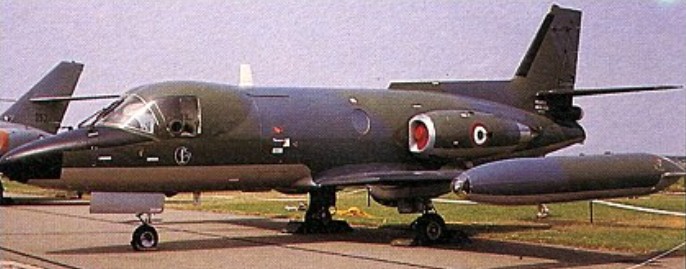
Only 27 examples of this type, with low-set wings and aft-mounted turbojet engines, were produced, and 25 of these went to the Italian air force. The first aircraft were configured for the utility role (navaid calibration, navigation training for three pupils, and light transport of up to eight passengers or an equivalent freight load), but the last six aircraft were completed as electronic warfare platforms with cabin accommodation for specialist Elint (electronic intelligence) equipment and its three operators.

Power increased in 1966 to 3,300 lbs. s.t. The PD-808 differed from the original model by having larger tip tanks, a longer dorsal fin, and a forward-sliding nose fairing. By 1972, the aircraft was available in several versions: a five-seat executive version, a seven-seat executive transport, a six-seat version for the Italian Air Force, and one powered by 3,500-lb. s.t. AiResearch turbofans. Other PD-808s are powered by twin 3,360-lb. s.t. turbojets drawing from two integrated tanks of 511 gallons total capacity and wingtip tanks with 473 gallons total capacity.

Four versions were produced for the Italian Air Force as the PD-808 VIP six-seater for government and military VIP transport duties; PD-808 TA nine-seat transport and navigation trainer; PD-808 ECM electronic-countermeasures version; and the PD-808 RM radio-calibration version that is equipped for medium- and high-altitude calibration of navigation aids.

Engines: two Rolls-Royce Bristol Viper Mk 526 turbojets, 3,368-lb. s.t / 1524kg
Wingspan: 13.2 m / 43 ft 4 in
Length: 12.85 m / 42 ft 2 in
Height: 4.8 m / 16 ft 9 in
Wing area: 20.9 sq.m / 224.97 sq ft
Max take-off weight: 8165 kg / 18001 lb
Empty weight: 4830 kg / 10648 lb
Max. speed: 850 km/h / 528 mph
Cruise 497 mph
Stall 104 mph
Service ceiling: 13700 m / 44950 ft
Range w/max.fuel: 2100 km / 1305 miles
Initial climb rate: 5,400 fpm
Takeoff distance (35′): 3,180 ft
Landing distance (50′): 2,990 ft
Seats: 5-9

PD-808ECM
Five-seat electronic warfare plane
Engines: two 3,360-lb (1,524-kg) thrust Piaggio built Rolls-Royce (Bristol Siddeley) Viper Mk 526 turbojets
Maximum speed 529 mph (851 kph) at 19,685 ft (6,000 m)
Initial climb rate 5,415 ft (1,650 m) per minute
Service ceiling 44,950 ft (13,700 m)
Range 1,322 miles (2,128 km)
Empty weight 10,648 lb (4,830 kg)
Maximum take-off weight 18,001 lb (8,165 kg)
Wing span 43 ft 3.75 in (13.20 m)
Length 42 ft 2in (12.85 m)
Height l5ft 9in (4.80m)
Wing area 224.97 sq ft (20.90 sq.m)
Armament: none

Piaggio PD-4

The P.D.4 was a four-seat helicopter with two rotors placed in tandem. Initially it had to be equipped with 450hp Alpha Romeo engine but then a 215hp Franklin was adopted.

The helicopter flew in the first half of 1952, demonstrating good handling characteristics although being seriously underpowered. In a wrong maneuver during a landing with lateral wind it was seriously damaged and wasn’t repaired.

PD.4
Engine: 1 x Franklin, 215hp
Rotor diameter: 9.0m
Loaded weight: 1400kg

Piaggio P.166 / Kearney and Treck­er Royal Gull

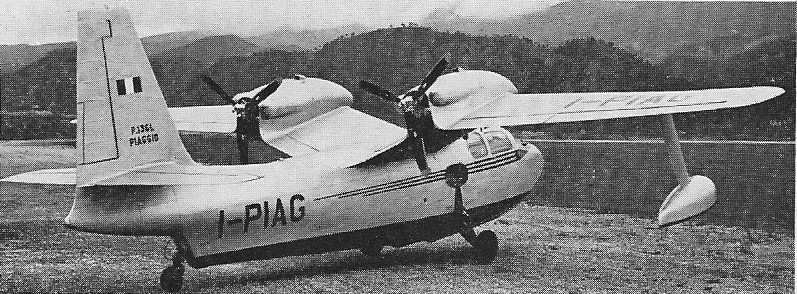
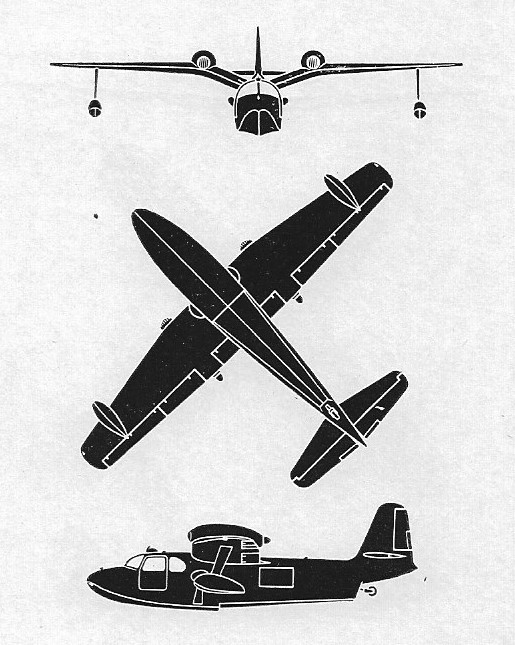
Piaggio P.166

The P.166 first flew on 28 November 1957. Introduced in 1959 for executive use, the P.166 had a rear baggage compart with a capacity of 300 lb.

Piaggio P.166 Article

Thirty-two examples of the P.166 twin-engined light transport were produced together with 51 P.166M general-purpose military counterparts (for the Italian Air Force); five P.166B Portofinos; two P.166Cs; 20 P.166S radar-equipped search, surveillance and coastal-patrol aircraft (for the South African Air Force as the Albatross).

P166B ZK-DAI

Production of the Piaggio P.166 in its several piston-engined variants ended in 1973.

Piaggio P.166 Air Test

The last version was the ten-seat P.166-DL3. A first flight was recorded by the Piaggio P.166 DL3 prototype (I-PJAG) on 3 July 1976. It differed from earlier versions by introducing 438kW Avco Lycoming LTP 101-600 turboprop engines, but these were still mounted in pusher configuration, and was produced for service in the transport role with the Somali Air Force. Four P.166DL-3SFMs were delivered to the Italian Ministry of Merchant Marine to serve as maritime and ecological research aircraft, carrying radar in a 360-deg scan installation under the nose, plus other sensors. The 1987 production version of the P.166, the DL3 can be configured for light tactical transport, medevac, multi engine training, armed counterinsurgency with four underwing pylons, SAR, and maritime reconnaissance with an integrated search/detection / identification / plotting / reporting system.

Kearney and Trecker Royal Gull

The Royal Gull, a twin engine pusher amphib (nee Piaggio P.166) was assembled and distributed by Kearney and Trecker during the late 1950s and early 1960s. Two models offered a choice of a 270 hp or a supercharged 340 hp Lycoming.

Gallery

Brian Heath
28 Jul 13
Kearney & Trecker Milling Machine Company was — probably still is — located in Milwaukee, Wisconsin. In the 1950’s and 60’s they leased 2 hangers on the west side of General Billy Mitchell Field in Milwaukee next to the Air National Guard with it’s F-86’s. The north hanger housed the business aviation division of the milling machine company. They had a DC-3, a Cessna 182, a Piaggio Royal Gull, and an aero-coupe. Hope I got the names right.

I was 10 years old in 1958 and my dad was the mechanic for the operation, co-pilot on the DC-3, and pilot on the others. They flew milling machine sales people and maintenance people around the eastern U.S. And they often flew the company owners and brass on vacations and fishing trips.

The south hanger housed Kearney & Trecker’s other business investment — a contract with Piaggio in Italy to assemble and sell Royal Gulls. Later the P-166 executive plane was added. My recollection is that the first P-166 at Mitchell Field was a prototype. It was the only one I ever saw, but I did ride in it several times. While the two businesses were legally separate, the mechanics/pilots often consulted with each other.

I recall being there one day when a lively discussion was held between 4 or 5 people about the length of the main forward hull that floats. Mid ship there was a step, and the rear part of the fuselage was not in the water. Some of them, including dad, thought the plane would take off and land better if the floating part of the hull extended back a foot or so. Not everyone agreed, but there was a consensus to try the idea by building a block (out of wood, I think) that would extend the floating hull back. They did that and tried it out. It worked and I think that Piaggio accepted the idea and modified the design.

I went to the airport with dad when there was a vague hope of getting a plane ride. Perhaps he was going to do a short test flight after doing some work. Or perhaps he was flying a low level company person that he knew would not mind a kid on the trip. Sometimes he had to deliver a milling machine part to a customer in, say, New York. On some of those trips I got the right hand seat — several times on the Gull.

I believe it was in the early 60’s that Kearney & Trecker sold a dozen or so of the Royal Gulls to Peru’s air force. They were looking for pilots to deliver the planes and for someone to teach Peru’s pilots and mechanics how to fly and maintain them. Dad volunteered and was selected to fly one plane from Milwaukee to Peru, and then spend a month or so teaching before returning. No, I was not invited. But I thought that what he did was cool. They bought the supercharged engines for going over mountain passes and landing on mountain lakes at over 12,000 feet. Neat planes. Sounds like Kearney & Trecker got out of the airplane business shortly after dad left.

P.166-DL3
Engines: 2 x Lycoming LTP 101-600, 600 shp / 447kW.
Props: Hartzell 3-blade, 95-in.
Seats: 6/12
Length: 39 ft 4 in
Height: 16 ft 5 in / 5 m
Wingspan: 48 ft 2 in / 14.69 m
Wing area: 285.9 sq.ft / 26.56 sq.m
Wing aspect ratio: 7.3
Maximum ramp weight: 9480 lb
Maximum takeoff weight: 9480 lb
Standard empty weight: 4960 lb
Maximum useful load: 4520 lb
Zero-fuel weight: 8377 lb
Maximum landing weight: 8377 lb
Wing loading: 33.2 lbs/sq.ft
Power loading: 7.9 lbs/hp
Maximum usable fuel: 1698 lb
Best rate of climb: 2100 fpm
Certificated ceiling: 20,000 ft
Maximum single-engine rate of climb: 650 fpm @ 95 kt
Single-engine climb gradient: 411 ft/nm
Single-engine ceiling: 12,500 ft
Maximum speed: 225 kt
Normal cruise @ 10,000ft: 212 kt
Fuel flow @ normal cruise: 530 pph
Endurance at normal cruise: 2.7 hr
Stalling speed clean: 79 kt
Stalling speed gear/flaps down: 66 kt
Turbulent-air penetration speed: 157 kt

Piaggio P.166

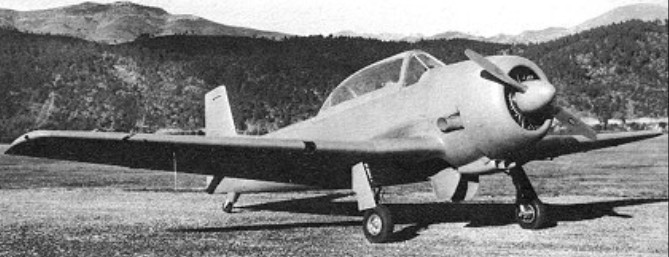
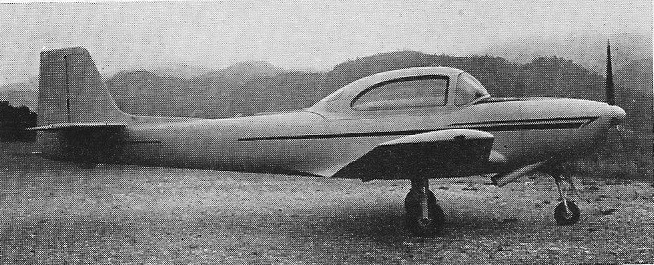
Piaggio P.150

Built to compete against the Fiat G.49 and Macchi M.B.323 as a replacement for the North American T-6 used widely by the Aeronautics Militare Italians, the Piaggio P.150 made its first flight in November 1952. An all-metal cantilever low-wing monoplane with square cut wingtips and tailplane, the P.150 had wide-track inward-retracting main landing gear legs. Pupil and instructor were housed in tandem with dual controls, under a long glazed canopy. The original powerplant was a 447kW Pratt & Whitney Wasp R-1340-S3H1 radial engine, which gave a maximum speed of 380km/h. A later version was fitted with a geared Alvis Leonides engine, but the type was not considered suitable to be built in quantity for the Italian air arm.

Engine: 1 x Pratt & Whitney Wasp R-1340-S3H1, 447kW / 600 hp
Wingspan: 42 ft 4.5 in
Length: 30 ft 4 in
Height: 9 ft 2.5 in
Empty weight: 4277 lb
Loaded weight: 5600 lb
Max. speed: 380 km/h / 236 mph at 5000 ft
Cruise: 195 mph
ROC: 1663 fpm
Service ceiling: 25,200 ft
Range: 880 mi

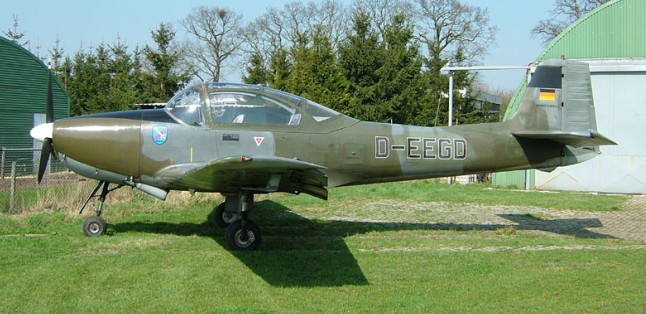
Piaggio P.149

The Piaggio P.149 was a 4-seat touring development of the P.148 with many of the same structural components. A 2-seat side-by-side all metal trainer with a fixed tailwheel undercarriage.

Piaggio P.149 Article

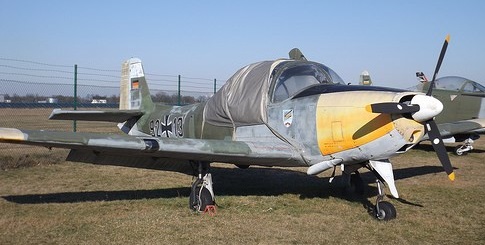
The prototype of the P.149 (I-PIAM c/n 171) with a 260 hp Avco Lycoming GO-435-C2 engine and a retractable tri-gear flew first on 19 June 1953. Two years later the P.149 was selected by the Federal German Air Force as a standard basic training and liaison monoplane.

To meet their requirements a 2-seat military trainer version of the P.149 with glazed cabin roof, deeper rear fuselage and a 280 hp Lycoming GO-480 engine was developed, designated P.149-D. The Federal German Air Force (Luftwaffe der Bundesrepublik Deutschland) ordered 265 Piaggio P.149D for use as a 2-seat primary trainer and 5-seat liaison aircraft.

92+13 Piaggio P-149 D 309

Piaggio built 76, including one which was written off before delivery. Focke-Wulf built 190 under licence from Piaggio. The first Piaggio built P.149D (AS+401 c/n 250) was delivered to Memmingen Air Base in May 1957. In the mean time Focke-Wulf had started production in Bremen, Germany and delivered its first example in November 1957.

Accommodation was provided for five, reduced to two for aerobatic flying.

P.149D
Engine: 1 x Avco Lycoming GO-480, 201kW / 270hp
Prop: 3 blade constant speed
Wingspan: 11.12 m / 37 ft 6 in
Length: 8.8 m / 29 ft 10 in
Height: 2.9 m / 10 ft 6 in
Wing area: 18.85 sq.m / 202.90 sq ft
Empty weight: 1160 kg / 2557 lb
Max take-off weight: 1680 kg / 3704 lb
Max. speed: 305 km/h / 190 mph
Cruise: 165 mph
Ceiling: 6050 m / 19850 ft
Range: 1090 km / 677 miles

Piaggio P.148

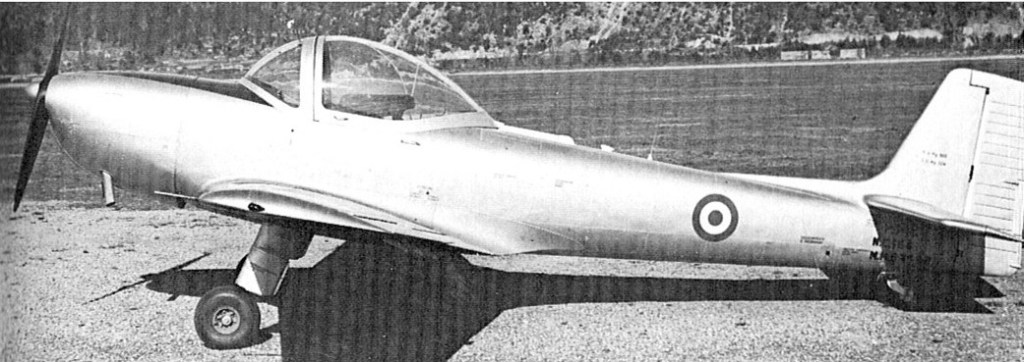
In September 1950 Piaggio began development of the P.148 primary trainer and in less than six months the prototype had been certificated. Production examples became standard trainers with the Italian Air Force.

Piaggio P.148 Article

Engine: 1 x Avco Lycoming O-435-A, 142kW
Max take-off weight: 1280 kg / 2822 lb
Empty weight: 876 kg / 1931 lb
Wingspan: 11.12 m / 37 ft 6 in
Length: 8.44 m / 28 ft 8 in
Height: 2.4 m / 8 ft 10 in
Wing area: 18.85 sq.m / 202.90 sq ft
Max. speed: 234 km/h / 145 mph
Ceiling: 5000 m / 16400 ft
Range: 925 km / 575 miles

Piaggio P.148

Piaggio P.136 / Trecker Gull / Super Gull

P.136F

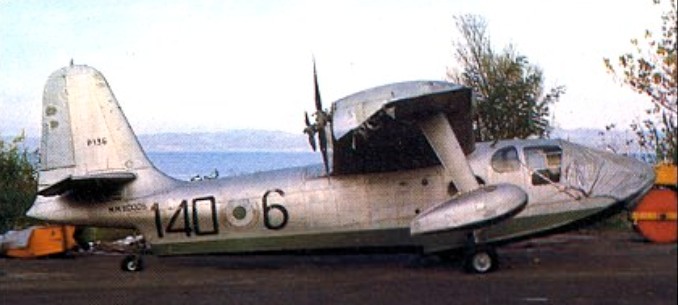
The P.136 was flown for the first time on 29 August 1948 and he first production aircraft were powered by 215 hp Franklin 6A8-215-B9F engines. Eighteen of these were acquired by the Italian Air Force followed by a further fifteen of the P.136-L powered by Lycoming engines.

More than 80 P.136 five-seat light amphibians were built as one of the company’s first post-war products, 33 of which were supplied to the Italian Air Force for use as flying-boat trainers and for air-sea rescue duties.

A second production series, the P.136-L, differed in having higher-power Lycoming engines and redesigned, enlarged squared-off tail surfaces.

A total of 32 were delivered to non-military customers, including twenty to the USA where they were marketed as the Trecker Gull. Most of these were P.136-L-1 or P.136-L-2.

P.136-L

Trecker Aircraft Corp, a division of Kearney & Trecker Corporation, in early/mid-1960s assembled at Milwaukee, Wisconsin, Piaggio P.136L-1 s and L-2s under names Trecker Gull and Super Gull.

Gallery

P.136
Engine: 215 hp Franklin 6A8-215-B9F

P.136-L
Engine: 2 x Lycoming GO-435-C2
Wingspan: 44 ft 4.75 in
Wing area: 268 sq.ft
Length: 35 ft 5 in
Height: 11 ft 6 in
Empty weight: 3211 lb
Loaded weight: 5842 lb
Max speed: 181 mph
Cruise: 160 mph at 6890 ft
Time to 3280ft: 3 min 40 sec
Service ceiling: 17,716 ft
Normal range: 373 mi
Max range: 621 mi

P.136-L-1
Engines: 2 x 270 hp Lycoming GO-480-B
Wingspan: 44 ft 4.5 in / 13.53 m
Length: 35 ft 4 in / 10.8 m
Height: 12 ft 7 in / 3.83 m
Wing area: 270.2 sq.ft / 25.1 sq.m
Empty weight: 4400 lb
Loaded weight: 5996 lb
Max speed: 183 mph at SL
Cruise 70%: 167 mph
Service ceiling: 19,685 ft
Max range: 1056 mi

P.136-L-2
Engines: 2 x 340 hp / 254kW Lycoming GSO-480
Wingspan: 44 ft 4.5 in / 13.53 m
Length: 35 ft 4 in / 10.8 m
Height: 12 ft 7 in / 3.83 m
Wing area: 270.2 sq.ft / 25.1 sq.m
Empty weight: 4652 lb / 2110 kg
Loaded weight: 6600 lb / 2995 kg
Max speed: 208 mph / 335 km/h at SL
Cruise 70%: 190 mph
Service ceiling: 25,500 ft / 7800 m
Max range: 900 mi / 1450 km

P.136

Piaggio

SA Piaggio & Co, an engineering and shipbuilding company, produced some Caproni aircraft and parts during the First World War at a Finale Ligure factory, but subsequently abandoned aircraft manufacture until it took over Pegna & Bonmartini in 1923. First product was the Piaggio-Pegna pursuit monoplane with Hispano-Suiza engine. Later was associated with Societa di Costruzioni Meccaniche Aeronautiche in license-construction of Domier Wal flying-boats. Built P.32 twin-engined heavy bomber at end of 1930s and several four-engined P.108 heavy bombers during Second World War.

Resumed aeronautical work in late 1946 with conversion of Dakotas for airline service. Built P.136 five-seat twin-engined amphibian, prototype flying in 1948, followed by a series of trainers for the Italian Air Force; the P.149 was also license-built by Focke-Wulf in Germany. Produced the P.166 executive transport in 1957, with two Lycoming engines and pusher propellers, as with the P.136; P.166-DL3 turboprop variant later developed and produced, with final P.166-DL3-SEM Maritime variant for search and surveillance, coastal patrol and other roles still available in 1998, but only to special order. Signed agreement with U.S. Douglas company in 1961 for joint development of light utility aircraft, first flown in 1964. Designated PD.808 and powered by two Bristol Siddeley Viper turbojets, only a small number was built.

The present Rinaldo Piaggio company was formed in February 1964 as a separate concern, but in 1994 was put under insolvency protection; 51 percent shareholding in the company was purchased by Tushav, a Turkish holding company, in mid-1998, and protection was thereafter lifted. P.180 Avanti twin-pusher turboprop business aircraft flown September 1986, but only 43 production aircraft ordered; turbofan derivative may be developed. Has manufactured components for Aeritalia/Alenia, AMX International, Dassault and Panavia.
In 1998 three Italian industrial families bought the debt-free assets from the Government and formed Piaggio Aero Industries SpA.

In 2024 Italy approved the sale of Piaggio Aerospace to the Turkish unmanned combat aerial vehicle (UCAV) producer Baykar. In 2023, Baykar ranked among the top 10 exporters in Türkiye across all sectors, racking up $1.8 billion in exports. Türkiye dominates 65% of the global unmanned aerial vehicle (UAV) export market, with Baykar alone holding nearly 60% of the market – three times the size of its closest US competitor. In recent years, Baykar has generated more than 90% of its revenues from exports, delivering Bayraktar TB2 UCAVs and Bayraktar AKINCI UCAVs to 35 countries.