RFB / Rhein-Flugzeugbau Fantrainer

Fantrainer 400

The project was initially a cooperative one with Grumman American, GA supplying wings and empennage, for the most part off the shelf Cheetah parts, and retaining an option to market the airplane in the U.S. RFB has been responsible for design, development and certification. The second prototype embodied improvements in duct and fan technology and a somewhat larger airframe; it was the prototype that will be used for certification in Germany, from which, under reciprocal agreements between the two countries, FAA certification will more or less routinely follow. Grumman declined the marketing option in January 1977, but there is a continuing agreement between the two firms to explore the possibilities of ducted fans.

RFB / Rhein-Flugzeugbau Fantrainer Article

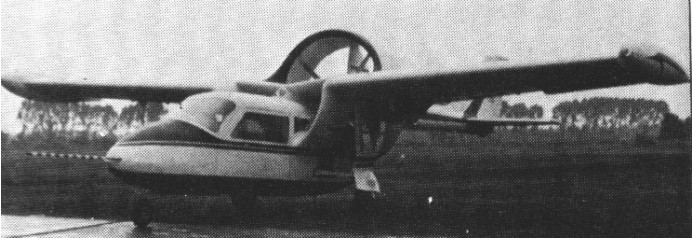
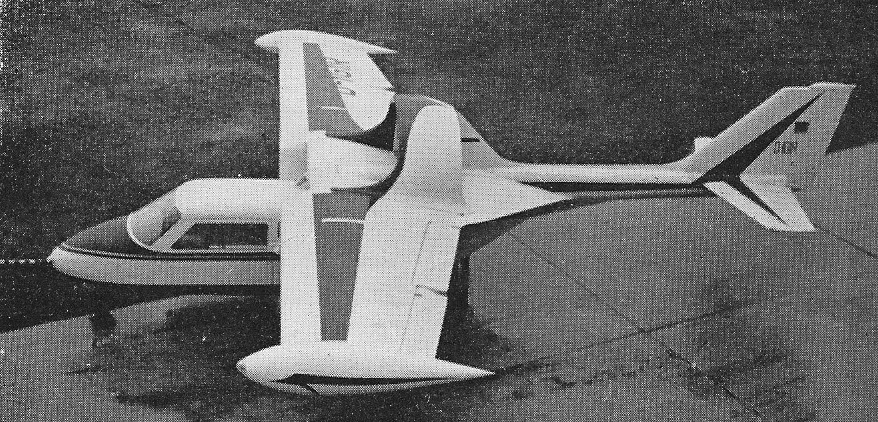
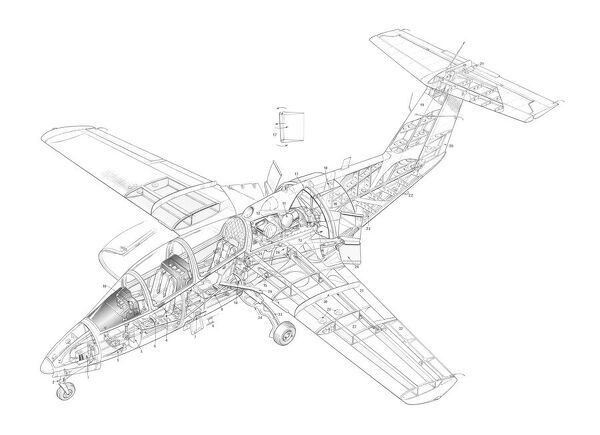
Luigi Colani ended up designing the entire forward fuselage and cabin a fiberglass and plexiglass shell grafted onto a simple keel upon which the entire airplane is built. The pilot and single passenger recline in an elegantly streamlined shell at the front of the airplane. Behind them is a smallish luggage space precisely like that in a small sports car, right down to the transmission tunnel hump provided by the keel structure. A well padded firewall separates the cabin from the engine compartment, the tubular spar of the GA wing. Wings and gear are from a Grumman Cheetah. Reconfigured from a low wing to a mid body location.

The engine is a two rotor NSU Wankel of 150 horsepower. It is water cooled and uses a double automotive ignition system of the battery/generator/coil/distributor type. The Wankel comfortably delivers its peak power at about 6,000 rpm, and the ducted fan allows it to turn at that speed regardless of the forward speed of the airplane.

Rather than take advantage of the ability of the fan to operate efficiently at high speed to eliminate the need for reduction gearing; RFB found that the noise produced by the small, multi-blade, fast-turning fan was so unbearable that they had to turn to a larger three blade version geared down to turn at about half the speed of the engine.

The fan itself is simply a fixed pitch propeller with broad, stubby blades of rather complicated shape. The optimum design has not yet been found, but it is thought that replacing the blades with a scimitar shaped type will further reduce noise at no cost in thrust. The circular duct enclosing the propeller counteracts the natural inefficiency of a stubby blade, which, like a stubby wing, tends to produce a lot of drag along with its lift.

The engine is cooled by radiators behind and below the cabin, with almost invisible flush air inlets be-neath the aft fuselage, exhaling into the fan duct. Cabin heat (not satisfactory on the prototype) is provided, as in most cars, by pumping some of the engine cooling water through a heat exchanger in the cabin air inlet.

The composite-construction Fantrainer first flew in October 1973 powered by two Wankel rotary engines.

Subsequent aircraft have used a single Allison 250 turboshaft to drive a Dowty Rotol five-blade constant-speed ducted fan. Its 150hp, water cooled Wankel engine drives a 43 inch, three blade, shrouded fan, which is located directly behind the two seat cabin. The tail cone is not a cone; instead, it consists of intersecting vertical and horizontal beams whose caps pass around the fan, and at whose intersection is a slender, tapering tube the “cone”. The empennage is a “T” arrangement with a swept vertical.

The RFB AWI 2 Fantrainer first prototype (98+30) was flown for the first time on 27 October 1977. Two prototypes of this tandem two seat trainer had been ordered by the Federal German defence ministry for evaluation as a potential replacement for the Piaggio P.149D primary trainers in Luftwaffe service.

The RFB Fantrainer, flown in AWI 2 and ATI 2 prototype forms, was in production in 1984 as the Fantrainer 400 and Fantrainer 600 with 420 shp (313 kW) and 650 shp (485 kW) Allison turboshafts for the Royal Thai air force. All but six of the 31 Fantrainer 400s and 16 6Ws were assembled in Thailand.

The Royal Thai Air Force is to receive 31 Fantrainer 400s and 16 more-powerful Fantrainer 600s. All but four are to be assembled in Thailand from kits supplied by RFB but using Thai designed and built metal wings in place of the original GRP units. The Thai aircraft will have four underwing weapons pylons. The first two German-built aircraft were delivered in October 1984, but the license-assembly programme has suffered a number of delays, particularly associated with production of the metal wings. To expedite deliveries, a number of Thai-assembled aircraft have been completed using German-supplied GRP wings. Thai aircraft also have a revised cockpit, Alkan stores management, and Stencel Ranger rocket assisted escape systems.

Two production models were offered, the Fantrainer 400 with the Allison 250-C20B 420 shp engine, and the Fantrainer 600 with a 650 shp Allison 250-C30 power plant.

Lufthansa also selected the type for its pilot training school.

Projected Fantrainer 800 did not enter production; neither did the proposed Tiro-Trainer with a turbofan engine.

Fantrainer 400
Engine: 1 x Allison 250 turboshaft, 420 shp

Fantrainer 600
Engine: 1 x Allison 250-C30 turboshaft, 600 shp
Span: 9.7 m
Length: 9.5 m
Height: 3.2 m
Wing area: 150.696 sq.ft / 14 sq.m
Empty wt: 2557.8 lb / 1160 kg
MTOW: 2300 kg
Warload: 800 kg
Max speed: 430 kph
Landing speed: 61 kts / 113 km/h
Cruising speed: 200 kts / 370 km/h
Initial ROC: 960 m / min / 2952.76 ft/min / 15.0 m/s
Service Ceiling: 25000 ft / 7620 m
T/O run: 200 m
Ldg run: 270 m
Fuel internal: 475 lt
Range: 1390 km
Endurance: 4.8 hr
Crew: 2

RFB / Rhein-Flugzeugbau GmbH

Founded in 1957, RFB obtained a license from Rhein-West Flug to build the RW-3 Multoplane in 1957, flying the first production aircraft in 1958 and following with a small batch.

Built and flew the RF1 six-seat STOL transport in 1960; with two Lycoming engines geared to drive single pusher propeller in a wide-chord duct.

In 1968, VFW-Fokker acquired 65% of shares in RFB, and in 1969 RFB acquired a percentage holding in Sportavia company. Company became busy with military contracts for overhaul, and target towing for some years.

Built in collaboration with Grumman-American the Fanliner two-seat light aircraft with Wankel rotary engine, first flown in 1973. It was re-engined in 1976 with a Dowty Rotol ducted propulsor. Based on the Fanliner’s promise, the Federal German Government awarded a contract for two Fantrainer prototypes with ducted fan engines, first flown in 1977 and 1978. In the 1970s German interest in general aviation was maintained by one or two smaller companies, but there has also been quite a large R&D investment by Rhein Flugzeugbau, in ducted fan propulsion for a new generation of lightplanes represent¬ed by its Fanliner.

Production Fantrainer 400s and 600s were ordered only by Thailand, the first (a 600) flying in 1984 and most assembled in Thailand from kits. Projected Fantrainer 800 did not enter production; neither did the proposed Tiro-Trainer with a turbofan engine. Company ceased trading in 1997.

Rey R-1

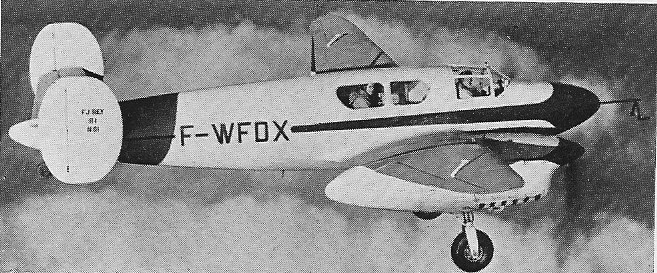
The R-1 was an experimental twin-engine monoplane with variable- incidence wings, first flown with normal wings on 16 December 1949, and with articulated wings in 1951.

Original patents taken out in 1938 and an aircraft built in 1940, but was destroyed during the war. Two prototypes were built, of wooden construction, powered by two Renault 6R engines.

The outer wing panels are articulated on an oblique hinge-line and these orientate automatically in turbulent air, the varying incidence absorbing the loads imposed.

Engines: two Renault 6R, 216 hp
Wingspan: 43 ft 2.5 in
Length: 30 ft 2 in
Height: 11 ft 11 in
Empty weight: 4950 lb
Loaded weight: 6490 lb
Max speed: 202 mph
Time to 3280 ft: 4 min 10 sec
Ceiling: 19,025 ft

Revmaster R-2100

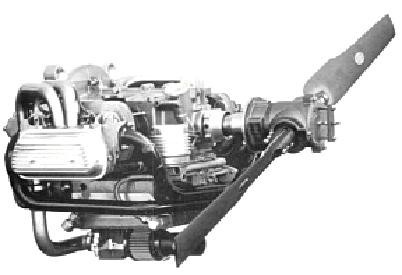
The Revmaster 2100D is a Volkswagen air-cooled engine modified for Homebuilt aircraft with dual magneto ignition. Designed by Joe Horvath the unit cost was US$1,095 in 1971

Two versions available were the R-2100 75 hp and the R-2100 turbo 80 HP. Originally, the R-2100 was equipped with POSA 28mm carburettors.

Specifications:
R-2100D
Bore: 92 mm
Stroke: 78 mm
Displacement: 2073cc
Valvetrain: Single overhead exhaust valve, single side inlet valve per cylinder
Fuel system: Single carburettor
Cooling system: Air-cooled
Tillotson Floatless Carburetor
Power output: 65hp

Republic XF-91 Thunderceptor

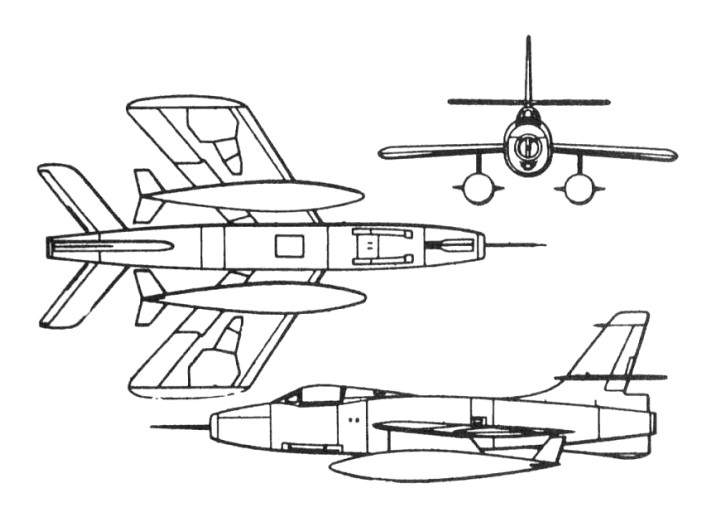
The design evolved to compete with the XF-92 was the Republic XF-91 Thunderceptor. This was based on the F-84F Thunderstreak swept-wing derivative of the F-84 Thunderjet straight-winged tactical fighter.

Republic XF-91 Thunderceptor Article

Ordered in 1946, the wing was of the variable-incidence type to permit a higher angle of attack for take-off and landing, but this feature was combined with a planform of inverse taper and thickness, together with leading-edge slots. Thus the chord and thickness of the wing increased from root to tip, producing more lift at the tip than at the root, and this arrangement dictated that the main landing gear units retract outward into the thick tips rather than inward into the thin roots.

The XF-91 was built to test the use of rocket power to boost a jet fighter in combat. In addition to a 2359kg / 5200-lb thrust General Electric J47-GE-3 turbojet, the two XF-91s each employed four 680kg thrust Reaction Motors XLRII-RM-9 rocket motors mounted two-each above and below the jet exhaust. With all five powerplants burning, the XF-91 was supersonic in level flight, attaining 1812km/h.

The first XF-91 made its initial flight on 9 May 1949 on jet power alone. By late 1949, evaluation of the rocket boost powerplant began. In December 1952 the type exceeded Mach 1.

The first XF-91 was refitted with a nose radome housing APS-6 radar above the engine intake. The second machine was retrofitted with a V-shaped butterfly tail and tested with this configuration after it was determined, in 1951, that the XF-91 would not be placed into production.

This second airframe was eventually destroyed while the first has been retained by the Air Force Museum in Dayton, Ohio.

XF-91
Wingspan: 9.53 m / 31 ft 3 in
Length: 13.18 m / 43 ft 3 in
Height: 5.69 m / 19 ft 8 in
Wing area: 29.73 sq.m / 320.01 sq ft
Max take-off weight: 10800 kg / 23810 lb
Empty weight: 7190 kg / 15851 lb
Max. speed: 1812 km/h / 1126 mph
Ceiling: 14000 m / 45950 ft
Range: 1600 km / 994 miles

Republic XF-91 Thunderceptor

Republic XF-12 Rainbow / XR-12 / RC-12

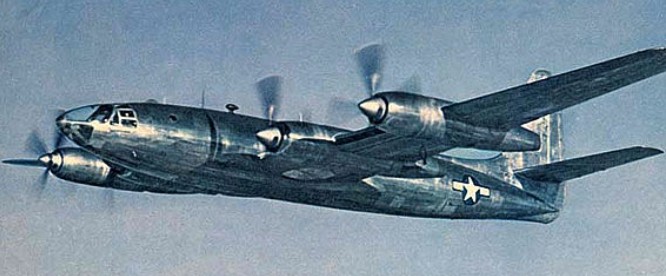
Development of the XF-12 photo-reconnaissance airplane began in 1944 when it appeared that a fast, specialized reconnaissance airplane would be needed during the final stages of the war in the Pacific. The XF-12 was roughly the same size as the C-54, hut it was much heavier and had more than twice as much power. The four turbo¬supercharged, 3,000hp (2,200kw) Pratt & Whitney Wasp Major engines were enclosed in long, slender nacelles that extended well beyond the wing trailing edges. The wing and empennage shared a resemblance with those of the F-84 Thunderjet. The fuselage was a slender teardrop shape, unbroken even by the windshield. Each main landing gear had a very large single wheel to fit inside the confines of the laminar flow wing. The Rainbow had its own darkroom in order to develop reconnaissance images on the way back from a long photo mission.

The first of two XF-12 prototypes was completed and flown on February 7, 1946. Subsequent experimental flight tests showed that it had lived up to its promise, and it passed into the service-test phase in June 1947. The XR-12 delivered to the Air Force crashed on its second test flight. The other Rainbow was sent to a gunnery range.

Unfortunately, the day of high-performance reciprocating engine-powered military airplanes had passed and the anticipated contract for 20 production F-l2As never materialized.

Republic still hoped to make the Rainbow into a 46-seat airliner, which they called the RC-2. Their selling point was speed, for which customers would pay a premium. Unfortunately, the expected postwar boom was not immediate and the airlines bought the slower but roomier DC-4 and Boeing 377 instead.

XF-12
Engine: 4 x Pratt & Whitney R-4360 Wasp Major, 2250kW
Max take-off weight: 45950 kg / 101303 lb
Wingspan: 39.36 m / 129 ft 2 in
Length: 28.59 m / 94 ft 10 in
Height: 8.63 m / 28 ft 4 in
Wing area: 152.30 sq.m / 1639.34 sq ft
Max. speed: 684 km/h / 425 mph
Cruise speed: 640 km/h / 398 mph
Ceiling: 13000 m / 42650 ft
Range: 7000 km / 4350 miles
Crew: 5-7

Republic

Founded as Seversky Aircraft Corporation at Long Island, New York, in 1931. Since de Seversky had made somewhat of a pariah of himself in the USA by selling combat aircraft to Japan, the Army ordered no more P-35s from Seversky. By early 1939, his company had gotten itself into some deep financial trouble. In Apr 1939, while de Seversky was out of the country on a business trip, the board of directors of his company voted him out of office as CEO and changed the name of the company to Republic. The newly-formed company then recapitalized itself and Alexander Kartveli was appointed as vice president and technical director. Having been forced into involuntary early retirement, de Seversky spent the rest of his life writing and consulting, and Kartveli and the Republic company went on to design and produce the famed P-47 Thunderbolt.

Secured $56.5 million contract for fighter from the USAAC in 1940, largest single fighter order ever placed until then by U.S. Government. Built P- 35, P-44 and P-43 Lancers for USAAC plus some EP-1 s, based on P-35, for Swedish Government. Lancer design developed further into P-47 Thunderbolt for USAAF, of which 15,329 were built during Second World War.

Aircooled Motors, manufacturers of the Franklin aircraft engines, were acquired by Republic on 27 December 1945.

Immediate postwar designs included the Seabee single-engine amphibian, the XF-12 high-altitude long-range four-engine photo-reconnaissance aircraft prototype, and the F-84 Thunderjet/Thunderstreak/Thunderflash series of jetfighters. The larger and heavier F-105 Thunderchief followed in 1955, and in 1965 the company became the Republic Aviation Division of Fairchild Hiller Corporation.
Republic became a division of Fairchild in 1965, becoming the Fairchild Republic Company in 1972.

Replica Plans SE-5A

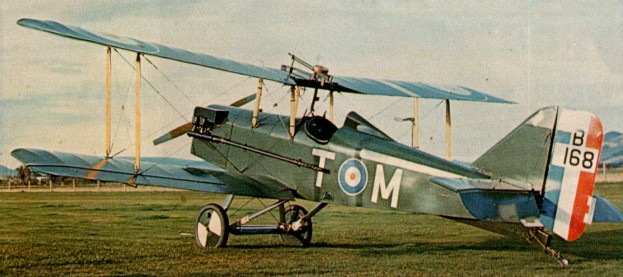
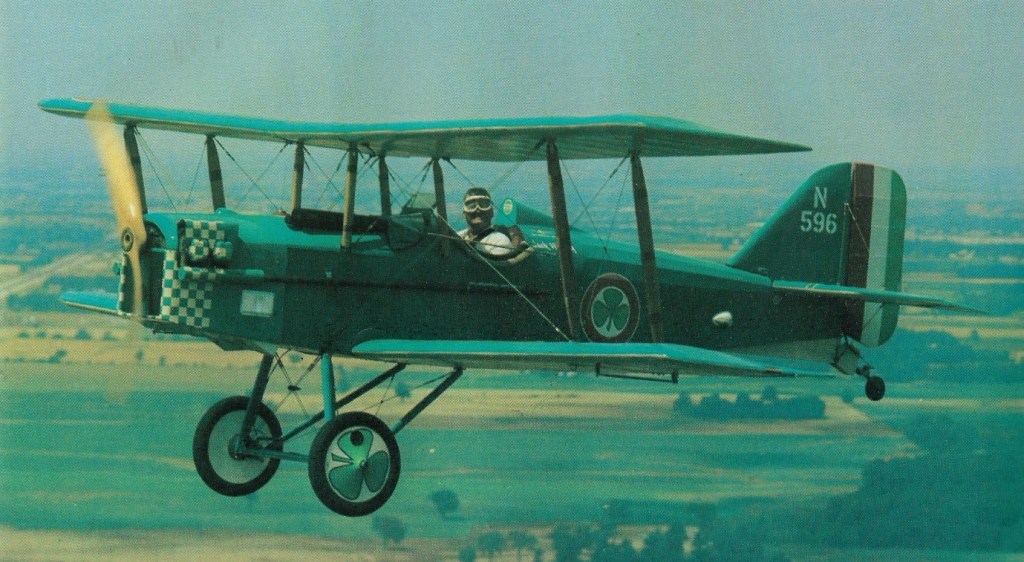
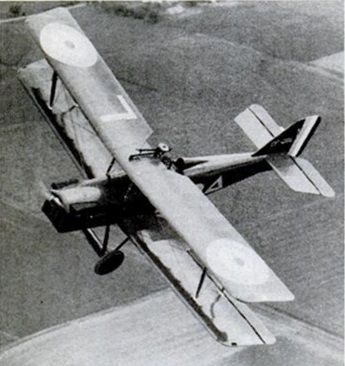
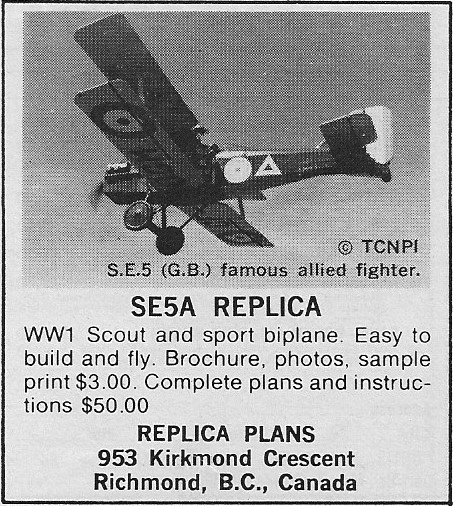
The 5/6th scale replica was designed as an easy and inexpensive representation of this famous First World War Fighter using modern materials and engines. The reduced scale allows for the use of 65 to 100 hp “flat four” engines although some examples have more powerful engines. Wood and fabric construction.

The prototype flew in Canada in 1970 and there were two flying in New Zealand with at least two more under construction. The wooden wing has a leading edge covered with either fibreglass or aluminum, the rest being fabric-covered. The plywood-covered box fuselage has a fabric-covered turtle-deck and aluminum-covered forward section. Performance from an 85 hp powered SE-5A Replica are a cruise speed of 135 km/h and 150 m/min climb rate.

Dec 73

Gallery

Engine: Continental O-200, 100 hp
HP range: 85-125
Height: 7.67 ft
Length: 18.18 ft
Wing span: 23.33 ft
Wing area: 146 sq.ft
Fuel cap: 18 USG
Weight empty: 750 lb
Gross: 1150 lb
Speed max: 110 mph
Cruise: 80 mph
Range: 250 sm
Stall: 35 mph
ROC: 900 fpm
Take-off dist: 400 ft
Landing dist: 550 ft
Service ceiling: 10,000 ft
Seats: 1
Landing gear: tail wheel