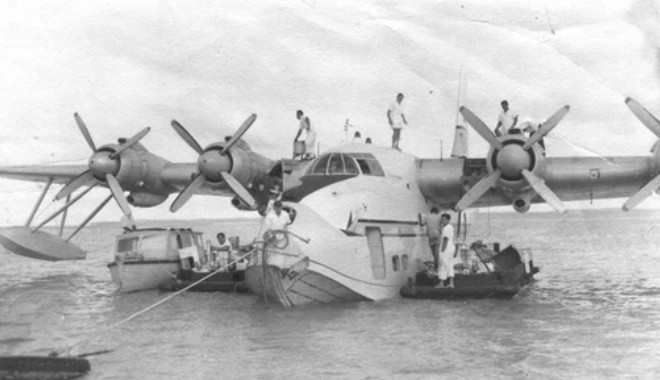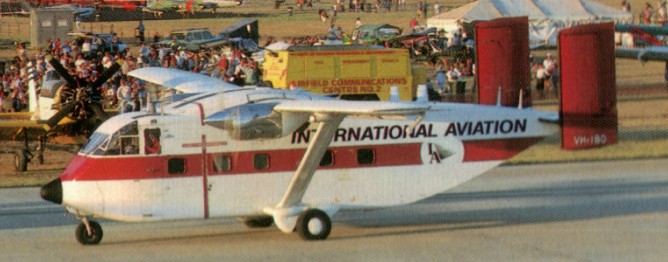
Short SC-7 Skyvan

The Skyvan had its origins in the Miles Aerovan, the concept of which was taken on by Short in a radically overhauled design. It was designed to carry an 11 ton payload over 200 miles at 160 m.p.h, with an all up weight of 8,600 lb.

Two prototypes were built at Belfast during 1960 with two 390 bhp Continental GTS IO 520s. It was decided that turboprop power was required, so the prototype and early production (Series 2) examples were ultimately fitted with Astazou II turboprops.

Short Turbo-Skyvan Article

The Short Skyvan (G ASCN), re engined with Turbomeca Astazou turboprops, flew for the first time with its new power plants on October 2, 1963. With Dennis Taylor at the controls the Skyvan was in the air for twenty five minutes on its first flight.
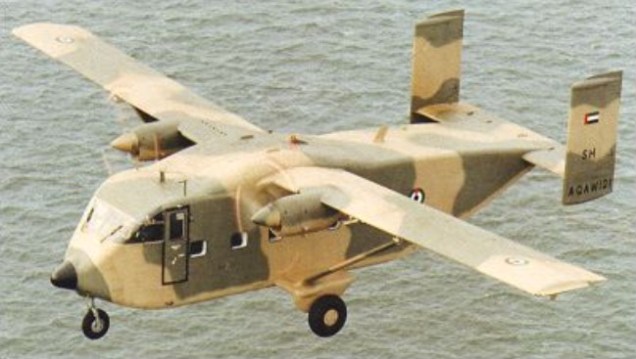
These engines were not ideal for hot-and-high conditions or American customers, so the Series 3 was upgraded to the specified Garrett type.

The Skyliner was a dedicated passenger-carrying version.

The military version of the twin-turboprop Skyvan is the Skyvan 3M-200, which is cleared to an increased maximum take-off weight of 6,804kg for military operations. Powered by two 533kW Garrett TPE331 engines, the prototype Skyvan 3M first flew early in 1970. Troop transport, paradropping, assault transport, SAR, and medevac are among the capabilities of the Skyvan. The Skyvans of the Sultan of Oman’s Air Force have Racal ASR 360 airborne surveillance radars for maritime patrol and SAR duties.

The sole example of the Skyvan sold to the Sharjah Amiri Air Wing was delivered in 1986. It was also the last Skyvan built.

In all, 149 Skyvans were built and sold to commercial freight/passenger ‘bush’ operators and military/paramilitary operators up until 1986.

Gallery

SC-7
Engines: 2 x Garrett TPE 331-2-201A, 715 shp / 533kW
Props: Hartzell 3-blade, 102-in
Seats: 19
Length: 40 ft
Height: 15 ft
Wingspan: 64.8 ft
Wing area: 373 sq.ft
Wing aspect ratio: 11
Maximum ramp weight: 12,500 lb
Maximum takeoff weight: 12,500 lb
Standard empty weight: 7100 lb
Maximum useful load: 5400 lb
Equipped useful load: 3900 lb
Maximum landing weight: 12,500 lb
Wing loading: 33.5 lbs/sq.ft
Power loading: 8.7 lbs/hp
Fuel cap: 2320/3105 lb
Payload max fuel: 795 lb
Range max fuel/cruise: 770nm/4.5hr
Range max fuel /range: 849nm/5.9hr
Best rate of climb: 1640 fpm
Service ceiling: 22,100 ft
Maximum single-engine rate of climb: 450 fpm @ 92 kt
Single-engine ceiling: 12,500 ft
Maximum speed: 176 kt
Normal cruise @ 10,000ft: 169 kt
Fuel flow @ normal cruise: 482 pph
Endurance at normal cruise: 6 hr
Max range cruise: 145 kt
Vmc: 67 kt
Stalling speed clean: 74 kt
Stalling speed gear/flaps down: 55 kt
Turbulent-air penetration speed: 140 kt
Min field length: 1580 ft
1.3 Vso: 78 kt

Skyvan Series 3
Engines: 2 x Garrett TPE331-201 turbo-prop,
Max take-off weight: 5670 kg / 12500 lb
Empty weight: 3500 kg / 7716 lb
Wingspan: 19.79 m / 65 ft 11 in
Length: 12.22 m / 40 ft 1 in
Height: 4.6 m / 15 ft 1 in
Wing area: 34.65 sq.m / 372.97 sq ft
Cruise speed: 325 km/h / 202 mph
Ceiling: 6860 m / 22500 ft
Range w/max.fuel: 1117 km / 694 miles
Range w/max.payload: 450 km / 280 miles
Crew: 2
Passengers: 19

Skyvan 3M-200
Engine: 2 x Garrett TPE331
Installed pwr: 1060 kW
Span: 19.8 m
Length: 12.2 m
Wing area: 35.1 sq.m
Empty wt: 3768 kg
MTOW: 6800 kg
Payload: 2360 kg
Cruise speed: 308 kph
Initial ROC: 470 m / min
Ceiling: 6700 m
T/O run: 290 m
Ldg run: 210 m
Fuel internal: 1330 (+440) lt
Range/payload: 1075 km with 4000 kg
Capacity: 20 pax
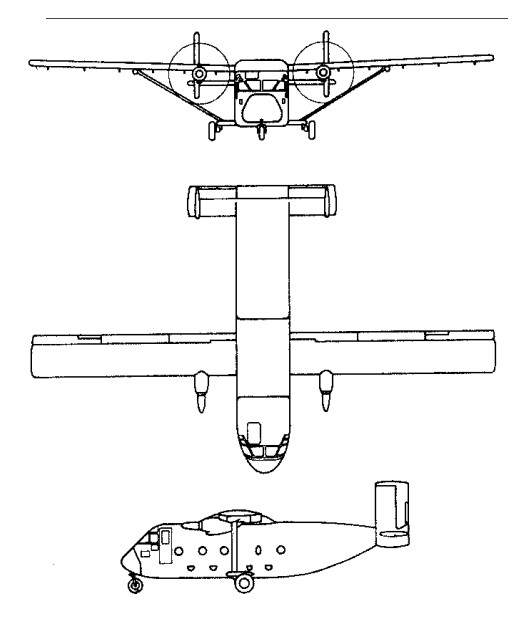
Short SC.7 Skyvan

Short SC-5/10 Belfast

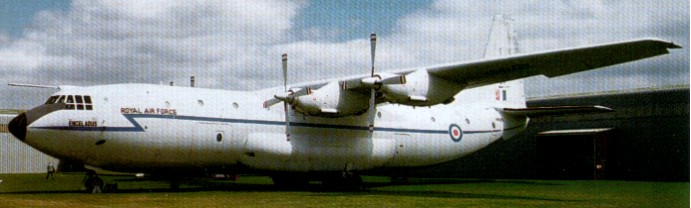
The Shorts Belfast was originally built for the RAF in the 1960s and although the manufacturer initiated a civil certification programme, of which approximately 65% was completed, this was cancelled due to apparent lack of interest displayed by commercial carriers at that time. The development of the Belfast was initially based upon that of the Bristol Britannia the design was for some time dubbed the Britannic, and the RAF finalised a contract for 10 of the type to serve in the strategic, heavy airlift role.

The aircraft eventually utilised only some of the Britannia’s basic wing structure. It was specifically designed for the carriage of heavy freight, including the largest types of guns, vehicles, guided missiles and other loads and had ‘beaver-tail’ rear loading doors capable of permitting the unhindered passage of any load that the fuselage could contain. As a troop transport it could carry 200 men, and was often used to carry helicopters overseas.

Following a development which spanned four years, the first Belfast made its maiden flight on 5 January 1964 and deliveries to the RAF commenced on 20 January 1966, when the first C.Mk l was handed over to No 53 Squadron at Brize Norton.

Shorts SC-5/10 Belfast Article

As a result of defence cuts at the end of 1976, the RAF phased out Belfast operations and, on 23 March 1977, Eurolatin Aviation concluded the purchase of the aircraft. At this stage in their career the Belfasts had flown 23 million nm without incident, averaging 8,000 flying hr/airframe. Of the original 10 aircraft, four were scrapped, one was destined for display with the RAF Museum and TAC HeavyLift had access to the other five.

On obtaining the aircraft, the airline completed an investigation to ascertain the outsanding conditions for Civil Aviation Authority (CAA) approval and following the go ahead decision for certification, they enrolled the aid of Marshalls of Cambridge to provide the design and flight test support for the Belfasts under the organisation’s existing CAA approvals. An independent engineering base at Southend airport was set up to carry out modifications required by the programme and to organise the management, identification, certifying and transport of spares for the fleet.

The Belfast civil certification programme involved a cost of over £4 million and included 120hr of flight testing; 20,000man/hr of design; 25,000man/hr of aircraft engineering; a complete assessment of all aircraft systems; civil certification of the Rolls Royce Tyne engine; production of civil maintenance schedules, flight operating and technical manuals; and design, manufacture and installation of modifications to the radio station, navigation equipment and the aircraft’s compulsory ‘black boxes’, cockpit voice recorder and flight data recorder. Additional tasks were the removal of both the Belfast’s RAF automatic landing system (the type became the first military transport in the World cleared for ‘hands¬off’ autolanding in fully operational conditions), and in flight refuelling equipment.

The dimensions and specifications of the Belfast are impressive and its hold has a volume of 11,000 cu.ft with a cross section minimum of 12ftx 12ft. It is capable of carrying up to 34 tons of freight although at this weight its range is a very limiting 700 800nm, and it has a cruising speed approaching 330mph.

Several aircraft operated with civil Heavylift Cargo Airlines at Stansted in Britain.

Gallery

Short Belfast C 1
Engines: 4 x Rolls Royce Tyne RTy 12 Mk 101 turboprops, 5,730eshp / 4273kW
Length: 136ft 5in / 41.58 m
Height: 47ft / 14.33 m
Wing span: 158ft 10in / 48.4 m
Wing area: 2464.956 sq.ft / 229.0 sq.m
Max take off weight: 230050 lb / 104330.0 kg
Weight empty: 127023.4 lb / 57607.0 kg
Cruise with max payload: 275kts (510km/hr)
Service ceiling: 30003 ft / 9145 m
Cruising altitude: 23950 ft / 7300 m
Range w/max.fuel: 10200 km / 6338 miles
Range w/max.payload: 2000 km / 1243 miles
Max hold width: 16ft 1in
Max payload: 75,000 lb (34,000kg)
Capacity: 200 troops
Crew: 4-5

Short SC.5/10 Belfast

Short SC-1

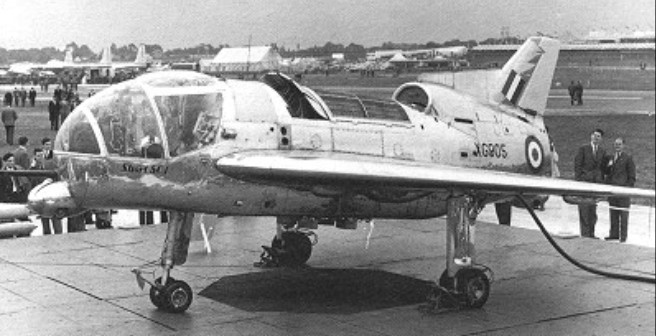
In 1953, the Ministry of Supply issued Specification ER.143 for a research aircraft which could take off vertically by jet lift, then accelerate forward into normal cruising flight.

The SC. 1 was designed to study hover, transition and low-speed flight, and had a fixed landing gear. The Short SC. 1 was powered by four RB.108 lift engines vertically mounted on gimbals in the centre fuselage and one RB.108 cruise engine in the rear for forward flight. Bleeds from the four lift engines powered nose, tail and wing-tip reaction jets for control at low speeds.

The first conventional flight was made on 2 April 1957, first tethered vertical flight was on 26 May 1958, and first free vertical flight was on 25 October 1958. The first transition was on 6 April 1960.

The SC.1 appeared at the Farnborough air show in 1960 and Paris air show in 1961 (for the latter it flew the English Channel both ways).

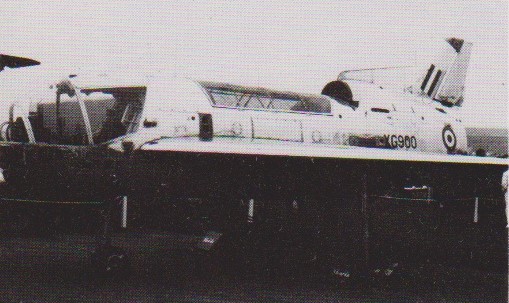
After first flying May 1958, the second Short SC.1 VTOL research aircraft (XG905) crashed at Sydenham airfield, Belfast, on October 2nd, 1960, the pilot, John R. Green, being killed. Equipped with a new auto stabiliser system with which it had begun tests on August 2nd, the SC.1 was hovering at an altitude of 50 ft (15.2 m) when control was lost, the aircraft turning over on hitting the ground. It was rebuilt and the two aircraft continued to fly.

James M. Patton, Jr was a research pilot at NASA Langley, and a guest of the Royal Aircraft Establishment at Bedford in August & September, 1971. He conducted 10 flights in SC-1 XG905 to obtain data pertinent to NASA VTOL research.

One was on display at the Ulster Folk and Transport Museum.

Gallery

Engines: 4 x 965kg Rolls-Royce RB.108 lift engines and 1 x RB.108 cruise engine
Max take-off weight: 3650 kg / 8047 lb
Wingspan: 7.16 m / 24 ft 6 in
Length: 9.10 m / 30 ft 10 in
Max. speed: 396 km/h / 246 mph
Range: 240 km / 149 miles
Crew: 1

Short S.C.1

Short SB.5

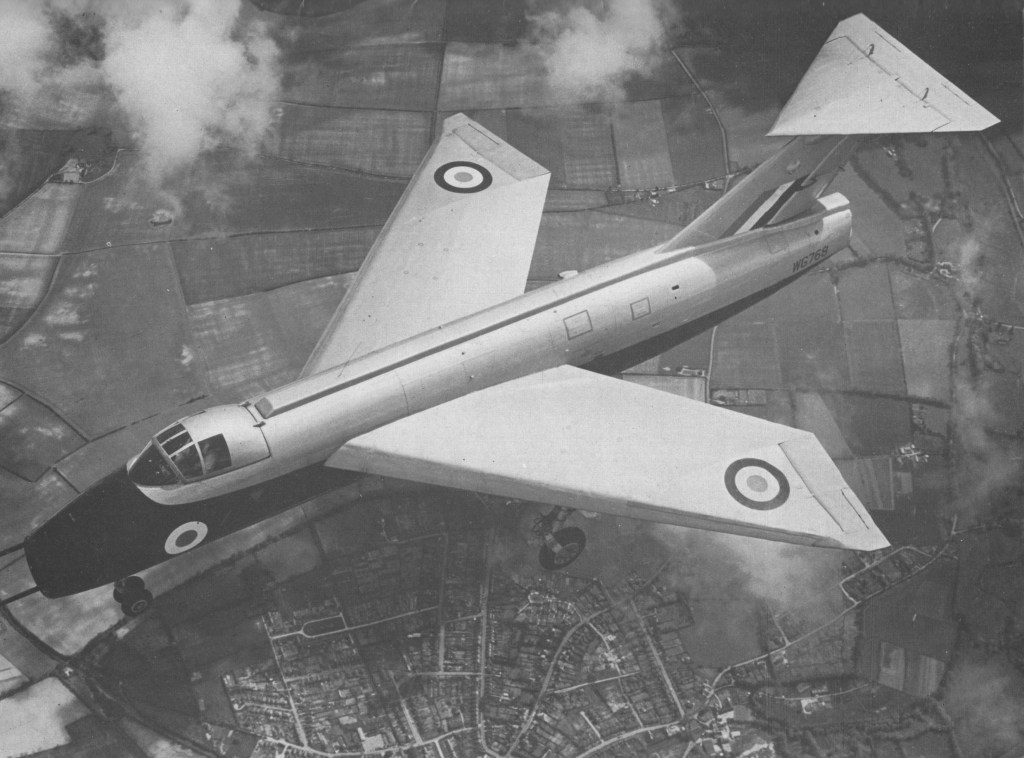
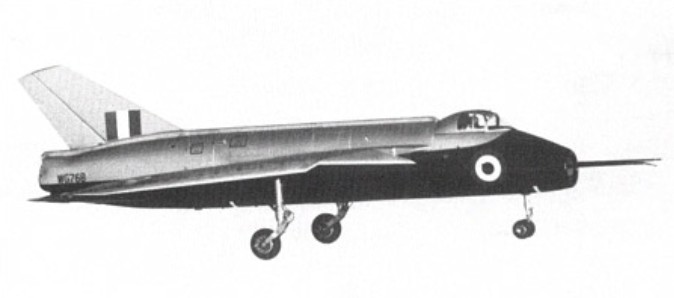
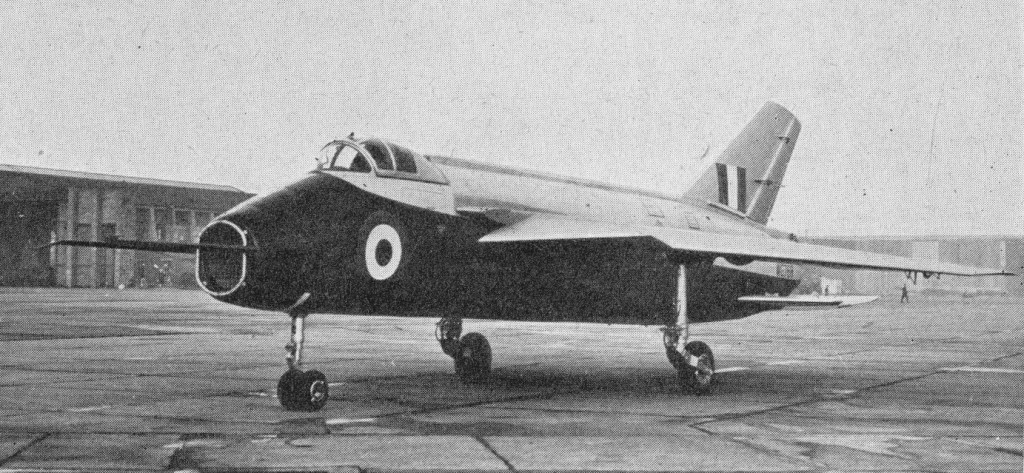
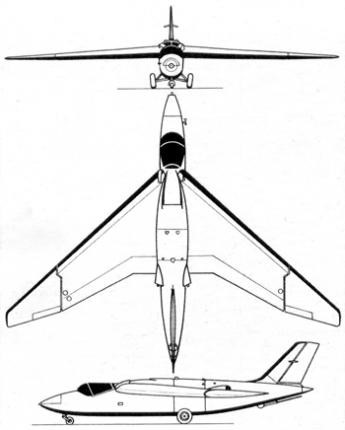
The S.B.5 was a test bed to examine flight characteristics using highly swept wings. The single example S.B.5 (WG768) first flew in December 1952 on the 3500lb (1588-kg) thrust of its Derwent turbojet, and piloted by Roland Beaumont. Though modelled aerodynamically on the Mach 2 English Electric P.l., was intended to investigate the low-speed handling qualities of swept wings. The aeroplane was fitted with wings whose sweep could be adjusted on the ground at angles of 50 degrees for use with a T-tail, 60 degrees for use with a conventional tail or a T-tail, and 69 degrees for use with a T-tail.

Short SB.5 Article

The variable incidence tailplane was later set at the bottom of the fuselage, as on the P.1.

On the S.B.5 wing there is an unusual fixed “droop snoot” on a small portion of the centre section leading edge.

1958 tests included a 69 degree sweepback and a Bristol Orpheus engine.

Gallery

Short SB.5
RR Derwent
Span 30 ft 6 in
Sweep 60 deg
Length 45 ft 9 in

Short SB.1 / SB.4 Sherpa

The Short SB-1 experimental glider was constructed mainly of wood, and was used for research into the aero-isoclinic wing concept.

Short SB.4 Sherpa Article

The particularity of this flying wing, designed by David Keith-Lucas, the arrow leading edge reaching 42 deg 22 min isoclinic developed from the theory of Major Hll, which had also been tested on a series of flying wings (Pterodactyl), built before the war by Westland. This demanded a flexible rather than stiff wing structure with the tips hinged to serve collectively as elevators and differentially as ailerons.

Following a serious incident occurred during a towed takeoff flight, it was found that this method was too dangerous. As Blackburn had acquired the license to manufacture small French Turbomeca engines, it was decided to redesign the system with two Blackburn-built Turbomeca Palas of 330-1b (150-kg) thrust, as the SB.4 Sherpa. The engines are placed side by side on the back of the fuselage in a compartment isolated from the rest of the cell by firewalls. The air inlet is located on the back.

The ejection of the burnt gases is done by two independent nozzles. It is slightly divergent. Compared with SB-1, the airfoil has been enhanced so as to allow a significant increase in the weight, primarily due to the increased presence of engines, their components and the fuel.

The SB.4 Sherpa first flew on 4 October 1953 from the airfield near Sydenham, piloted by Tom Brooke -Smith, chief pilot of Short.

Only one was produced.

The aircraft was recovered and partially restored (the wings are missing) by the Medway Aircraft Preservation Society Rochester, Maidstone Road.

It is now in possession of the Ulster Aviation Society. This association had recovered two Palas engines (Nos. 53 and 54), and considering a static display, based on the former Long Kesh in Northern Ireland.

Gallery

Short SB.4 Sherpa
Engines: 2 x Blackburn Turbomecca Palas
Length: 9.70 m (31 ft 10 in.)
Wingspan: 11.58 m (38 ft)
Height: 2.77 m (9 ft 1.12 in.)
Wing area: 21.40 m² (230 ft ²)
Empty weight: 1400 kg (3,000 lb.)
Max speed: 275 km / h (150knts)
Cruise speed: 188 km / h (102 knts)
Service ceiling: 1500 m (5,000 ft.)
Endurance: 45-50 min

Short SB.3 Sturgeon

(Mamba project)

Originally designed as a twin-engined naval reconnaissance bomber for operation from the Ark Royal and Hermes-class aircraft carriers. With the end of the war, the need for such an aircraft receded and so a new specification was drawn up to convert the Sturgeon into a high-performance carrier-based target tug, suitable for towing targets for ground-to-air firing practice, photographic marking of ground-to-air firing, target towing for air-to-air practice by night and day, ‘throw-off’ target practice and radar calibration.

The FAA received a small number during the early 1950s.

The Short SB.3 had an anti submarine twin Mamba powered development.

Sturgeon TT3
Engines: 2 x 2080hp Rolls-Royce Merlin 140
Max take-off weight: 9840 kg / 21694 lb
Empty weight: 7696 kg / 16967 lb
Wingspan: 18.26 m / 60 ft 11 in
Length: 13.70 m / 45 ft 11 in
Wing area: 48.16 sq.m / 518.39 sq ft
Max. speed: 590 km/h / 367 mph
Ceiling: 10700 m / 35100 ft
Crew: 2

Short Sturgeon

Short SA-4 Sperrin

Even though the Valiant was produced as an interim type, the British felt it essential to develop an alternative in case the Valiant proved a failure in its initial trials. Designed to Specification B.14/46, the Short SA.4 Sperrin was intended as an insurance, which conformed to a less demanding specification in terms of speed and altitude over the target.

Short SA-4 Sperrin Article

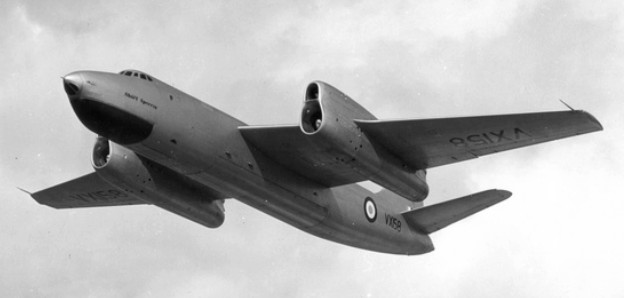
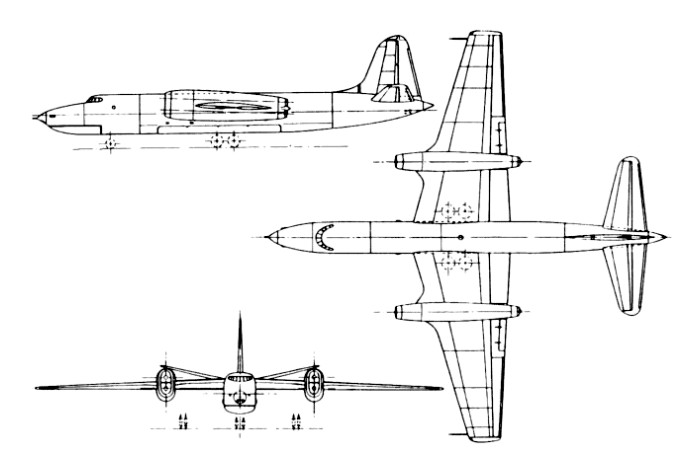
The aeroplane was thoroughly conventional by the structural and aerodynamic concepts of the day, with straight flying surfaces whose wings were set in the shoulder position on a comparatively deep fuselage whose lower portions accommodated the large nay/attack radar (chin position) and internal bomb bay (central position). One unusual feature was the powerplant, whose four Rolls-Royce Avon turbojets were located in under-and-over pairs on the wings about two-fifths of the way between the fuselage and the wingtips.

Short Sperrin prototype VX161 at Farnborough Golden Jubilee 9 July 1955

Two prototypes were built, the first flying on 10 August 1951 and used to test new high-altitude radar navigation and bombing equipment that was to be incorporated in the V-bombers. The second aircraft, which flew in August 1952, was used to test aerodynamic bomb shapes in connection with the development of Britain’s first atomic bomb, the MC.Mk 1 ‘Blue Danube’.

VX158 Short-Sperrin Gyron at Farnborough 1956

Gallery

Engines: 4 x 2944kg Rolls-Royce Avon RA.3 turbojet
Max take-off weight: 52200 kg / 115082 lb
Wingspan: 33.20 m / 109 ft 11 in
Length: 31.42 m / 103 ft 1 in
Height: 8.69 m / 29 ft 6 in
Max. speed: 913 km/h / 567 mph
Ceiling: 13725 m / 45050 ft
Range: 6050 km / 3759 miles
Crew: 5

Short S.A.4 Sperrin

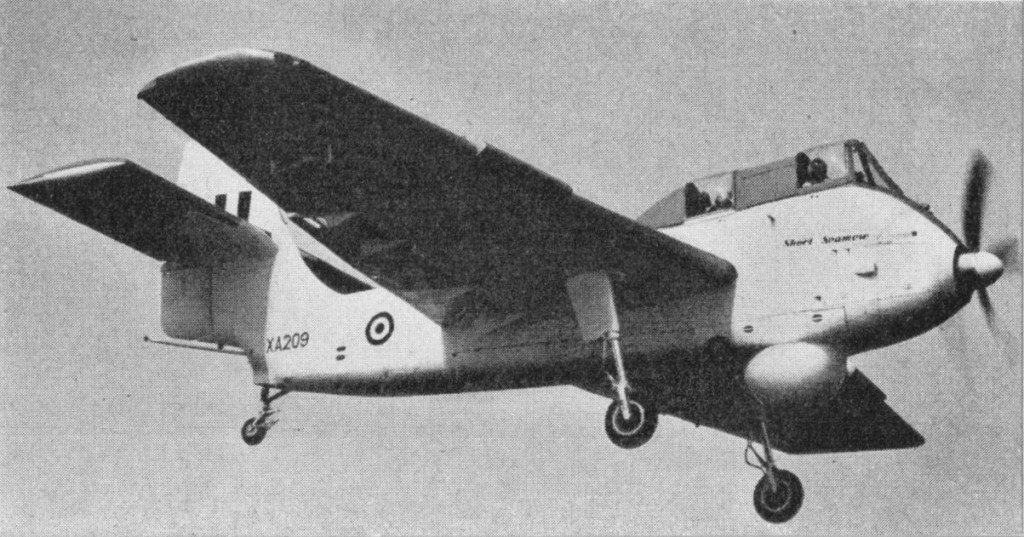
Short S.B.6 Seamew

The Seamew was conceived as a cheap, rugged anti-submarine aircraft able to operate from small carriers used by the UK and some other allied nations. To this end it was built with a fixed landing gear and a strong structure. The fixed undercarriage legs could be jettisoned in the event of a ditching at sea. The need to house a large search radar under the belly led to the adoption of a tailwheel undercarriage layout. Despite this, the prototype was badly damaged on its first landing, although it was repaired in time for the Farnborough Air Show.

The Mamba powered anti submarine Short Seamew with 1,590 s.h.p. underwent intensive development with two prototypes. The higher lift characteristics at slow speeds for operation from escort type carriers have been improved by the installation of fixed slats at the mid span of each wing, while the slat under the inner tailplane leading edge was replaced by a vented fillet. The Seamew can power fold its wings and extended them.

In handling terms the Seamew was described as having some ‘vicious tendencies’. It was capable of aerobatics, but the chief test pilot seemed to be the only one able to wring the full manoeuvrability out of the Seamew – until he stalled the prototype Mk.2 during a display and was killed.

Production began for RAF Coastal Command and the Royal Navy, but the RAF order was cancelled in 1956 and the Navy’s was a victim of the defence cuts of the following year. The Mk 2 was a version for Coastal Command with larger wheels and manual wing folding. It was cancelled after rwo were completed.

Short SB-6 Seamew AS1

S.B.6 Seamew
Engine: 1 x 1780hp Armstrong Siddeley Mamba turboprop
Max take-off weight: 6804 kg / 15000 lb
Wingspan: 16.75 m / 55 ft 11 in
Length: 12.50 m / 41 ft 0 in
Max. speed: 378 km/h / 235 mph
Crew: 2

Short Sealand

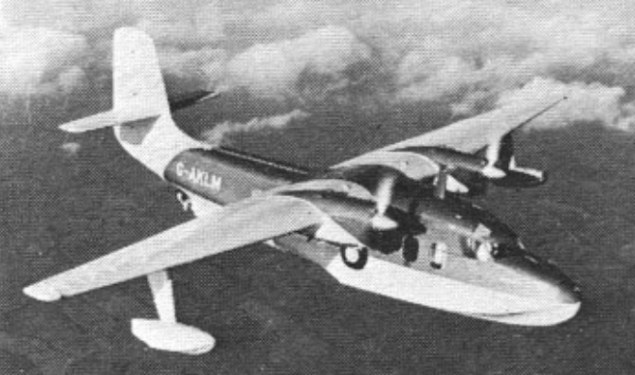
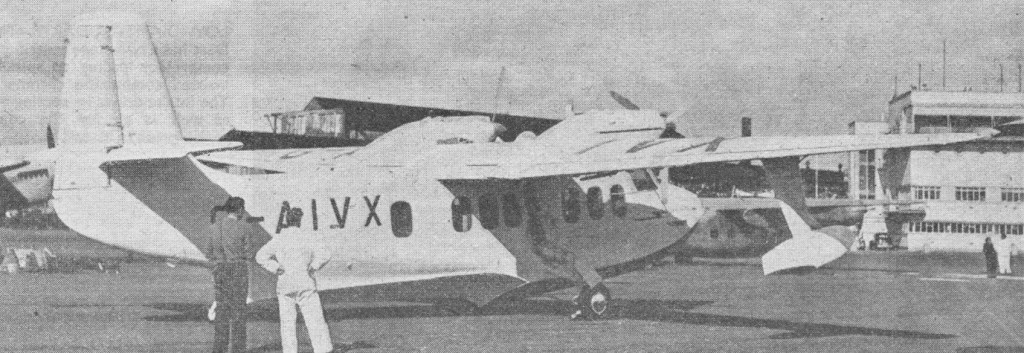
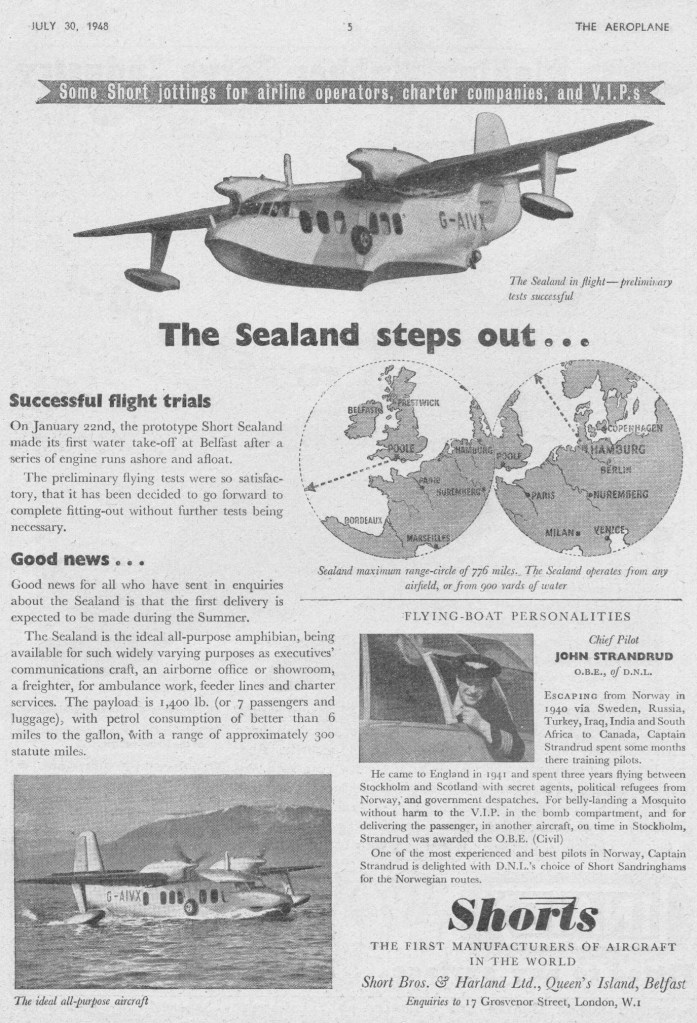
The Sealand twin-engined light commercial amphibian flying-boat was first flown on 22 January 1948. Power was provided by 254kW de Havilland Gipsy Queen 70 engines and accommodation was for five to eight passengers. Only a small number were produced, including three for the Indian Navy.

1948
September 1948

Sealand III
Engines: 2 x de Havilland Gipsy Queen 70, 254kW
Max take-off weight: 4128 kg / 9101 lb
Empty weight: 3205 kg / 7066 lb
Wingspan: 18.75 m / 62 ft 6 in
Length: 12.85 m / 42 ft 2 in
Height: 4.57 m / 15 ft 0 in
Wing area: 32.79 sq.m / 352.95 sq ft
Max. speed: 298 km/h / 185 mph
Ceiling: 6340 m / 20800 ft
Range: 958 km / 595 miles

Short S.45 Solent / Seaford

Seaford

For service in the Pacific the Air Ministry required a more powerful, more heavily armed flying boat than the Short Sunderland, and specification R.8/42 was met by a new Short design, known originally as the Sunderland IV but later renamed Seaford, with the company designation S.45.

Gross weight rose to 34000kg and a number of structural improvements were incorporated to compensate for this; these included a strengthened wing and enlarged horizontal tail surfaces. The hull was also modified, its beam being increased by 0.99m. Armament comprised two 12.7mm machine-guns in a Brockhouse turret in the bow, and two 7.7mm machine-guns in the nose decking. Two 20mm cannon were mounted in a Boeing B-17 dorsal turret, and the Martin tail turret contained a pair of 12.7mm guns, two more of which were located in beam positions. A bomb load could also be carried in a fashion similar to that of the Sunderland.
The first of two prototypes, powered by four 1253kW Bristol Hercules XVII engines, was flown on 30 August 1944 and 30 production aircraft, with 1283kW Hercules XIXs, were also ordered. Of these only six were completed.

In April and May 1946 No.201 Squadron carried out operational trials with the Seaford, in co-operation with the Marine Aircraft Experimental Establishment at Felixstowe, but the programme was cancelled and the completed machines were converted as 39-passenger aircraft for BOAC, acquiring the designation Solent 3. A seventh Solent 3 was a conversion of the second production Seaford, which had been evaluated by BOAC in 1946, leading to an order for 12 30-passenger Solent 2s which was delivered in 1948.

18 Solent were operated by BOAC as 30-passenger Solent 2s (12) and 34-passenger Solent 3s (6) before the company abandoned the use of flying-boats in 1950. Power for these was provided by Bristol Hercules 637 engines.

The was the civil version of the Seaford flying-boat, Four Solent 4s were operated by Tasman Empire Airways with Hercules 733 engines and accommodation for 42 day passengers.

Short S.45 Solent IV

Gallery

S.45 Seaford
Engines: 4 x Bristol Hercules XIX, 1283kW / 1696 hp
Max take-off weight: 34000 kg / 74958 lb
Empty weight: 20400 kg / 44975 lb
Wingspan: 34.37 m / 112 ft 9 in
Length: 27.00 m / 88 ft 7 in
Wing area: 1486.939 sq.ft / 138.14 sq.m
Max. speed: 210 kt / 389 km/h / 242 mph
Range: 2694 nm / 4990 km / 3101 miles
Armament: 2 x 20mm cannon, 4 x 12.7mm + 2 x 7.7mm machine-guns

Solent 3
Engines: 4 x Bristol Hercules 637, 1260kW
Max take-off weight: 35650 kg / 78595 lb
Empty weight: 21860 kg / 48193 lb
Wingspan: 34.38 m / 113 ft 10 in
Length: 26.72 m / 88 ft 8 in
Height: 10.45 m / 34 ft 3 in
Wing area: 156.72 sq.m / 1686.92 sq ft
Max. speed: 430 km/h / 267 mph
Ceiling: 4725 m / 15500 ft
Range: 3540 km / 2200 miles

Solent IV
Engines: 4 x Bristol Hercules, 2040 hp
Cruise speed: 244 mph