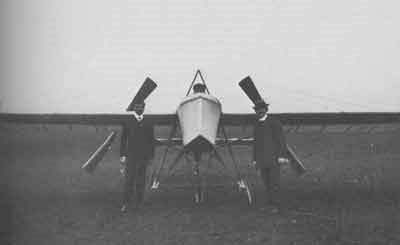
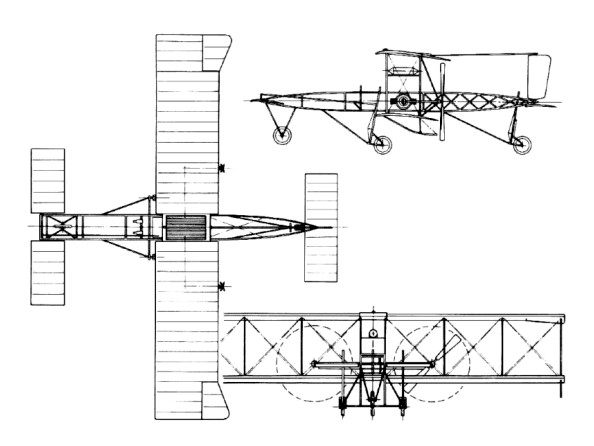
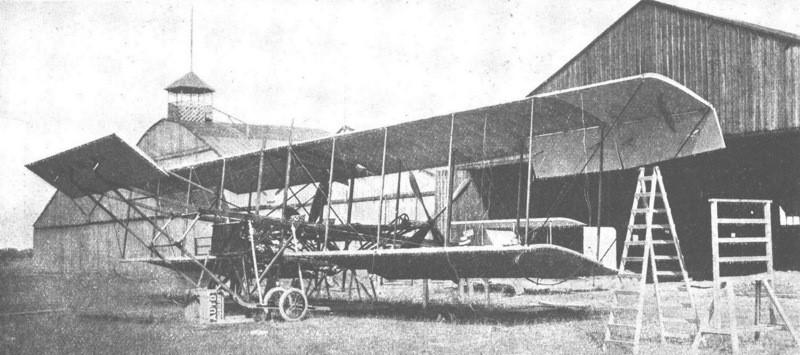
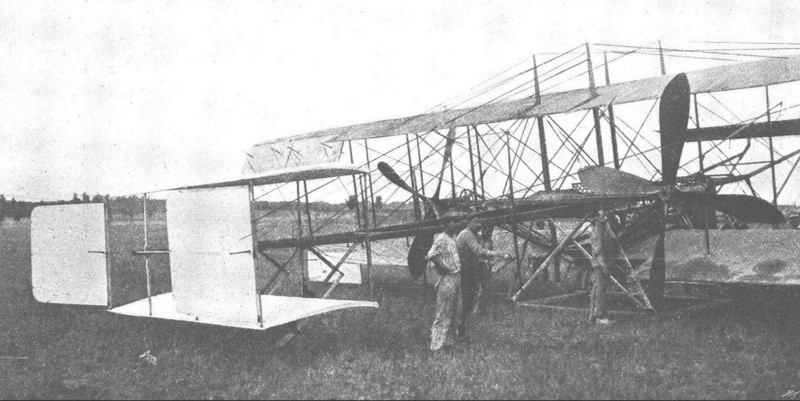
A high-wing monoplane with two pusher propellers powered by a RAW engine. Probably the 1911 typ C, although possibly the typ B. Deicke was quite prolific; he built 10 types from 1908 until 1933, when he introduced a “Volksflugzeug”, the Deicke ADM 11.
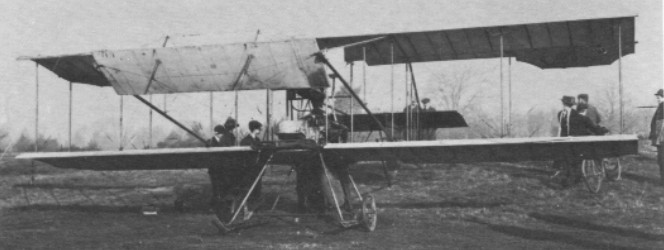
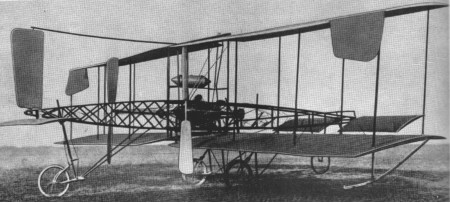
The Balloon Factory at Farnborough decided to buy the de Havilland No. 2 for £400. Being a pusher biplane like the Farman, de Havilland’s aircraft was given the official designation F.E.1 (Farman Experimental No. 1). After quite a lot of flying it was wrecked, rebuilt with a Gnome instead of its original 45 hp de Havilland Iris engine and re-designated F.E.2. A successful fighter of 1916-17.
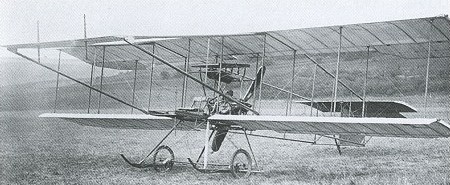
The first Geoffrey de Havilland aeroplane was a biplane built by de Havilland and F.T.Hearle in a shed near Newbury (Berks) in 1908-9. The airframe was American white pine, spruce and ash. The propeller had steel shafts with aluminium blades, and the airframe covered in undoped bleached cotton.
Flown (or hopped) on a racecourse there, it crashed; but he built another.
Engine: 45 hp Iris-built de Havilland 4-cyl horizontally opposed Span: 36 ft 0 in / 10.97 m’ Length: 29′ 0 in / 8,84 m Height: approx. 9 ft 10 in / 3.00 m Wing area: 408 sq.ft / 37.90 sq.m Weight all up: 850 lb 386 kg
Geoffrey de Havilland built his first (unsuccessful) aircraft in 1909. His second, flown in 1910, was bought by the War Office, and de Havilland was taken on as designer at the Balloon Factory (later Royal Aircraft Factory), where between 1911 and 1914 he designed the F.E.2, S.E.1, S.E.2, B.E.1, and B.E.2. In 1914 he joined the Aircraft Manufacturing Company at Hendon, designing the D.H.2 pusher fighter, D.H.3, and D.H.10 twin-engined bombers, D.H.5 fighter, and D.H.4 day bomber. The latter was extensively built in the USA. The D.H.9 and 9a were variations; the 9a equipped post-war RAF bomber squadrons and it, too, was built in the USA. Nearly 3,000 were constructed in Russia as the R-1.
The Aircraft Manufacturing Co. was sold in 1919 to the B.S.A.-Daimler group who, disappointed at the failure of air transport in 1919-20, shut the firm down. Almost immediately de Havilland and C.C.Walker, financed largely by Holt Thomas, out of money which he got by selling B.S.A. shares which he received in payment for the A.M.C. Ltd, started de Havilland Aircraft Co. Ltd. Airco name was temporarily revived January 1958 for production of D.H.121 jet transport.
The first aeroplane built at Stag Lane was the DH.18. The D.H.53 Humming Bird ultralight was the best entrant in the 1923 Air Ministry Light Aeroplane competition, but de Havilland realised that their passion for lightness was an error, and in 1925 produced the first Moth to more sensible proportions. It was sold all over the world. A number of cabin monoplanes and a military version, the Tiger Moth, followed; over 8,000 Tigers were built for various air forces. The three-engined D.H.66 Hercules was flown by Imperial Airways from 1926, and in the 1930s many domestic and foreign airlines used the twin-engined D.H.84/89 Dragon/Dragon Rapide and four-engined D.H.86 Express. In 1934 de Havilland designed the all-wood D.H.88 Comet twin-engined racer for entrants in the “MacRobertson” England-Australia race. At a fixed unit price of GBP5,000 this gamble paid off; three were entered, and one of these won the speed prize. By 1939 the firm was producing the D.H.91 Albatross, a fast airliner with four engines; the twin-engined D.H.95 Flamingo feederliner and the diminutive D.H.94 Moth Minor. All production of these ceased at the outbreak of war, which also cut short a promising bombertrainer, the D.H.93 Don. In 1938 work started on a fast unarmed wooden bomber, the D.H.98 Mosquito. It became one of the most versatile aircraft of its time, and by the end of the war a single-seat fighter version attained a speed of 760km/h. The Vampire, de Havilland’s first turbojet fighter, Venom, Sea Venom and later Sea Vixen, served for a decade after the war.
Geoffery de Havilland in a Vampire cockpit
The other problem arising from the cancelled Don order was the under-utilisation of woodworking skills at the de Havilland factory. To compensate the Company, on 2nd September 1938 the Air Ministry awarded them orders for a large batch of Tiger Moths, some more Queen Bees, plus a contract to build 150 all wooden Airspeed Oxford trainers for the RAF. When Geoffrey de Havilland read the letter, he saw red – de Havilland’s did build somebody else’s aeroplane. de Havilland gave Nixon a simple order – “Buy that company!”
As it transpired, this order took some doing and it would be several years before de Havilland’s owned Airspeed Ltd, of Portsmouth. Airspeed joined de Havilland in 1951. Back in civil work, the company produced the twin-engined Dove, four-engined Heron and, in 1949, the first jet airliner in the world, the D.H.106 Comet. The Comet 1 ran into constructional problems, but the Mark IV achieved success. The last DH designs were the D.H.121 Trident, a three-engined airliner for BEA, and the D.H.125 executive jet (both first flown 1962). Both were still in production in 1978, long after the company’s absorbtion into the Hawker Siddeley Group in 1960, and the D.H.125’s successors were still in production at the turn of the new century.
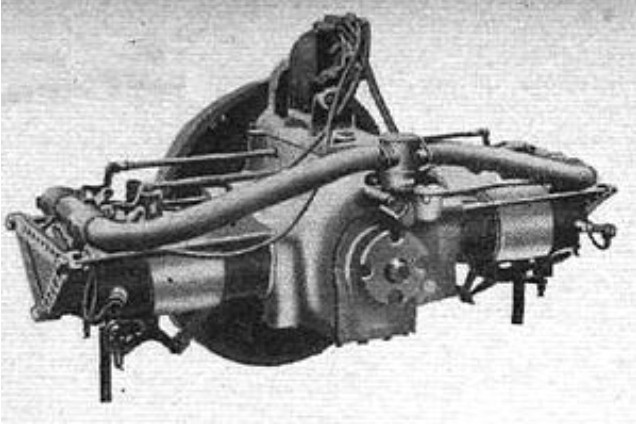
The de Havilland Iris was a British four-cylinder, liquid-cooled, horizontally opposed aero engine. Notable as the first aero engine to be designed by Geoffrey de Havilland it was produced in small numbers between 1909 and 1910 by the Iris Motor Company of Willesden from which it took its name.
By 1908 Geoffrey de Havilland had designed and built two motorcycle engines and his first aircraft, the de Havilland Biplane No. 1. He had studied the engine used by the Wright brothers and believed that he could design a similar unit with an improved power-to-weight ratio. Whilst working as a designer for the Motor Omnibus Construction Company in London he produced drawings for his new engine over a period of three to four months and commissioned the Iris Motor Company, where his brother Ivon de Havilland had been the Chief Designer, to build the first prototype at a cost of £250.
The design featured a horizontally opposed, four-cylinder layout with a single camshaft operating poppet valves through pushrods that were hollowed to save weight. The crankshaft was supported on ball bearings which allowed a simple ‘splash’ lubrication system to be used. Cooling was by water with the cylinders being encased in copper jackets. It first ran in 1909 and, although the engine ran well, it was not placed into production. Only six were built. The only order was a small contract from the British Government for use in airships.
In 1957 instructors and apprentices from the de Havilland Aircraft Company Technical School decided to construct a replica engine, almost 50 years after the original Iris was built. The Iris Motor Company had long since closed and its records, along with the original engine drawings, were destroyed by German bombing during World War II. Flight magazine had featured an article on the engine in May 1910 with a detailed technical description and line drawings. This information along with the original designer’s memory were used to produce a new set of drawings and components. Several companies involved with the original engine assisted with new parts, Claudel-Hobson supplied the carburettor, Lodge Plugs Ltd the spark plugs and Simms Motor Units assisted with re-conditioning a magneto that had been borrowed from the London Science Museum. Connected to a lathe via a belt drive, the engine started at the first attempt in May 1961 and idled steadily at 2-300 rpm. It is reported that the engine was then displayed in the showroom of the de Havilland Engine Company at Leavesden.
Applications: de Havilland Biplane No. 1 de Havilland Biplane No. 2 Government Balloon Factory Gamma
Specifications Type: 4-cylinder liquid-cooled horizontally opposed piston aircraft engine Bore: 4.5 in (114 mm) Stroke: 4.75 in (120 mm) Displacement: 301.46 cu in (4.94 L) Dry weight: 250 lb (113 kg) Valvetrain: Overhead valve Fuel system: Carburettor Fuel type: Petrol Cooling system: Water-cooled, thermo-siphon system Power output: 45 hp (33.5 kW) at 1,500 rpm Specific power: 0.15 hp/cu in (6.8 kW/L) Power-to-weight ratio: 0.18 hp/lb (0.3 kW/kg)
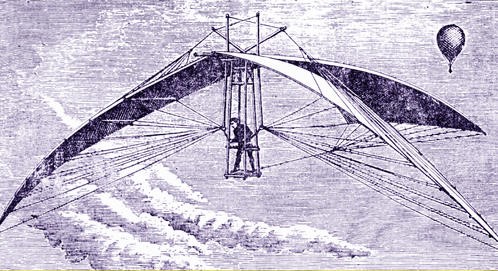
In 1864, a Belgian shoemaker named Vincent de Groof designed an apparatus which was a sort of cross between beating wings and a parachute. His plan was to cut loose with it from a balloon, and to glide down in a predetermined direction by manoeuvring the supporting surfaces. He endeavoured to make a practical experiment, both in Paris and in Brussels, but it was only in 1874 that he succeeded in doing so in London.
The apparatus consisted of two wings, each 24 feet long, moved by the arms and the weight of the operator, and a 20 foot long tail which could be adjusted using one’s feet.
De Groof first went up on June 29, 1874, from Cremorne Gardens, London, attached to the balloon of Mr. Simmons. He came down safely, and claimed to have cut loose at a height of 1,000 feet. Subsequently however, it was stated by others that in fact he had not, on this occasion, cut loose at all, but had descended still attached to the balloon. In any event, he went up again on July 5 following, with the same balloon, and on this occasion he really did cut loose. The result was disastrous. In his descent, as soon as pressure gathered under the moving wings, they were seen to collapse together overhead into a vertical position, bringing De Groof down like a stone and killing him on the spot.
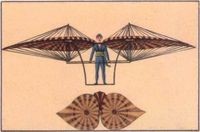
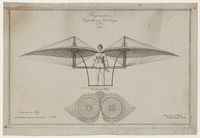
Ornithopter built by Jakob Degen – a Swiss watchmaker living in Vienna – first drafted and published in 1807. Degen made his earliest somewhat successful flights by using a counterweight to assist his lift, indoors at the Winter Riding School of the Spanish Riding School in Vienna on April 18, 1808. That same year, on November 13 and 15, he gave two outdoor performances with his Flying machine at the Wiener Prater using a small hydrogen-filled balloon to aid his ascensions. Later on over the years, three times Degen staged his performance in Paris and is also known to have visited Berlin with his apparatus. These attempts generally resulted in complete failure accompanied with personal injury.
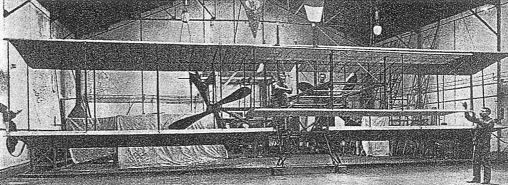
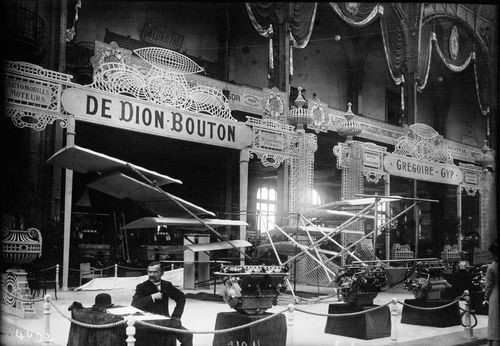
The first of two unsuccessful aeroplanes designed and built by Établissement de Dion-Bouton, the car and motor company. Remotely resembled a Wright Flyer, with twin rudders at the rear, a single small tailplane, and a triplane elevator in front, but instead of wings, each side had four wing-segments set at 30 degrees dihedral. Four propellers were to be employed, driven by a 100 hp engine. Displayed incomplete at the Première Exposition internationale de la locomotion aérienne at the Grand Palais in Paris during September 25 – October 17, 1909, construction and/or testing was likely halted afterwards as nothing more was heard of this flying machine of Jules-Albert de Dion and Georges Bouton.



 All Aero