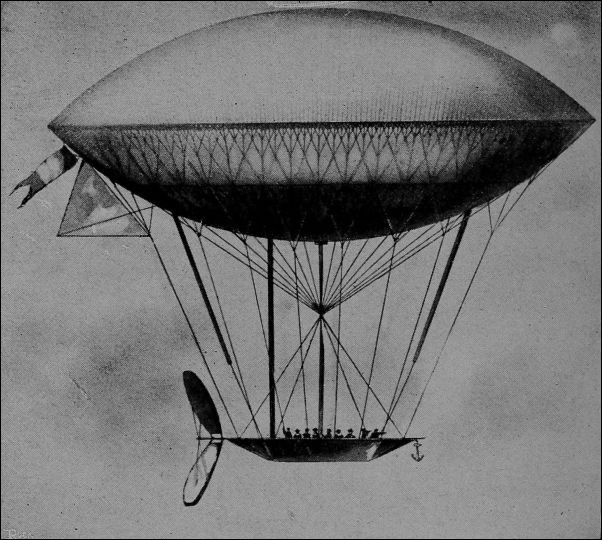
In 1870 Dupuy de Lôme devoted a large amount of time to perfecting a practical navigable balloon, and the French Government gave him great assistance in carrying out the experiments. For carrying out the project, he was given a credit of 40,000 francs; but the balloon was not ready until a few days before the capitulation. These experiments led to the development of one of the first navigable balloons, named the Dupuy de Lôme.
The Dupuy de Lôme airship was 36 meters in length, 14.84 meters in diameter, 29 meters tall, and had a total volume of 3,454 cubic meters. It was powered by a crank, which was operated by 4 or 8 men and which could provide a speed of between 9 and 11 km/h. The basket under the balloon could carry 14 people.