Lorraine 9N Algol

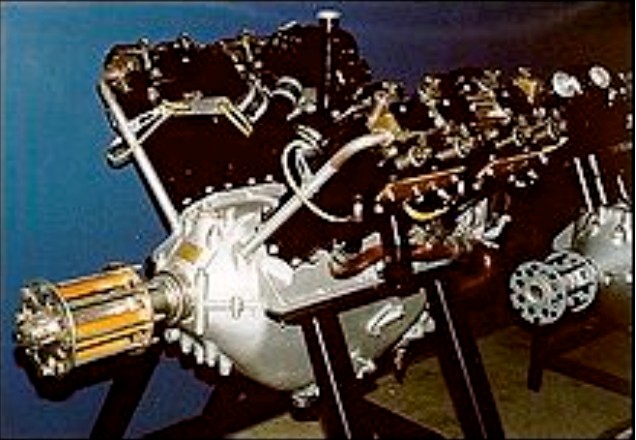
The Lorraine 9N Algol was a French 9-cylinder radial aeroengine built and used in the 1930s. It was rated at 500 hp (375 kW).

A conventionally laid out radial engine, with nine cylinders in a single row. The crankcase was a barrel-shaped aluminium alloy casting, with an internal integral diaphragm which held the front crankshaft bearing. Forward of the diaphragm there was an integrally cast cam-gear case for the double track cam-ring. The reduction gear was housed under a domed casing attached to the front of the crankcase.

Flange-mounted steel barrels were bolted to the crankcase and enclosed with cast aluminium alloy, screwed-on, cylinder head with integral cooling fins. The pistons were also made of aluminium alloy and had floating gudgeon pins. The nine pistons drove the single throw crankshaft via one channel-section master rod and eight circular section auxiliary rods. The master rod had an integral, split type big-end. The crankshaft was machined from a single forging, with bolt-on balance weights.

The Algol had a single pair of overhead inlet and exhaust valves per cylinder. The cam-ring drove roller tappets, mounted in the cam-case, which in turn operated rocker arms, fitted with ball bearings, via pushrods. The cam-ring was concentric with the crankshaft and driven via epicyclic gears.

Most Algols were conventionally aspirated via a single carburetter but at least one 1938 variant used a form of fuel injection, where fuel was blown into the induction system rather than the cylinder head.

Applications:
ANF Les Mureaux 120
Bernard 161
Bloch 120
Bloch 500
FBA 290
Potez 33
PWS-24
Romano R.16
SAB-SEMA 12
Weymann 66

Specifications:
Type: 9-cylinder single row supercharged radial
Bore: 140 mm (5.51 in)
Stroke: 150 mm (5.90 in)
Displacement: 20.78 L (1,268 cu in)
Length: 1.347 m (53.2 in)
Diameter: 1.275 m (50.2 in)
Dry weight: complete 390 kg (860 lb)
Valvetrain: one inlet and one exhaust overhead valve per cylinder, operated with rocker arms, pushrod driven via roller tappets bearing on a double track cam-ring
Fuel system: single Stromberg carburettor, heated by exhaust
Fuel type: petrol
Cooling system: air-cooled
Reduction gear: 11:17
Power output: rated 221 kW (296 hp)
Compression ratio: 6:1
Lorraine / Lorraine-Dietrich

Lorraine-Dietrich was a French automobile and aircraft engine manufacturer from 1896 until 1935, created when railway locomotive manufacturer Société Lorraine des Anciens Etablissments de Dietrich and Cie (known as De Dietrich et Cie, founded in 1684 by Jean de Dietrich) branched into the manufacture of automobiles. The Franco-Prussian War divided the company’s manufacturing capacity, one plant in Niederbronn-les-Bains, Alsace, the other in Lunéville, Lorraine.

In 1896, managing director of the Lunéville plant, Adrien, Baron de Turckheim, bought the rights to a design by Amédée Bollée. This used a front-mounted horizontal twin engine with sliding clutches and belt drive. It had a folding top, three acetylene headlights, and, very unusual for the period, plate glass windshield. While the company started out using engines from Bollée, de Dietrich eventually produced the entire vehicle themselves.

After World War I, with Lorraine restored to France, the company restarted manufacture of automobiles and aero-engines. Their 12-cylinder aero-engines were used by Breguet, IAR, and Aero, among others.

The de Dietrich family sold its share in the company, which became simply known as Lorraine from 1928 on.

Automobile production eventually became unprofitable and, after the failure of their 20 CV model, the concern ceased production of automobiles in 1935.

In 1930, de Dietrich was absorbed by Société Générale Aéronautique, and the Argenteuil plant was converted to making aircraft engines and six-wheel trucks licenced from Tatra. By 1935, Lorraine-Dietrich had disappeared from the automobile industry. Until World War II, Lorraine concentrated on the military market, manufacturing vehicles such as the Lorraine 37L armoured carrier.

The Lunéville plant returned to rail locomotives. In 2007, it still operated as De Dietrich Ferroviaire.

Loring R-III / C-1 / T-1

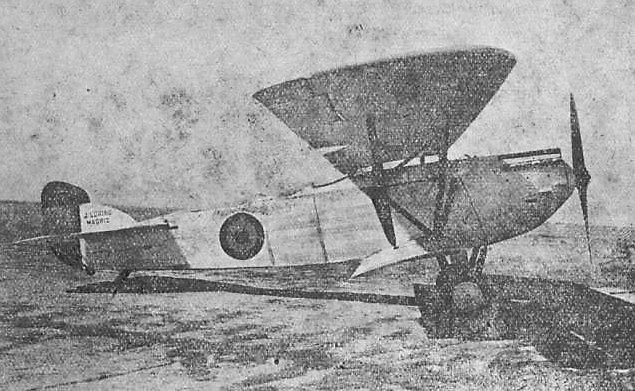
The Loring R-III or R-3 was a 1920s Spanish two-seat sesquiplane reconnaissance and light attack aircraft designed by engineer Eduardo Barrón and built by Dr. Jorge Loring’s company — Talleres Loring.

In the mid 1920s, during General Primo de Rivera’s dictatorship the R-III entered a contest along with the Potez 25 for the modernization of the Spanish Military Air Arm. Both planes had similar characteristics, but the Military Directory favoured the Loring R-III in order to promote local industries. First flying in 1926, the Aeronáutica Militar placed an order of 110 units, which put the Loring company at the head of the Spanish aeronautical industry of the time.

In October and November 1926 three variants of the R-3 were exhibited at the Loring section of the National Aeronautics Exhibition held in Madrid’s Palacio de Cristal: The R-3, the C-1 fighter (one built in 1926) and the T-1 light trainer (one built in 1926). Neither the fighter nor the trainer variants, however, went into production.

Some R-3s remained in service well after the proclamation of the Spanish Republic until the outbreak of the Spanish Civil War. It is not clear, however, whether they saw active service in the civil war.

Engine: 1 × Hispano Suiza 12Hb, 447 kW (600 hp)
Wingspan: 14.50 m (47 ft 7 in)
Length: 9.7 m (31 ft 10 in)
Height: 2.60 m (8 ft 6 in)
Empty weight: 1,400 kg (3,080 lb)
Gross weight: 2,380 kg (5,240 lb)
Maximum speed: 235 km/h (146 mph)
Crew: 2 (pilot, observer)
Armament:
2 × fixed, forward-firing 7.7 mm (0.303 in) machine guns in the engine cowling.
2 × trainable 7.7 mm (0.303 in) machine guns on a Scarff ring for the observer.
40 × 11 kg (24 lb) bombs on under-fuselage racks, or 8 × 50 kg (110 lb) bombs

LoPresti Fury / SwiftThunder

In September 1990 it was reported the name SwiftThunder was adopted for the derivative of the SwiftFury offered to the USAF’s enhanced flight screening aircraft programme. The two aircraft differ only in the tricycle undercarriage on the Swift Thunder. A three-day evaluation of the SwiftFury prototype was being made during August 1990 at the Air Force Academy, Colorado Springs, with five sorties to be flown each day.

LoPresti Fury
Engine: Lycoming IO-360-A1B6, 200 hp @ 2700 @ SL
TBO: 2000 hrs
Fuel type: 100/100LL
Propeller type/diameter: Hartzell CS/76 in.
Landing gear type: Tri/Retr.
Max ramp weight: 2300 lb
Gross weight: 2300 lb
Max landing weight: 2300 lb
Empty weight: 1450 lb
Useful load: 850 lb
Payload, full fuel: 490 lb
Usable fuel (gals.): 60
Wingspan: 29 ft. 3 in.
Overall length: 22 ft. 6 in.
Height: 7 ft. 2 in.
Wing area: 138.6 sq. ft
Wing loading: 16.6 lbs./sq. ft
Power loading: 11.5 lbs./hp
Wheel base: 12 ft. 5 in.
Wheel track: 9 ft. 9 in.
Wheel size: 6.00 x 6 in
Seating capacity: 2
Cabin width: 44 in
Cabin height: 45 in
Baggage capacity: 200lb
Cruise speed 75% power @ 8,300 ft.: 182 kt
Cruise speed 65% power @ 8,300 ft.: 175 kt
Max range (w/ reserve) 55% power: 870 nm
Fuel consumption 75% power: 10.5 USgph
Fuel consumption 65% power: 9.1 USgph
Fuel consumption 55% power: 7.7 USgph
Stall speed (flaps up): 49 kt
Stall speed (flaps down): 44 kt
Best rate of climb: 1350 fpm
Service ceiling: 21,000 ft

López Jalisco

Designed, patented, built and flown in 1909 by Mexican aviation pioneer José Guadalupe Mejía López. During its first test on the plains of the Rosary in the city of Guadalajara, the aeroplane was pulled with a rope by an automobile and rose 4 meters before it collided with a cactus, although suffering only minor damage. López subsequently received a German-made engine of 35 hp and flew the machine a distance of 800 meters at a height of 2.5 meters, thus becoming the first Mexican to build and fly his own aircraft.