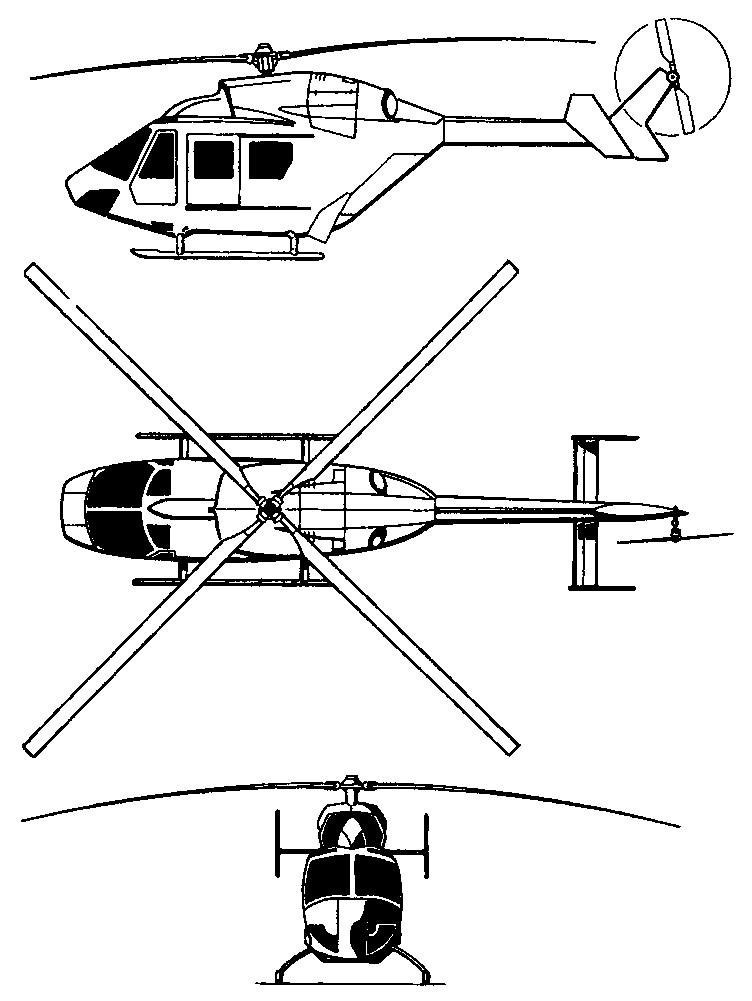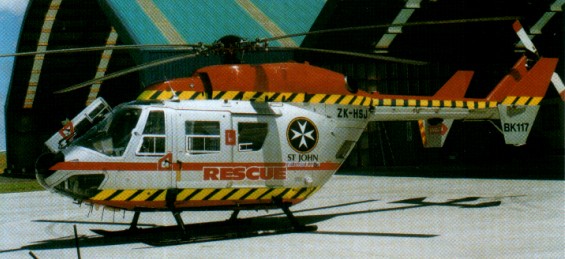
On 25 February 1977, MBB of West Germany and Kawasaki of Japan signed an agreement for the joint development of a twin-turbine utility helicop¬ter suitable for military as well as civil use, following more than two years’ negotiation. Joint development costs were to be divided equally, the financing being guaranteed by the respective governments. MBB was to be responsible for the main rotor and tail rotor, tail boom, empennage, hydraulic system and controls, while Kawasaki was to develop the landing gear, fuselage, transmission and other minor components. This emerged as the BK 117, which uses the BO 105’s rigid main rotor and a Japanese-developed transmission.
The original programme was based on four prototypes, two to be built by MBB in Munich and two by Kawasaki in Gifu, all to be completed by mid 1979. In each case, one of the prototypes was intended for flight testing and the other for static tests. However although the German company succeeded in completing its two models by the end of 1979, only one of the Japanese prototypes was ready on time.
A fair percentage of parts and systems are identical to those of the German Bo.105 helicopter. The hydraulic system is based on the original Bo.105 version and even the rotor is taken from the Bo.105, suitably enlarged to match the demands of the bigger and heavier BK-117. The four-blade rotor is of the rigid type with a titanium hub and reinforced fiberglass blades. The transmission is derived from the Japanese KH-7 project: a seven-ten-seat helicopter which was to have been fitted with two 590shp Lycoming turbine engines. The BK-117 also has a pair of Avco-Lycoming LTS-101-650B-1 engines, delivering 600shp on take-off and 550shp maximum continuous power. The fuel tanks, with a total capacity of 605 liters, are housed in the lower part of the fuselage.
The executive version of the BK-117 carries a pilot and five passengers, but the volume of 3.22cu.m gives room for nine passengers in the high density version or in those used for commuter and offshore services to oil platforms. It can be loaded through two large sliding doors, one on either side of the fuselage. Behind the passenger cabin is a large baggage hold with a capacity of 1.34cu.m, which is reached through two hinged doors at the rear of the fuselage. A cargo hook can be fitted to the cabin floor for external lift work.
German and Japanese prototypes flew for the first time on 13 June 1979 (D-HBKA) and 10 August 1979 (JQ0003, the third BK.117) respectively. Kawasaki was first to fly a production aircraft (JQ1001) on 24 December 1981; MBB followed with D-HBKC on 23 April 1982, this machine being the first production aircraft to be delivered to a customer, in early 1983.
By the beginning of 1982, the BK-117 prototypes had logged more than 750 flying hours and type approval by the German Federal Authorities followed shortly afterwards. Half of the 130 aircraft ordered by February 1982 were for customers in the United States, where deliveries began in early 1983, from two production lines, in Germany and Japan.
Combining utility troop trans¬port and anti-tank capability, the BK.117A-3M was originally conceived as a contender for the Belgian Aeromobility 1 requirement. Based on the civilian BK.117A-3 airframe, the A-3M is offered in a multirole military configuration equipped with an under-nose Lucas 12.7mm or 0.5in gun turret with helmet sight, HOT anti-tank missiles with stabilised roof mounted sight, rocket pods, AAMs, and an ECM and Racal radar warning system, managed by a Racal 3000 Series avionics management system. Provision is also made for a mast mounted sight. Up to 11 troops can be carried in the utility role. Powered by twin Lycoming LTS1O1-650B-1 turboshafts, the BK.117 A-3M has a maximum take-off weight of 3,200kg and an operating range (minus auxiliary tanks) of 495km. MBB later abandoned its armed military BK 117A-3M.
The 1990 production version was the BK.117B-1. This was certificated in 1987 and is powered by two 592 shp (442 kW) Textron Lycoming LTS 101-750B-1 turboshafts.
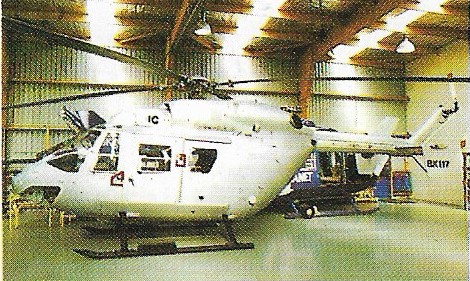
The B-2 model has an increased MTOW and an extended C of G range.
Germany’s ministry of defence used one BK 117 as a composites testing aircraft.
More than 180 BK 117s had been delivered from the production lines in Germany and Japan by 1990.
The BK 117M is a military version, six.of which were delivered for trials with the West German Army.
An agreement was concluded in 1982 for the type to be built in Indonesia under licence by IPT Nurtanio as the NBK-117.
By January 1990 more than 250 BK 117s had been delivered worldwide, including 36 by Kawasaki, the standard aircraft being the BK 117B-1.
Since April 1990 a BK 117 engine testbed has been flying equipped with Turbomeca Arriel turboshafts in an effort to offer customers an alternative engine, and certification was scheduled for 1992.
On 1 September 1991, MBB transferred its Helicopter Division to Eurocopter Hubschrauber GmbH. This was later integrated with Aerospatiale’s helicopter interests into the Paris-based Franco-German Eurocopter Holdings, along with the NH-90, BO 105, BO 108 and BK 117.
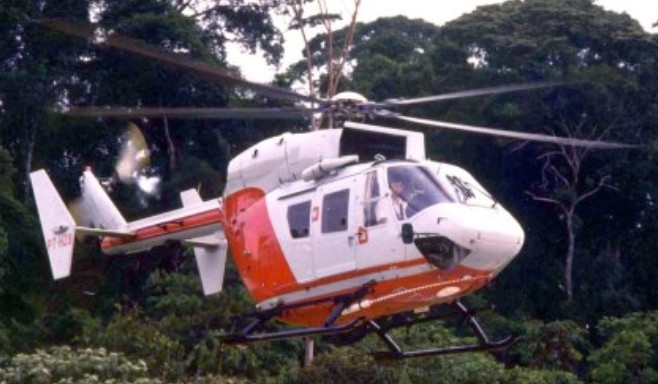
Variants:
BK 117A-1
Initial production version with LTS 101-650B-1 engines
BK 117A-3
Certificated in March 1985 with larger tail rotor fitted with twisted blades and take-off weight increased to 3200kg
BK 117A-4
Certificated in July 1986 with increased transmission limits at take-off power, improved tail rotorhead, and extra internal fuel (on German aircraft), all giving enhanced performance
BK 117 B-1
Fitted with more-powerful LTS 101-750B-1 engines to provide further increased performance and 140kg more payload; certificated in 1987
BK 117M
Military version of A-1 proposed by MBB in 1985, and flying since 1988; fitted with taller skids, a Lucas turret mounted under the fuselage houses a Browning 12.7mm automatic machine-gun and 450 rounds of ammunition, controlled by a helmet-mouted sight; outrigger pylons can carry up to eight HOT II or TOW antitank missiles, air-to-air missiles, rocket-pods, or forward-firing cannons; a doorway gunners position with a 12.7mm gun can also be installed, or 11 troops can be carried
Specifications:
MBB/Kawasaki BK 117
Engine: 2 x Lycoming LTS101-650B-1, 650 shp / 410kW
TBO: 2400 hr
Main rotor: 36.1 ft / 11m
Seats: 8/10
Length: 32.7 ft / 9.91m
Length rotors turning: 13m
Height: 10.9 ft / 3.83m
Max ramp weight: 6283 lb
Max takeoff weight: 6283 lb / 2850kg
Standard empty weight: 3505 lb / 1650kg
Max useful load: 2778 lb
Max landing weight: 6283 lb
Max sling load: 2645 lbs
Disc loading: 6.1 lbs/sq.ft
Power loading: 7.4 lbs/hp
Max usable fuel: 1058 lbs
Max rate of climb: 1830 fpm
Service ceiling: 17,000 ft / 4570m
Hover in ground effect: 11,000 ft
Hover out of ground effect: 8700 ft
Max speed: 150 kts
Normal cruise @ 3000 ft: 139 kt / 250km/h
Fuel flow @ normal cruise: 463 pph
Endurance @ normal cruise: 2.1 hr
Range max payload: 500km
BK.117
Engine: 2 x Lycoming LTS 101-750A3, 986 shp
Empty wt: 1849 kg
Cruise: 130 kts
Range: 540 km (340nm)
BK.117B-2
Engine: 2 x Lycoming LTS 101-750B-1
Instant pwr: 548 kW
Rotor dia: 11 m
MTOW: 3350 kg
Useful load: 1595 kg
Max speed: 150 kts
Max cruise: 133 kts
Max range: 540 km
Crew: 2
Pax: 10
Seats: 8/11.
BK.117C-1
Engine: 2 x Turbomeca Arriel 1E2
Instant pwr: 574 kW
Rotor dia: 11 m
MTOW: 3350 kg
Useful load: 1585 kg
Max speed: 140 kts
Max cruise: 133 kts
Max range: 540 km
Crew: 2
Pax: 10
Seats: 8/11
BK.117M
Engines: two 592-shp (441-kW) Lycoming LTS 101-650B-1 turboshafts
Maximum speed 155 mph (250 km/h) at sea level
Initial climb rate 1,476 ft (450 m) per minute
Service ceiling 15,000 ft (4,570 m)
Range 308 miles (495 km)
Empty weight 5,644 lb (2,560 kg)
Maximum take-off weight 7,055 lb (3,200 kg)
Main rotor diameter 36 ft 1 in (11.00 m)
Length overall, rotors turning 42 ft 8 in (13.00 m)
Height 11ft 0.3 in (3.38 m) to top of rotor head
Main rotor disc area 1,022.96 sq ft (95.03 sq.m)
Armament: one 0.5-in (12.7-mm) machine gun and disposable weapons
Hardpoints: 2