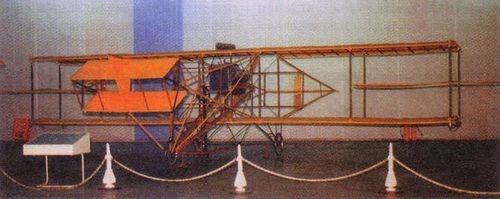
Feng Yue #2 at the National Aviation Museum in Nanking.
Although the “Feng Ru No. 1″ airplane was damaged during the first test flight, it can be proven that it flew, and the Chinese immigrants in the USA were legitimately very proud. They continued to support Feng Ru’s airplane endeavors, and in January 1911 Yue started his new airplane”Feng. 2” in Oakland.
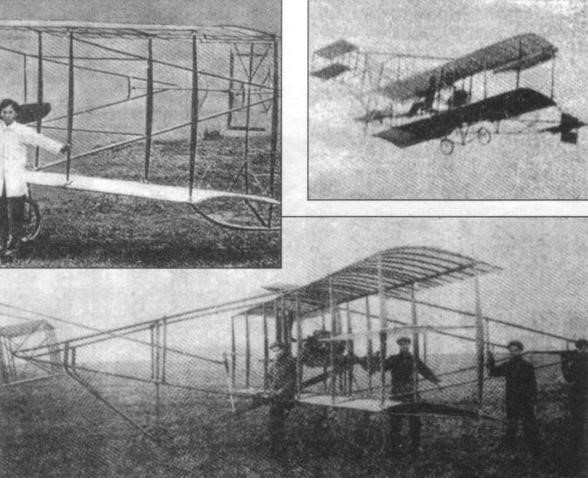
Yue launched his second airplane above the Piedmont hills on September 21, 1909. The Feng Yue #2 was Curtiss-like, but had some differences in the front elevator assembly.
This was the first airplane manufactured by an Oakland resident to fly in that area. Unfortunately, this airplane crashed as well after a twenty minute flight when the bolt holding the propeller shaft broke. Fong continued building planes, and in 1911, his plane stayed in the air for 40 minutes and landed without a mishap.
With financial support from other Chinese immigrants in the USA, Feng Yue began to build an airplane in 1906. In 1907, in Oakland, a city east of San Francisco, in spite of all kinds of difficulties, he constructed the Guangdong Airplane Factory. By 1909 he had built an aeroplane, the first which had been designed and built by a Chinese. He called it “Feng Ru No. 1”.
On September 21, 1909, Feng Ru completed the first test flight from a hill in the proximity of Oakland, which was witnessed by some American journalists as well as three of his coworkers. Feng Ru reached a height of 4.5 meters with his airplane, and flew some 800 meters along the hill. Thus, he was the first Chinese who had built and flown an airworthy airplane.
After approximately 20 minutes, the flight came to a sudden end when the propeller failed and the aeroplane fell to earth from a small height. Fortunately, Feng Ru got off with only a bad scare and was not hurt. The first one crashed into his own workshop, starting a fire that burned it to the ground.
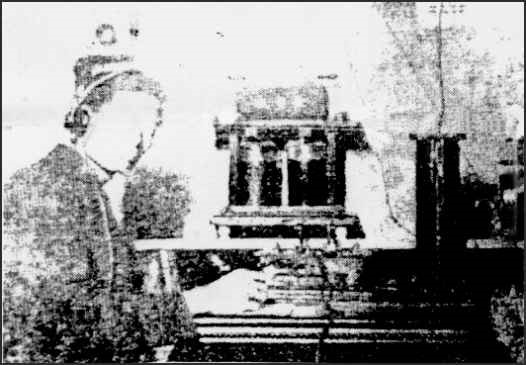
Born on 15 December 1882 in the Yanping district of Kwangtung province, Fong Yue (or the now more accepted spelling of his name, Feng Ru, also seen as Fung Joe Guey and Feng Ru) came to the United States at the age of twelve, living and working in various parts of California and attended evening classes to study English before trying to settle in San Francisco in 1906. The earthquake spoiled his plan and sent him fleeing to Oakland. He developed an interest in machinery and electrical technology, spending his evenings home carrying on experiments to satisfy his curiosity. He designed and constructed electric motors and set up a wireless telegraph set in his own room. He was always interested in machinery, and one of the first things he did after arriving in Oakland was to organize an airplane manufacturing company, only a few years after the Wright Brothers’ Kitty Hawk flight.
1904 brought the Japanese-Russian war in northeast China. Feng Ru participated in the happening in China in the USA, and he was conscious itself of the military meaning of the new flight apparatuses. He said: “Had we had thousands of airplanes at the Chinese border, the foreign forces would have surely been deterred.” Thus he decided to dedicate himself to the development of aviation in China.
Fong Yu in his Machine Shop, circa 1907
Within two years of founding the company in 1908, Fong Yue constructed his first airplane and even manufactured his own motor.
On its test flight the first one crashed into his own workshop, starting a fire that burned it to the ground. Assumably the airplane went with it, but Yue was undaunted, and built a second ship that he flew from the Piedmont Hills on 21 September 1909, as reported by Associated Press. After 20 minutes a bolt on its propeller shaft broke and it, too, crashed, and its creator was thrown out, but escaped injury. He returned to China in 1911 with his mechanic and two Curtiss planes, and built China’s first aircraft. Yue was killed in a crash there in 1912, but his legend is perpetuated by a play, “Dragonwings,” last presented, as known, in San Francisco 1992.
Undaunted, the aviation pioneer found space to build his second airplane which he launched above the Piedmont hills on September 21, 1909. This was the first airplane manufactured by an Oakland resident to fly in that area. Unfortunately, this airplane crashed as well after a twenty minute flight when the bolt holding the propeller shaft broke. Fong continued building planes, and in 1911, his plane stayed in the air for 40 minutes and landed without a mishap.
Dr. Sun Yat Sen, the prominent revolutionary who at the time was in the USA and had heard of the flights of the Chinese Feng Ru in Oakland. When he learned more of the successful test flights, Sun Yat Sen commended the flight pioneer Feng Ru’s courage and encouraged him to dedicate himself to aviation in China and help organize a national air force.
He did. In February 1911, Feng Ru made his way to China from Oakland, taking with him two airplanes. He wanted to develop aviation in China.
A revolution led by Sun Yat Sen caused the downfall of the Qing dynasty monarchy in China in October, 1911. Feng Ru participated in it and was appointed Captain of the Air Force by the revolutionary government of the Guangdong province. In March 1912, he built his first airplane in China, the very first airplane to be manufactured in China. At that time, the country as a whole acknowleged that Feng Ru had become the pioneer of Chinese aviation.
Later, he organized aviation shows on several occasions in China in order to popularize aviation among the Chinese. On August 25, 1912, at one of the shows in Guangzhou, Feng Ru crashed and died. He was only 29 years of age.
The contribution of Feng Ru to the development of aviation in China is not forgotten. After his death a monument for him was erected in Guangdong.
Built in 1928 by Richard E Young in 1928, the Model A / Special cabin biplane first flew on 5 October 1928. The registration NX7960 was cancelled on 1 January 1959.
Engine: Warner Scarab, 90hp Wingspan: 28’0″ Length: 19’6″ Seats: 4
Circa 1922 J.J.Young built a single place coaxial rotor helicopter. The rotors consisted of carved propellers driven by a rotary engine. It is not known if the machine was flown.
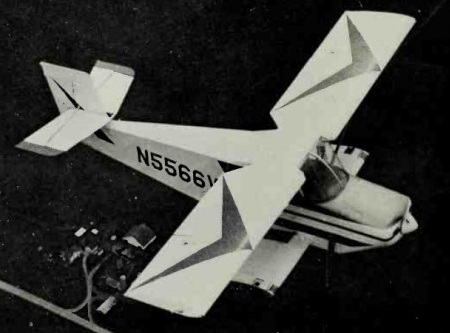
Designed by FAA employee Edward Young of Erie, Colorada, USA, the Young Eddyo F-2 was a two-seat side-by-side light aircraft and took three years of spare-time activity to complete at a cost of $2,500.
The Eddyo F-2 was a sesquiplane and had Vee-braced upper wings, which carried the ailerons, and cantilever lower stubwings which contained the fuel tanks. It had full span trailing-edge flaps. Construction was conventional, with wooden wings and a steel-tube fuselage and tail unit, all fabric-covered. The design featured tail-wheel landing gear which utilised cantilever spring steel main legs. The engine was a Lycoming O-290-D2 four-cylinder 135 hp horizontally-opposed air-cooled which drove a two-blade fixed-pitch propeller.
The sole aircraft, registered N55566V, first flew on November 4, 1963.
The aircraft registration was finally cancelled on 12 December 1983.
Powerplant: Lycoming O-290-D2, 135 hp Wing span (upper): 23 ft 1 in (7.04 m) Constant chord: 3 ft 10 in (1.17 m) Length: 19 ft 5 in (5.92 in) Height: 6 ft 0 in (1.83 m) Empty weight: 997 lb (452 kg) Maximum take-off weight: 1,525 lb (692 kg) Maximum level speed at sea level at MTOW: 145 mph (233 km/h) Cruising speed: 130 mph (209 km/h) Landing speed: 70 mph (ll3 km/h) Service ceiling: 8,000 ft (550 m) Range with maximum fuel: 425 miles (685 km) Accommodation: 2 seats
The Swales SD3-15 was developed from the Birmingham Guild BG 135 Gipsy, the 13.5m span version of the BG 100/12 designed by J. C.Gibson, K. Emslie and L. P. Moore of Sailplane Design Ltd. Manufacturing rights of the BG 135 were acquired by Yorkshire Sailplanes Ltd, who built a batch of seven as the YS 55 Consort. The BG 135 was itself developed from the earlier and very similar Birmingham Guild Gipsy 12/15 project which, like the BG 100/12, was intended to be a low cost lightweight Standard/Sports Class sailplane in which either a medium-performance 12m wing or a high performance 15m one could be fitted to a common fuselage and tail unit. This was to be achieved by special attention to structural efficiency resulting from efficient wing skin stabilisation, with rigid foam cores, and low cost was achieved by eliminating taper as well as twin-skin sandwich or ribbed forms of construction. The prototype BG 100/12, with a 12m (39ft 4in) span wing, first flew on 7 April 1970 and was a cantilever shoulder-wing monoplane of all-metal construction with a V-tail and a large hinged moulded cockpit canopy; a 13.5m span wing was later fitted.
Structurally, the SD3-15 is very similar to the BG 135 and BG 100/12.


 All Aero