Pottsville PA.
USA
Circa 1950s airplane builder
Pottsville PA.
USA
Circa 1950s airplane builder
Designed by Felix Knoll during 1929-1930, the Y-1 and Y-2 were three place open cockpit biplanes.
The Y-1 N421N c/n 1 was powered by a 165hp Warner. When the company floundered it sold for a whole dollar ($1) to Carrol Beckwith of Larned KS. The registration was cancelled by CAA 7 January 1933 after he informed them it was dismantled.
The Y-2 N490N c/n 2 was powered by a165hp Wright R-540A. the Y-2 crashed on 27 March 1930 and its registration was cancelled.
Established in 1929
(George C) Yunker Aircraft Co
115 Osage St
Wichita KS.
USA
Airplane builder
In receivership in 1930.

The Yuneec International E430 is a Chinese two-seat electric aircraft designed for commercial production by electric model aircraft manufacturer Yuneec International.
The E430 is a two-seat, V tailed, composite aircraft with a high-aspect ratio wing. Take-off speed is 40 mph, cruise speed is 60 mph, and max speed is 95 mph.
The company claims that the battery packs have an expected lifespan of 1500 hours and cost US$7000 each, with the aircraft carrying 3-5 battery packs, giving two to two and half hours endurance. The batteries can be recharged in 3–4 hours from a 220v outlet.
The aircraft was being developed as a kit aircraft for the US market. The development of the E430 was being funded entirely by Yuneec CEO Tian Yu.
The aircraft was first flown on 12 June 2009 from the Yuneec factory near Shanghai, China, and then shipped for further testing to Camarillo, California. On 14 July 2009 the prototype aircraft was registered in the USA as N386CX and on 18 July 2009 it was given a Certificate of Airworthiness by the Federal Aviation Administration and further test flights were carried out, totalling 22 hours. The prototype E430 was then shipped by truck to Wisconsin and displayed at EAA AirVenture Oshkosh in July 2009. It was also on display at that venue in summer of 2010.
In July 2009 the company estimated that the price for a commercially available light sport aircraft production version of the E430 would be US$89,000.
At AirVenture 2010 the company announced that it would start accepting orders for the aircraft after the show. At that date the aircraft was advertised as having an endurance of 2.25 to 2.5 hours with a useful load of 390 lb (177 kg). The E430 was named the winner of the Lindberg prize for electric aircraft at AirVenture in 2010. The Lindbergh Electric Aircraft Prize (LEAP) was awarded by Erik Lindbergh, the grandson of Charles A. Lindbergh and Anne Morrow Lindbergh. In the same year it was named Brit Insurance Design of the Year in the transport category. Deliveries were initially scheduled for late 2011, but by the end of 2012 there was no indication that more than prototypes had been completed.
Yuneec International, created GreenWing International and in June 2013 it was announced that their GW280 (eSypder) and GW430 (e430) airplanes will be produced, marketed and supported by GreenWing International, however that company went out of business in about 2014.
By December 2012 a total of two examples had been registered in the United States with the Federal Aviation Administration. The first one was the initial prototype shipped to the US, registered in the Experimental – Exhibition category on 14 July 2009, although its registration expired on 31 March 2012. The second was registered in the Experimental – Research and Development category on 26 January 2011 to Flying Tian of Monterey Park, California.
E430
Engine: 1 × Yuneec Power Drive 40, 40 kW (54 hp)
Batteries: Yuneec OEM Lithium Polymer, 13 kg (28.6 lbs), 66.6V (30 Ah) each
Propeller: 2-bladed fixed pitch
Length: 6.98 m (22 ft 11 in)
Wingspan: 13.8 m (45 ft 3 in)
Wing area: 11.37 sq.m (122.4 sq ft)
Empty weight: 250 kg (551 lb) with batteries
Gross weight: 470 kg (1,036 lb)
Maximum speed: 150 km/h (93 mph; 81 kn)
Cruising speed: 90 km/h (56 mph; 49 kn)
Stall speed: 70 km/h (43 mph; 38 kn)
Range: 227 km (141 mi; 123 nmi)
Maximum glide ratio: 25:1
Rate of climb: 3.5 m/s (690 ft/min)
Wing loading: 41.3 kg/sq.m (8.5 lb/sq ft)
Seats: 2

The Flightstar is a large family of single and two-seat, high wing, single engined kit aircraft that was produced by Flightstar Sportplanes of South Woodstock, Connecticut. In 2009 the rights, tooling and parts inventory were sold to Yuneec International of China when Flightstar Sportplanes’ business was wound up.
In April 2014 Yuneec International of China debuted its eSpyder electric at the AERO event in Germany. The eSpyder is a reworked Flightstar ultralight from the 1980s. Flight Design USA’s Tom Peghiny, producer of the Flightstar for many years, sold the design to Yuneec but continued helping with development. The eSpyder, has completed Germany’s DULV aviation standard.
In July 2009 a new single seat model was exhibited at EAA AirVenture Oshkosh. The aircraft is intended to be developed into a commercially available kit and forecast to be available for under US$25,000.
The e-Spyder is an electric-powered and beefing up (enlarging and strengthening) version of the Flightstar Spyder. The aircraft replaces the Spyder’s two-stroke engine with a Yuneec Power Drive 20 20 kW / 27 hp electric motor and two 28 lb (13 kg) Lithium polymer battery packs which provide a 40-minute endurance.

The E-Spyder, a single seat electric powered aircraft featuring the PowerDrive 24 propulsion system integrating the Motor, Motor Controller, 75 Volt Battery, and Charger, received the world’s first type certification for an electric aircraft from Deutschen Ultraleichtflugverbandes (DULV) E.V in 2013.

Yuneec International created GreenWing International to further develop and market their GW280 (eSypder) and GW430 (e430) airplanes. GreenWing International went out of business in about 2014.
GreenWing International had announced the release of its first 50 eSpyder single-seat electric planes, which were to be sold as build-it-yourself kits for for under US$40,000. The company was to ship 25 eSpyders in the United States at a cost of US$39,990. Another 25 were to be sold in Europe for €34,990 each.
Power: PowerDrive 24, 24 kW / 32 hp
Battery: 75 Volt, 13-kWh lithium
Wingspan: 10.1 m / 33.1 ft
Length: 5.9 m / 19.4 ft
Height: 2.4 m / 7.9 ft
Empty weight: 186 kg / 410 lb
Max cruise: 68 mph / 109 km/h
Economy cruise: 38 mph / 61 km/h
Standard flight time: 60 – 90 min
Battery recharging: 2 – 3 hr

The Yuneec Power Drive 40 is a Chinese electric motor for powering electric aircraft and motorgliders, designed and produced by Yuneec International of Kunshan, Jiangsu.
The Power Drive 40 is part of a family of scalable electric motor designs produced by Yuneec. The family of engines is designed to use the company’s own power controller, Lithium polymer battery pack and charger, as an integrated package of components. This ensures that all components are compatible and also removes the need for aircraft builders to separately source components.
The Power Drive 40 is a brushless 133 volt design producing 40 kW (54 hp), with an outrunner. The low working rpm of the engine means that it can turn a propeller at efficient speeds without the need for a reduction drive.
Applications:
Yuneec E430
Yuneec EViva
Specifications:
Power Drive 40
Engine type: Brushless electric aircraft engine
Length: 163 mm (6.4 in)
Width: 240 mm (9.4 in)
Height: 240 mm (9.4 in)
Weight: 19 kg (42 lb)
Coil type: Outrunner
Bearings: 2
Reduction drive: none
Cooling: air
Voltage: 133 nominal
Current drain, maximum: 285 A
Current drain, cruise: 180 A
Power: 40 kW (54 hp) at 2400 rpm
Power to weight: 2.1 kW/kg
The Yuneec Power Drive 10 is a Chinese electric motor for powering electric aircraft, designed and produced by Yuneec International of Kunshan, Jiangsu. Major applications are paramotors.
The Power Drive 10 is part of a family of scalable electric motor designs produced by Yuneec. The Power Drive 10+ produces the same power but at a reduced rpm.
The family of engines is designed to use the company’s own power controller, Lithium polymer battery pack and charger, as an integrated package of components. This ensures that all components are compatible and also removes the need for aircraft builders to separately source components.
The Power Drive 10 is a brushless 67 volt design producing 10 kW (13 hp), with an outrunner. The low working rpm of the engine means that it can turn a propeller at efficient speeds without the need for a reduction drive.
Variants:
Power Drive 10
Model that produces 10 kW (13 hp) at 2400 rpm, with a weight of 4.5 kg (9.9 lb).
Power Drive 10+
Model that produces 10 kW (13 hp) at 2000 rpm, with a weight of 6.0 kg (13.2 lb).
Applications:
Yuneec International EPac paramotor
Yuneec International ETrike ultralight trike
Specifications:
Power Drive 10
Engine type: Brushless electric aircraft engine
Length: 114 mm (4.5 in)
Width: 160 mm (6.3 in)
Height: 160 mm (6.3 in)
Weight: 4.5 kg (9.9 lb)
Coil type: Outrunner
Bearings: 3
Reduction drive: none
Cooling: air
Voltage: 67 nominal
Current drain, maximum: 180 A
Current drain, cruise: 55A
Power: 10 kW (13 hp) at 2400 rpm
Power to weight: 2.2 kW/kg
Founded in Hong Kong in 1999, Yuneec International Co. Ltd. became a leader in electric aviation.
With hundreds of patents filed, Yuneec’s core technologies power its manned aircraft as well as its drones and its line of radio controlled aircraft for the hobby market.
The company was constructing a 260,000 square foot (25,000 sq m) factory to produce the E430 aircraft in Shanghai that was expected to open in October 2009.
In 2009 the rights, tooling and parts inventory of Flightstar Sportplanes of South Woodstock, Connecticut, were sold to Yuneec International of China when Flightstar Sportplanes’ business was wound up.
AB Yumashiev built the Yu-1 glider in Kiev in 1925. Designed as a training glider, it was developed with a view to participating in the competitions that year in Crimea.
The Yumashiev Yu-1 (Russian: Юмашев Ю-1) was conceived as a single-seat training glider. It was conceived as a high-wing cantilever monoplane. The wing, with the Pr-426 profile, had a double spar structure and a trapezoidal shape in the plane.
The fuselage was built with a plywood frame structure and had an aerodynamic wing profile shape (curved at the top and flat at the bottom). The front 2/3s were covered in sheets of plywood. The tail section was covered with fabric.
The Yu-1’s offset rudders featured a rounded shape.
The landing gear featured a conventional wheeled structure, but for record flights they could be concealed within the fuselage. For training flights they were kept exposed.
First flying in September 1925, the Yu-1 glider was entered in the III National Sailing Competitions held in Koktebel in 1925. On September 30, Yumashiev managed to stay in the air in this glider for 1 hour and 30 minutes, which was a national record.
A day later, on October 1, Yumashiev at the controls of the Yu-1 would achieve for the first time in the USSR, a long-distance flight taking advantage of thermal currents. This flight recorded 4800 meters and was considered a national record, because in the competitions the longest flight value would be 24.4 km, reached by the German Nering on his “Consul” glider. For this flight Yumashiev would receive the award for second place in the competition.
Yumashiev Yu-1
Wingspan: 12.20 m
Wing area: 17.20 m²
Length: 5.70 m
Empty weight: 83 kg
Wing loading: 9.5 kg / m²
Rudder surface area: 2.00 m²
Ailerons surface: 3.00 m²
Wing elongation ratio: 8.7
Accommodation: 1
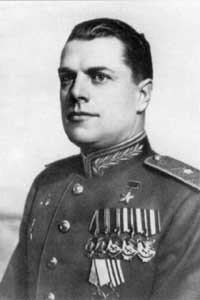
Andrei Borísovich Yumashiev (Russian: Андрей Борисович Юмашев) Andrei Yumashiev was born in Saint Petersburg on March 31, 1902. He finished art school. He joined the Red Army in 1918. In October 1920 and February 1921 he participated in combat actions on the southern front as a soldier in an artillery division. In 1921 he finished artillery courses in Sevastopol.
In 1923 he finished training at the Yegórievsk Aviation Theoretical-military School and in 1924 the Borisoglebsk Higher Flight School and the Serpukhov Higher School of Air Combat, Shooting and Bombing. He later served in the VVS. Between 1926 and 1927 he worked as an instructor pilot at the Serpukhov school.
Between 1927 and 1937 he worked on the NII VVS as a test pilot. He made the first flight and tests of the Bartini Stal-6 (1933). He ran the state tests of the models of A. N Túpolev I-4 (1927), R-3 (1928), TB-1bis (1929 – 1930), R-7 (1930), R-6 (1931), TB -3 (1933), the Polikarpov I-3 fighter (1928 -1929) and the Bartini Stal-7 transport (1936 – 1937).
At the Third National Flying Competitions in Koebel, held in 1925, one of the best Soviet gliders was the Yu-1 designed and built by Yumashiev. This glider demonstrated staying in the air for an hour and a half and reaching 375 meters in height. These results were national records.
He set six world records (including two as co-pilot): in 1936 two flight weight records in the Tupolev TB-3TB-3 and in 1937 two flight distance records aboard the Túpolev ANT-25 as a crew member of MM Gromov.
Between 1937 and 1941 he worked as a test pilot for the TsAGI. During this period, it made the first flight and tests of the BOK-7 (1939). It participated in the crew tests in preparation for the projected long-range voyage on the BOK-15 (1940).
He participated in the Winter War with Finland. Between January and March 1940 he was appointed substitute for the commander of the 85 bombing regiment, carrying out more than 10 combat sorties. As of March 1941 he went on to serve as a substitute for the head of the LII (MM Gromov), attending the flight section. He participated in the flights of the Yakovlev UT-2 with an air cushion and the Gribosvki G-28 “Krechet”.
He fought in the Great Patriotic War. Between July and August 1941, he led the second independent fighter squadron subordinate to the Moscow Air Defense (PVO). In January and February 1942 he commanded the 237th Fighter Aviation Regiment on the Kalinin Front. Between March and August 1942 he was appointed substitute for the commander of the 3rd Air Army and between August 1942 and February 1943, substitute for the commander of the 1st Air Army. Between March and June 1943 he commanded the 6th Fighter Aviation Corps and between July 1943 and December 1944 he led the PVO of the Western and Southern fronts.
Between 1945 and 1946 he was appointed head of the Directorate of Hunting Aviation of the Main Directorate of Combative Preparation of the VVS. From 1946 it went to the reserve.
Lived in Moscow. In his spare time he devoted himself to painting, forming part of the Union of Painters of the USSR. He died on May 20, 1988. His remains rest in the Bagankovsky Cemetery in Moscow.
Awards and distinctions:
Hero of the Soviet Union (1-09- 1937)
Two Order of Lenin
Five Order of the Red Banner
Order of the Patriotic War 1st rank
Order of the Red Star
Medals
He received the De la Vaux medal awarded by the FAI (1937).
 All Aero