Mohawk Aircraft Corporation formed at Minneapolis in 1927, developing their Spurwing two-seat monoplane with a Warner Scarab engine and similar three-seater Redskin.
Era
Mohawk Air Services
Subsidiary of Allegheny Airlines Inc., Washington D.C., formed to control conversion program for Mohawk 298, UACL PT-6A-45-powered Nord 262 airliner, being undertaken by Frakes Aviation Inc. First example flew January 7,1975.
Mohawk Aerial Navigation Company Glider
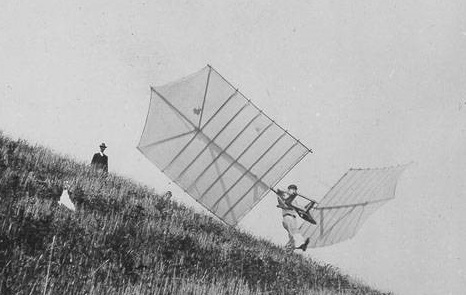
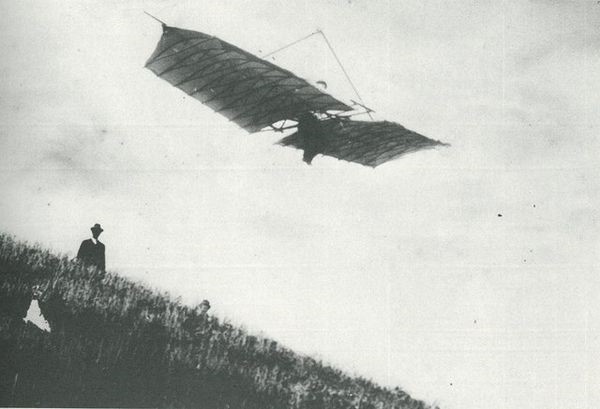
One of the gliders built by Charles Proteus Steinmetz – the “Wizard of Schenectady” – and others in 1894. While working for General Electric at Schenectady, N.Y., Steinmetz organized a band of fellow flying machine enthusiasts into the Mohawk Aerial Navigation Company, and over the summer of 1894 built and tested a man-carrying kite and two true gliders. None were particularly successful.
Mohawk Aerial Navigation Company
Charles Proteus Steinmetz he had dwarfism, was hunchback, and had hip dysplasia. While working for General Electric at Schenectady, N.Y., Steinmetz organized a band of fellow flying machine enthusiasts into the Mohawk Aerial Navigation Company, and over the summer of 1894 built and tested a man-carrying kite and two true gliders. None were particularly successful.
MNV MMV-1
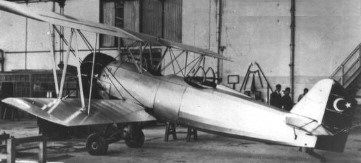
The aircraft designer Selahattin Resit Alan worked after studying in France at the Aircraft-Repair-Center, Eskisehir. Apart from his official activities at the center, he constructed, with the help of the carpenter master Mehmet and a small team, the two-seat training and reconnaissance aircraft MMV-1. The aircraft was ready for flight in October 1932. Except the fact that the aircraft was flown on 29 October 1935 for the ceremonies for the establishment of the Turkish Republic, there is no further indication it was ever flown again. Since the Ministry of Defence did not have any interest in the aircraft, Alan quit his position and began to work with Nuri Demirag in 1935.
M.M. Super Rotor AC.4
AC.4 single-seat autogyro dated from 1970s as a design of Altair Coelho. Marketed by this company after purchase of rights and many sold in assembled and kit forms.
MMPL / MCDC Kanpur
For the Maintenance Command Development Centre, Air- Vice Marshal Harjinder Singh of the Indian Air Force designed Kanpur I four-seat light aircraft, prototype built at MCDC in 132 days.
Kanpur II with 250 hp Lycoming engine, first flown October 1961.
MMPL / MCDC
India
For the Maintenance Command Development Centre, Air-Vice Marshal Harjinder Singh of the Indian Air Force designed Kanpur I four-seat light aircraft, prototype built at MCDC in 132 days. Kanpur II with 250 hp Lycoming engine, first flown October 1961.
M.L. Aviation Utility / ML.1
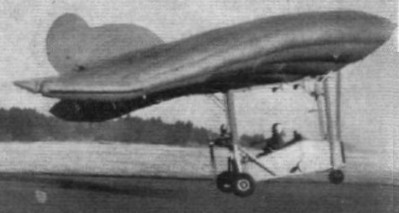
In 1955 ML Aviation at White Waltham designed and produced a portable flying machine called the ML Utility ML.1. Given the serial number XK776, the aircraft featured an inflatable rubberised fabric wing and quick release fittings enabling the aircraft to be rigged and de-rigged fairly quickly.
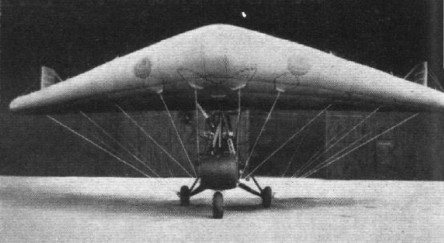
Over the period of a year, the prototype fuselage was redesigned from the box like structure, to a slimmer, longer structure with tandem seating fir a pilot in the front, and passenger. The tricycle undercarriage, with swivelling nosewheel, changed from wheels on a horizontal axle to rear wheels mounted on legs.
The 65 hp McCulloch pylon mounted pusher of the prototype was changed in the Mk.1 to a Walter Mikron in a cowling faired into the rear of the fuselage. Fuel was a mix of methanol, benzole, and petrol. Cruising speed increased from 45 mph to 58 mph.
The inflatable rubberised-fabric wing, of delta planform, was cleaned up. The basic structural method was retained with the upper and lower surfaces being connected by a number of porous fabric diaphtrams running spanwise and maintaining a symmetrical aerofoil profile developed from NACA 0024. After initial inflation on the ground, the wing is maintained at its correct internal pressure, under 1 lb/sq.in, by an electric pump and relief valve. The prototype had a windmill operated pump.
Control was by inflated elevons over almost the full span of the trailing edge, operated by cable from an inverted control column mounted on the fuselage superstructure. Vertical stabilising surfaces fitted near the wingtips replaced the central fin of the prototype.
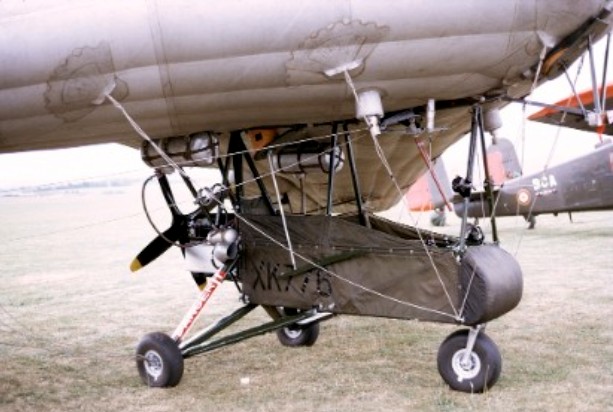
The whole wing can be deflated and packed in a bag. The wing is attached to the superstructure by a series of toggles, and flying wires lead from patches on the wing undersurface to points on the fuselage and undercarriage members.
Despite evaluation by the British Army Air Corps at Middle Wallop further production was not taken up. The flight characteristics were unusually slow and the machine was then stored until saved by the Army Air Corps museum.
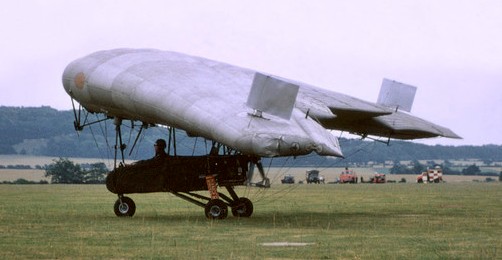
This was an experimental 2-seat observation aircraft built in 1957 for the Army. Fuselage consisted of a canvas bathtub type fuselage reminiscent of some later microlight aircraft.
XK776 was the first of three inflatable wing aircraft flight tested between 1954 & 1960. It went to Cardington on 27/11/69, and is now preserved at the Museum of Army Flying at Middle Wallop.
Utility Mk.1 Prototype
Engine: 65 hp McCulloch
Utility Mk.1
Engine: Walter Mikron III
Span: 35 ft 0 in
Overall length: 23 ft 3 in
Overall height: 10 ft 6 in
Wing area: 400 sq.ft
Dry weight: 450 lb
Fuel: 85 lb
Pilot weight; 180 lb
Passenger weight: 180 lb
Baggage weight: 40 lb
Total weight: 935 lb
Max speed: 68 mph
Cruise: 58 mph
Stall: 30 mph
Rate of climb: 740 fpm
Takeoff distance: 210 ft
Endurance: 2 hr 30 min
Ceiling: 5000 ft
Root chord: 17 ft 6 in
Tip chord: 5 ft 9 in
Wheelbase: 7 ft 1 in
Track: 5 ft 4 in
M.L. Aviation Rotabuggy / Rotajeep
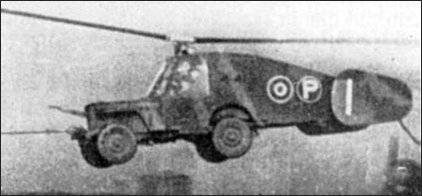
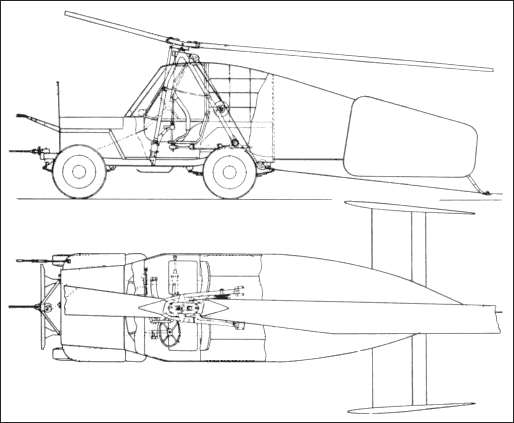
Raoul Hafner, an Austrian expatriate engineer, was working for the British Airborne Forces Research Establishment when he developed the idea of using free¬wheeling rotors to deliver airborne personnel into enemy territory. Having proved that his Rotochute could support a combat ready soldier, Hafner suggested that much heavier loads might also be delivered by rotor; a jeep, perhaps, or a truck, possibly a tank.
The scheme had a naive simplicity; take a vehicle, add a suitably sized rotor and tail surfaces, tow it to altitude behind an aircraft, then cast it free at the planned landing point for landing. M.L. Aviation at White Waltharn airfield in Berkshire, were awarded a development contract for the first Rotabuggy to Specification 10/42, which appeared in 1943. The basic vehicle was a US Army jeep, to which was attached a fuselage extension with a twin finned tailplane (no rudders), and a 14 m (46 ft 8 in) diameter rotor. The jeep was equipped with a rotor control column which hung from the roof, a rotor tachometer, and a rudimentary set of flight instruments, but was otherwise quite standard. Preliminary tests were conducted with the Rotabuggy, or Rotajeep as it was otherwise known, ballasted with concrete to 1430 kg (3150 lb) and dropped from a height of about 2.1 m (7 ft) to test its impact absorption.
This demonstrated that the standard model could absorb impacts of 1lg without damage, and a two blade rotor with a diameter of 46 ft 8in (12.4 m) was then fitted.
Camouflaged in the wartime fashion and sporting a prototype “P” and RAF roundels, a 4½ litre super charged Bentley sports car was hitched to the jeep and towed the combination at speeds up to 105 kph (65 mph). The Rotabuggy becoming airborne for the first time on 16 November 1943. These trials took place at Sherburn-in-Elmet, near Leeds.
By November 1943 the Rotajeep was ready for air testing from Sherburn in Elmet airfield towed by a Whitley bomber. Seven flights were made, one flight crashed nearly killing the pilot. The combination made one very short circuit on the final flight.
Mary de Bunsen with the Air Transport Auxiliary witnessed one of the flights: “We all stood and watched while an old Whitley taxied out on to the runway and took off, with a jeep in tow. They made a very short circuit, and when the Whitley touched down, the jeep, which had not cast loose, remained airborne for some seconds a few feet above the runway. It was at this juncture that we realized that the occupants were unhappy. The pilot held the control column, which was directly connected with the rotor and was suspended from the roof. The driver sat beside him and held the steering wheel. Up and down, up and down, it wandered, white we all stood and prayed that it would stall on a “down” rather than an “up”. This it fortunately did, landing plop on all four wheels, and the motor driver took over and steered it down the track like Stirling Moss. When it stopped, nobody got out for a while, and then the pilot was assisted out and laid down flat beside the runway to recover. Apparently the joystick had whipped round and round in circles all the time they were in the air and only sheer strength had kept the jeep under control, so the poor man was completely exhausted.”
Not all the flights were as nerve shattering as this had apparently been. The handling and flying qualities of the Rotabuggy have been described officially as “highly satisfactory”, especially after larger fins had been fitted and greater blade articulation provided. However, the development of the Horsa and Hamilcar vehicle carrying gliders made further development of the idea unnecessary, before a 47.25 m (155 ft) rotor could be tested on a Valentine tank.
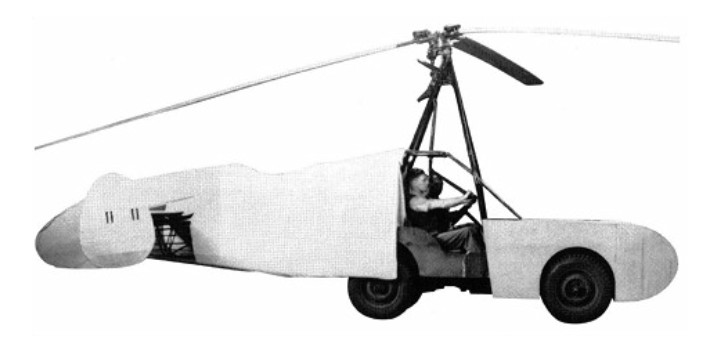
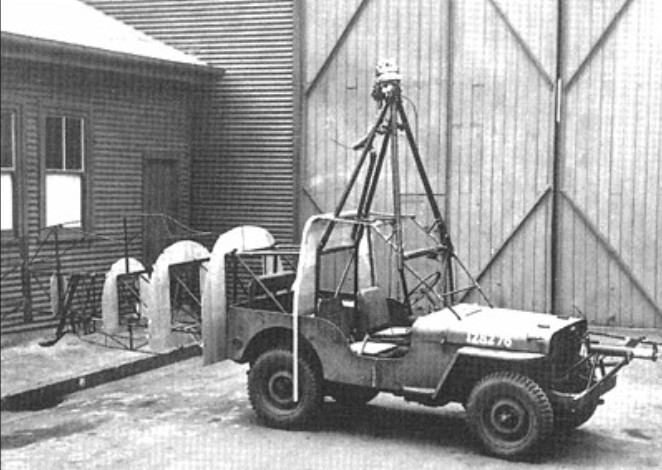
Rotabuggy
Rotor diameter: 12.40m
Gross weight: 1411kg / 3,110 lb
Empty weight – Jeep: 964kg
Weight – rotor unit and tail: 249kg / 550 lb
Design max speed: 241kph / 150 mph
Rates of descent – est: 4.9 – 10m/s / 960 1,980 fpm
Minimum take-off and landing speed: 58kph
Basic rotor speed: 230 rpm
Max rotor speed: 260 rpm
Crew: 2