USA
The original Osprey amphibian was designed by George Pereira. The Osprey 2 two-seat amphibian first flew 1973 and plans and kits are available to allow amateur construction.
Osprey Aircraft also marketed as plans and kits is the Osprey GP-4, a two-seat monoplane first flown in 1984.
Era
Oslist Microgiro
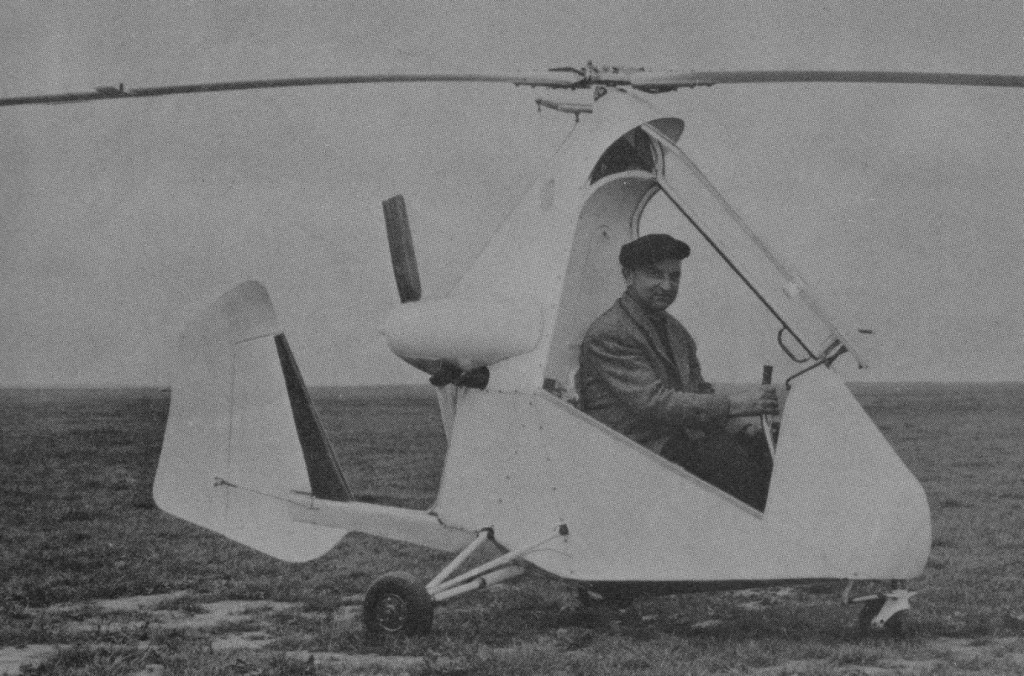
Francois Oslist designed and built a small autogiro, he called Microgiro, in 1964.

Rotor blades are formed from solid spruce, with an aluminium hub. The fuselage is steel tube with an aluminium skin. The tail is also tubular steel but with fabric cover.
Engine: McCulloch, 72 hp
Rotor diameter: 20.6 ft
Rotor chord: 7.8 in
Fuselage length: 10.66 ft
Hieght: 6.3 ft
Landing gear tread: 54 in
Landing gear track: 65 in
Main wheel diameter: 9.5 in
Nosewheel diameter: 6 in
Empty weight: 330 lb
MTOW: 550 lb
Oslist, Francois
Francois Oslist, an aviation mechanic with the French Ministry of Aviation, designed and built in 1964, a small autogiro he called Microgiro.
Oškinis T-1 / Technikas-1 / BrO-1
After completing aviation courses, Bronius Oškinis led the construction of gliders in ATM workshops. Reconstructed the German training glider RRG-23 “Zoegling” and thus in August 1932 developed the Lithuanian T-1 (“Technikas-1”) glider. In Pažaislis.
The Technikas-1 was an improved RRG-23 Zögling (based on German drawings). One was built. The first flight was performed by B. Oškinis himself. This glider was tested by military pilot Gregorius Radvenis. The T-1 was used to test/train Lithuanian military pilots at Kaunas
During 1935-36 four ‘production’ version of the T-1 were built, re-named BrO-1.
Oškinis BRO-23KR Garnys / BrOK-1M Garnys
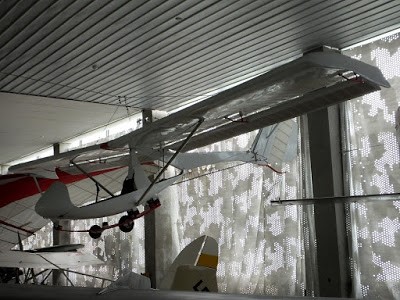
The BRO-23KR was designed by Bronis Oškinis and constructed by Česlovas Kisonas and K. Rinkevičius (the KR of the name) at the Kaunas hang gliding club.
The BRO-23KR is a glassfibre aircraft with a strut and wire-braced high wing and a pod and boom fuselage with an open-sided cockpit and a T-tail. Its wing is rectangular in plan out to blunted and turned-down tips and both its single spar and ribs are formed from woven glassfibre. Three-ply glasscloth skin ahead of the spar forms a torsion resistant D-box. The narrow trailing edge of the wing was cast in epoxy with spanwise glassfibres and glasscloth covered. The whole wing was then covered with glued and thermally bonded, transparent polyethylene terephthalate film. It has narrow, full span, slotted ailerons, operating in co-ordination with rudder deflections and built in the same way as the wings. Single struts on each side brace the spar to the lower fuselage.
The fuselage of the BRO-23KR is formed from two GRP halves and attached to the wing centre-section. It has a long, shallow open cockpit which stretches back under the wing with the pilot in a reclined position. The tail unit, constructed in a similar way to the wing, has a highly swept, near-rectangular fin with a high aspect ratio horizontal tail mounted on its top. Its rather angular rudder, on a backward-leaning hinge, is large.
The BRO-23KR has very adaptable landing gear based on a landing skid sprung on five rubber blocks, which stretches nearly from the nose to just aft of the spar. The skid is wide enough to land on snow but can be fitted with a tyred wheel in summer. More unusual attachments include a set of introductory tricycle wheels and floats for landing on water. There is a long, self-sprung GRP landing skid under the tail.
It first flew in 1981.
Only two BRO-23KRs were constructed, the prototype and one built in 1984 by Panévežio Atsk. One took part in the 2nd World Championship, an Eastern European series gliding contest distinct from the FAI event, where it showed distinct improvements over earlier Soviet primary gliders. Both aircraft remained airworthy in 2015.
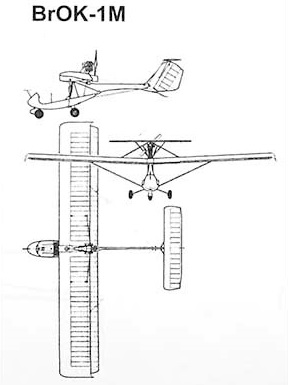
In 1982, Kišonas, Česlovas and Rinkevičius, K. (who had built the BrO-23KR glider) adapted a 25 HP engine on the BrO-23KR which thus became the BrOK-1M. The added K designates KIŠONASr.
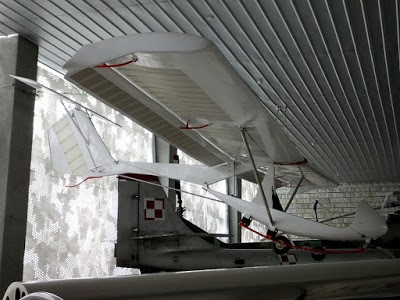
In 1982 the prototype was motorized into the BROK-1M, with a largely uncowled, pusher configuration, 25 hp (19 kW) engine. Its installation, designed by Kišonas, placed it well above the rear part of the wing on forward and aft transverse V-struts from the central wing mountings, laterally braced on each side by a long strut out to the wing. It used the tricycle landing gear.
In 2009 one airframe remained in the Sport Aviation Museum in Kaunas.
Wingspan: 8.20 m (26 ft 11 in)
Wing area: 10.40 sq.m (111.9 sq ft)
Aspect ratio: 6.5
Airfoil: GA(W)-1
Length: 6.40 m (21 ft 0 in)
Height: 2.2 m (7 ft 3 in)
Empty weight: 83.5 kg (184 lb)
Gross weight: 158.5 kg (349 lb)
Maximum speed: 100 km/h (62 mph, 54 kn) smooth air
Stall speed: 42 km/h (26 mph, 23 kn)
Maximum glide ratio: 15
Min sink: 1.1 m / s (200 ft/min)
Seats: 1
Oškinis BrO-21 Vyturys
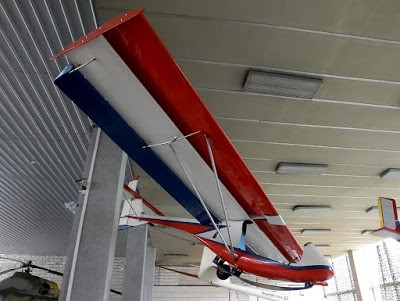
The BrO-21 Vyturys training glider prototype was built in Kuibyshev with the help of Aviation Factory engineers and Aviation Institute students.
The wing of the of the BRO-21 Vyturys glider consists of four balances and two ailerons. The wings were arranged one after the other with an overlap of 70 mm, forming a 40 mm slit forming an angle of 7 degrees.
The BrO-21 1980 At the beginning of 1980, the construction of the second example of BRO-21 was started in Palanga, the construction of which was completed in Kaunas in 1980. June 20 his trials began.
Polymers and glass cloth were used in the construction. The gap between the spar is filled with epoxy- impregnated foam, covered with glass cloth.
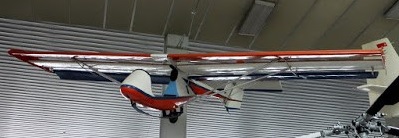
The fuselage consists of a front part (cockpit) and a tail beam. The cabin is made of fiberglass. All cabin sides are covered with microporous rubber edging.
At the bottom, the cabin has 5 rubber “legs” to which it can be attached:
wide fiberglass ski (for winter),
ski with wheel 200 × 80 or 255 × 115 (for summer),
three-wheel chassis (training in landing)
a float that turns the apparatus into a hydraulic dispenser.
The tail beam is made of fiberglass.
The BRO-21 variant of the glider built in Kuibyshev, was demonstrated in Moscow at a union competition of youth gliding schools. The glider, starting with the shock absorber, showed a great advantage over another classic-designed training glider “Trener” developed by Kuibyshev.
Wingspan: 5.2 m
Length: 7 m
Wing area: 10.5 m²
Empty weight: 84 kg
Take off weight: 160 kg
Pilot weight: up to 76 kg
Maximum speed: 100 km / h
Minimum speed: 35 km / h
Glide ratio: 12
Wing load: 15.2 kg / m²
Seats: 1
Oškinis BrO-20 Pukelis
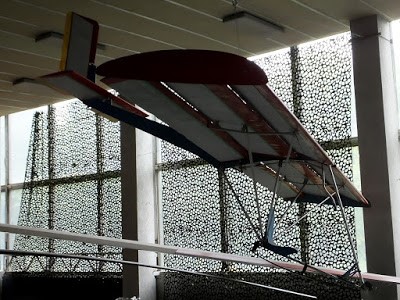
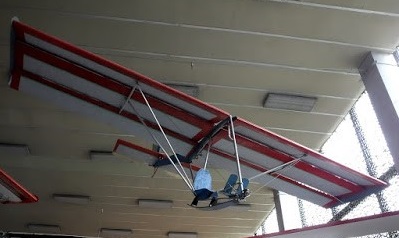
Wing span: 6 m
Length: 5.30 m
Height: 1.50 m
Oškinis BrO-18 Boruze
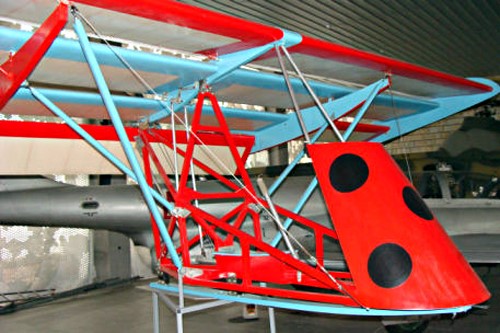
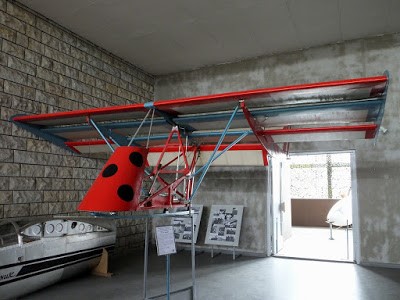
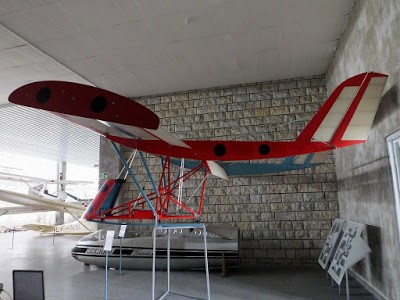
The Oškinis BrO-18 Boružė mini glider was easy to manufacture and easy to handle. With its short wings, Boružė cannot reach high speeds and heights, so it is perfect for training children from 12 years of age. The glider takes off at a speed of 35-40 km / h (3-4 people are enough to take off).
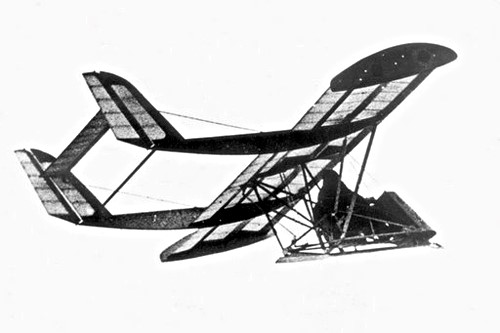
Boružė is an experimental device and probably the smallest glider in the world (wing span – 4.9 m).
Oškinis BrO-12
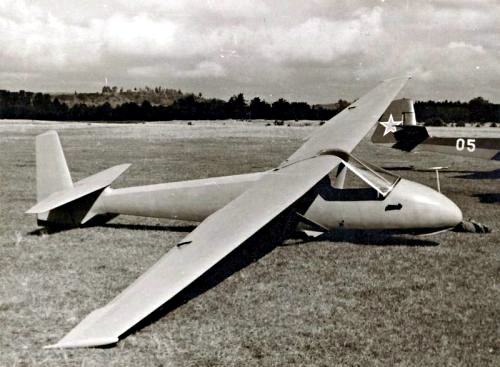
According to Bronius Oškinis, this glider is designed to be launched with a puller and to be able to reach the thermal. The glider had to be inexpensive, suitable for mass production, so that every gliding club could buy it. Oškinis applied an unprecedented innovation to gliders – hanging flaps and ailerons, which greatly increase the lifting capacity of the wings.
At that time, the Soviet Union’s air construction bureaus focused on the construction of military aircraft, while Lithuanian designers designed gliders because they did not have the opportunity to construct aircraft during the Soviet occupation.
The wings were covered with 1.0-1.5 mm thick plywood, varnished and polished.
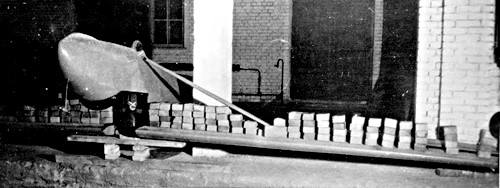
In order for novice pilots to clearly see the fluctuations in the direction of flight, the glass of the BrO-12 cockpit covered the glider only from the front – the deviation from the straight flight was immediately felt by the pilot blowing in the wind through the open sides. The seat is suitable for flying with a parachute ПНЛ-45.
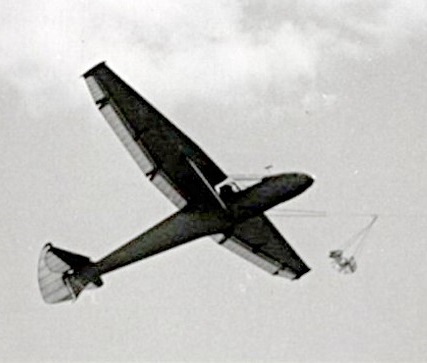
The BrO-12 prototype was built in 1957. In the workshops of Kaunas Gliding Station. Pulled by a winch, it rose to 400-500 m, and even higher in the event of stronger winds. No other glider was able to take off so much then. In Moscow it was decided to produce BrO-12 series.
The BrO-12 was produced at the Simferopol Aviation Workshop, where during 1959–1961 about 120 units were produced.
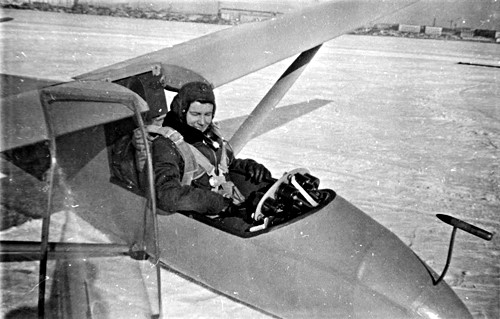
In 1959-61, a total of about 20 gliders of this type flew in Lithuania.
In 1959-61, a total of about 20 gliders of this type flew in Lithuania. After the Soviet Union decided to produce metal-gliders, the BrO-12 soon competed with the Czech two-seater Blanik.
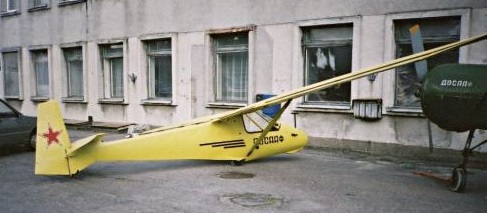
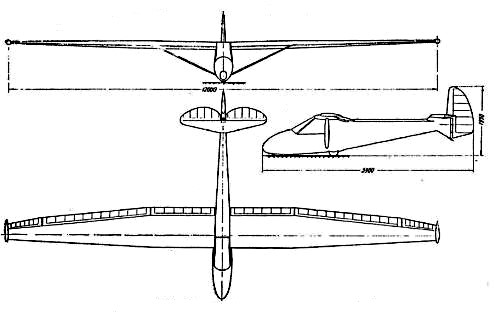
Wingspan: 12 m
Wing area: 11.3 m²
Length: 5.9 m
Height: 1.50 m
Empty weight: 160 kg
Takeoff weight: 245 kg
Wing loading: 21.7 kg / m²
Landing speed: 45 km / h
Cruising speed: 60 km / h
Glide ratio: 20
Seats: 1
Oškinis BrO-11 / LAK LAK-2
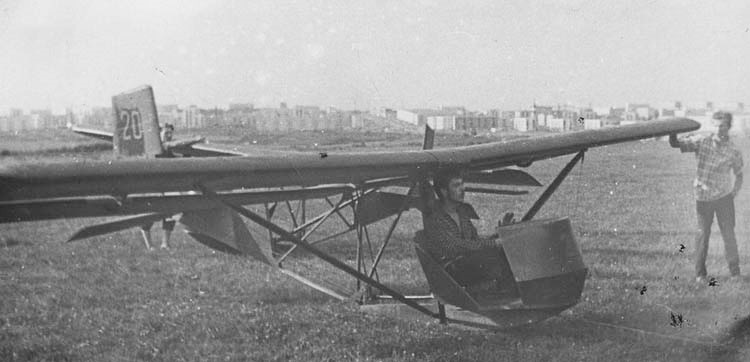
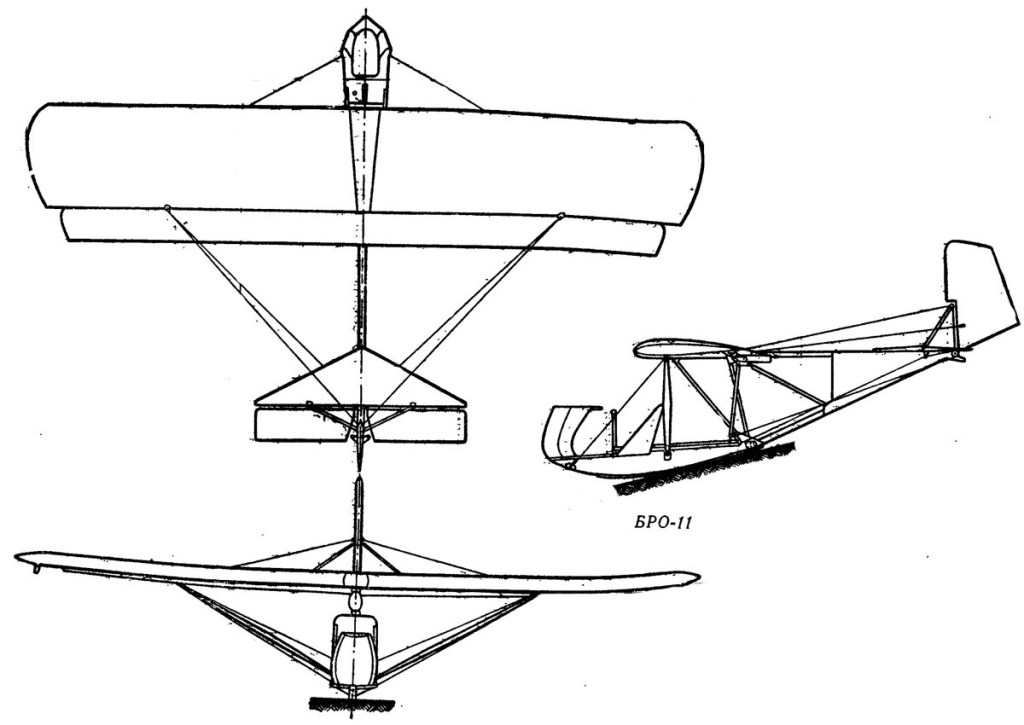
The Oškinis BrO-11 was a simple, single-seat primary glider designed in the USSR by Bronis Oškinis in the open girder style exemplified by the pre-war SG 38 Schulgleiter. It was more refined, with slotted ailerons and somewhat better-protected seating.
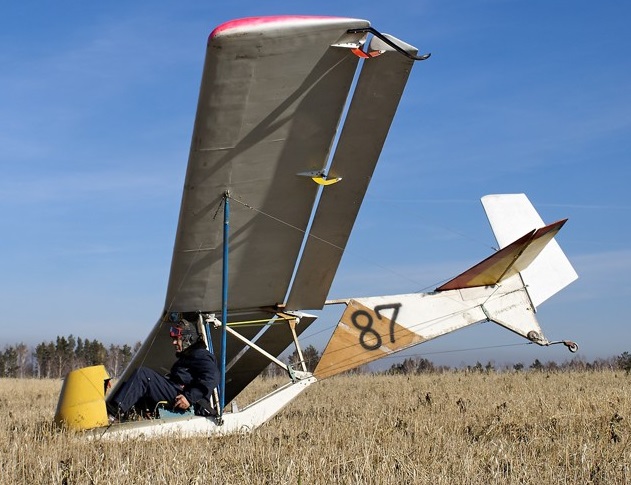
Its high wing, mounted on top of the fuselage girder, was rectangular in plan and built around a single, wooden spar with plywood skin ahead of it, forming a torsion-resistant D-box, and fabric covering behind. The wing was braced to the bottom fuselage beam with a single strut on each side, assisted by drag wires from the nose. Narrow and very high aspect ratio ailerons were hung behind and below the whole trailing edge, leaving a slot between wing and aileron.
The wing of the original production model, named Pionier, Lithuanian for Pioneer (or Pionerius, the plural) had a span of 7.58 m (24 ft 10 in) and an area of 10.5 m2 (113 sq ft). The later Zylė (Tit), alternatively known as the LAK-2, had a slightly larger wing with a span of 7.80 m (25 ft 7 in) and an area of 11.8 m2 (127 sq ft), improving the glide ratio a little.
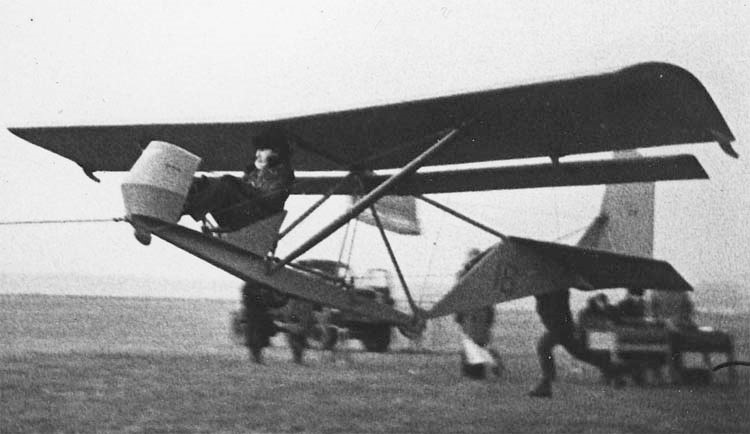
The forward part of the fuselage was a wooden beam which extended aft to end under the wing trailing edge. At the nose there was a simple, semi-circular enclosure formed from two single-curvature surfaces. This gave the pilot, seated just under the leading edge, some protection from the wind, though not for his upper body or sides. The same beam was attached to the wing with an N-form cross-member and also carried the forward end of the horizontal upper fuselage member. The rear lower member ran upwards to meet the upper one at the tail. In addition, they were interconnected at mid-fuselage by a pair of vertical and diagonal struts. Immediately ahead of the tail the fuselage was fabric covered, though not elsewhere.
Both variants had triangular tailplanes mounted on the upper frame with elevators which were rectangular in plan apart from a cut-out for rudder movement. Their little, triangular fins carried rather angular, quadrilateral rudders.
The fuselages of the Pionier and Zylė differed only in their landing gear. The Pionier landed on the underside of the forward beam but the Zylė had a monowheel semi-recessed into its beam below the forward wing and a short nose skid.
The BrO-11 Pionier first flew in 1954 and was very widely used across the DOSAAF; some 2000 were built between about 1955 and 1960. The date of the first flight of the Zile is not known exactly but was about 1968. Production began by Lietuviškos Aviacinės Konstrukcijos (Lithuanian Aero-Construction, LAK) in mid-1969 and ended in 1979. Production numbers for this variant are not known.
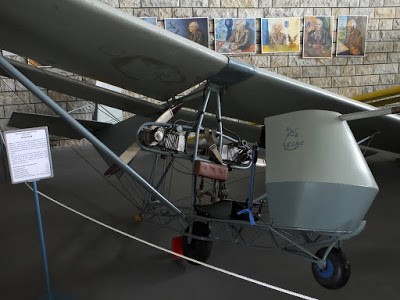
BrO-11 Pionier(ius)
Original design
BrO-11M Zylė
Wingspan: 7.80 m (25 ft 7 in)
Wing area: 11.80 m2 (127.0 sq ft)
Aspect ratio: 5.05
Height: 2.50 m (8 ft 2 in)
Length: 5.16 m (16 ft 11 in)
Empty weight: 65 kg (143 lb)
Max takeoff weight: 125 kg (276 lb)
Stall speed: 31 km/h (19 mph, 17 kn)
Maximum glide ratio: 12
Rate of sink: 1.0 m/s (200 ft/min) minimum
Crew: One