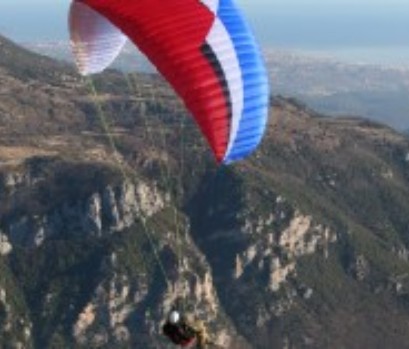
The Rush Power was created circa 2005 for the performance pilot who needs DHV 1-2 security in their DULV certified wing. With a higher aspect ratio and more cells than the Mojo Power, the Rush Power is closer to a DHV2 in performance while remaining well within the boundaries of the DHV 1-2 class. It features sportier, more dynamic handling, along with a higher speed range.
The Rush Power’s launch characteristics are benign for a wing with such performance and dynamic character, and pilots will find that the inflation is simple to control in all conditions. In light wind or no wind, the Rush Power comes up easily overhead, with no tendencies to hang back or slip to one side.
In flight, the handling is direct and well coordinated, and ideal for maneuvering close to the ground or for thermalling with the engine off. Feedback is transmitted to the pilot and it is feedback that the pilot can understand and use, not just turbulence or noise.
The Rush Power is a well proven and ideal intermediate paramotor wing that also flies just as well unpowered. We think that pilots searching for an intermediate wing that is equally capable of powered and unpowered flight need look no further.
The Rush Power is constructed with Porcher Marine Skytex Evolution cloth, and comes standard with Ozone Paramotor Risers which feature double hang points, reinforced trimming system, and trimmer lock-off for free flight.
Small
Cells: 46
Projected Area: 21.18 sq.m
Flat Area: 24.57 sq.m
Projected Span: 8.89 m
Flat Span: 11.27 m
Projected Aspect Ratio: 3.73
Flat Aspect Ratio: 5.17
Root Chord: 2.77
Glider Weight: 12.3 lb
Weight Range: 154-242 lb
DHV: 1-2
Medium
Cells: 46
Projected Area: 23 sq.m
Flat Area: 26.66 sq.m
Projected Span: 9.26 m
Flat Span: 11.74 m
Projected Aspect Ratio: 3.73
Flat Aspect Ratio: 5.17
Root Chord: 2.89
Glider Weight: 13 lb
Weight Range: 187-275 lb
DHV: 1-2
Large
Cells: 46
Projected Area: 25.14 sq.m
Flat Area: 29.16 sq.m
Projected Span: 9.68 m
Flat Span: 12.28 m
Projected Aspect Ratio: 3.73
Flat Aspect Ratio: 5.17
Root Chord: 3.02
Glider Weight: 14 lb
Weight Range: 220-308 lb
DHV: 1-2