mgr: William S Wilson, sales mgr: E H Brawner
3135 Broderick St and 1480 Bush St
San Francisco
California
USA
Circa 1930 built the A / Brawner-Bauer airplane
mgr: William S Wilson, sales mgr: E H Brawner
3135 Broderick St and 1480 Bush St
San Francisco
California
USA
Circa 1930 built the A / Brawner-Bauer airplane

Designed by Frank R Seesock circa 1925, the Pacer was a two place light airplane.
Engine: 90hp Anzani
Wingspan: 36’0″
Length: 23’9″
Useful load: 570 lb
Max speed: 90 mph
Cruise: 75 mph
Stall speed: 30 mph
1925: Pacer Aircraft Co, Perth Amboy NJ.
1928: New Pacer Aircraft Corp, Main & Grant, Fords NJ.

Built by Henry Chazal in 1910 Nice, France, a tractor monoplane with a wing span of 9 meter and a length of 12 meters. The elevator was placed in front of the wings; the rudder at the rear immediately aft of the stabilizer. A 40 hp E.N.V. engine drives the propeller via a chain. The pilot is placed below the wings, behind the engine.

Formed in 1957 at Santa Monica, California, as a subsidiary of Pacific Airmotive Corporation to continue manufacture of the Learstar Executive transport, with two Wright Cyclone engines. PacAero also carried out modifications to other types, including conversion of North American T-28 trainers to Nomad standard with a bigger engine. Dissolved and merged with Pacific Airmotive Corporation’s Aircraft Division in early 1960s.
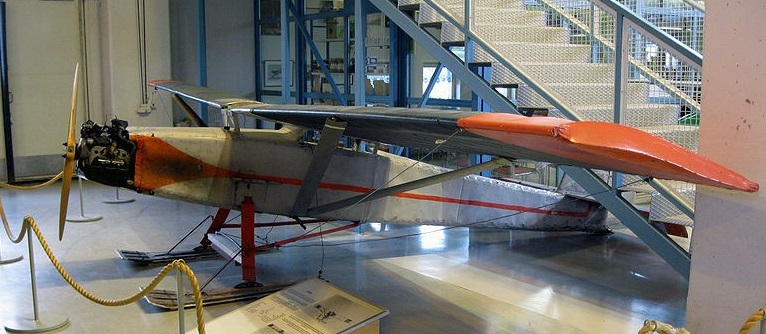
The single-seater Tiira aircraft was designed and built by Raimo Päätalo (b. 1947) from Sanginjoki. It was completed in 1973 and used until 1977, flying for about 70 hours. The aircraft was designed without any training other than that obtained from the construction of the aircraft. The raw materials were found in agricultural goods, for example, a furniture tube was used in the wing areas and a greenhouse plastic film was used to upholster the machine. The powertrain was Volkswagen’s 50-horsepower engine. The hobby of flying could have lasted longer, but in 1977 Tiira was spotted on the radar of Oulu air traffic control. Today, the plane is in the Aviation Museum of Central Finland.
A second Tiira 2 aircraft was built in 1983, and flying it resulted in a four-month suspended prison sentence.
Later, Päätalo has also built a third Tiira 3 aircraft.
In 2010, a “Oulu man” was sentenced to daily fines for an unauthorized flight in September 2009: “two aviation violations and the right to drive a vehicle.”
On August 30, 2014, air traffic control spotted a small self-propelled aircraft on the radar about 60 kilometers from Oulu Airport and reported the matter to the police. The pilot is suspected of an aviation violation and the right to drive the vehicle. Police have had information about the man’s previous similar activities.
Engine: Volkswagen 1,600 cm³, 50 hp
Wingspan: 8.04 m
Wing area: 9.6 m²
Length: 5.4 m
Height: 1.4 m
Flight weight: 340 kg
Top speed: 130 km / h
Ceiling: 2,500 m
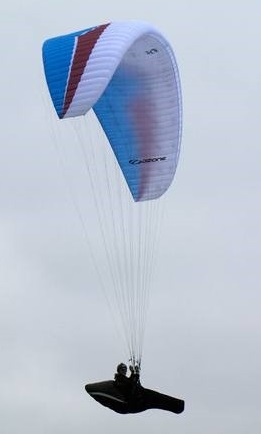
In 2010 Ozone released the Delta.
The Delta features a profile for a sport class (LTF2/ENC) and an optimized line plan with 31% less drag than its predecessor.
The Ozone Delta has a 9.3 glide according to Thermik Magazine. This is not a glider suitable for beginners – it’s Intermediates and up.
Medium
Pilot weight: 80-100kgs
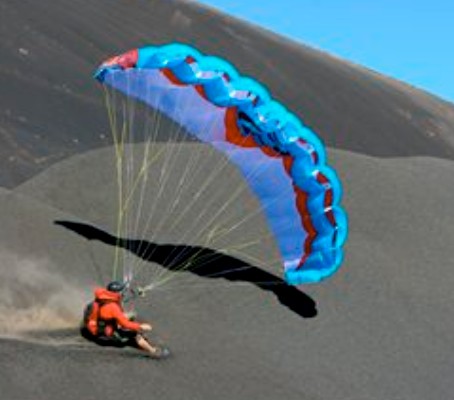
The Ozone Bullet speedwing has easy launch and great progressive brake feel. A lighter, more packable material makes gathering the wing up after a flight much easier. Braided unsheathed lines are resistant to damage, easier to inspect, and less prone to tangles / knots. Line arrangement has resulted in a more balanced sail tension, with far better roll behaviour, and a new profile is more stable, and gives a more carving, lift-free feel, which makes it easier to stay near the terrain.
The easy launch is imperative for new speed-flyers, and the sometimes difficult launching conditions that can be experienced in the mountains (tailwind, crosswind, etc). Relatively slow speed take-off as the profile is high lift, allowing early take-off and excellent slower speed performance. The line configuration and sail tension help reduce in-flight glider flexing and accordion movements seen in other wings to a minimum.
The high lift profile and moderate sail tension allow the wing to be slowed down easily for soft, slow speed landings.
OzTech 30g/sm.m cloth has been tested from the Polar ice-caps to the Sahara desert and is the best material possible for Speed-Flying. Cousin Dyneema lines are water tolerant braided lines and are highly resistant to cutting by ski edges and can withstand heavy use in wet environments.
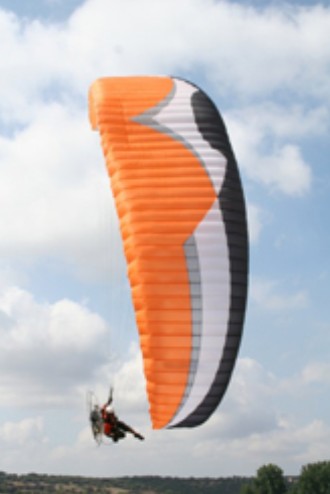
The Viper is a paramotor wing for expert pilots who fly in high level competitions and make advanced XC flights. This wing is an advanced competition glider designed for highly experienced pilots only. The Viper is a paramotor specific wing that has stability at high speed and the high maneuverability and handling of a normal paraglider.
Developed in cooperation with Mathieu Rouanet, World Champion 2005, the high top speed, low sink rate and high efficiency of the Viper gives lower fuel consumption and longer, faster flights. The handling is direct and precise, with clear feedback. Launching is simple due to the benign inflation characteristics.
This Viper is an Open Class wing, and load tested to 1607kg on average, which means 11.5G for the 27 and 14G for the 24.
The Ozone Roadster and Viper both feature a customized Ozone Reflex Profile (OZRP) that has been tuned specifically for powered flight. The OZRP is what gives the Roadster and Viper their stability at high speed and collapse resistance in turbulent air.
This special airfoil design provides constant lift in a wider range of angles of attack. When you apply speed-bar or fly with the glider accelerated at a lower angle of attack, the RP takes effect and provides continuous lift and heightened stability.
Through carefully moderating the shape and amount of curve in the OZRP, a balance that provides increased lift at extreme angles of attack, while still retaining excellent launch characteristics and stall resistance has been achieved.
The Viper is constructed with Porcher Marine Skytex Evolution 45, and comes standard with the Ozone Paramotor Risers which feature double hang points and a reinforced trimming system.
Viper 24
Cells: 59
Flat Area: 24.5 sq.m
Projected Area: 21.0 sq.m
Flat Span: 12.24 m
Projected Span: 9.78 m
Flat Aspect Ratio: 6.11
Projected Aspect Ratio: 4.54
Root chord: 2.50 m
Glider weight: 11.9lb
In flight weight range: 80-115 kg
Recommended weight: 95-105 kg
Load test: Yes
Viper 27
Cells: 59
Flat Area: 27.5 sq.m
Projected Area: 23.6 sq.m
Flat Span: 12.97 m
Projected Span: 10.36 m
Flat Aspect Ratio: 6.11
Projected Aspect Ratio: 4.54
Root chord: 2.65 m
Glider weight: 13lb
In flight weight range: 100-140 kg
Recommended weight: 115-125 kg
Load test: Yes
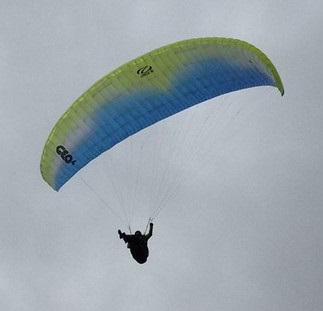
Paraglider circa 2005.
DHV1-2
Ozone Geo 4 L
Pilot weight: 95-115 kg

