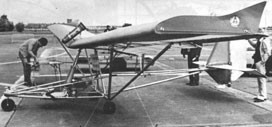
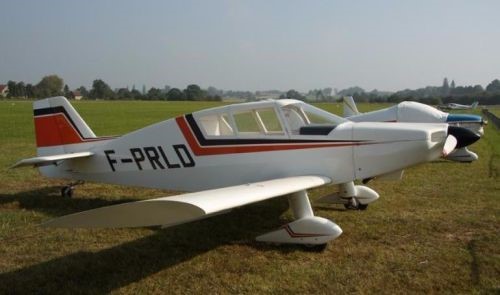
The 1983 PGO Aviation AJS 2000 is a two-seater tandem multiaxis ultralight. It was fitted with dual controls, hydraulic disc brake, and Fournalès shock absorbers.
Engine: Rotax 532, 65 hp Wingspan: 10.60 m Wing area: 16 sq.m Fuel capacity: 40 lt VNE: 145 km / h Cruise: 110 km / h VSo: 55km / h Fuel consumption: 13 lt/hr
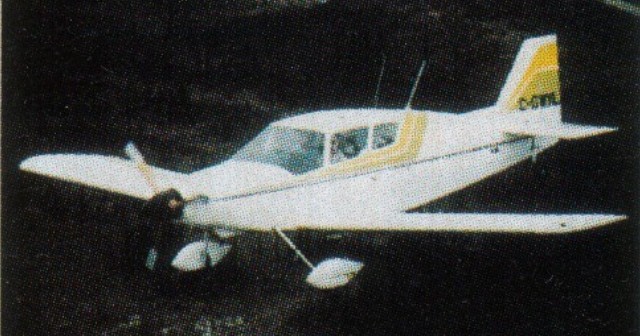
The PGK-1 Hirondelle was designed by Jean Peters, Glenn Gibb and John Kopala. The prototype aircraft C-GWYL (pictured) was six years in development and the designers main objectives were: to design a two-place aircraft that was safe and easy to fly; fast and maneuverable; comfortable and attractive; and easy and economical to build. The aircraft is well suited to first time builders. Engines of 100-125 hp.
Western Aircraft Supplies of Canada markets plans and some components to construct the PGK-1 Hirondelle two-seat monoplane.
Since their success with the first recorded powered flight, the Wright Brothers had patented many of their methods and had sought to enforce their patents through the courts. Most if not all other manufacturers were keen to develop alternative techniques; Pfitzner avoided the Wrights’ method of warping the wings to achieve a lift differential between port and starboard wings by using wing extensions (or ‘compensators’). In his book “Monoplanes and Biplanes: Their Design, Construction and Operation” (1911), Grover Loening wrote “This aeroplane is a distinct departure from all other monoplanes in the placing of the motor, aviator, and rudders, and in the comparatively simple and efficient method of transverse control by sliding surfaces, applied here for the first time.”. The issue of patent protection was sufficiently in the public eye for The New York Times, in its issue of 16 January 1910, to headline Pfitzner’s design as an “Aeroplane Without Patent Drawbacks”. The same article refers to the “Wright suits” and their attempts to “build up their patent fences”; Pfitzner is quoted there as saying that “any one who wants to do so is welcome to use [his] panel invention without cost or fear of injunction”. Pfitzner designed his Flyer as a private project but it was constructed in the Curtiss factory.
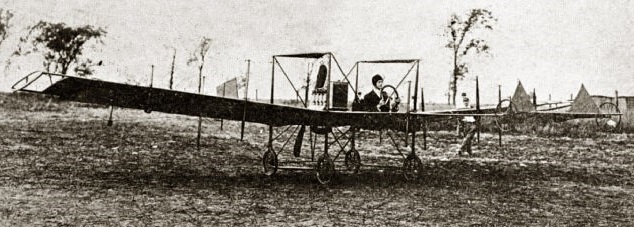
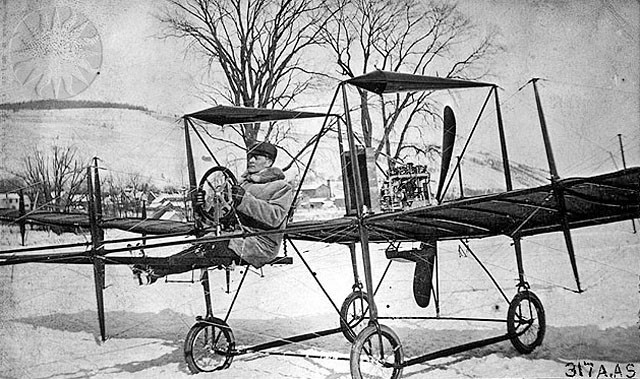
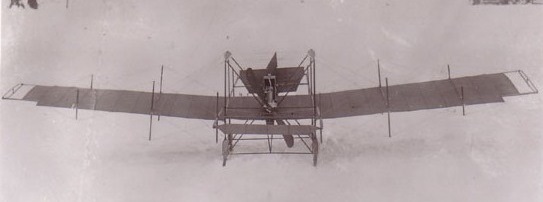
The Pfitzner Flyer was designed in 1909 by Alexander Pfitzner and built by the Curtiss company at Hammondsport, NY, where Pfitzner was employed at the time, a “designer of high-class gasoline motors, transmissions, and gears”. The Flyer was the first monoplane designed, built and flown in the United States. It incorporated several novel features, the most innovative of which was the method of achieving lateral control by means of reciprocating lateral (telescopic) wing extensions, which the pilot controlled via a steering wheel. Also unusual for a monoplane was the use of a pusher configuration, the engine also being mounted behind the pilot.
The aircraft consisted of a rectangular cuboid cross-braced central frame, onto which the main monoplane wing, the motor, the forward and rear booms and the ‘undercarriage’ (consisting of one wheel at each of the lower corners) were mounted. Between the upper front and rear posts of the frame were fitted two streamlined fuel tanks (clearly visible in the image above), one on each side of and above the pilot’s seat, with a combined capacity of six gallons (22.7 L.).
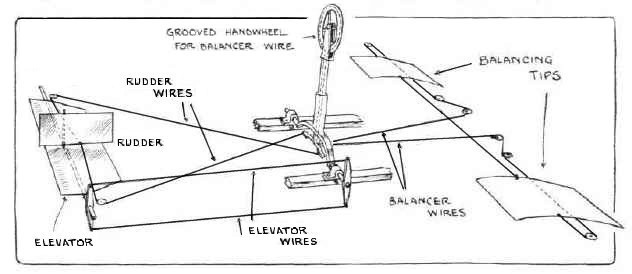
The pilot sat immediately forward of the wing and controlled the aircraft by a combination a movable column and a wheel mounted on that column. Pitch was controlled by fore and aft movement of the column, which, by means of wires, moved the elevator mounted at the forward end of the front boom. Yaw control was effected by twisting the column about its vertical axis (by means of pressure on the steering wheel), which turned the vertical rudder (mounted above the elevator) left or right. Lateral control was achieved by rotating the wheel: When the pilot turned the steering-wheel to port, the linkage retracted the port wingtip, at the same time extending the starboard extension by the same amount. Thus there was no need for a rudder bar (or pedals); the pilot’s feet were not used for controlling the aircraft. Also mounted on the control column was a throttle lever; a button on the wheel enabled “the Bosch high-tension magneto to be switched off for the purpose of switching off the engine”. There was a fixed tail-plane surface with an area of 10.5 sq.ft. (0.98 sq.m.) at the end of the rear boom to provide longitudinal stability.
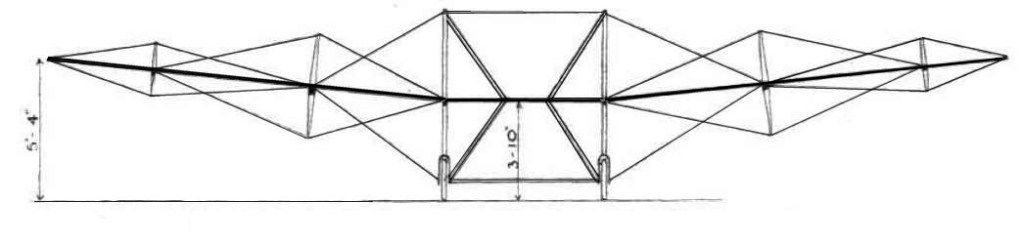
The span of the main wing, which was set at an angle for incidence of 8°, was 31 ft., with a wingtip extension of 30 in (76 cm) on each wing, providing a constant wingspan of 33 ft. 6 in. (10.21 m). The wing was 6 ft. (1.8 m) wide; the extensible wingtips were 4 ft. 2 in. (1,27 m) wide, each providing a maximum of 10.5 sq. ft. (0.98 sq.m.) wing area. The wing extensions were of the same curvature as the main wing. “The main supporting plane at a 5-deg. dihedral angle consists of two main beams across which are placed spruce ribs. The surface is made of Baldwin vulcanized silk, of jet black colour, tacked to the top of the ribs and laced to the frame. The curvature of the surface is slight and is designed for high speed.” The wing ribs had a camber of 3.75 in. (9.05 cm) over 6 ft (1.8 m).
Each of the wings consists of three detachable sections, each 5 ft. (1.5 m.) long, which are supported by steel sockets and steel cable, the latter forming a symmetrical double king truss with the beams, fore and aft pairs of King posts being situated at the junctions of the sections.
Pfitzner himself, although an inexperienced flyer at the time, conducted initial test flights with his Flyer, the first taking place in early January 1910. Despite the presence of a light covering of snow at the time, it was reported that the Flyer had made a large number of short flights and that it required an average run of 100 ft. (30 m) to get airborne.
The aircraft was not a success, and a disappointed Pfitzner is thought to have committed suicide on 12 July 1910.
Following Pfitzner’s disappearance (and assumed suicide) in July, 1910, Horace K. Kearney took over the aircraft and demonstrated it at aero meets in the succeeding months, including in Boston, before the Pfitzner Flyer became little more than an interesting footnote in the history of aviation.
Powerplant: 1 × Curtiss 4-cyl., 25 hp (19 kW) Propellers: 2-bladed, 6 ft (1.8 m) diameter Wingspan: 33 ft 6 in (10.21 m) (The main span was 31 ft, with extensions providing additional 2 ft. 6 in.) Wing area: 196.5 sq ft (18.26 sq.m) (Area of main wing: 186 sq. ft. (17.3 sq.m.); area of each wingtip extension 10.5 sq. ft.(0.98 sq.m.)) Aspect ratio: 5.17 : 1 Length: 30 ft (9.1 m) Height: 7 ft (2.1 m) Gross weight: 430 lb (195 kg) (Gross weight includes 6 gallons of petrol, 1 gallon of oil and 1.5 gallons of water.) Max takeoff weight: 600 lb (272 kg) Wing loading: 3.2 lb/sq ft (16 kg/sq.m) Maximum speed: 42 mph (68 km/h; 36 kn) Crew: 1
Pfitzner was born in 1880 in Csete, Hungary. He attended the Hungary University of Technology before joining the Hungarian Army, serving as a Lieutenant in an artillery regiment before immigrating to the United States in the early years of the 20th century.
Pfitzner worked for several automobile manufacturers before starting with the Curtiss Aeroplane and Motor Company. He designed and built the gasoline engine with which Curtiss won the overall speed event in 1909 Gordon Bennett Cup in Rheims, France.
Frustrated by the efforts of the Wright Brothers’ use of the courts to dominate the developing market for powered flight, Pfitzner designed his own aircraft, the Pfitzner Flyer, which avoided the Wrights’ method of warping the wings to achieve a lift differential between port and starboard wings by using wing extensions (or ‘compensators’). In his book “Monoplanes and Biplanes: Their Design, Construction and Operation” (1911), Grover Loening wrote “This aeroplane is a distinct departure from all other monoplanes in the placing of the motor, aviator, and rudders, and in the comparatively simple and efficient method of transverse control by sliding surfaces, applied here for the first time”. The issue of patent protection was sufficiently in the public eye for the “New York Times”, in its issue of 16 January 1910, to headline Pfitzner’s design as an “Aeroplane Without Patent Drawbacks”. The same article refers to the “Wright suits” and their attempts to “build up their patent fences”; Pfitzner is quoted there as saying that “any one who wants to do so is welcome to use [his] panel invention without cost or fear of injunction”.
The performance of his monoplane “Flyer” disappointed Pfitzner. In 1910 he joined the Burgess Company at Marblehead, Massachusetts, where he worked on the design of a biplane which also employed his sliding wing-tip principle. This aircraft was destroyed in a crash in 1910.
Pfitzner is reported to have been depressed by his lack of success; on July 12, 1910 he rowed out into Marblehead Harbour with a suitcase containing his drawings. The otherwise empty boat was found a few days later with his hat, coat and a recently used revolver, but Pfitzner’s body was never found.
The Elfe series started from a 9 m sailplane designed by W.Pfenninger before World War II. A new design was introduced by him in 1947 to become the Elfe 2, probably the first sailplane with a laminar flow airfoil. Subsequently the series was further developed by Markwalder to become the Elfe PM-3 (brought to the US in the sixties), then by Albert Neukom the Elfe M, Elfe MN and AN66 before the Standard Elfe S-1
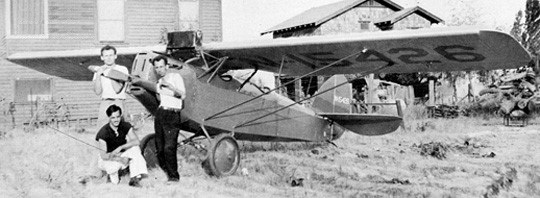
The 1936 Sport was a two place open cockpit monoplane. Registered N15426 c/n J-4 it was first flown on 6 May 1936 and powered by various motors from 50hp Ford B to 90hp Warner. The original crashed at Santa Susana CA on 9 August 1941 (p: John Toborg) and the registration was cancelled.
Originally a reworked Pietenpol, a version of this plane was built by Pfeifer in 1975 with a 110hp Corvair auto engine and higher parasol wing (span: 30’5″).
This aircraft was a biplane version of the E V monoplane. It was to the Walfisch format, with deep gap-filling fuselage and car-type radiator at the nose. Although not confirmed, the engine is thought to have been 100 h.p. Mercedes D I.
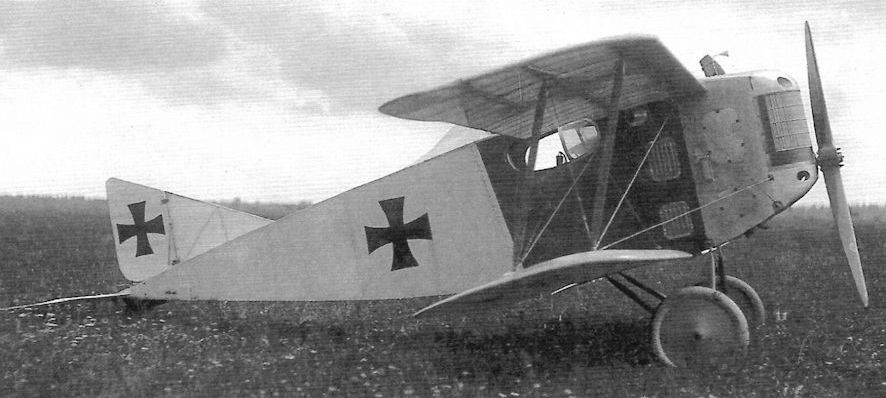
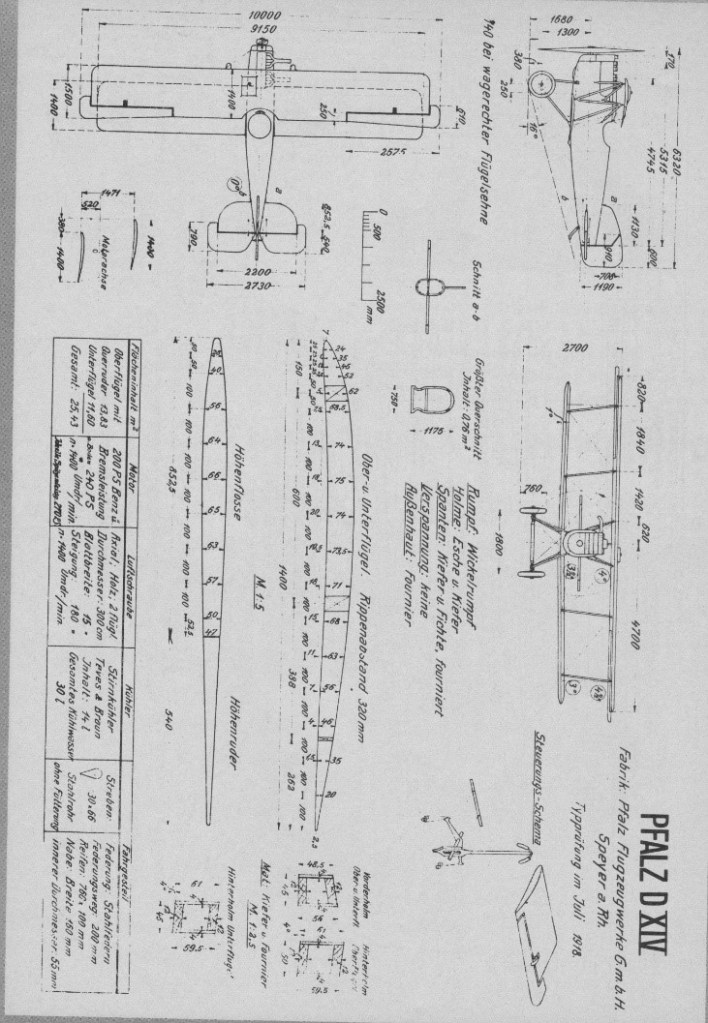
The Pfalz D 4 was the first biplane fighter design from Pfalz. With a fuselage resembling the earlier Pfalz E.V, the D 4 was powered by a 150 hp Benz Bz.III engine. The cutouts in the sides of the cockpit gave the pilot better visibility downwards to the front.
The Pfalz D 4 version without fixed fin or headrest is shown here. The exhaust pipe was also longer than that of the version with fixed fin and headrest. Iron crosses are painted on both sides of the elevators like Pfalz E-types.
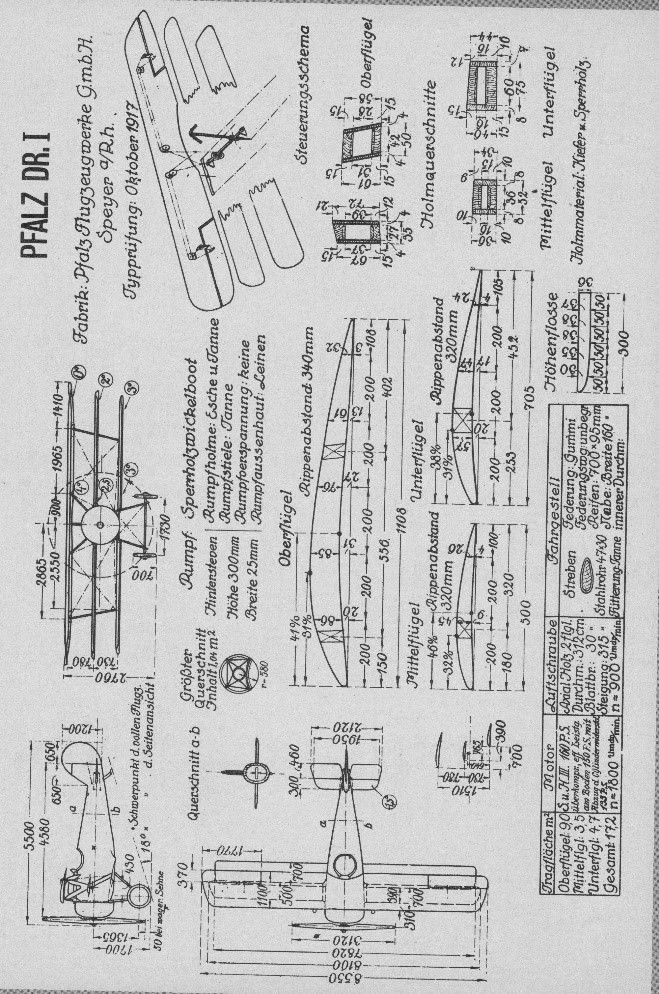
The Pfalz Dr.I was a German fighter prototype of World War I. Official interest in the potential of the triplane configuration for single-seat fighters prompted Pfalz to develop the Dr.I. It underwent initial testing in October 1917, and an initial batch of 10 aircraft were shipped to the Front and arrived in April 1918.
Service pilots involved in testing the Dr.I considered it too slow and its Sh III engine too unreliable for frontline use and no further examples were produced. Jasta 73 was equipped with this aircraft in 1918.
Powerplant: 1 × Siemens-Halske Sh.III, 119 kW (160 hp) Propeller: 2-bladed fixed-pitch Wingspan: 8.55 m (28 ft 1 in) Wing area: 17.2 m2 (185 sq ft) Length: 5.5 m (18 ft 1 in) Height: 2.76 m (9 ft 1 in) Empty weight: 510 kg (1,124 lb) Gross weight: 705 kg (1,554 lb) Maximum speed: 190 km/h (120 mph, 100 kn) at 4,000 m (13,123 ft) Service ceiling: 6,000 m (20,000 ft) Time to 1,000 m (3,281 ft): 1 minutes 42 seconds Time to 3,000 m (9,843 ft): 6 minutes 12 seconds Time to 5,000 m (16,404 ft): 13 minutes 30 seconds Armament: 2 x synchronised LMG 08/15 machine guns Crew: 1