NY.
USA
Built the Plymouth A-A-2004 rotorwing in 1929.
NY.
USA
Built the Plymouth A-A-2004 rotorwing in 1929.
The PLV 1915 biplane was Chance Vought’s second design, in league with Anthony Stadlman.
A two-place, open biplane, powered by a Sturtevand 6 engine, it was built in the machine shop of Frank Pontkowski & John Lichorsik, hence the PLV designation.
Chicago and Cicero IL.
USA
Built a biplane in 1915.
The Plowright Gyroplane c/n 1 was registered ZK- HBP in November 1966. Built by M Plowright but not flown, it was scrapped registration cancelled circa January 1990.
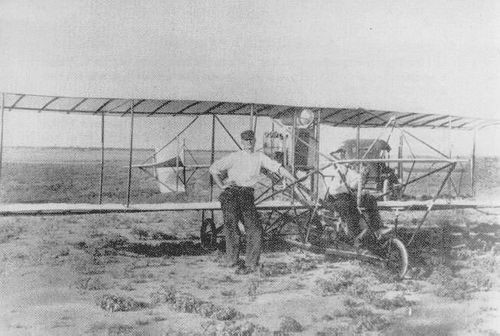
A Curtiss-pusher influenced design built by John V. Pliska and Gray Coggin of Midland, Texas; famed as being the first aeroplane to be built and flown in that state. In the photo, Pliska is on the left: his partner in the aviation project, Coggin, is in the pilot’s seat. Pliska was claimed to have been inspired by a Wright Flyer II (piloted by Robert G. Fowler) that landed in the area on November 19, 1911, and that he and Coggin carefully studied. It flew only once, but not very well, so was stored until rediscovery in 1962 and donation to a museum at Midland-Odessa airport and today is on exhibit at the Midland International Airport.
Engine: 50hp converted Roberts marine
Seats: 1
John V Pliska and Gary Coggin
Midland TX.
USA
Built a biplane in 1912.
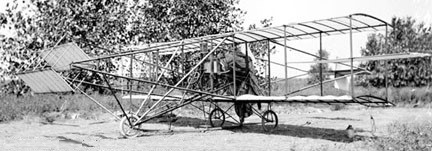
Built by J E Plews, the Plews 1910 biplane was a single-place Curtiss copy.
Chicago IL.
USA
Built a Curtiss copy in 1910.
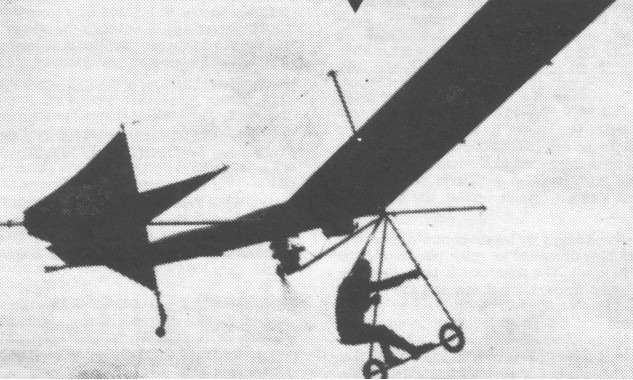
A single seat single engine, high wing mono¬plane with hybrid control circa 1983. Wing has unswept leading and trailing edges, and constant chord; cruciform tail. Pitch control by weight shift; yaw control by fully flying rudder; no separate roll control; control inputs through weight shift for pitch/yaw/roll. Wing braced from above by kingpost and cables, from below by cables; wing profile single ¬surface. Undercarriage has three wheels in tail dragger formation. Metal tube framework, without pod. Engine mounted below wing driving pusher propeller.
It appears to have a rudder to assist the weight-shift in yaw, a combination which is sufficient to class the Zhuravlic as a hybrid, but it is not clear whether a similar arrangement is used for pitch control or whether the pilot relies solely on weight shift for up/down control.
No details are given of the power unit, except that it is of 350 cc and is coupled to a two blade propeller.
Wing span 31.5 ft, 9.60 m
Engine: 350 cc
Empty weight 121 lb, 55 kg
Max level speed 37.5 mph, 60 kph
Best glide ratio with power off: 30/1
Take off distance 66ft, 20m
Landing distance 33ft, 10m
Service ceding 6600ft, 2000m
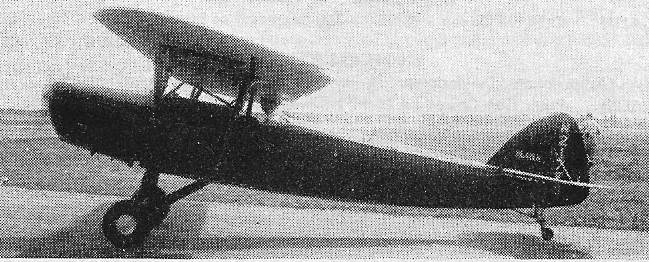
The 1941-built Player monoplane N21778 was fabric covered geodetic construction. Design based on Long Longster and Corben Super Ace plans published in Mechanix Illustrated. Wing modified from a Long Longster, tail from a Curtiss-Wright Junior. Fuselage was first of Player’s geodetic incorporations.
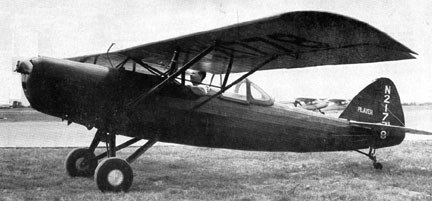
Canopy cockpit. Later repowered with 65hp Continental A-65. Still flying in the 1960s
c.1936
Engine: 45hp Ford A
Seats: 1
Engines: Continental A-65, 65 hp
Span: 30 ft 0 in
Length: 10 ft 0 in
AUW: 740 lb
Max speed: 95 mph
Cruise: 87 mph

