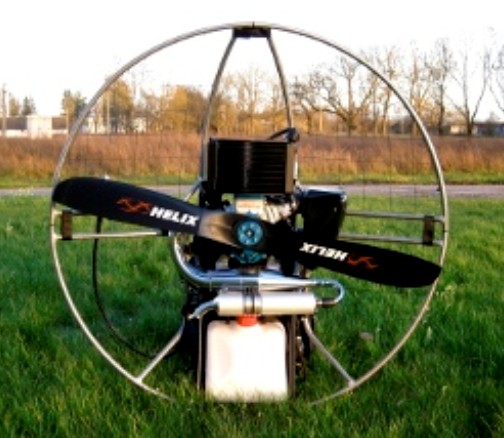
Propeller Sky 100

The SKY 100 has an enhanced cooling system and a larger radiator to improve output and stability even in hotter countries. Manufacturing technique employed, detailed finishing, performances, lightness resulting from the use of light alloys, use CNC machines. The line features the Walbro W8 carburator.

Paramotor frame and prop cage are made using an aluminium alloy D16T welded with argon gas. Its simplicity and level of construction still protect against impact.

Equip with APCO harness which has been specially designed for Propeller paramotors.
Harness include:
3 automatic metallic buckles, one ventral and two for the legs
Adjustable extension for the harness seatplate
High-quality pulleys for the foot accelerator
Connection points for rescue system
Large pocket below the seatplate
Automatic steel karabiners

Sky100 Light, more compact version with the Sky 100 engine. With lighter frame Sky100 Light is 2,5 kg lighter than its “big brother”. By default it includes 120 cm diam carbon-fiber propeller. Launching is easier due to lighter propcage, but at the same time it requires precise groundhandling because the propeller is “outside ” of the propcage

Sky 100
Engine: Sky 100 , 1 cyl, 2-stroke watercooled, 102 cc, 18 hp / 10200 rpm
Carburator: Walbro W8
Reduction: mechanical, lubrificated with centrifugal clutch
Reduction ratio: 1:4,0
Starter: Manual
Thrust: up to 60 kg
Fuel type: unleaded 98 + 2-3% synthetic oil
Fuel capacity: 14 l
Fuel consumption: ca 3,5 – 4 l/h
Frame: Aluminium alloy D16T
Propcage: 4-part
Propeller: 125 cm Helix Carbon 2-blade
Weight: 25 kg
Max pilot weight: 110 kg
Recommended pilot weight: 80 – 100 kg
Harness: APCO with automatic buckles
Sizes: 140 x 140 x 40 cm

Sky100 Light
Engine: Sky 100, 1 cyl, 102 cc, 18 hp/ 10200 rpm, 2-stroke watercooled
Carburator: Walbro W8
Reduction: mechanical, lubrificated with centrifugal clutch
Reduction ratio: 1:4,0
Starter: Manual
Thrust: up to 56 kg
Fuel type: unleaded 98 + 2-3% synthetic oil
Fuel capacity: 14 l
Fuel consumption: ca 3,5 – 4 l/h
Frame: Aluminium alloy D16T
Propcage: 4-part
Propeller: 120 cm Helix Carbon 2-blade (3-blade optional)
Weight: 22.5 kg
Max pilot weight: 100 kg
Recommended pilot weight: 75 – 95 kg
Harness: APCO with automatic buckles
Sizes: 128 x 128 x 40 cm
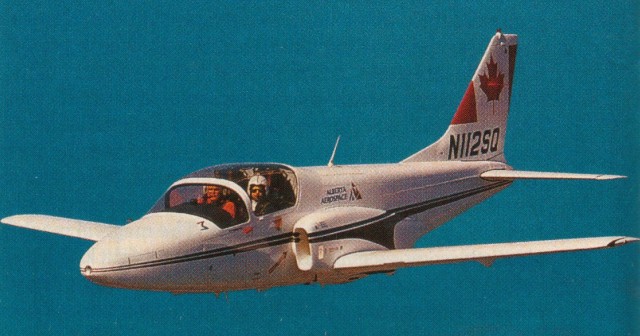
Promavia Jet Squalus / General Avia Jet Squalus / Alberta Aerospace Phoenix FanJet

Jet Squalus

A Belgian enterprise, the Jet Squalus was designed and built around the Garrett TFE109 engine by General Avia in Italy. Designed by Stelio Frati, the prototype Jet Squalus made a successful first flight on April 30, 1987. Three prototypes of the “all through” side by side seat trainer were built and flown to Belgium. The Squalus was promoted as “the first and only third generation global trainer”, offering ab initio and advanced training from one cockpit.

Two proto¬types of the Jet Squalus are being built by General Avia in Italy, the first powered by a Garrett TFE-109 turbofan, and the second by a more powerful Williams International FJ-44. Following completion of initial flight trials the aircraft will be flown to Belgium, where production, marketing, and support of the “all-¬through” jet trainer will be administered by Promavia.

The initial 1,330 lb st (5.92 kN) -1 unit was replaced by the Garrett TFE 109-3 turbofan of 1,600 lb st (7,12 kN).
Light weapons and/or drop tanks can be carried on underwing hardpoints.

No orders had been placed for the aircraft by 1988.

In 1995 the Belgian company Promavia licensed Alberta Aerospace to begin development of an ab initio trainer version of its Jet Squalus, under the name Phoenix FanJet. Eventually Promavia sold Alberta Aerospace the flying Jet Squalus prototype for conversion (to include new Williams- Rolls FJ44 turbofan engine in a revised airframe, new “glass” cockpit, larger flying control surfaces and more), allowing certification in about the year 1999. After Promavia ceased trading, Alberta Aerospace purchased other Promavia assets, allowing eventual production in Canada.

Based in Calgary, Canada, Alberta Aerospace obtained the two prototypes built with plans to install Williams-Rolls FJ44-1a engines. Almost 80% of the structural and stress testing for certification was completed by Frati, who tested the airframe to +7 and –3.5G. With a 140 kt gear extension speed, the aircraft did not meet the 61 kt stall speed required for civilian certification for single engine, so the wing span was to be extended by four feet.

A flight demonstrator was fitted with the Williams FJ44 engine.

Jet Squalus
Engine: 1 x Garrett F109-1, 1,330 lb st (5.92 kN)
Span: 9 m
Length: 9.4 m
Wing area: 13.6 sq.m
Empty wt: 1200 kg
MTOW: 2000 kg
Max speed: 584 kph
Initial ROC: 975 m / min.
Ceiling: 11,280 m
T/O run: 366 m
Ldg run: 336 m
Fuel internal: 720 lt
Range: 1850 km
Combat radius: 460 km
Hardpoints: 4

Jet Squalus
Engine: 1 x Garrett TFE 109-3 turbofan, 1,600 lb st (7,12 kN).

Jet Squalus
Engine: 1 x Williams-Rolls FJ44-1A, 1600 lb
ROC SL: 2360 fpm
Max cruise: 315 kt at 20,000 ft
Max range; 715 nm at 261 kt
MTOW: 5100 lb
Equipped weight; 3408 lb
Useful load: 1692 lb
Fuel capacity: 185 USG

Progressive Aircraft Pro Star

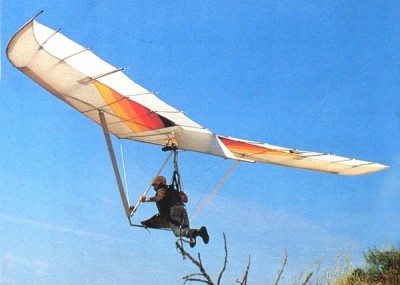
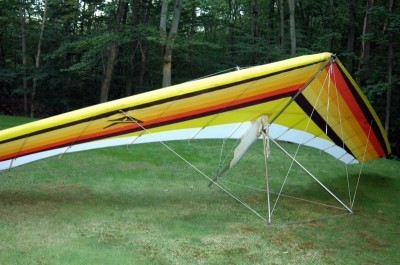
Pro Star 2

A 1980s hang glider.

The ProStar 2 is a 1983 version.

Prostar 2
Wing area: 12.09 m²
Wing span: 8.7 m
Aspect ratio: 6.2
Hang glider weight: 26 kg

Prostar 2
Wing area: 14.9 m²
Wing span: 9.6 m
Aspect ratio: 6.2
Hang glider weight: 31 kg

Prostar 2
Wing area: 17.6 m²
Wing span: 10.4 m
Aspect ratio: 6.1
Hang glider weight: 35 kg

Projekt 8 Dolphin

The Danish Dolphin tandem two-seater motor glider was designed and built by the Projekt 8 I/S company of Roskilde, and 10 construction of the prototype was taking place at three separate sites near Copenhagen,
and it was expected that the first flight was to be made late in 1978.

The Dolphin is a cantilever mid-wing monoplane of mixed constrution with a T-tail, powered by a 54hp Volkswagen VW1600 engine driving a two-blade pusher propeller, mounted on a pylon and retracting rearwards behind closed doors into the top of the fuselage aft of the wings. The wings, which have 4° dihedral, have an aluminium centre section and wood and glassfibre outer panels, flaps and ailerons; there are aluminium air brakes in the upper surfaces just ahead of the flaps. The forward fuselage is a welded steel tube framework covered with a light glassfibre shell, and the rear fuselage is a wooden structure reinforced by glassfibre. The tail unit is likewise of wood, with a fixed incidence tailplane, a central trim tab in the elevator and an inset tab at the base of the rudder. There is a semiretractable rubber-sprung mainwheel plus a nosewheel and a steerable tailwheel, as well as retractable wing tip balancer wheels. The one-piece cockpit canopy opens sideways.

Span: 61 ft 5 in
Length: 27 ft 10.75 in
Height: 4 ft 3.25 in
Wing area: 223.9 sq ft
Aspect ratio: 16.8
Empty weight: 1,058 lb
Max weight: 1,653 lb
Max speed: 163 mph
Max aero-tow speed: 77.5 mph
Min sinking speed: 2.30 ft/sec at 50 mph
Best glide ratio: 32:1 at 62 mph

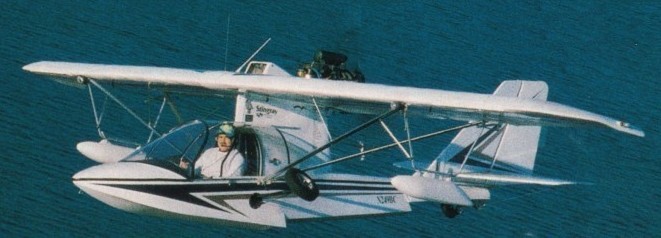
Progressive Aerodyne Sting Ray

The Stingray is the single seat version of the Searay.

Engine options include the Rotax 447, 503, and 582.

Engine: Rotax 447, 40 hp
HP range: 40-65
Height: 6.2 ft
Length: 21.4 ft
Wing span: 30.83 ft
Wing area: 150 sq.ft
Weight empty: 470 lb
Gross: 800 lb
Fuel cap: 6 USG
Speed max: 85 mph
Cruise: 65 mph
Range: 100 sm
Stall: 27 mph
ROC: 600 fpm
Take-off dist: 175 ft
Landing dist: 200 ft
Service ceiling: 9,000 ft
Seats: 1
Landing gear: retractable tail wheel