The 1911 Proudhon monoplane was designed and built by Proudhon in France.
Era
Protech PT2
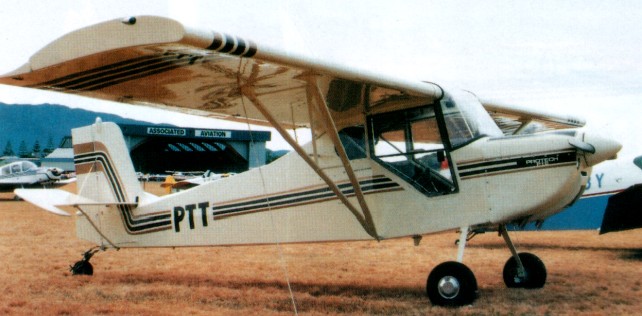
A high wing aircraft with all aluminium wings that can be easily and quickly folded rearwards, parallel with the steel tube, ceconite-covered fuselage. It has transparent doors which hinge upwards under the wings and can be opened in flight. The undercarriage is one-piece spring steel and either two or four 20 lt fuel tanks in the wing roots. Standard tires are 600×6, with optional 700×6.
The Protech PT2 Sassy origi¬nates from Houston, Texas circa 1988. Being a high wing side by side two seater of taildragger design, power comes from a 75hp Revmaster, providing a maximum speed of 140 mph. An interesting feature is the aircraft’s fold back wings to facilitate storage. The first was N211PT.
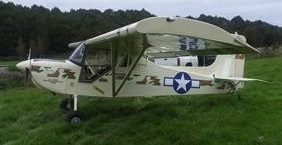
PT-2 Sassy
Engine: 75hp Revmaster
Wingspan: 31’9″
Length: 17’6″
Useful load: 604 lb
Max speed: 115 mph
Cruise: 105 mph
Stall: 29 mph
Range: 420 mi
Seats: 2
Engine: Continental O-200, 100 hp
Cruise: 85 kts
Stall: 38 kts
Landing dist: 100-200 m
Take off dist: 100-200 m
Seats: 2
PT-2C
Engine: 150hp Textron Lycoming O-320
Wingspan: 32’6″
Length: 22’0″
Useful load: 750 lb
Max speed: 130 mph
Cruise: 115 mph
Range: 300 mi
Seats: 2
Protech
Prostar Aircraft Inc,
Beeville TX.
USA
ProTech Aircraft Inc,
Houston TX.
USA
LSA builder
Prosper Monoplane
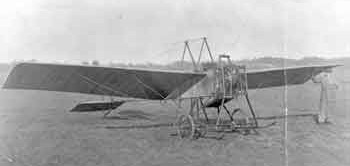
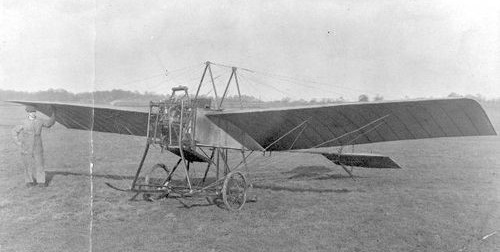
A fifty-five horsepower Viale 5-cylinder radial-powered monoplane from Canada circa 1909, constructed by Louis Prosper, possibly of Montreal.
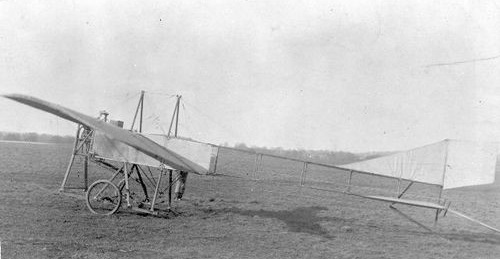
Prosper, Louis
Possibly of Montreal, Canada, circa 1909, almost nothing is known of Prosper, although he was reported to have assisted in the assembly of the infamous “Scarabée” – a Channel-crossing 50 hp Blériot XI flown by Comte Jacques De Lesseps – at the Montreal aviation meet, Canada’s first airshow, which ran from June 25 until July 5, 1910.
Prospective Concepts Stingray
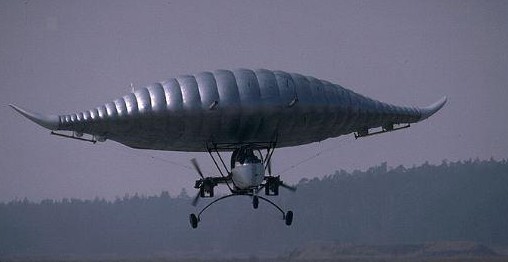
The media talked about a “flying stingray” when Prospective Concepts AG finally unveiled its secretive technology demonstrator in May 1998. Stingray is designed by this Swiss company, with a wing that derives its rigidity from compressed air. Later versions will be filled with helium. The second radical concept developed especially for the Stingray is a pneumatic catapult to be placed in the aicraft’s tail. The concept has been tested on the “Kangarou,” a light airplane with slow flight characteristics similar to the Stingray’s: a cylinder that extends to 5 meters catapults the craft right into the air and accelerates it from standstill to flying speed at 1.5 g.
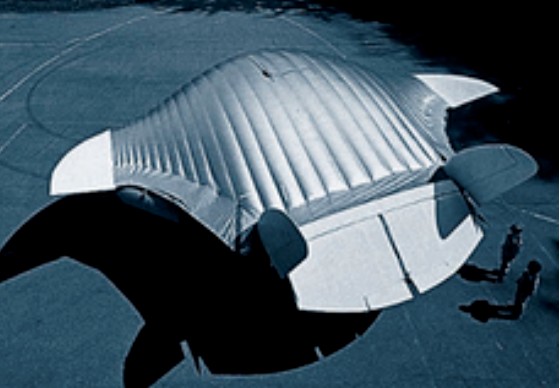
According to the company, a significantly larger successor to the Stingray is also planned. It will derive 25 percent of its lift from helium in its wing and integrate propulsion and the gondola into the wing. Development of the Stingray was supported by the German pneumatic conglomerate Festo.
Stingray
Wingspan: 13 m
Length overall: 9.4 m
Wing surface: 70 sq.m
Volume: 68 cu.m
Max. speed: 130 km/h (85 mph)
Prosch Loki
The 1973 formula racer ‘Loki’ was built by Ernest Prosch. A single-place, mid-wing monoplane, it raced at Reno in 1973 and 1974.
Wingspan: 17’10”
Length: 19’11”
Seats: 1
Propuls’r C2 TX3
Circa 1998.
Cycle: 2 stroke
No cylinders: 3
Bore: 83.4 mm
Stroke: 61 mm
Displacement: 1014 cc
Cooling: Liquid
Ignition: Electronic
Reduction: Integral mechanical 2-2.4/1
Dimension: 680 x 380 x 380 mm
Weight: 45 kg
Max pwr: 90 hp at 5500 rpm
Price 1998: 42 000 Fttc
Propuls’r
1998:
14 rue Jean Jaures
F-31190 Hauterive
France
Power pack builder
Prop-Jets Inc.
USA
Prop-Jets Inc acquired Mike Smith Aero Inc in 1986.
Prop-Jets Inc was founded to continue development of Interceptor 400 turboprop- powered four-seat light aircraft, as 400A.

