Schultz Nucleon

The Nucleon designed by Art Schultz, which first flew in 1954, has a wing bult of Styrofoam around a spar and convered with a fiberglass shell. To save weight, struts were used with cuffs at both ends. It has full span flaps, with drooping ailerons, and a horizontal tail which folds up for trailing.

The structure was I-strut braced all-wood wings, steel-tube/ fabric wings and braced tail.

Wing span: 14 m / 46 ft
Wing area: 12.17 sq.m / 131 sq.ft
Aspect ratio: 16
Airfoil: NACA 65 (2)-415
Empty Weight: 156 kg / 345 lb
Payload: 86 kg / 190 lb
Gross Weight: 242 kg / 535 lb
Wing Load: 19.88 kg/sq.m / 4.1 lb/sq.ft
L/DMax: 22 76 kph / 41 kt / 47 mph
MinSink: 1.00 m/s / 3.3 fps / 1.96 kt
Seats: 1

Schultz ABC / TG-16

The ABC, an Art Schultz development of the simpler, shorter span Midwest MU-1 designed three years earlier, won the 1937 Eaton design competition. The result was due largely to its design and ease of construction, while the much higher performing Ross-Stephens RS-1 Zanonia placed second due to complicated construction and emphasis on ground tow capability. The first all-metal Schweizer sailplane, the SGU-1-6, was third.

The structure was steel tube fuselage and tail, two-spar two-strut wood wing, all fabric coverd. The ABC was offered in plan form and a few were built prior to World War II. After the outbreak of war, one was used as the TG-16 at the USAAC glider training school in Mobile, Alabama.

Wing span: 14.78 m / 48.5 ft
Wing area: 16.26 sq.m / 175 sq.ft
Aspect ratio: 13.2
Airfoil: NACA 6212
Empty Weight: 136 kg / 300 lb
Payload: 77 kg / 170 lb
Gross Weight: 213 kg / 470 lb
Wing Load: 13.1 kg/sq.m / 2.69 lb/sq.ft
L/DMax: 18
MinSink: 0.85 m/s / 2.8 fps / 1.66 kt
Seats: 1
Number built: 4

Schülke Flügelfliegermodell

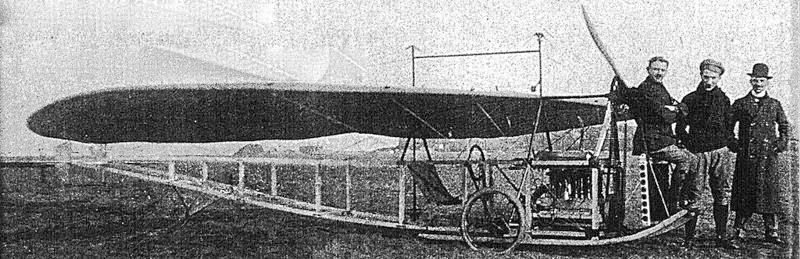
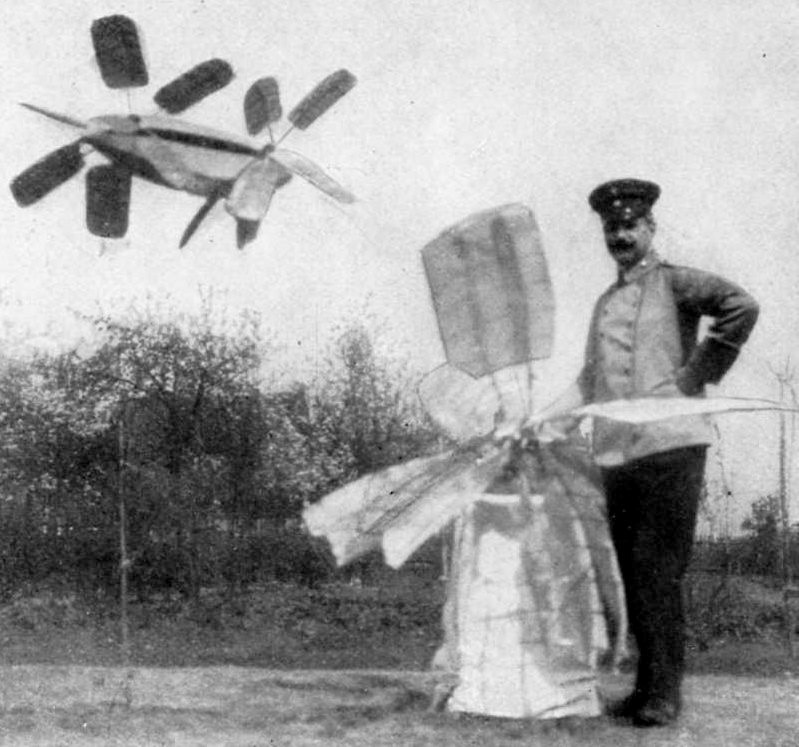
This machine with two four-blade propellers but no wings was the subject of a detailed article in Flugsport and patents in several countries. It was constructed by Ingenieur Julius Schülke of Jena, Germany, in 1909 together with his son Oberleutnant Schülke. Nothing is known of tests, but it looks very unlikely that they would have led anywhere.

Sclaves 1910 Biplane

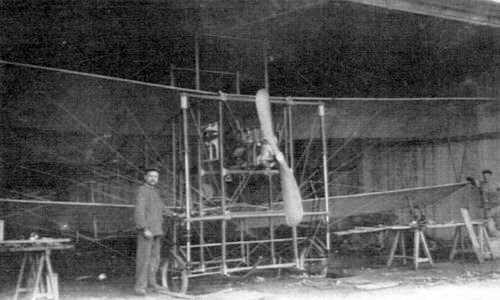
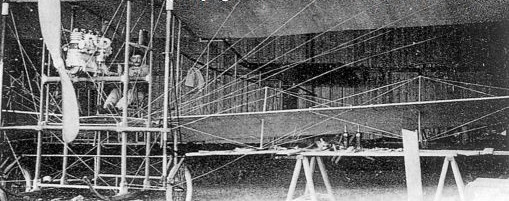
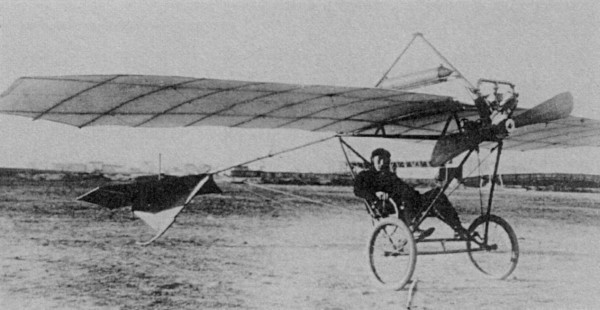
This tractor French biplane, constructed of metal pipes and an abundance of wire bracing, powered by an acetylene motor was tested at Amberieu in 1910 by a man from Lyon named Sclaves. At least one photo shows a 50 hp Prini-Berthaud engine. The rectangular wings were braced entirely by one pair of outboard struts on each side and wires from double kingposts on top. The heavy forward box structure seemed made of pipes; the rear fuselage was uncovered. The two wheels were castering.

Schüler 1909 Eindecker

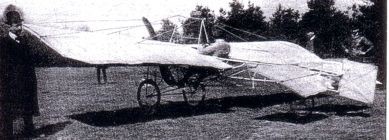
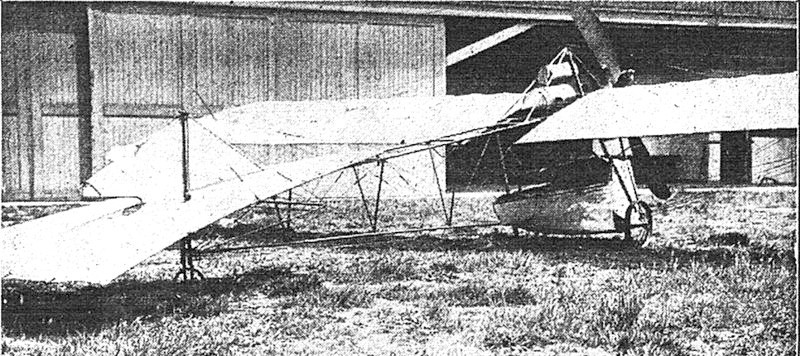
This high-wing monoplane was tested in late spring and summer of 1909 at the parade ground in Chemnitz, Saxony, after a public exhibition in April 1909. Schüler had completed his engineering studies there. It was probably inspired by the Demoiselle and was completed before Hans Grade had built his first similar “Libelle” in June 1909. The machine was not a great success and thus Schüler didn’t appear at the first German aeronautical exhibition (ILA) in Frankfurt or the first meeting at Johannisthal in September/October 1909, but he was among the first who rented a shed at this newly built airfield. At the beginning of 1910 Schüler was busy working on a monoplane for Leo Lendner and building engines for Hanuschke and others in his “Max Schüler Aeroplan-Fabrik”, which he had founded in his hometown Berlin in late 1909.

Schukking 1908 Glider

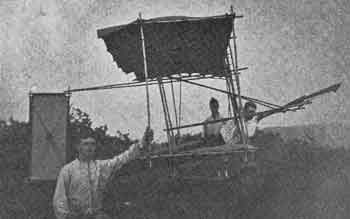
A glider built and flown in the Netherlands by Willem Hendrik Schukking – a member of the the Dutch Royal Engineers – in 1908. It was not proceeded with, one reason being that Schukking married and had to swear that he would never fly again. The machine was a biplane on which the pilot flew downhill while in a forward prone position.