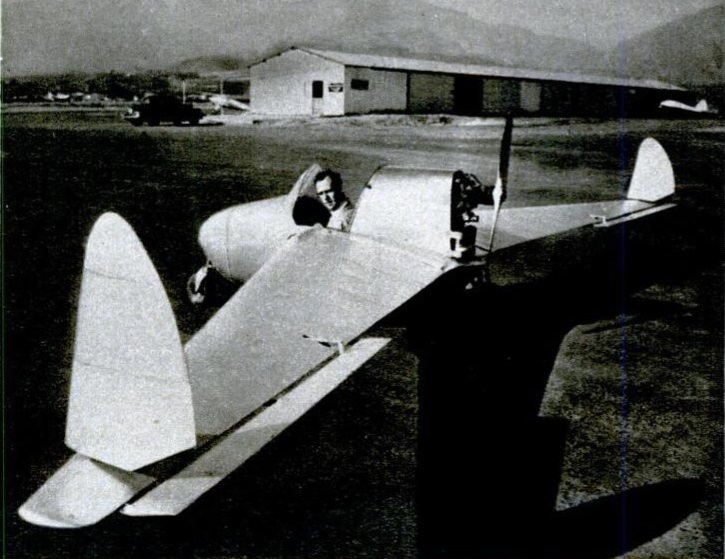
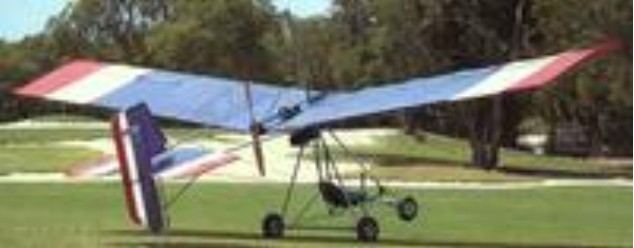
Designed and built by Robert M Sebring over a three-year period, the 1949 Wee Wing was a single-place pusher, the airframe was reportedly built for less than $100. The wing was of bonded plastic plywood. The wood construction aircraft was completed in 1949 and in its structure several composite material parts and components were used. The aircraft had so called wingtip tails and was fitted with one 12hp Richter two-stroke (drone) engine, the Richter company later being acquired by the Nelson Engine company.
Only limited testing of the aircraft took place and further development was soon halted.
Only a single example of the flying wing was built.
Engine: one 12hp Richter (Nelson) two-stroke Wingspan: 22 ft Height: 2.5 ft Empty weight: 150 lb Cruise: 65 mph Seats: 1
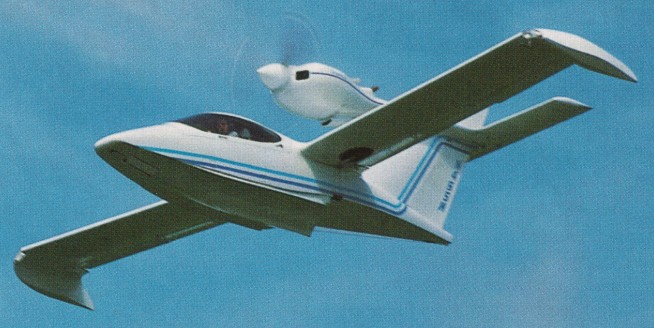
The Seawind 2000 am¬phibian offered by Seawind International of Ontario, Canada, was designed by Rodger Creelman and first flown in 1993.
The pylon mounted engine sits well forward of the fin leading edge, giving an impression that it might part company if subjected to gyroscopic or turbulence loadings. However the mount has been subjected to and survived a 20G test loading, twice the required FAA rertifica¬tion requirements. The Seawind has a wingspan of 35 feet, a MAUW of 3100 lbs and provides a cruise of 145 knots on its fin mounted single Lycoming IO 360 consuming 10 US gal¬lons each hour.
The four seat Seawind 2500 amphibian design is of composite manufacture, and first flown in 1994. The amphib¬ian’s power source is a 200 hp tail-mounted Lycoming IO 360; cruise is noted at 145 knot.
The certified Seawind 300C is manufactured Exclusively by Sea Air Composites, inc, a single engine 4/5 place amphibian.
Initially with tail-mounted 300hp Lycoming IO-540 (prototype with 200hp IO-360), later powered by 400hp Allison 250-B17B turboprop.
Of fiberglass and cellfoam construction the Seawind received the EAA award for craftsmanship in 2000. The standard kit with molded components, less engine sold for $58,980.
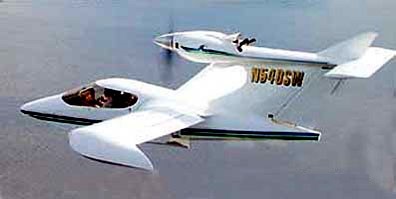
Seawind N548SW
Seawind 2000
Seawind 2500 Engine: Lycoming IO-540-T, 300 hp HP range: 250-300 Height: 10.2 ft Length: 27.2 ft Wing span: 35 ft Wing area: 160 sq.ft Weight empty: 2230 lb Gross: 3400 lb Fuel cap: 110 USG Speed max: 187 mph Cruise: 178 mph Range: 1600 sm Stall: 59 mph ROC: 850 fpm Take-off dist: 1010 ft, (1600 ft water) Landing dist: 770 ft (620 ft water) Service ceiling: 14,800 ft Seats: 4 Landing gear: retractable nose wheel
Seawind 3000 Engine: Lycoming IO-540, 300 hp Height: 10.2 ft Length: 27.2 ft Wing span: 35 ft Wing area: 160 sq.ft Weight empty: 2300 lb Gross: 3400 lb Fuel cap: 110 USG Speed max: 200 mph Cruise: 191 mph Range: 1460 sm Stall: 57 mph ROC: 1250 fpm Take-off dist: 820 ft, (1100 ft water) Landing dist: 770 ft (620 ft water) Service ceiling: 20,000 ft Seats: 4 Landing gear: retractable nose wheel
Seawind 300C Engine: Engine Continental IO-550-N. 310 hp Propeller: McCauley 3-blade 76” Constant Speed Wing Area: 163 sq. ft. Wing Span: 35 ft Height: 10 ft 2 in Overall Length: 27 ft 2 in Ground Clearance: 8.5 in Wing Loading: 20.81 lbs/sq ft Power Loading: 10.97 lbs/hp Max Gross Weight: 3400 lbs Std Empty Weight: 2300 lbs Equipped Empty Weight: 2350 – 2400 lbs Useful Standard: 1150 lbs Useful Equipped: 1000 – 1150 lbs Fuel Capacity Mains: 80 US gals Long Range – Aux Tanks: 30 US gals Sea Level Speed 100% Pwr: 200mph / 174 kt. Cruise 75% Pwr (8,000 ft): 190mph / 165kt. Cruise 65% Power (8,000 ft): 180mph / 156kt. Cruise 55% Power (8,000 ft): 169mph / 147kt. Fuel Burn at 55% Power: 12.8 gph Max. Range (no reserve main) 1040sm / 905nm. Extended Fuel Range: 1460sm / 1270nm. Rate of Climb: 1250 fpm B/Rate of Climb Speed: 99mph / 86kt. B/Angle of Climb Speed: 74mph / 65kt. Stall Speed: Clean 72mph / 63kt, Flaps & Wheels: 60mph / 54kt. Service Ceiling: 18,000 ft. Take off Distance 3200 lbs: Land 870 ft / Water 1100 ft Take off Distance 3400 lbs: Land 1175 ft / Water 1400 ft. Over 50’ Obstacle: Land 1175 ft / Water 1400 ft Landing Distance: Land 770 ft / Water 620 ft. Over 50’ Obstacle: Land 1300 ft / Water 1150 ft. Cabin Length: 105” Cabin Width: Front 52″ / Rear 54″ Cabin Baggage: 16 x 48″ wide, 24” high, 10 cu ft Aft Baggage: Opening 19” x 40”, Length 71″, Volume 30 cu ft Nose Deck Forward Storage: 3 cu ft
Designed and built by H.A. Searsby of Nottingham, UK, the Special was a single-seat, wooden, primary glider. It featured wing-warping, and one of the A-frame members was placed in front of the pilot.
Only one was built, which had its first flight on 7 September 1930 at Wirksworth, Derbyshire, UK.
Located at Felixstowe, Suffolk, its products being identified by initial F. Particularly associated with Squadron Commander J. C. Porte, RNAS, who assumed command of the Felixstowe station in September 1915. Porte had started aeronautical work in 1909; his interest in flying-boats led him to join Curtiss, in U.S.A., during 1914. Before taking command at Felixstowe had flown Curtiss flying-boats on operations, and set out to improve them. Felixstowe F.1 had wings and tail of Curtiss H.4 but Porte hull. F.2 was comparable development of H.12, and further improved as F.2A and used extensively from late 1917. Porte Baby was early 3-engined type, from one of which a Bristol Scout was air-launched in May 1916. F.3 was larger than F.2A, but though built in quantity was less highly regarded. Some were built in Malta Dockyard, others by British contractors. Some completed as further developed F.5, a type also used by U.S. Navy and Japan. Felixstowe Fury was very large 5- engined type, flown (and wrecked) after Armistice.
The Condor is a single-engine, high-wing monoplane has a cruciform tail and kingpost and cable braced single-surface wing. The Condor is controlled solely by weight shift. The engine is a twin-cylinder Kawasaki with 2.0 reduction is mounted in the center below the wing. Drive shaft to pusher prop is above the wing. The taildragger gear has torsion bar suspension. Fourteen-inch wheels have pneumatic tires.
The Condor II has three-axis aerodynamic controls include stick controls for elevator and spoilerons plus rudder pedals. The engine is a Kawasaki twin-cylinder 440 engine has 2.0 reduction and is mounted below the wing in the center. It drives a pusher prop of 54×32-inch wood. Some of the two seaters were equipped with Kawasaki liquid cooled engines of 80 hp. The taildragger gear has 14-inch main wheels with pneumatics and torsion bar suspension. The plane is has a single surface wing, and is wire braced. The kit came as a simple bolt together assembly taking approximately 75 hours to assemble.
The Condor single place and two place were produced up until about 1984.
Condor Wingspan, 32 ft Wing area 160 sq.ft Empty weight, 164 lb Wing loading, 2.06 lbs/sq.ft Fuel capacity, 3.1 USG Engine displacement, 440cc Rated HP, 40 hp
Condor II Wingspan, 32 ft Wing area, 160 sq.ft Empty weight, 196 lbs Wing loading, 2.26 lbs/sq.ft Fuel capacity, 3.1 USG Engine displacement, 440cc Rated HP, 40 hp